
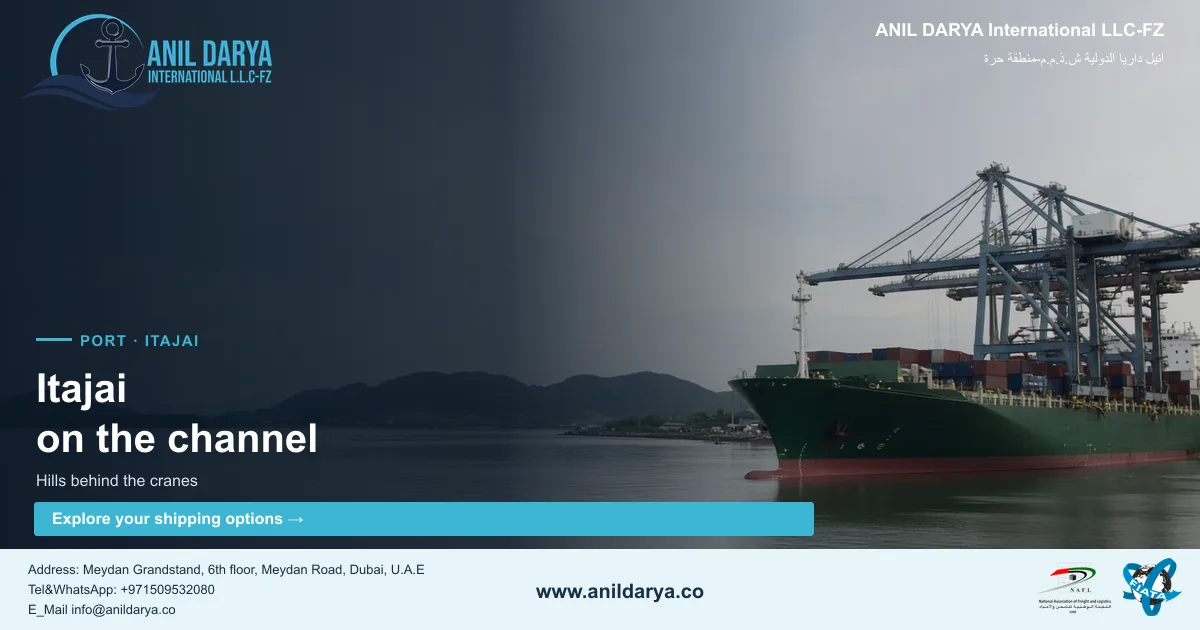
Port of Itajai shipping really means the Itajai and Navegantes complex at the mouth of the Itajai-Acu river in Santa Catarina, southern Brazil. Two container terminals work there today: JBS Terminais in the public Port of Itajai and the private Portonave terminal in Navegantes. Porto Itapoa, about 80 km from Joinville, is the other big container option in the state. This guide covers the terminals, reefer and general cargo, a short customs summary and how we ship your cargo from Dubai. We ship both from Dubai to Itajai and from Itajai to Dubai.
Port of Itajai guide: key facts at a glance
| Item | Detail |
|---|---|
| Location | Mouth of the Itajai-Acu river, Santa Catarina, southern Brazil |
| Port codes (UN/LOCODE) | BRITJ (Itajai), BRNVT (Navegantes) |
| Port authority | Superintendencia do Porto de Itajai, a municipal body |
| Container terminals | JBS Terminais (Port of Itajai) and Portonave (Navegantes) |
| Other terminals on the authority's map | Braskarne, Barra do Rio, Trocadeiro, Poly Terminal, Teporti |
| JBS Terminais | 1,030 m of quay, 4 berths, 14 m depth, up to 600,000 TEU a year |
| Portonave | 1,108,029 TEU in 2025, capacity rising from 1.5 to 2 million TEU |
| Reefer outlets | More than 1,700 at JBS Terminais, 2,130 listed for Portonave by its owner TIL |
| Cargo handled (Port of Itajai, 2021) | 18.9 million tonnes |
| Main exports | Frozen chicken and pork, wood, pulp, ceramics, kraft paper |
| Roads | BR-101, BR-470 and BR-486 |
| Nearby container port | Porto Itapoa, Babitonga Bay, 16 m natural depth |
| Import declaration | Duimp on the Portal Unico Siscomex |
| Itajai to Dubai | DU-E export declaration by the shipper or its agent; UAE duty 5% of CIF for most goods, plus 5% VAT |
Where is the Port of Itajai and what does it serve?
The Port of Itajai sits at the mouth of the Itajai-Acu river, on the north coast of Santa Catarina. Its first wharf of 233 m was started in 1938 and the port has been run by the city of Itajai since the 1990s. Portonave is in Navegantes on the other side of the river, and Navegantes airport (NVT) is close by.
Wikipedia lists the port's area of influence as Santa Catarina, Rio Grande do Sul, Parana, Mato Grosso, Mato Grosso do Sul and Sao Paulo. Its main goods in recent years have been wood and wood products, frozen chicken and meat, ceramics, kraft paper, machines, tobacco, vehicles, textiles and sugar. Road access is by BR-101, BR-470 and BR-486.
A simple rule for UAE shippers: if your consignee is in Santa Catarina or the north of Rio Grande do Sul, price Itajai, Navegantes or Itapoa before Santos. Forwarder guides make the same point: a southern port cuts the truck leg inside Brazil.
Which terminals does the Itajai and Navegantes complex have?
The port authority's map shows eight terminals along the river: Portonave, JBS Terminais, the public Port of Itajai berths, Braskarne, Barra do Rio, Trocadeiro, Poly Terminal and Teporti. For container cargo from the UAE, the choice is between the two big container terminals, plus Itapoa further north.
| Terminal | Side of the river | Quay and berths | Depth | Capacity or volume |
|---|---|---|---|---|
| JBS Terminais | Itajai (public port) | 1,030 m, 4 berths | 14 m | Up to 600,000 TEU a year |
| Portonave | Navegantes (private terminal) | 900 m quay, 700 m operational during works, 2 ships at once today | Quay being rebuilt for 17 m | 1,108,029 TEU in 2025 |
| Porto Itapoa | Babitonga Bay, about 80 km from Joinville | 800 m, 2 berths | 16 m natural depth | Expansion planned to about 2 million TEU storage capacity |
JBS Terminais, the container terminal in the public port
Container work at the public port stopped after APM Terminals' 22-year lease ended in December 2022. JBS Terminais restarted operations in October 2024 on a temporary lease, which was extended in 2025 for up to two years or until a new auction. In its first two years it handled more than 800,000 TEU, and nearly 500,000 TEU in January to September 2026.
The terminal has about 180,000 m2 of area, 1,030 m of quay over four berths and 14 m of depth. It runs two mobile harbour cranes of 125 tonnes and more than 1,700 reefer outlets. It is adding an X-ray scanner for container inspection, more truck gates (from eight to 10) and two weighing lanes. A yard expansion should add about 80,000 TEU a year. JBS Terminais reports 10 regular services linking Brazil with Asia, Europe, the Americas, the Middle East and Africa.
Portonave in Navegantes
Portonave opened in 2007 as Brazil's first private port terminal. It handled 1,108,029 TEU in 2025 and, according to ANTAQ data reported by the terminal, led Brazil in vessel productivity at about 114 moves per hour. Its top export markets are China, Japan and the Philippines, and its top import origins are China, Vietnam and Italy.
The 900 m quay is being rebuilt in two halves so one can work while the other is upgraded. In August 2026 a new 250 m section took operational quay to 700 m and allowed two ships to berth at once again, with three planned when the works end. The finished quay is designed for 17 m depth and ships of up to 400 m, if the access channel and turning basin are upgraded to match. New electric STS cranes and RTGs are part of the plan. Its owner TIL lists 2,130 reefer plugs and the Iceport cold store next door with 16,000 pallet positions.
Porto Itapoa, the deep-water option to the north
Itapoa is not part of the Itajai complex, but many shippers compare it on the same quote. It has two berths on an 800 m quay, 16 m natural depth and room for ships of up to 336 m length and 48.3 m beam. Its specification table lists 8 ship-to-shore cranes and 4,377 reefer plugs, and 8 gates work 24 hours. The port is about 80 km from Joinville and 140 km from Curitiba, linked to BR-101 by the SC-416 road.
What cargo moves through the Port of Itajai?
The complex is above all a reefer export port. Wikipedia describes Itajai as Brazil's largest export port for frozen chicken, and Datamar figures for JBS Terminais show poultry, sawn wood, pork and wood pulp as the top exports in 2026. Imports are mainly containers of manufactured goods, machinery, chemicals and consumer goods for Santa Catarina's industry and retail.
| Cargo from the UAE | How it moves | What to plan |
|---|---|---|
| General goods, spare parts, packaging | FCL or LCL to JBS Terminais, Portonave or Itapoa | NCM code, importer's Radar, terminal on the booking |
| Polymers, chemicals and additives | FCL, often via a transshipment hub | SDS, agency consent where needed |
| Machinery and steel items | Containers or flat racks | Piece list, weights, lifting points |
| Food and perishables | Reefer containers | Health certificates, temperature, MAPA or ANVISA rules |
| Dangerous goods | IMDG containers | Carrier and terminal acceptance before booking |
| Heavy or oversized pieces | Breakbulk, usually through another port | Check river access and terminal equipment first |
Shipping from Dubai to Itajai: FCL and LCL
There is no direct UAE to Santa Catarina service. Cargo usually changes ship at a hub before the final leg to Itajai, Navegantes or Itapoa. Lines reported at Itajai include Maersk, Hapag-Lloyd, ONE, CMA CGM, COSCO and MSC.
- FCL (full container load). You book a whole 20ft or 40ft box. It suits most commercial shipments to Brazil because there is less handling and only one importer to clear.
- LCL (less than container load). Your cargo shares a box and is unpacked at a bonded warehouse after arrival. It suits small volumes, but storage at the warehouse runs until your Duimp is cleared.
Our guide to FCL vs LCL costs shows where the break-even point sits. See our sea freight service for what we cover at the UAE end.
[AMIR-FACT: our real port-to-port days from Jebel Ali or Khor Fakkan to Itajai or Navegantes in 2026 and the carrier and transshipment hub we use]
When you compare quotes, check the transshipment port, the discharge terminal (JBS Terminais, Portonave or Itapoa) and the free time on the box. The terminal matters because storage, inspection and trucking are all booked there.
Breakbulk, project cargo and dangerous goods at Itajai
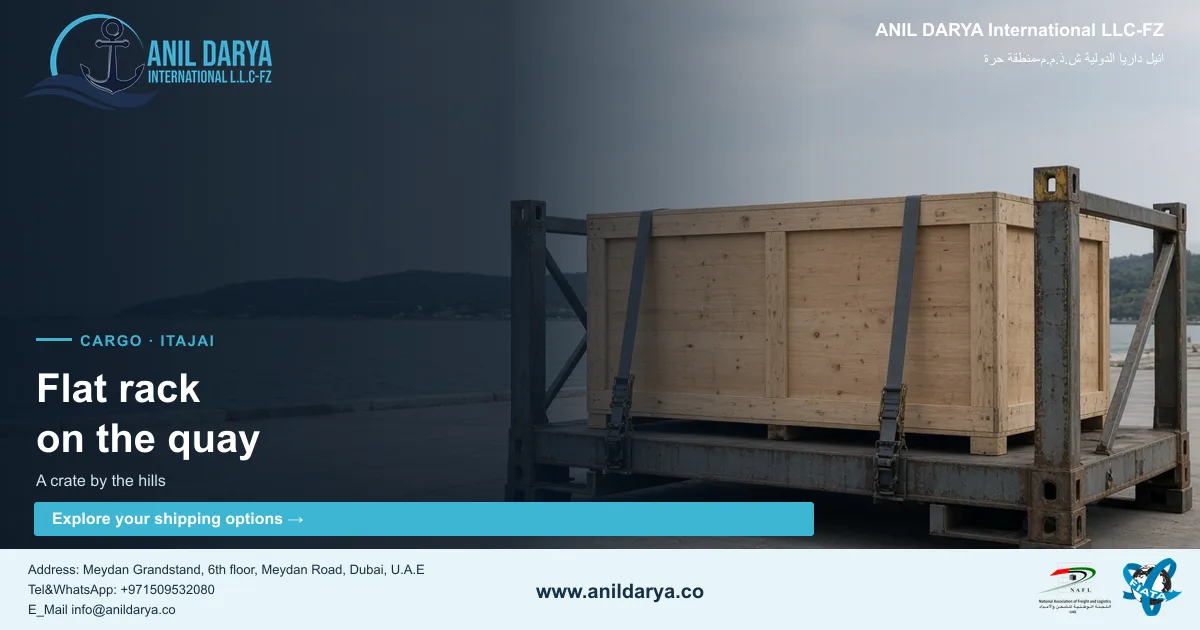
The Itajai complex is mainly a container port on a river, so heavy and oversized cargo needs a check before you commit. The public port berths handle wheeled cargo, pulp and general cargo, and JBS Terminais has 125-tonne mobile harbour cranes. Very large pieces may suit a breakbulk call at another southern port better, such as Paranagua or Rio Grande.
- Send drawings, dimensions, weights and centre of gravity for each piece.
- Check whether the piece fits a 40ft flat rack by size and weight. If it does, a container service to Itajai or Navegantes gives the most sailings.
- If it does not, we compare breakbulk or heavy-lift tonnage and the best discharge port.
- Agree lifting and lashing with the carrier and terminal.
- Plan the road move in Brazil. Oversize loads need state and federal road permits, which the consignee's carrier arranges.
Our break bulk and project cargo team handles the UAE side, and our heavy-lift shipping guide explains how lifts are planned.
Dangerous goods
DG cargo moves under the IMDG Code with a UN number, class, packing group, SDS and a signed DG declaration. Each terminal and carrier must accept the class before booking. In Brazil, many chemicals also need consent from a government agency through the Siscomex before clearance. Our dangerous goods shipping team checks classification and acceptance before you pick a sailing.
Customs at the Port of Itajai: a short summary
Customs rules are the same at every Brazilian port, and our Santos guide covers the full process. Here is the short version and what changes at Itajai.
| Step | Who does it | What to watch at Itajai |
|---|---|---|
| Importer habilitation (Radar) | Brazilian importer | Must be in a modality other than limited to register a Duimp |
| NCM code and agency consent | Importer and broker | Fix before sailing, for food, chemicals and some electronics |
| Duimp registration | Importer or broker | Can be filed before the cargo arrives or after it is stored |
| Taxes and release | Importer and broker | Storage at the terminal keeps running until release |
| Inspection | Receita Federal and agencies | Scanners at JBS Terminais and Portonave, so plan for possible checks |
The import taxes the federal government lists are II (import duty), IPI, PIS/PASEP and COFINS, AFRMM, ICMS and the Siscomex fee, all based on the customs value. AFRMM on long-haul shipping is 8% of the ocean freight. ICMS is a state tax, so the importer's state matters. The importer's tax adviser decides how it applies to your goods.
Documents you send from the UAE: a commercial invoice and packing list that match each other, the bill of lading, a certificate of origin where the importer needs it, and ISPM 15 marked wood packaging.

How to ship from Dubai to the Port of Itajai: step by step
- Send us the cargo details. Commodity, HS code, weight, volume or dimensions, pickup point in the UAE, delivery city in Brazil and the agreed Incoterm.
- Confirm the importer is ready. Radar habilitation, NCM code and any agency consent started with the broker.
- Pick the routing. We compare services to JBS Terminais, Portonave and Itapoa, the transshipment hub and the free time.
- Book space. For DG, reefer or out-of-gauge cargo we get carrier acceptance first.
- Pick up and export from the UAE. We arrange trucking to Jebel Ali or Khalifa Port and file the UAE export declaration.
- Check documents before sailing. Invoice, packing list and draft bill of lading must match on names, weights, descriptions and NCM-ready product data.
- Send documents to the broker early so the Duimp can be filed before arrival.
- Release and delivery. After taxes are paid and the cargo is released, the consignee's trucker collects from the terminal and returns the empty.
On the UAE side, see our guides to shipping through Jebel Ali Port and Khalifa Port in Abu Dhabi.
How to ship from the Port of Itajai to Dubai
We also handle shipping from Itajai to Dubai, with arrival at Jebel Ali, Khalifa Port or Sharjah port. This is the natural direction for the complex: it is above all a reefer export port, with poultry, pork, sawn wood and wood pulp among its top exports. We book space with the carrier from Portonave or JBS Terminais and run the UAE side. The Brazilian export papers stay with the shipper or its Brazilian agent, as we have no office in Brazil.
The Brazil export side
- Export declaration. The exporter prepares a DU-E (Declaracao Unica de Exportacao) in the Portal Unico Siscomex. The shipper or its Brazilian agent does this.
- Cargo and clearance. The terminal receives the cargo and presents it for clearance, and Receita Federal reviews and clears the DU-E.
- Loading. The carrier reports the shipment data after loading, and the system then confirms the export (averbacao).
- Reefer cargo. The shipper or its trucker delivers the reefer to the terminal pre-cooled and at the booked set temperature, inside the carrier's receiving window.
The UAE import side
Dubai Customs takes the import declaration with the commercial invoice, the packing list, the certificate of origin and any permit from the authority that controls restricted goods. The carrier releases the cargo against the bill of lading. The importer needs a Dubai Customs business code, or a licensed clearing agent files with its own code and the owner's authorisation. Customs duty in Dubai is 5% of the CIF value for most goods, with 50% on alcohol and 100% on cigarettes. Import VAT is 5%. A VAT-registered importer that has linked its customs registration number with the Federal Tax Authority reports the VAT on its return instead of paying it at release; other importers pay it before the goods are released. For frozen poultry, meat and other food, the importer also needs the permits the UAE food authorities ask for before the box sails.
- Send us the shipper's details in Santa Catarina or another southern state, the cargo, the HS code, the Incoterm and the UAE delivery address.
- We book space from Portonave or JBS Terminais to Jebel Ali, Khalifa Port or Sharjah and send the booking and cut-offs to the shipper.
- The shipper or its trucker collects the empty, stuffs it and delivers the box to the terminal before the cut-off.
- The shipper or its Brazilian agent files the export declaration and any permit, and customs releases the cargo for loading.
- We check the draft bill of lading against the invoice and packing list, with the UAE consignee named correctly.
- We file the UAE declaration before the vessel arrives.
- We arrange payment of the duty and VAT.
- We collect the delivery order from the carrier.
- We truck the box to your site, free zone or warehouse, and return the empty within free time.
[AMIR-FACT: the carriers and hubs we actually use from Itajai to Jebel Ali, Khalifa Port or Sharjah, and our real port-to-port transit days in this direction]
Free time, storage and demurrage at Itajai
Two clocks run on every import: the terminal's storage, set in each terminal's own price list, and the carrier's container free time. Storage keeps running until the Duimp is cleared and the box leaves the terminal, so a slow declaration costs money. Itapoa publishes a yearly price table, and we confirm the current terms with the terminal on your booking.
Three habits keep costs down: file the Duimp before arrival, have agency consents ready before sailing and book collection as soon as release is due. Ask for extra container free time at booking if the cargo needs inspection. Our article on demurrage and detention shows how the charges build.
Itajai, Navegantes, Itapoa or Santos: which port fits your cargo?
| Your situation | Port to compare | Why |
|---|---|---|
| Consignee in the Itajai valley, Blumenau or the Santa Catarina coast | Itajai or Navegantes | Shortest truck leg |
| Consignee in Joinville or Curitiba | Itapoa | About 80 km to Joinville and 140 km to Curitiba |
| Consignee in Parana or grain-belt states | Paranagua | Closer to Parana and the interior |
| Consignee in Sao Paulo state | Santos | Brazil's main port, closest to Sao Paulo |
| Consignee in Rio Grande do Sul | Rio Grande | Deep-water port in the far south |
We can price more than one port on the same quote so you can compare the total cost to the door.
Checklist before you ship to the Port of Itajai
- NCM code confirmed with the Brazilian broker for every item.
- Importer's Radar habilitation active in a modality other than limited.
- Agency consents (food, chemicals, electronics) started before sailing.
- Invoice, packing list and bill of lading match on names, weights and descriptions.
- Wood packaging ISPM 15 treated and marked.
- Discharge terminal known: JBS Terminais, Portonave or Itapoa.
- For DG: SDS, DG declaration, packaging and labels, and carrier and terminal acceptance.
- For reefer cargo: set temperature, health certificates and a plan to collect quickly.
- Container free time agreed and cargo insurance arranged.
Common mistakes when shipping to Itajai
- Shipping to Santos for a consignee in Santa Catarina because the ocean rate looked lower, then paying a long truck leg.
- Booking without checking the importer's Radar modality, so the Duimp cannot be filed.
- Vague invoice descriptions that do not support the NCM code.
- Untreated wooden pallets or crates, which can be refused or sent back.
- Not telling the trucker whether the box is in Itajai, Navegantes or Itapoa.
- Assuming an oversized piece can be handled at a river terminal without checking the cranes and berth first.
Frequently asked questions
Are Itajai and Navegantes the same port?
They are one port complex on the Itajai-Acu river. JBS Terminais works in the public Port of Itajai on one bank, and the private Portonave terminal is in Navegantes on the other. Each has its own port code: BRITJ and BRNVT.
Who operates the container terminal at the Port of Itajai?
JBS Terminais has run the container terminal in the public port since October 2024, under a temporary lease extended in 2025. The earlier operator, APM Terminals, left when its lease ended in December 2022.
How many containers does Portonave handle?
Portonave handled 1,108,029 TEU in 2025, and its capacity is being raised from 1.5 million to 2 million TEU a year.
How deep is the water at Itajai?
JBS Terminais reports 14 m of depth. Portonave's rebuilt quay is designed for 17 m and ships of up to 400 m once the channel and turning basin match. Porto Itapoa nearby has 16 m natural depth.
Is Itapoa part of the Itajai port complex?
No. Porto Itapoa is a separate private terminal on Babitonga Bay, about 80 km from Joinville. Shippers often compare it with Itajai and Navegantes for cargo to northern Santa Catarina.
Can I ship refrigerated cargo to Itajai?
Yes. JBS Terminais has more than 1,700 reefer outlets, and Portonave's owner TIL lists 2,130 reefer plugs plus a large cold store next to the terminal.
What import taxes apply at Itajai?
The same as any Brazilian port: II, IPI, PIS/PASEP and COFINS, ICMS, the Siscomex fee and AFRMM at 8% of the ocean freight on long-haul shipping. ICMS is a state tax, so the importer's state matters.
Is there a direct ship from Dubai to Itajai?
Cargo from the UAE usually changes ship at a hub before the final leg to Santa Catarina. Ask us for the current routing, hub and sailing dates on your booking.
Can you handle shipping from Itajai to Dubai?
Yes. We book the space from Portonave or JBS Terminais, the shipper or its Brazilian agent files the DU-E, and we clear the cargo through UAE customs and deliver it. Most goods pay 5% duty on the CIF value plus 5% import VAT in Dubai.
Get a quote for Port of Itajai shipping
Send us the cargo details and the delivery city in Brazil, and we will compare routings to Itajai, Navegantes and Itapoa. Use our freight rate inquiry or contact us at info@anildarya.co or +971 50 953 2080.
Sources
- Porto de Itajai: port authority home page (terminals map, address)
- Wikipedia: Port of Itajai (history, cargo, roads, area of influence)
- DatamarNews: JBS Terminais at Port of Itajai tops 800,000 TEUs (October 2026)
- Brazil Stock Guide: JBS Terminais tops 800,000 TEUs (quay, berths, depth, cranes)
- DatamarNews: Itajai port lease and APM Terminals exit (August 2024)
- Portonave: 2025 volume and productivity (January 2026)
- Portonave: operational quay and two-ship berthing (August 2026)
- DatamarNews: Portonave pushes ahead with expansion (March 2026)
- TIL: Portonave terminal data and Iceport cold store
- Porto Itapoa: home page (2026 price table)
- Porto Itapoa: infrastructure
- Porto Itapoa: location
- Cogoport: Port of Itajai (BRITJ), carriers at the port
- FreightAmigo: Itajai-Navegantes port codes and transshipment
- Receita Federal: Preparing the Duimp
- Government of Brazil: Tax treatment of imports
- Ministry of Ports and Airports: AFRMM rates
- Receita Federal: Export manual, DU-E in the Portal Unico Siscomex (flow of operations)
- Dubai Customs: Submit customs declaration (invoice, packing list, certificate of origin, permits)
- Dubai Customs: FAQ (customs business code, clearing agents with owner authorisation, 5% of CIF)
- UAE Government portal: Clearing customs and paying customs duty (5% of CIF in Dubai, alcohol 50%, cigarettes 100%)
- UAE Federal Tax Authority: VAT guide, import VAT at 5% and deferral for registered importers
Reviewed: 10 November 2026