
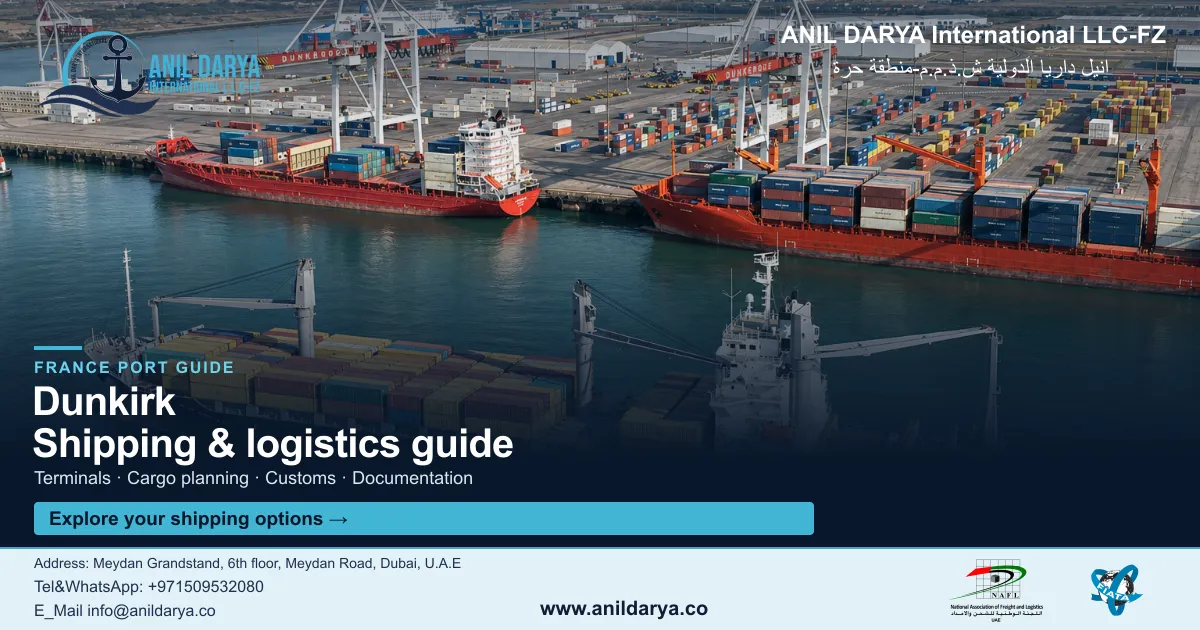
Port of Dunkirk shipping is mostly about three things: deep-water containers at Terminal des Flandres, chilled and frozen cargo, and heavy bulk and steel. Dunkerque-Port, the port authority, handled 48 million tonnes and a record-equalling 747,000 TEU in 2025, and its West Port takes the largest container ships with no lock or tide limits. This guide covers the terminals, cargo types, inland links, customs points that are specific to Dunkirk, and how we ship your cargo there from the UAE. We ship both from Dubai to Dunkirk and from Dunkirk to Dubai.
Port of Dunkirk: key facts at a glance
| Item | Detail |
|---|---|
| Port authority | Dunkerque-Port (Grand Port Maritime de Dunkerque) |
| Location | Northern France, on 17 km of North Sea coastline, about 90 minutes' sailing from the Dover Strait shipping lane |
| Port code | FRDKK |
| Layout | East Port behind locks; West Port with open sea access |
| Total traffic 2025 | 48 million tonnes, up 5% |
| Containers 2025 | 747,000 TEU, up 14% |
| Container terminal | Terminal des Flandres (TDF), West Port |
| TDF quay and depth | 1,600 m of quay, 2 berths dredged to 17.50 m |
| Reefer plugs at TDF | 700 |
| East Port limits | Ships up to 120,000 tonnes, maximum draught 14.20 m |
| Port railway | 160 km of track, about 12 million tonnes moved by rail a year |
| Ro-ro links | DFDS to Dover (12 crossings a day) and Rosslare (5 a week) |
| Customs | French customs (DGDDI), EU customs rules |
| Import VAT in France | 20% standard, reduced rates of 10% and 5.5% |
| Dunkirk to Dubai | EU export declaration by the shipper or its representative; UAE duty 5% of CIF for most goods, plus 5% VAT |
How is the port of Dunkirk laid out?
Dunkirk has two separate entrances along its 17 km of coast. Which one your ship uses depends on the cargo, and it changes what size of vessel can call.
| Area | Access | Main cargo |
|---|---|---|
| East Port | Behind locks; ships up to 120,000 tonnes and 14.20 m draught | Liquid and dry bulk, general cargo, steel and breakbulk |
| West Port | Open access, with no lock or tidal constraints according to the port | Containers (TDF), ferries and ro-ro, LNG, dry bulk including capesize ships |
For a container shipper from the UAE this is good news. Your box lands in the West Port, where the container terminal and the logistics zone sit side by side. Breakbulk such as steel coils or machinery may berth in the East Port instead, so check the berth on the booking before you plan the truck.
The port authority reports annual added value of about 3.8 billion euros and more than 29,000 direct, indirect and induced jobs. That matters to you only in one way: Dunkirk is a large industrial port, not a small feeder stop, so carrier calls, hauliers and customs agents are all on hand.
Terminal des Flandres: the container terminal at Dunkirk
All deep-sea containers at Dunkirk go through Terminal des Flandres (TDF) in the West Port. The port authority lists these facts:
| TDF feature | Figure |
|---|---|
| Deep-water quay | 1,600 m |
| Berths | 2, dredged to 17.50 m |
| Gantry cranes | 8, of which 6 can work ships over 20,000 TEU |
| Terminal area | 70 hectares |
| Reefer plugs | 700 |
| On-site rail | Dry port with four 850 m tracks |
| Working hours | 24/7, largest container ships at full load, no tidal constraints |
Container traffic at Dunkirk has tripled over the last 10 years, says the port. In 2025 it rose 14% to 747,000 TEU, equal to the 2022 record. The port has started the CAP 2020 project, which extends the Atlantic dock so a second container terminal can open by 2029. Its stated aim is to double container handling capacity.
What this means for you: one terminal handles every deep-sea box, so there is no guessing which terminal to send the truck to. Ask for the vessel's arrival date at TDF and the line's free time on your quote.
What cargo does the port of Dunkirk handle?
Dunkirk is a mixed port. Its 2025 results split the 48 million tonnes into three similar blocks.
| Cargo family | 2025 volume | Share | Examples and terminals |
|---|---|---|---|
| General cargo (containers, ro-ro, breakbulk) | 19.3 million tonnes, up 4% | 40% | TDF containers, DFDS ferries, steel at BARRA SNM and STE |
| Liquid bulk | 14.4 million tonnes, up 18% | 30% | LNG terminal, TEPSA and DPC tank storage, TOTAL and Versalis plants |
| Dry bulk | 14.3 million tonnes, down 5% | 30% | Ore (7.8 Mt), coal (2.7 Mt), grain (1.3 Mt), cement, scrap, slag |
The port authority calls Dunkirk France's leading dry bulk port. Around a dozen bulk terminals handle ores, coal, scrap, slag, aggregates, cement and minerals. The Nord Céréales terminal loads full Panamax grain ships of up to 63,000 tonnes.
The Dunkerque LNG terminal has 600,000 m3 of storage and handled more than 10 million tonnes in 2025, a record. For most UAE shippers, though, the relevant cargo is containers, reefers, steel and project pieces.
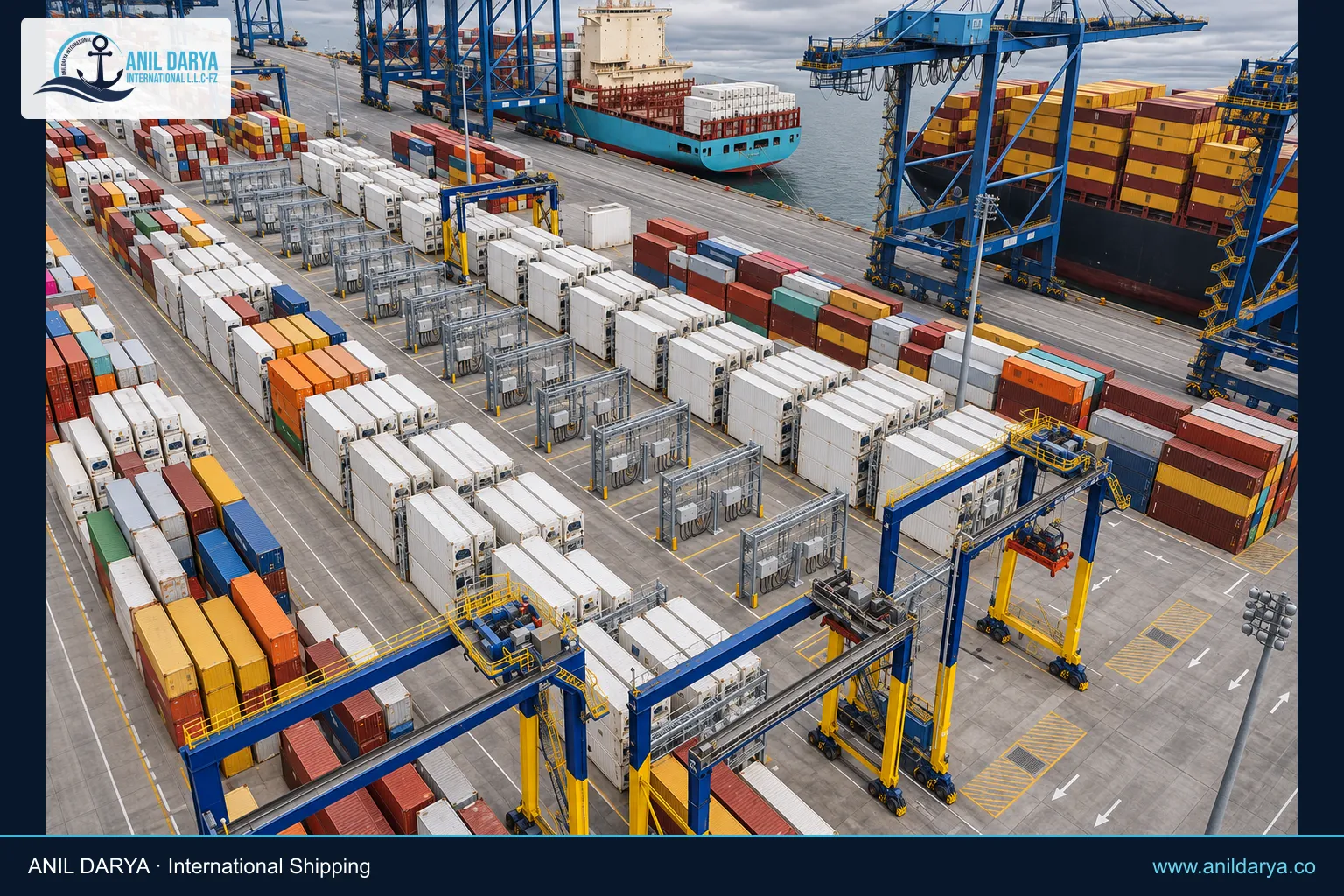
Reefer cargo and fresh produce: Dunkirk's speciality
Dunkirk is the leading French port for containerised fruit imports, according to the Dunkirk economic development agency. The port began as the gateway for bananas from the West Indies and now handles chilled fruit and vegetables and frozen goods.
- TDF has 700 reefer plugs.
- Cold store operators are based in the West Port logistics zone, next to the container and ferry terminals, for dry, chilled and frozen goods.
- The veterinary and phytosanitary inspection services (SIVEP) of the border control post have facilities in that same logistics zone.
- From January 2026, CMA CGM's NEWFI service brings more than 70 reefer containers of bananas and pineapples a week from Latin America, with Dunkirk as its first European call.
If you ship chilled or frozen food from the UAE to Dunkirk, the plan is simple but strict. Book a reefer with the right set temperature, send the health certificate with the documents, and make sure the importer notifies the inspection post before arrival. A recent report on the SIVEP says notice is due no later than one working day before the goods arrive. Our sea freight team books the reefer and checks the certificates before loading.
Breakbulk, steel and heavy lift at Dunkirk
Dunkirk has a long steel and heavy industry base, and its breakbulk terminals reflect that. The port authority names three operators:
| Operator | Area | What it handles |
|---|---|---|
| BARRA SNM | East Port | Conventional cargo, especially steel products, exceptional loads and heavy lifts; also new vehicles off car carriers |
| STE | East and Central Ports | Conventional cargo, steel, exceptional loads and heavy lifts |
| TDF | West Port | Exceptional shipments along its container quays |
For project cargo from the UAE, the first decision is the ship type. If each piece fits a 40ft flat rack by size and weight, it can sail on a container service into TDF, which usually means more sailings. If it does not, you need a breakbulk or heavy-lift vessel, and the berth will often be in the East Port, where the 14.20 m draught and the locks set the limits.
We plan the move in this order:
- Collect drawings, weights, dimensions and centre of gravity for each piece.
- Choose flat rack, breakbulk or heavy-lift tonnage, and confirm the discharge berth at Dunkirk.
- Agree lifting, lashing and securing with the carrier.
- Have the consignee's agent plan the road, rail or barge move from the quay, including permits for oversized loads.
- Send the customs documents before arrival so the cargo can leave the quay quickly.
Our break bulk and project cargo service covers the UAE side, and our heavy-lift shipping guide explains lift plans and vessel choice.
Dangerous goods to Dunkirk
Dunkirk handles large volumes of chemicals and fuels through its liquid bulk terminals, but packaged dangerous goods from the UAE normally arrive in containers at TDF. They move under the IMDG Code at sea and need the carrier's acceptance before you book.
What you need for a DG container to Dunkirk:
- UN number, proper shipping name, class and packing group for each product.
- A Safety Data Sheet in English, and the French importer may ask for a French version.
- A Dangerous Goods Declaration signed by a trained person.
- UN-approved packaging, labels and container placards.
- Confirmation from the carrier that the class is accepted on the service and at the discharge port.
Some carriers restrict certain classes on certain services, so we check acceptance first and only then confirm the sailing. Our dangerous goods shipping team handles the declaration, packing checks and the Dubai Customs export side.
Rail, barge and road: moving cargo inland from Dunkirk
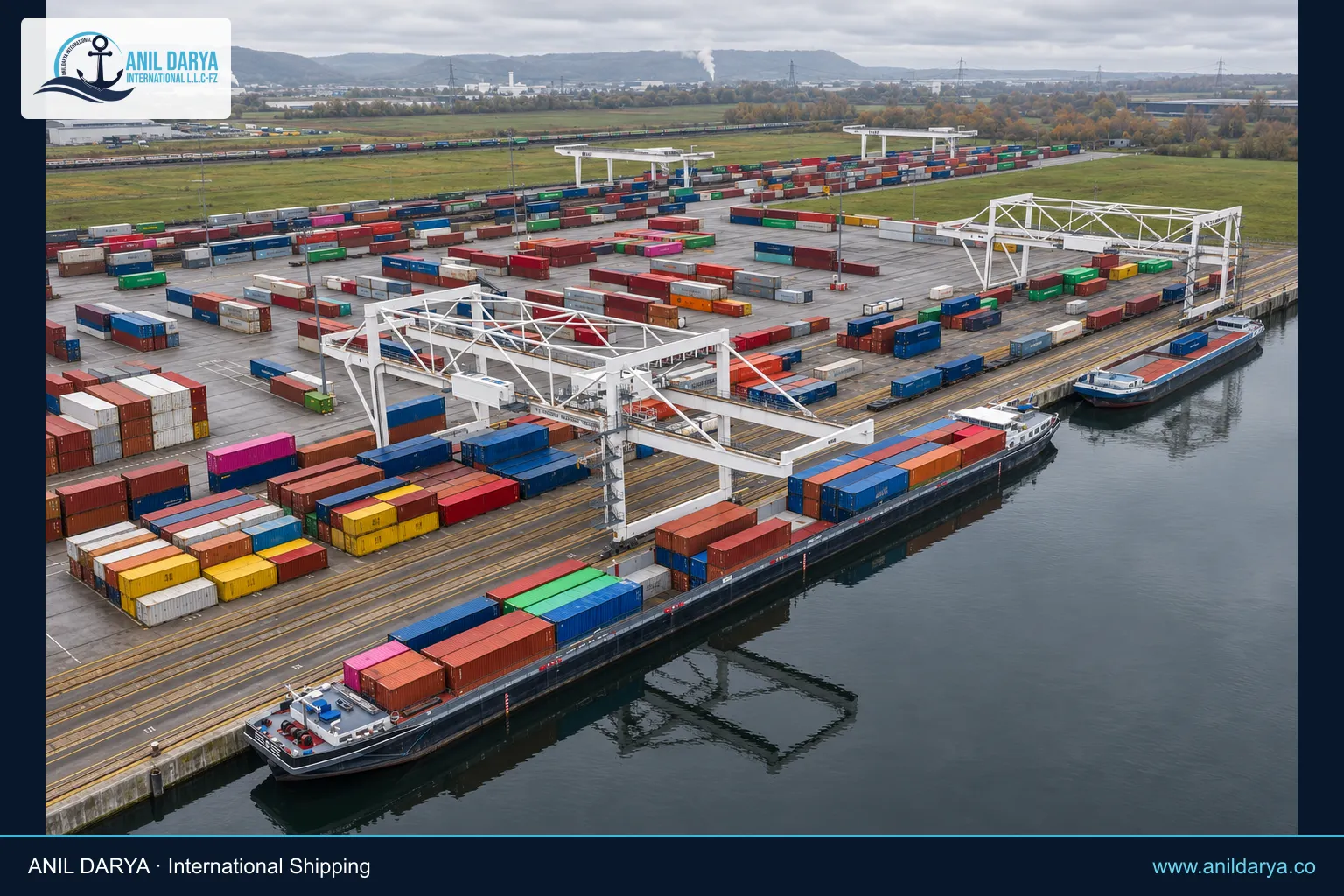
Dunkirk calls itself France's leading port for rail shipments, and its non-road share has been above 50% for years, according to the economic development agency. This is the main reason to choose Dunkirk for cargo going to northern France, Belgium or eastern France.
| Mode | What Dunkirk offers | When to use it |
|---|---|---|
| Rail | 160 km of port railway, about 12 million tonnes by rail a year, four 850 m tracks at TDF | Full containers and heavy bulk to inland terminals |
| Barge | 3,000-tonne barges on the Hauts-de-France network, 1,350 tonnes toward the Rhine, 650 tonnes toward the Paris basin today | Heavy or low-urgency cargo to canal-side sites |
| Road | Motorway access, Channel Tunnel 26 km away | Most LCL and short-distance FCL deliveries |
| Ro-ro | DFDS to Dover (12 a day) and Rosslare (5 a week) | Trailers onward to the UK or Ireland |
The Seine-Nord Europe Canal is scheduled to open in 2028, according to the agency. It should let larger barges reach the Paris region from the north.
A practical rule: if your consignee is within a few hours by road, take the truck. If the cargo is heavy and going further inland to a site with a rail or canal connection, ask the consignee's agent to price rail or barge from Dunkirk before you choose the port.
Customs at the port of Dunkirk
French customs applies the same EU rules at every French port, and our Le Havre guide covers them in detail. The short version:
- The importer needs a free EORI number from the SOPRANO service, active within 24 hours of issue.
- The import declaration is filed electronically in DELTA by the importer or a customs representative. It can be lodged up to 30 days before the goods are presented.
- The carrier files the entry summary declaration at least 24 hours before your container is loaded in the UAE.
- Duty follows the EU TARIC rate for your goods code. There is no EU-UAE trade agreement in force (negotiations were launched on 28 May 2025), so UAE-origin goods pay the normal third-country rate.
- Import VAT is self-assessed on the French VAT return by businesses identified for VAT in France. A foreign importer needs a French VAT number first.
Here is what is specific to Dunkirk:
| Item | At Dunkirk |
|---|---|
| Customs office for the port | Dunkerque port bureau at Loon-Plage, office code FR001260; ferry traffic has its own office |
| Office functions | Container and bulk clearance, release for free circulation, export, and opening and closing of T1/T2 transit |
| Clearance outside office hours | Customs authorised 24/7 clearance at the port in 2018, so container releases can be planned for night and weekend arrivals |
| Food, plant and animal checks | SIVEP border inspection facilities in the West Port logistics zone |
The office hours listed for the port bureau are Monday to Friday, 08:00 to 18:00. Check with the consignee's agent how night releases work for your shipment. Our Dubai freight forwarding team sends the full document set to that agent before the vessel leaves the UAE, so the declaration can be ready before arrival.
How long does shipping from Dubai to Dunkirk take?
We did not find a carrier schedule page that lists a direct UAE to Dunkirk sailing with a published transit time, so we do not quote one here. Dunkirk has been a North Europe call on CMA CGM's EPIC service, which links the Indian subcontinent and northern Europe, and many UAE shipments reach northern Europe with a transshipment on the way. The port of discharge on your bill of lading may also be another North Europe port, with an onward leg to Dunkirk.
[AMIR-FACT: our real port-to-port transit days from Jebel Ali to Dunkirk and the carriers or services we actually book on this lane]
Always confirm on the booking whether the box discharges at Dunkirk itself or at another port, because that changes the customs office and the inland plan.
Shipping from Dubai to the port of Dunkirk: step by step
- Agree the Incoterm with your French buyer, so it is clear who books the freight and who clears customs at Dunkirk. Our article on Incoterms 2020 for sea freight explains the split.
- Check the goods code in TARIC for the duty rate and any measures, and confirm the importer has an EORI and a French VAT number.
- Send us the cargo details: goods, HS codes, weight, volume or dimensions, packing and the final delivery address.
- We compare services from Jebel Ali and other UAE ports, confirm the discharge port and terminal, and book space. Reefer, DG and out-of-gauge cargo need carrier acceptance first.
- We check the invoice, packing list, certificate of origin and draft bill of lading, so names, weights and codes match.
- We truck the cargo to the UAE port, file the Dubai Customs export declaration and gate in before the cut-off. Our Jebel Ali port shipping guide covers that end.
- We send the document set to the consignee's French agent, who lodges the import declaration before arrival and arranges any SIVEP inspection.
- The container is discharged at TDF, released and leaves by truck, train or barge.
How to ship from the port of Dunkirk to Dubai
We also handle shipping from Dunkirk to Dubai, with arrival at Jebel Ali, Khalifa Port or Sharjah port. We book space with the carrier from Terminal des Flandres, or from another North Europe port when the service does not call Dunkirk, and run the UAE side. The French export papers stay with the shipper or its French agent, as we have no office in France.
The France export side
- Export declaration. Goods leaving the EU need an export declaration, lodged electronically. The EU says it goes through the Automated Export System (AES) at the customs office where the exporter is established.
- French system. French customs has used the DELTA IE online service for export declarations since 4 November 2025. The shipper can lodge the declaration itself or use a customs representative.
- Exit. The goods are presented at the customs office of exit, here Dunkirk, which checks them against the declaration and supervises their departure.
- Pickup. The shipper or its trucker delivers the box to Terminal des Flandres, by road, rail or barge, inside the carrier's receiving window.
The UAE import side
Dubai Customs takes the import declaration with the commercial invoice, the packing list, the certificate of origin and any permit from the authority that controls restricted goods. The carrier releases the cargo against the bill of lading. The importer needs a Dubai Customs business code, or a licensed clearing agent files with its own code and the owner's authorisation. Customs duty in Dubai is 5% of the CIF value for most goods, with 50% on alcohol and 100% on cigarettes. Import VAT is 5%. A VAT-registered importer that has linked its customs registration number with the Federal Tax Authority reports the VAT on its return instead of paying it at release; other importers pay it before the goods are released.
- Send us the shipper's details in Hauts-de-France or northern France, the cargo, the HS code, the Incoterm and the UAE delivery address.
- We book space from Terminal des Flandres to Jebel Ali, Khalifa Port or Sharjah and send the booking and cut-offs to the shipper.
- The shipper or its trucker collects the empty, stuffs it and delivers the box to the terminal before the cut-off.
- The shipper or its French customs representative files the export declaration and any permit, and customs releases the cargo for loading.
- We check the draft bill of lading against the invoice and packing list, with the UAE consignee named correctly.
- We file the UAE declaration before the vessel arrives.
- We arrange payment of the duty and VAT.
- We collect the delivery order from the carrier.
- We truck the box to your site, free zone or warehouse, and return the empty within free time.
[AMIR-FACT: the carriers and hubs we actually use from Dunkirk to Jebel Ali, Khalifa Port or Sharjah, and our real port-to-port transit days in this direction]
FCL or LCL to Dunkirk?
- Choose FCL if you fill most of a 20ft box, ship heavy goods, ship DG or plan to send the box on by rail. You control the stuffing and the seal.
- Choose LCL for a few pallets. Your cargo is unpacked at a warehouse after discharge, so release also depends on the other shipments in the box. Check whether the consolidator delivers LCL into Dunkirk itself or into another North Europe port.
- Choose a reefer for chilled or frozen food, and plan the inspection notice before arrival.
Our guide to FCL vs LCL costs sets out the break-even point.
Which French port fits: Dunkirk, Le Havre or Marseille Fos?
| Your situation | Port to look at first | Why |
|---|---|---|
| Consignee in Hauts-de-France, Belgium or near the Channel | Dunkirk | Short road leg, strong rail and canal links |
| Chilled or frozen food, fruit | Dunkirk | 700 reefer plugs, cold stores and inspection post in the West Port |
| Steel, heavy lift, bulk | Dunkirk | Dedicated breakbulk operators and a large bulk base |
| Paris region and the Seine valley | Le Havre | Large container port with Seine barge links |
| Southern France and the Rhone valley | Marseille Fos | Shorter inland leg to the south |
The cheapest ocean freight is not always the cheapest total cost. We can price more than one French port so you can compare the cost to the door.
Checklist before you ship to Dunkirk
- HS code confirmed and duty checked in TARIC.
- Importer has an EORI and a French VAT number.
- Invoice, packing list and bill of lading show the same weights, pieces and consignee.
- Certificate of origin issued in the UAE.
- Discharge port confirmed as Dunkirk, and the terminal or berth known.
- For reefer cargo: set temperature, health certificate, and the SIVEP notice planned.
- For DG: SDS, DG declaration, packaging and labels, and carrier acceptance.
- For project cargo: drawings, lifting points, berth and inland route plan.
- Consignee's customs agent appointed and holding the documents before arrival.
- Free time agreed with the carrier, and cargo insurance arranged.
Common mistakes with Dunkirk shipments
- Assuming the ship calls Dunkirk. Some bookings discharge at another North Europe port. Check the port of discharge on the bill of lading.
- No French VAT number. A foreign importer without one cannot self-assess import VAT, and clearance stalls.
- Late inspection notice for food. Missing the advance notice to the inspection post holds a reefer at the terminal.
- Planning breakbulk like a container. A heavy-lift ship may berth in the East Port behind the locks, with a different draught limit and haulier.
- Ignoring free time. Demurrage starts when free days end. Our article on demurrage and detention shows how it adds up.
- Treating DG as general cargo. Undeclared dangerous goods can be refused, delayed or fined.
Frequently asked questions
What is the port code for Dunkirk?
The port code for Dunkirk (Dunkerque) is FRDKK. You will see it on bookings, bills of lading and tracking systems.
Who runs the port of Dunkirk?
The port authority is Dunkerque-Port. The container terminal in the West Port is Terminal des Flandres (TDF), and private operators such as BARRA SNM and STE run the breakbulk terminals.
How does shipping from Dubai to Dunkirk work?
We book space from Jebel Ali, usually with a transshipment on the way, and handle UAE export clearance. The consignee's customs representative files the import declaration in France, and duty and import VAT are settled before or on release.
How deep is the container terminal at Dunkirk?
The two berths at Terminal des Flandres are dredged to 17.50 m, along 1,600 m of quay. The port says the West Port has no lock or tidal constraints, so the largest container ships can call at full load.
Is Dunkirk a good port for refrigerated cargo?
Yes. Dunkirk is the leading French port for containerised fruit imports. TDF has 700 reefer plugs, and cold stores and the SIVEP inspection facilities are in the West Port logistics zone next to the terminal.
Can containers leave Dunkirk by train or barge?
Yes. TDF has four 850 m rail tracks, the port has 160 km of railway, and barges of up to 3,000 tonnes use the regional canal network. Rail and barge together carry more than half of the port's inland traffic.
Can I clear customs at Dunkirk before the ship arrives?
Yes. In France an import declaration can be lodged up to 30 days before the goods are presented to customs. The importer needs an EORI number, and a customs representative can file on its behalf.
Does UAE-origin cargo pay reduced duty in France?
No. There is no EU-UAE trade agreement in force; negotiations were launched on 28 May 2025. UAE goods pay the normal EU third-country rate shown in TARIC, plus French import VAT.
Can you handle shipping from Dunkirk to Dubai?
Yes. We book the space from Dunkirk, the shipper or its French representative files the EU export declaration, and we clear the cargo through UAE customs and deliver it. Most goods pay 5% duty on the CIF value plus 5% import VAT in Dubai.
Get a quote for port of Dunkirk shipping
Send us your cargo details and we will come back with a routing and a price to Dunkirk. Use our freight rate inquiry form, or contact our team to talk through a reefer, DG or project shipment first.
Sources
- Dunkerque-Port: Maritime solutions (East and West Port, TDF, ro-ro, bulk, breakbulk operators)
- Dunkerque-Port: The port of Dunkirk in brief (container growth, CAP 2020, jobs)
- Dunkerque-Port: Logistics solutions (temperature-controlled logistics, SIVEP)
- Dunkerque-Port: Press conference 2025 (second container terminal by 2029)
- IBJ: Port of Dunkirk 2025 results (January 2026)
- Dunkerque l'Energie Creative: Dunkirk, major international maritime port (rail, barge, rankings)
- FreshPlaza: Latin American fruit shipments to move to Dunkirk in 2026
- Nakordoni: Dunkirk SIVEP border inspection post (July 2026)
- IBJ: 24/7 customs clearance at Dunkirk Port (December 2018)
- Celna24: Dunkerque port customs bureau FR001260
- Nord France Invest: CMA CGM EPIC service calling Dunkirk
- Cogoport: Port of Dunkerque (FRDKK)
- French customs: EORI number
- French customs: Lodging a customs declaration
- French customs: Import VAT self-assessment from 2022
- European Commission Access2Markets: Customs clearance documents and procedures (ENS timing)
- European Commission: EU Customs Tariff (TARIC)
- European Commission: EU-UAE agreement negotiations
- Your Europe: VAT rates in EU countries
- French customs: Lodging a customs declaration for import or export (DELTA IE for export since 4 November 2025, representative, electronic)
- European Commission: What is exportation (AES, customs office of export and exit)
- Dubai Customs: Submit customs declaration (invoice, packing list, certificate of origin, permits)
- Dubai Customs: FAQ (customs business code, clearing agents with owner authorisation, 5% of CIF)
- UAE Government portal: Clearing customs and paying customs duty (5% of CIF in Dubai, alcohol 50%, cigarettes 100%)
- UAE Federal Tax Authority: VAT guide, import VAT at 5% and deferral for registered importers
Reviewed: 10 November 2026