
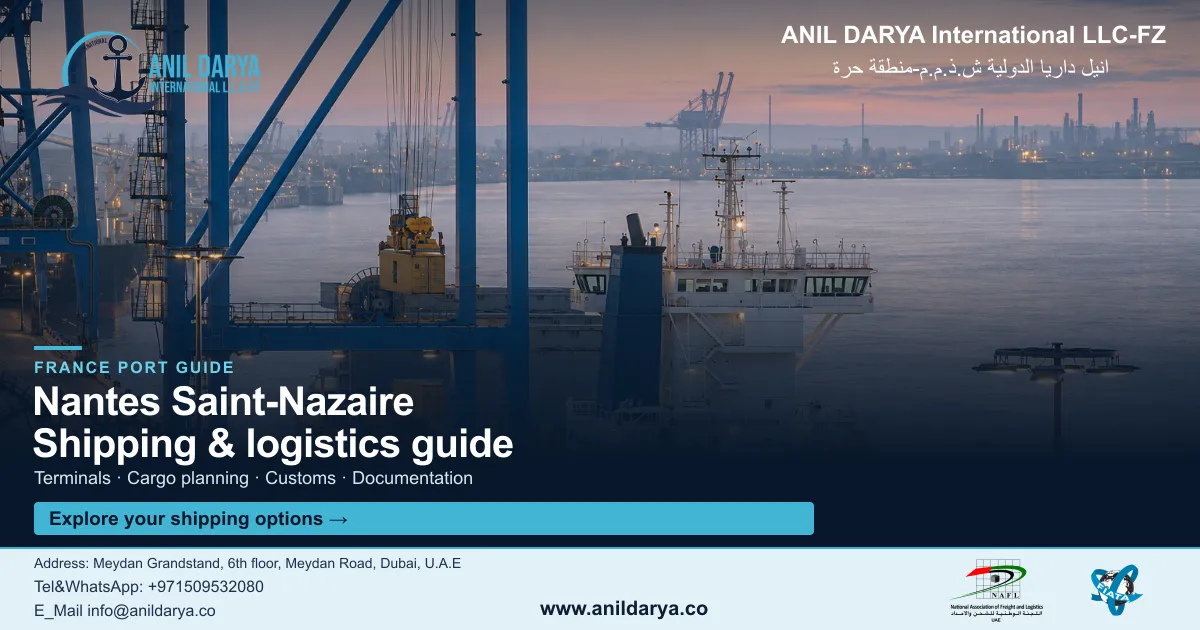
Nantes Saint-Nazaire port shipping covers France's largest Atlantic port, a chain of sites along the Loire estuary from Saint-Nazaire up to Nantes. Containers, Ro-Ro, aircraft parts and heavy-lift cargo mostly use Montoir-de-Bretagne and Saint-Nazaire, while bulk and energy cargo use Donges, Montoir and Nantes. For shipping from Dubai to Nantes Saint-Nazaire, containers usually arrive on a feeder from a hub port such as Le Havre, Antwerp or Rotterdam, so the routing matters as much as the port itself. This guide also covers shipping from Nantes Saint-Nazaire to Dubai, for machinery, steel and other cargo bound for the UAE.
Nantes Saint-Nazaire port: key facts at a glance
| Item | Detail |
|---|---|
| Port authority | Nantes Saint-Nazaire Port, a public enterprise wholly owned by the French State, created by decree on 9 October 2008 |
| UN/LOCODE | FRNTE |
| Main sites | Saint-Nazaire, Montoir-de-Bretagne, Donges, Paimboeuf, Le Carnet, Cordemais, Le Pellerin, Nantes |
| Total traffic 2025 | 26.4 million tonnes, up 2.6% (20 Mt imports, 6.4 Mt exports) |
| Containers 2025 | 1.2 million tonnes, about 120,000 TEU (port estimate), down nearly 9% |
| Ro-Ro 2025 | 0.4 million tonnes, 95,832 vehicles and trailers |
| Ship calls 2024 | 2,655, of which 237 container ships and 142 Ro-Ro ships |
| Container terminal | Terminal du Grand Ouest (TGO) at Montoir: 600 m of quay, 4 berths, 3 gantry cranes, 2 mobile cranes, 350 reefer plugs |
| Largest container ship at Montoir | Up to 8,000 TEU |
| Heavy lift | 400-tonne jumbo derrick, mobile cranes of 150 and 200 tonnes, quays rated 15 t/m² |
| Port infrastructure | 12 km of berths, 35 km of rail, 2,722 ha in total |
| Maritime channel | About 60 km, kept open by the port's 3 dredgers |
| Import VAT (France) | 20% standard, reduced rates 5.5% and 10% |
How is Nantes Saint-Nazaire port laid out?
The port is not one harbour but a string of sites along the estuary. Knowing which one your cargo uses tells you the depth, the gear and the onward route.
| Site | What it handles |
|---|---|
| Saint-Nazaire | Dock basins with heavy-lift quays, the Joubert sluice dock, three dry docks and the Chantiers de l'Atlantique shipyard; about fifty companies |
| Montoir-de-Bretagne | Container and general cargo terminal (TGO), Ro-Ro terminal, bulk berths and the Elengy LNG terminal |
| Donges | One of France's largest refineries |
| Le Carnet | 395 ha land reserve on the south bank |
| Cordemais | Former power plant site being converted |
| Nantes (Cheviré, Roche Maurice, Cormerais) | Construction and recycling bulk, breakbulk, onshore wind parts, grain, liquid chemicals; about 10% of total traffic |
A road link 1.2 km long and 21 m wide connects Montoir with the Saint-Nazaire basins, so heavy pieces can move between the two without public roads. Nantes is about 60 km up the channel. Wikipedia puts the allowable draught in the Nantes channel at 8.40 m for 98% of tides, so large ships stop downstream at Montoir, Donges or Saint-Nazaire.
The Montoir container terminal (TGO)
Containers at Nantes Saint-Nazaire go through one terminal: the general cargo and container terminal run by Terminal du Grand Ouest (TGO) at Montoir-de-Bretagne.
| Feature | Detail |
|---|---|
| Quay | 600 m, 4 berths; the quay was reinforced to 15 t/m², against the usual 6 t/m² |
| Cranes | 3 gantry cranes and 2 mobile cranes |
| Productivity | Over 30 moves an hour |
| Reefer | 350 plug-in points |
| Warehousing | 20,000 m² of dry and refrigerated storage |
| Gate | About 800 trucks a day; one VGM weighbridge; Easy Gate shows customs status and traffic in real time |
| Regulatory one-stop | Customs, veterinary and phytosanitary inspection and fraud control in one facility inside the terminal |
The terminal says its truck capacity is not fully used, which usually means short queues. The one-stop facility matters for food, plant and animal products, because checks happen inside the terminal perimeter rather than at a separate site.
Which shipping services call at Nantes Saint-Nazaire?
The port lists more than 10 shipping routes and links to 400 ports. For containers, most of that reach comes through feeders to big hubs.
| Service | Type | Route | Frequency |
|---|---|---|---|
| CMA CGM Atlantic Feeder | Feeder | Le Havre, about 2 days to the hub | Weekly |
| MSC | Feeder | Le Havre (2 days) and Antwerp (3 days) | Weekly |
| BG Freight (for Maersk and Hapag-Lloyd) | Feeder | Rotterdam | Weekly |
| Wec Line | Shortsea | Scandinavia and Baltic transhipment, 800 TEU ships | 2 calls a week |
| CMA CGM EURAF 1 | Deepsea | Tangier, Dakar, Abidjan | Weekly (Wednesday) |
| Bahri | Conro | Westbound Dalian, Shanghai, Ennore, Jeddah, Montoir; eastbound Bremerhaven, Antwerp, Jeddah, Dalian | Monthly |
One change to note. The port's services page still lists a direct French West Indies container line, but the port's January 2026 traffic release says container volume fell partly because the line to the Antilles stopped. Check the current schedule before you plan on any direct service. The same release says CMA CGM is still the largest carrier at Montoir by volume, and MSC, with its partner WEC Lines, made up 45% of activity in 2025.
How long does shipping from Dubai to Nantes Saint-Nazaire take?
We did not find a carrier schedule with a direct UAE to Montoir container service, so we do not quote a transit time from a carrier. Fluent Cargo, a route aggregator, shows its quickest Dubai to Nantes sea routing as Jebel Ali to Le Havre in about 38 days with one transfer, and that leaves the feeder leg from Le Havre to Montoir on top. The feeder to Le Havre takes about 2 days, per the port.
[AMIR-FACT: our real routing and port-to-port days from Jebel Ali to Montoir de Bretagne (which hub: Le Havre, Antwerp or Rotterdam) and the carriers we actually book on this lane]
The routing changes your costs and your customs. If the container stays on the bill of lading to Montoir, the hub is only a transhipment. If the bill ends at Le Havre, someone has to book and clear the onward leg. Confirm the final port of discharge on the booking.
FCL or LCL to Nantes Saint-Nazaire?
With FCL, you book a whole 20ft or 40ft box through to Montoir on the carrier's feeder. With LCL, your cargo is consolidated in the UAE and usually unpacked at a hub port or an inland warehouse, then trucked to western France. Montoir has its own warehousing, but LCL services through to Montoir depend on what the consolidator runs.
For a few pallets, LCL to Le Havre or Paris with a truck to your consignee is often the practical answer. For a full load to Brittany, Pays de la Loire or the Vendee, FCL through to Montoir cuts the truck leg. The break-even point is covered in our guide to FCL vs LCL costs, and our sea freight service can price both.
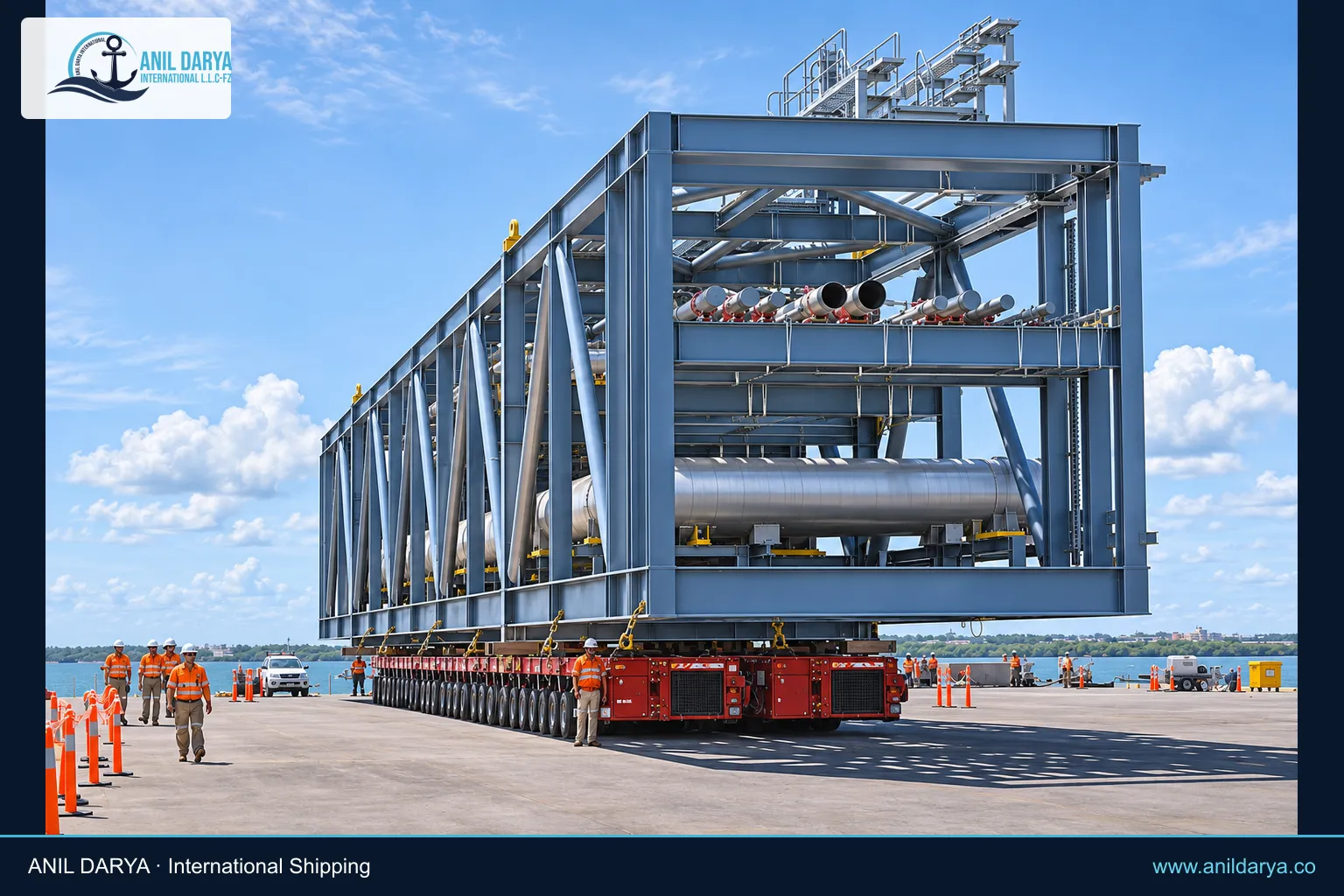
Breakbulk, heavy-lift and project cargo at Nantes Saint-Nazaire
Heavy industry built this port. Chantiers de l'Atlantique builds cruise ships in Saint-Nazaire, and Airbus moves aircraft parts through the estuary. Shippers of large pieces get gear and quays made for that work.
- Quays at Saint-Nazaire and Montoir reinforced or built for 15 t/m², up from 4 t/m².
- A 400-tonne jumbo derrick and two mobile cranes of 150 and 200 tonnes.
- A 12-hectare area beside the Joubert sluice dock, with direct sea access, for storing and pre-assembling offshore wind parts.
- Barges between Nantes and Montoir that carry up to 1,800 tonnes of heavy-lift cargo, 176 TEU or 3,600 m³ of bulk; the Flexiloire service runs at least 240 rotations a year.
The port gives one example of scale: a 4,000-tonne electrical substation built at the shipyard and moved by barge. Breakbulk specialists named by the port include Sogebras, IDEA and Scales. In 2025 the port also reported growing steel plate traffic at Saint-Nazaire, linked to shipbuilding and wind energy.
When we plan a heavy piece from the UAE to Saint-Nazaire, the order is:
- Get drawings, weights, centre of gravity and lifting points for each piece.
- Pick the vessel: flat rack on a container service via a hub, or a multipurpose or heavy-lift ship direct.
- Check the berth and gear at Saint-Nazaire or Montoir against the heaviest lift.
- Plan the onward move by road, the internal road link or barge up the Loire.
- Send customs papers ahead so the piece does not wait on the quay.
Our break bulk and project cargo team handles the UAE side, and our heavy-lift shipping guide covers vessel choice in more detail.
Ro-Ro, vehicles and aircraft parts at Montoir
The Montoir Ro-Ro terminal is the largest facility of its kind on France's Atlantic coast. It has 4 berths, two floating pontoons that let four ships work at once, 40 hectares of paved storage and a 750 m rail track for full trains. Its main flows are imports of new vehicles and Airbus components. Suardiaz runs a service to Vigo three times a week, and LD Seaplane links Montoir with the Mediterranean, the North Sea and Mobile in the United States.
In 2025 Ro-Ro tonnage dipped 1.9%, with vehicle numbers down, while aeronautical traffic rose 6.1%. Since October 2025 a new rotation to Saint-Pierre-et-Miquelon, Halifax and Baltimore uses a sail-assisted ship. For machinery or vehicles from the UAE, Ro-Ro usually means a deepsea Ro-Ro call at a hub, then a shortsea or road leg to western France.
Bulk and energy cargo
Across all sites the port has 13 liquid bulk berths and 12 solid bulk berths. It is France's leading port for cattle feed imports, which serve the country's biggest livestock region. Energy is the largest flow: LNG at the Elengy terminal in Montoir, crude oil and refined products for the Donges refinery. For dry bulk such as fertilisers, sand, clinker or grain, the berth depends on the receiver, from Montoir to Roche Maurice in Nantes.
Dangerous goods to Nantes Saint-Nazaire
The port handles LNG, crude oil, refined products and liquid chemicals, so dangerous cargo is routine here. Pilotage is compulsory for ships over 75 m and for any ship carrying hazardous cargo, and the Harbour Master's Office authorises each movement after the ship's agent sends the documents. We did not find a published notice deadline for dangerous goods on the port's English pages, so we confirm it with the agent for each call.
For containerised DG, the rules of the hub port also apply, because the box is handled there first. Prepare:
- UN number, proper shipping name, class and packing group.
- A Safety Data Sheet and a signed Dangerous Goods Declaration.
- IMDG packaging, labels and placards.
- Acceptance from the main carrier and the feeder operator.
Our dangerous goods shipping team checks each leg before booking.
Customs at Nantes Saint-Nazaire: a short summary
French customs applies the same EU rules at every French port, and our Le Havre guide covers them in detail. The short version:
- The importer needs a free EORI number from the SOPRANO service, active 24 hours after issue.
- The import declaration is filed electronically (DELTA G or DELTA IE) by the importer or a customs representative, up to 30 days before the goods are presented.
- The carrier files the Entry Summary Declaration at least 24 hours before your container is loaded in the UAE.
- Duty follows the EU TARIC rate for your goods code. No EU-UAE trade agreement is in force (negotiations were formally launched on 28 May 2025), so UAE-origin goods pay the normal third-country rate.
- Import VAT is self-assessed on the French VAT return by businesses identified for VAT in France. A foreign importer needs a French VAT number first.
What is specific to this port is the one-stop regulatory facility inside the TGO terminal, which brings customs, veterinary and phytosanitary checks together. If your container stays under customs control at the hub and moves on the feeder to Montoir, clearance can happen at Montoir. If the bill of lading ends at Le Havre or Antwerp, clearance or a transit declaration happens there instead. Decide this before the ship sails.
Shipping from Dubai to Nantes Saint-Nazaire: step by step
- Send us the cargo details. Commodity, HS code, weight, volume or dimensions, Incoterm and the delivery address in western France.
- Pick the routing. Container through to Montoir via a hub, container to a hub with a truck leg, or a direct breakbulk or heavy-lift vessel.
- Book space. We book with the carrier and get acceptance for DG, reefer or out-of-gauge cargo first.
- Prepare the documents. Commercial invoice, packing list, certificate of origin and the draft bill of lading, with the final port of discharge clearly shown.
- Handle UAE trucking and export. We arrange pickup, the export declaration and gate-in at Jebel Ali Port or another UAE port.
- Pass the file to the French broker. The consignee's customs representative files the import or transit declaration before arrival.
- Track the transhipment. Watch the hub connection, because a missed feeder adds a week.
- Deliver and return the empty. The trucker collects at Montoir and returns the empty to the depot the line names, inside free time.
How to ship from Nantes Saint-Nazaire to Dubai
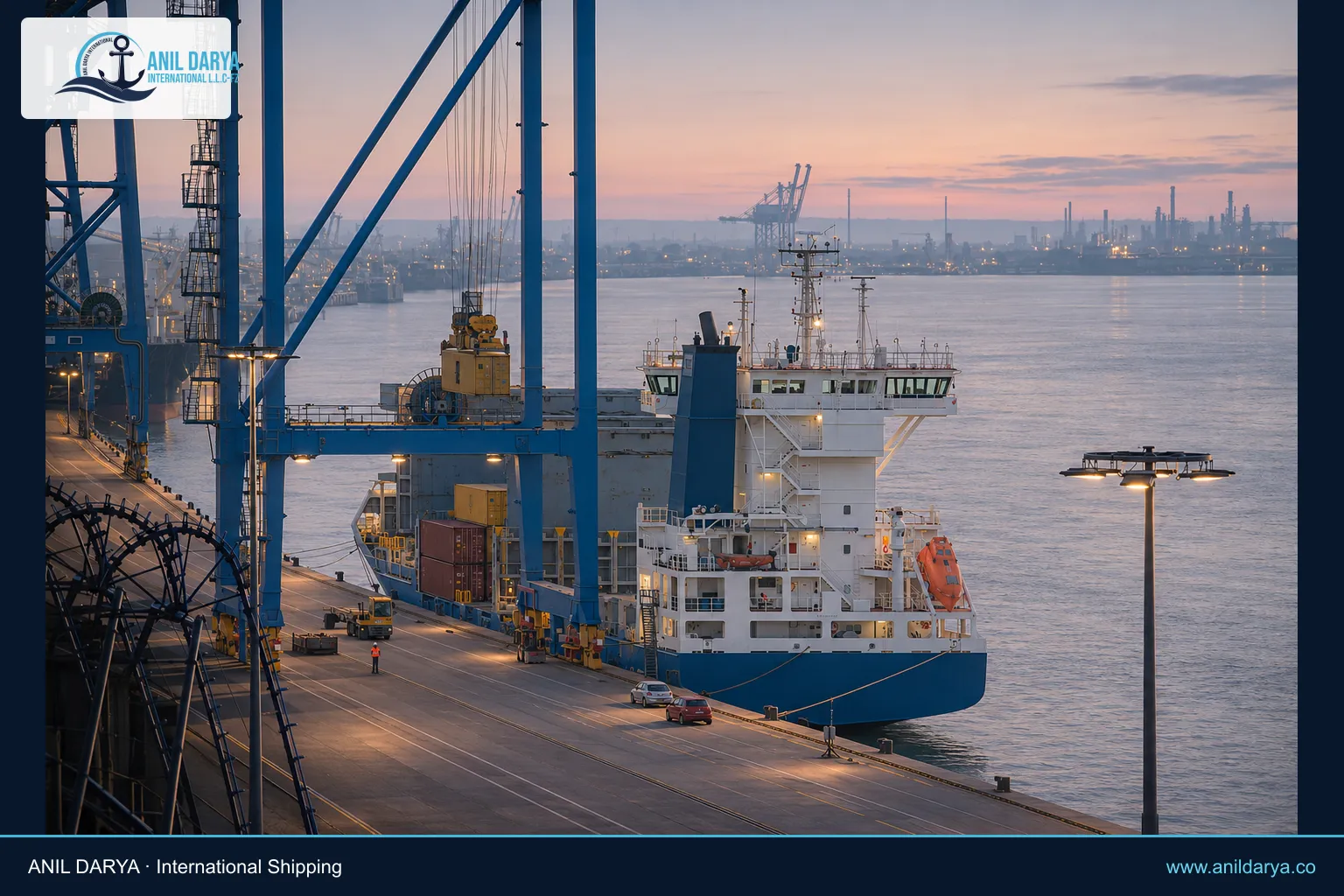
We also move cargo the other way, from Nantes Saint-Nazaire into Jebel Ali, Khalifa Port or Sharjah. We book the space with the carrier, and the shipper or its origin agent handles pickup paperwork and the EU export declaration at the Nantes Saint-Nazaire end. We take over for UAE clearance and delivery.
- Share the cargo and pickup details. Commodity, HS code, weights, the pickup address and the Incoterm agreed with your supplier.
- Book the routing. For containers, the box goes from Montoir on a weekly feeder to Le Havre, Antwerp or Rotterdam and on to Jebel Ali on a deepsea service. Heavy pieces can load on a multipurpose or heavy-lift ship at Saint-Nazaire or Montoir.
- Export formalities at origin. The shipper or its customs agent files the EU export declaration and provides the commercial invoice, packing list and certificate of origin.
- Check documents before sailing. We match weights, HS codes and the consignee on the invoice, packing list and draft bill of lading, and flag any UAE permit the goods need.
- Clear customs in the UAE. Dubai Customs asks for the invoice, packing list, certificate of origin and a permit for restricted goods. Duty in Dubai is 5% of the CIF value for most goods (50% on alcohol, 100% on cigarettes).
- Pay or defer VAT. The UAE VAT rate is 5%. A VAT-registered importer accounts for import VAT under the reverse charge; otherwise it is paid before release.
- Deliver in the UAE. We collect the delivery order, book the truck and deliver to your site, free zone or warehouse, then return the empty.
The importer needs a customs business code, or a licensed clearing agent with the owner's authorisation can file for it. If the goods will be re-exported, ask about a temporary admission or re-export declaration, where Dubai Customs takes a deposit equal to the duty and refunds it when the goods leave on time. For Abu Dhabi consignees, Khalifa Port in Abu Dhabi can shorten the truck leg.
Which French Atlantic gateway fits your cargo?
| Your situation | Port to consider | Why |
|---|---|---|
| Full containers for Brittany, Pays de la Loire or nearby | Nantes Saint-Nazaire (Montoir) via a feeder | Shorter truck leg; Paris is about 4 hours by road from the port, Rennes about 1.5 hours |
| Containers for Paris or northern France | Le Havre | Deepsea calls and rail and river links to Paris |
| Heavy lift, wind and project cargo for western France | Saint-Nazaire or Montoir | 400-tonne derrick, 15 t/m² quays, barge up the Loire |
| Urgent spare parts | Air cargo to Nantes Atlantique | The airport is 10 km from the Cheviré facilities |
For urgent items our air cargo service can book to Nantes or Paris instead.
Checklist before you ship to Nantes Saint-Nazaire
- Final port of discharge on the bill of lading agreed: Montoir, or a hub with an onward leg.
- Current feeder service confirmed, since some direct lines have stopped.
- HS code checked in TARIC for duty and any restrictions.
- Importer's EORI and French VAT number in place.
- Place of clearance agreed: hub, transit, or Montoir.
- For food and plant products: certificates ready for the one-stop inspection.
- For DG: SDS, DG declaration and acceptance by both carriers.
- For heavy lift: berth, crane and road or barge plan confirmed.
- Free time long enough to cover the transhipment and clearance.
Common mistakes with Nantes Saint-Nazaire shipments
- Booking to "Nantes" when the cargo needs Montoir. Container ships do not go up to Nantes city; the container terminal is at Montoir.
- Relying on an old schedule. The French West Indies line still appears on some pages but has stopped.
- Leaving the bill of lading at the hub. Nobody books the onward leg and storage builds up.
- Forgetting the French VAT number. Without it, a foreign importer cannot self-assess import VAT.
- Underestimating the heavy-lift plan. A piece that fits the derrick may still need a barge or road permit.
Frequently asked questions
What is the port code for Nantes Saint-Nazaire?
The UN/LOCODE is FRNTE. Check whether your booking shows FRNTE or a hub port code, because that tells you where the container is discharged.
Where is the container terminal at Nantes Saint-Nazaire?
Containers use the Terminal du Grand Ouest (TGO) at Montoir-de-Bretagne, near Saint-Nazaire. It has 600 m of quay, 4 berths, 3 gantry cranes and 350 reefer plugs.
How many containers does Nantes Saint-Nazaire handle?
The port estimates about 120,000 TEU in 2025, or 1.2 million tonnes. That was down nearly 9% on 2024, partly because the line to the French West Indies stopped.
Is there a direct ship from Dubai to Nantes Saint-Nazaire?
We did not find a direct container service from the UAE. Containers usually go via a hub such as Le Havre, Antwerp or Rotterdam and arrive at Montoir on a weekly feeder.
How long does shipping from Dubai to Nantes Saint-Nazaire take?
Fluent Cargo shows its quickest routing as Jebel Ali to Le Havre in about 38 days with one transfer, plus about 2 days on the feeder to Montoir. Confirm the real schedule with the carrier at booking.
Can I ship heavy-lift cargo to Saint-Nazaire?
Yes. Saint-Nazaire has a 400-tonne jumbo derrick, mobile cranes of 150 and 200 tonnes and quays rated at 15 t/m². The port has moved a 4,000-tonne substation by barge.
Can ships sail up the Loire to Nantes?
Yes, smaller ships can. The channel to Nantes is about 60 km long, and Wikipedia gives an allowable draught of 8.40 m for 98% of tides, so larger ships use Montoir, Donges or Saint-Nazaire.
Can you handle shipping from Nantes Saint-Nazaire to Dubai?
Yes. We book the carrier from Montoir via a hub to Jebel Ali, Khalifa Port or Sharjah. The shipper or its agent files the EU export declaration, and we handle UAE customs, where duty is 5% of the CIF value for most goods, and delivery.
What is the import VAT rate in France?
The standard VAT rate in France is 20%, with reduced rates of 5.5% and 10%. Businesses identified for VAT in France self-assess import VAT on their VAT return.
Get a quote for Nantes Saint-Nazaire port shipping
Send us your cargo and delivery address and we will compare routings through to Montoir with a hub and truck option, in either direction. Use our freight rate inquiry form, or contact our team for heavy-lift or DG cargo. You can also read more about our Dubai freight forwarding team.
Sources
- Nantes Saint-Nazaire Port: Home (routes, ports served, ranking)
- Nantes Saint-Nazaire Port: Key figures (calls 2024, berths, rail, area)
- Nantes Saint-Nazaire Port: 2025 traffic press release (9 January 2026, French)
- Nantes Saint-Nazaire Port: Our missions (status, 2008 decree)
- Nantes Saint-Nazaire Port: Sites and activities
- Nantes Saint-Nazaire Port: Montoir-de-Bretagne facilities
- Nantes Saint-Nazaire Port: Saint-Nazaire facilities
- Nantes Saint-Nazaire Port: Nantes facilities
- Nantes Saint-Nazaire Port: Containers (TGO terminal)
- Nantes Saint-Nazaire Port: Shipping services
- Nantes Saint-Nazaire Port: Breakbulk and industrial cargo
- Nantes Saint-Nazaire Port: Ro-Ro terminal
- Nantes Saint-Nazaire Port: Bulk cargo
- Nantes Saint-Nazaire Port: Pre- and post-carriage (rail, road, barge)
- Nantes Saint-Nazaire Port: Stopover (pilotage, Harbour Master, dredging)
- ShipNext: Nantes-St Nazaire (FRNTE)
- Wikipedia: Port of Nantes (channel and draught to Nantes)
- Fluent Cargo: Dubai to Nantes routings
- French customs: EORI number
- French customs: Lodging a customs declaration
- French customs: Import VAT self-assessment from 2022
- European Commission Access2Markets: Customs clearance documents and procedures
- European Commission: EU customs tariff (TARIC)
- European Commission: EU-UAE agreement negotiations
- Your Europe: VAT rates in EU countries
- Dubai Customs: Submit customs declaration (documents)
- Dubai Customs: FAQ (duty rate, business code, clearing agents, deposits)
- UAE Government portal: Customs duty and tariff
- Federal Tax Authority: VAT guide (5% rate, reverse charge on imports)
Reviewed: 10 November 2026