
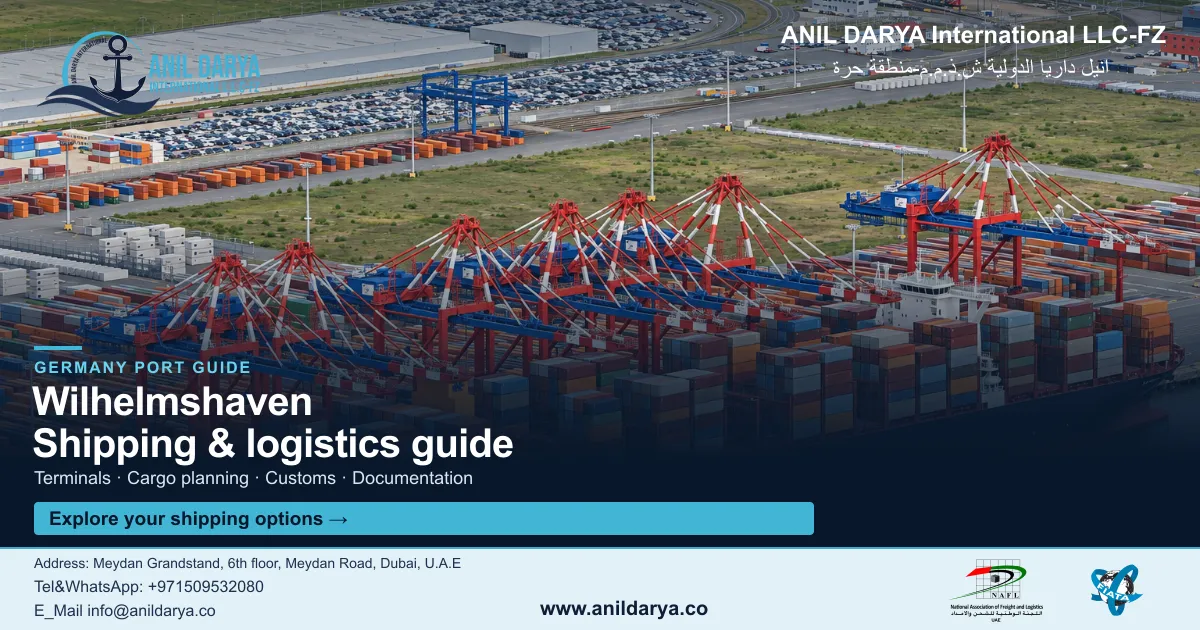
Port of Wilhelmshaven shipping means, for container cargo, one terminal: the EUROGATE Container Terminal Wilhelmshaven at JadeWeserPort, Germany's only deep-water container port. It has 18 m of water, so the biggest ships can call at any tide, and it handled about 1.47 million TEU in 2025. This guide covers the terminal, the ships and services that call, rail links inland, the customs points specific to Wilhelmshaven, and how we move cargo there from Dubai. We ship both from Dubai to Wilhelmshaven and from Wilhelmshaven to Dubai.
Port of Wilhelmshaven shipping: key facts at a glance
| Item | Detail |
|---|---|
| Location | Jade Bight, North Sea coast of Lower Saxony, about 120 km west of Hamburg |
| UN/LOCODE | DEWVN |
| Container terminal | EUROGATE Container Terminal Wilhelmshaven (CTW) at JadeWeserPort |
| Terminal shareholders | EUROGATE, with Hapag-Lloyd holding 30% of CTW and 50% of the rail terminal (RTW) |
| Port infrastructure owner | JadeWeserPort Realisierungs company, owned 50.1% by Lower Saxony and 49.9% by Bremen |
| Water depth | 18 m, tide-independent |
| Container quay | 1,725 m, four berths |
| Design ship | 430 m long, 16.5 m draught, at any tide |
| Design capacity | 2.7 million TEU a year |
| Containers handled in 2025 | About 1.47 million TEU, up 74% |
| Whole port, all cargo, 2025 | 38.3 million tonnes, up 8% |
| Terminal area | 130 ha (container terminal with quay and rail terminal) |
| Freight village (GVZ) | About 150 ha, with a customs and border checkpoint on site |
| Rail | 16 storage tracks for block trains, 6-track intermodal terminal with 3 gantry cranes |
| Customs office | Zollamt Wilhelmshaven, code DE005310 |
| Terminal opened | 21 September 2012 |
| Wilhelmshaven to Dubai | Also handled: ATLAS export filing by the shipper or its agent, UAE clearance at Jebel Ali, Khalifa Port or Sharjah by us |
Where is Wilhelmshaven and why do carriers use it?
Wilhelmshaven sits on the Jade Bight in Lower Saxony, on Germany's North Sea coast. Findaport puts it about 120 km west of Hamburg, with Bremen airport 102 km away. Unlike Hamburg, which ships reach up the Elbe, and Bremerhaven, which is on the Weser estuary, the JadeWeserPort quay faces deep water close to the open sea.
That depth is the reason the port exists. The terminal has 18 m of water, and Wikipedia's entry on JadeWeserPort says ships 430 m long with a 16.5 m draught can call at any tide. Seaports of Niedersachsen describes the terminal as working ships tide-independently and around the clock. For a carrier with a fully loaded mega-ship, that removes tide windows and draught limits from the plan.
The port of Wilhelmshaven is more than containers. Niedersachsen Ports, which runs the wider port, lists bulk cargo, refrigerated cargo, food, general cargo and project shipments, and the port has long handled crude oil, petroleum products, coal and chemicals. Germany's first LNG terminal opened there at the end of 2022. In 2025 the whole port handled 38.3 million tonnes, the largest volume of Lower Saxony's nine seaports.
The port has an outer deep-water port and an inner port behind a sea lock. Container ships use the outer port at JadeWeserPort.
The JadeWeserPort container terminal in numbers
JadeWeserPort has one container terminal. It was built on reclaimed land between 2008 and 2012 and opened officially on 21 September 2012. EUROGATE won the contract to run it in April 2006.
| Feature | Figure | What it means for your cargo |
|---|---|---|
| Quay length | 1,725 m | Room for several large ships at once |
| Berths | 4 | Main-line ships and feeders work side by side |
| Water depth | 18 m | No tide window for deep-draught ships |
| Largest ships | More than 24,000 TEU (per the Oldenburg Chamber of Commerce) | The biggest Asia-Europe ships can call fully laden |
| Annual design capacity | 2.7 million TEU | Volume in 2025 was a little over half of this |
| Throughput 2025 | About 1.47 million TEU | A record year, up 74% on 2024 |
| Container terminal area | 130 ha | Includes the quay and the rail terminal |
| Total JadeWeserPort site | 360 ha | Terminal, infrastructure and logistics land |
The terminal passed one million TEU in a calendar year for the first time on 18 September 2025. That box arrived on Hapag-Lloyd's NE1 service. Container gates work Monday to Friday, 06:00 to 22:00, according to Celna24's port page, with shorter hours before public holidays. Plan truck pick-ups inside those hours.
Ownership explains a lot about the services. Hapag-Lloyd holds 30% of the container terminal and 50% of the rail terminal behind it, and a carrier that part-owns a terminal tends to put its main ships there.
Which shipping services call at Wilhelmshaven?
JadeWeserPort says eight shipping companies have included the terminal in their regular schedules. Its liner list splits into deep-sea services and feeders.
| Type | Carrier and service as listed by JadeWeserPort |
|---|---|
| Europe to Asia and other deep-sea trades | Hapag-Lloyd NE1, FE2, IOS and EMX; CMA CGM FAL5; OOCL LL1; COSCO AEU1; HMM FE2; KAWA CEX; Maersk AE2 and ME1 |
| Feeders to Scandinavia | Unifeeder G15 (Fredericia, Aarhus) and G16 (Oslo, Gothenburg); CMA CGM services to Oslo, Gothenburg, Copenhagen, Helsingborg, Halmstad, Aarhus and Fredericia |
| Feeders to the Baltic and Finland | Unifeeder (Kotka, Gdansk, Riga); Maersk L35 (Gdansk, Tallinn, Gavle, Norrkoping); CMA CGM Baltic shuttle (Rauma, Tallinn) |
Two things stand out. First, Wilhelmshaven is one of three North European hubs of the Gemini Cooperation between Maersk and Hapag-Lloyd, and the first European call of the NE1 loop. Second, the Maersk ME1 entry on the terminal's list links to a Middle East, India and Europe route. That is the type of service a Gulf shipper should ask about.
Carrier rotations change often. For a shipment from Jebel Ali, ask whether your booking runs on a service that calls Wilhelmshaven directly, or loads at Jebel Ali and relays at a hub port onto a ship that calls Wilhelmshaven. The answer changes the transit time and the risk of a missed connection.
[AMIR-FACT: our real port-to-port transit time from Jebel Ali to Wilhelmshaven, whether it is direct or via a hub, and the carriers we normally book on this lane]
What cargo can you ship through the port of Wilhelmshaven?
| Cargo type | Where it goes | What to plan |
|---|---|---|
| General goods in containers (FCL) | EUROGATE CTW at JadeWeserPort | Carrier service that calls Wilhelmshaven, onward rail or truck |
| LCL cargo | Usually through a consolidator's warehouse, often in Hamburg or Bremen | Check where the box is unpacked, not just where the ship lands |
| Fruit and chilled food | Reefer boxes via CTW; a Nordfrost fruit and reefer terminal opened at the port in July 2012 | Health certificates, set temperature, border checks |
| Machinery, steel and project pieces | Flat racks via CTW, or general cargo berths in the wider port | Drawings, weights, lifting points |
| Dangerous goods in containers | CTW under the IMDG Code and Lower Saxony's port rules | Carrier acceptance, DG declaration, port notice |
| Liquid and dry bulk | Oil, LNG and bulk terminals of the wider port | Not a container lane; separate charter planning |
FCL and LCL shipping from Dubai to Wilhelmshaven
Most Gulf cargo for Wilhelmshaven moves as FCL. You book a 20ft or 40ft box with a carrier whose service calls the terminal, and the box is released at CTW. Wilhelmshaven suits FCL cargo for consignees in northern Germany, or cargo going on by rail to southern Germany, Austria, the Czech Republic or Hungary.
LCL works differently. Groupage boxes are unpacked at a consolidator's warehouse, and the warehouse location matters more than the port of arrival. If your LCL quote names Wilhelmshaven, ask where the container freight station is and how your cargo gets from it to your consignee.
A simple decision rule: if your shipment fills most of a 20ft box, compare an FCL price with LCL before you book. FCL often wins on cost and on handling once the volume is high enough. Our guide to FCL vs LCL costs shows how to work it out, and our sea freight service covers both.
Rail and road: getting cargo out of Wilhelmshaven
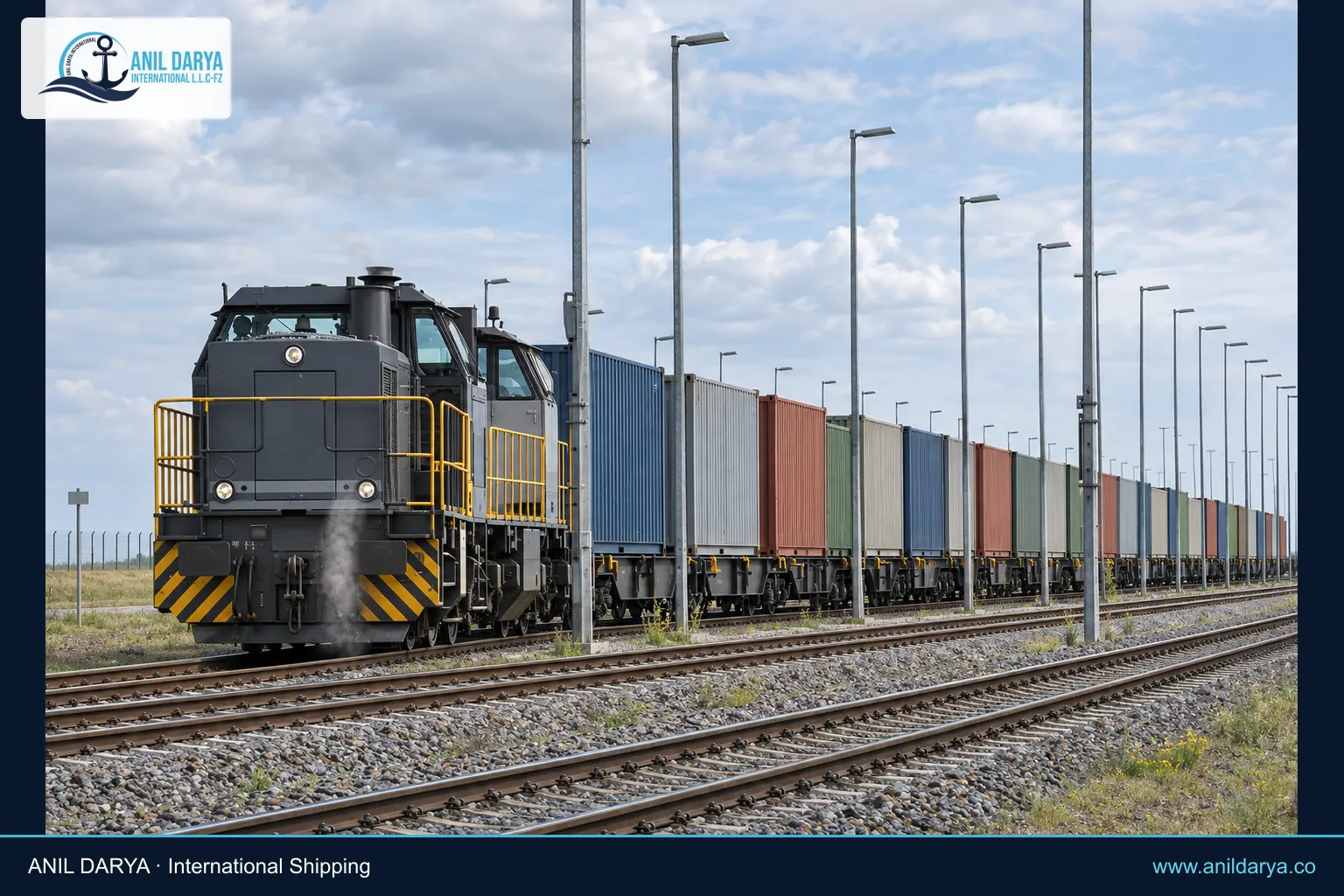
Wilhelmshaven's position on the coast means almost every box leaves by rail or truck. The rail side is well built for that.
- The port railway has 16 storage tracks suitable for block trains and a 6-track intermodal terminal with 3 gantry cranes.
- JadeWeserPort says the rail network reaches all major economic centres in Germany, Switzerland and Austria.
- Listed destinations abroad include Wolfurt, Graz, Vienna and Enns in Austria, Piacenza and Verona in Italy, and Melnik, Prague, Brno, Bratislava and Budapest in Central Europe.
- Frequencies run from once to several times a week, depending on the destination and operator.
Celna24's port page puts rail to Poland at about 2 to 3 days, and the road distance to Warsaw at about 850 km. By road, the A29 motorway runs directly to the port.
Decision rule for the inland leg: for consignees in Lower Saxony, Bremen or the Ruhr, a truck from Wilhelmshaven is usually simplest. For Bavaria, Austria, the Czech Republic or Hungary, ask for a rail option first. Rail can also move the container under customs transit, so duty and VAT are paid closer to the consignee.
The Wilhelmshaven freight village
Behind the terminal is a freight village (GVZ) of about 150 ha. It offers trimodal connections, rail sidings for half of the plots, 24/7 operation, a truck service centre with power points for reefer trucks, and a customs and border checkpoint on site. It suits importers who want to store or repack near the quay.
Breakbulk and project cargo at Wilhelmshaven
Containers are the focus at JadeWeserPort, but Niedersachsen Ports lists project shipments and general cargo among the port's cargo, and the freight village mentions heavy-duty areas at the Project Pier. Out-of-gauge pieces that fit a flat rack or open top travel on the container service like any other box. Pieces too large for a flat rack need a conventional breakbulk or heavy-lift ship, and for that cargo the choice of German port depends on which ships sail on your lane.
When you ship project cargo with us, we plan it in this order:
- Collect drawings, dimensions, weights and centre of gravity for every piece.
- Check whether each piece fits a 40ft flat rack by size and weight.
- If it fits, book it on a container service that calls Wilhelmshaven. If not, look for breakbulk or heavy-lift sailings and compare German ports.
- Agree lashing and lifting with the carrier and the terminal before loading at Jebel Ali.
- Line up the consignee's road permits in Germany before the ship arrives.
Read how we handle oversized pieces in our guide to flat rack, open top and out-of-gauge cargo, or see our break bulk and project cargo service.
Dangerous goods to the port of Wilhelmshaven
Dangerous goods move through Wilhelmshaven under three layers of rules: the IMDG Code at sea, Germany's sea dangerous goods ordinance (GGVSee), and Lower Saxony's port regulation (Niedersächsische Hafenordnung, NHafenO). The NHafenO defines dangerous goods by reference to the GGVSee and ties port reports to Germany's central maritime reporting portal. JadeWeserPort's own port use rules also have a section on reporting dangerous goods.
In practice the carrier files the DG data for the ship, but it relies on what you give it. Before you book DG cargo from Dubai to Wilhelmshaven, have these ready:
- UN number, proper shipping name, class and packing group for every product.
- A Safety Data Sheet for each product.
- A signed Dangerous Goods Declaration and a container packing certificate.
- UN-approved packaging, labels on packages and placards on the container.
- Carrier acceptance for the class on the specific service, including any transshipment port.
Some classes are accepted at Jebel Ali but not by every carrier or every hub on the way. Get acceptance for the whole route, not just the first leg. Our dangerous goods shipping team checks this before you commit to a sailing, and our guide to IMDG segregation in containers explains how classes are separated.
Customs at the port of Wilhelmshaven: what is specific to this port
Germany's import rules are the same at every port, and our Hamburg guide covers them in full. Here is the short version, then what is different at Wilhelmshaven.
The short customs summary
| Rule | What it means for a Dubai shipment |
|---|---|
| Entry summary declaration (ENS, ICS2) | For containers, filed at least 24 hours before loading at the port of departure. For bulk and breakbulk, at least 4 hours before arrival at the first EU port. ICS2 has been live for sea cargo since 3 June 2024. |
| EORI number | The German consignee quotes its EORI number on the import declaration. A UAE exporter does not need one unless it acts as declarant or carrier. |
| Customs duty | Set by the EU tariff (TARIC) for your HS code and origin |
| Import VAT | 19% standard, 7% for some goods such as food and books, charged on the customs value plus duty |
Zollamt Wilhelmshaven
Cargo landed at JadeWeserPort is cleared through Zollamt Wilhelmshaven, office code DE005310, at Flutstraße 86a. It works as the office for release into free circulation, supervision and transit. Put this code on transit documents if the box will move inland under customs control and be cleared elsewhere. A separate office, Zollamt Wilhelmshaven Dienstort Ozean-Pier (DE005311), reports to the same parent office, Hauptzollamt Oldenburg, but it is not a general clearance office for goods.
Clear at the port or inland?
You have two choices for a Wilhelmshaven import.
- Clear at Wilhelmshaven. Best if the consignee is nearby or wants the goods in free circulation straight away.
- Move under transit and clear inland. Best if the box goes by rail to a consignee far from the coast, or to Austria or another EU country. The duty and VAT are then paid where the box is cleared.

Documents for a Wilhelmshaven import
| Cargo | Core documents | Usually also needed |
|---|---|---|
| General FCL cargo | Commercial invoice, packing list, bill of lading | Certificate of origin if a preference or check needs it |
| Food and reefer cargo | Core set | Health certificates from origin, temperature records |
| Dangerous goods | Core set | DG declaration, SDS, carrier acceptance |
| Project cargo | Core set with piece-by-piece packing list | Drawings, lifting plan, road permits in Germany |
How to ship to the port of Wilhelmshaven from Dubai: step by step
This is how we handle a typical FCL export from the UAE to Wilhelmshaven. We book space and handle the UAE side. A German clearing agent, usually chosen by the consignee, handles clearance at Wilhelmshaven.
- Send us the cargo details. Commodity, HS code, weight, volume or dimensions, the consignee's town and the Incoterm you agreed.
- We check the routing. We look for services that discharge at Wilhelmshaven, direct or via a hub, and compare them with Hamburg or Bremerhaven for your final destination.
- Book space. For DG, reefer or out-of-gauge cargo we get carrier acceptance first.
- Pick up and stuff the container. We arrange the empty box, trucking from your site or warehouse and the seal.
- Export clearance in the UAE. We file the export or re-export declaration with Dubai Customs and deliver the box to Jebel Ali before the cut-off. See our Jebel Ali port shipping guide for how that side works.
- Send the data for the ENS. Correct shipper, consignee, goods description and HS codes, so the carrier can file before loading.
- Release the bill of lading. We check the draft and release the original or telex release as your payment terms require.
- Pre-clear in Germany. The consignee's agent prepares the import or transit declaration for Zollamt Wilhelmshaven before arrival.
- Delivery. The box leaves CTW by truck or train to the consignee, and the empty goes back to the carrier's depot.
How to ship from the port of Wilhelmshaven to Dubai
We also handle the other direction: shipping from Wilhelmshaven to Dubai, with arrival at Jebel Ali, Khalifa Port or Sharjah port. We book the space with the carrier and run the UAE side. The export papers at origin stay with the shipper or its German customs agent.
The German export side
- The export declaration is filed electronically in ATLAS-Ausfuhr, the German customs export system. German customs says the duty to file electronically applies whatever the transport mode, and the declaration can also be sent over the internet.
- Who files. Under EU rules, the exporter or its declarant lodges it at the customs office responsible for where the exporter is established.
- EORI. The European Commission says an EORI number is mandatory for all customs operations, export included.
- Exit. The goods are presented at the customs office of exit, which checks them against the declaration and supervises their departure from the EU.
- Restrictions. German customs groups export restrictions by country, person and goods, so the shipper's agent checks them before booking.
The UAE import side
On arrival, the declaration goes to Dubai Customs with the commercial invoice, packing list, certificate of origin and any permit for restricted goods. The bill of lading is what the line needs before it issues the delivery order. Customs duty in Dubai is 5% of the CIF value for most goods, with 50% on alcohol and 100% on cigarettes. Import VAT is 5% of the customs value, which includes freight and insurance. A VAT-registered importer whose customs number is linked with the Federal Tax Authority accounts for that VAT on its VAT return instead of paying it at release.
- Send us the shipper's details in Germany, the cargo, the HS code and the UAE delivery address.
- We book space on a service loading at the EUROGATE terminal and send the booking and cut-offs to the shipper.
- The shipper or its trucker, or a rail operator, delivers the box to CTW before the cut-off.
- The shipper or its German customs agent files the export declaration in ATLAS.
- We check the draft bill of lading against the invoice and packing list before the carrier issues it.
- We file the Dubai Customs declaration before the ship arrives.
- We arrange payment of the duty and VAT, or the VAT deferral if you are VAT-registered, and collect the delivery order from the line.
- We truck the cargo to your site in the UAE and return the empty inside free time.
[AMIR-FACT: the carriers and hub we actually use from Wilhelmshaven to Jebel Ali, Khalifa Port or Sharjah, and our real port-to-port transit days in this direction]
Wilhelmshaven, Hamburg or Bremerhaven: which port fits your cargo?
For Dubai shippers, the port is usually chosen by the carrier's service. You still have a say, because the same carrier can often discharge at more than one German port.
| Your situation | Port to look at first | Why |
|---|---|---|
| FCL on a Gemini carrier, consignee in Germany or Central Europe by rail | Wilhelmshaven | Gemini hub, deep water, rail to Austria, Czech Republic and Hungary |
| Consignee in or near Hamburg, or LCL | Hamburg | More consolidators and short delivery |
| Your carrier discharges your service only at Bremerhaven | Bremerhaven | Compare the inland leg from there with Wilhelmshaven |
Checklist before you ship to Wilhelmshaven
- Carrier service confirmed to discharge at Wilhelmshaven (DEWVN), and whether it is direct or via a hub.
- HS code checked in TARIC, with the duty rate and any licence or certificate it triggers.
- Consignee's EORI number and German clearing agent confirmed.
- Choice made: clear at Zollamt Wilhelmshaven or move inland under transit.
- Invoice, packing list and bill of lading show the same weights, piece counts and consignee.
- Goods description precise enough for the ENS (no "general cargo" or "spare parts" alone).
- Onward rail or truck booked, with pick-up inside terminal gate hours.
- For DG: SDS, DG declaration, packaging and labels, and carrier acceptance for every leg.
- For reefer: set temperature, ventilation and the importer's health certificates.
- Free time on the container agreed with the carrier, at both ends.
Common mistakes on Wilhelmshaven shipments
- Assuming every Asia or Gulf service calls Wilhelmshaven. Many call only Hamburg, Bremerhaven or Rotterdam. Confirm the port of discharge on the booking.
- Booking LCL "to Wilhelmshaven" without asking where the box is unpacked. The warehouse location decides your delivery cost.
- Vague goods descriptions. ICS2 can hold a container at loading if the ENS data is not specific enough.
- Clearing at the port when the cargo goes to Austria or the Czech Republic. A transit move is often simpler.
- Not booking onward rail early. Rail slots to some destinations run only once or twice a week.
- Getting DG acceptance for the first leg only. A transshipment hub can refuse a class the first carrier accepted.
- Letting free time run out while documents are fixed. Read our guide to demurrage and detention charges to see how quickly the costs add up.
Frequently asked questions
What is the port code for Wilhelmshaven?
The UN/LOCODE for Wilhelmshaven is DEWVN. You will see it on bookings, bills of lading and tracking systems for cargo to the JadeWeserPort container terminal.
Is JadeWeserPort the same as the port of Wilhelmshaven?
JadeWeserPort is the deep-water container port within the port of Wilhelmshaven. The wider port also has oil, LNG, bulk and general cargo facilities and an inner harbour behind a sea lock.
How deep is the water at Wilhelmshaven?
The JadeWeserPort container terminal has 18 m of water. Ships up to 430 m long with a 16.5 m draught can call at any tide, which makes it Germany's only deep-water container port.
Who operates the container terminal in Wilhelmshaven?
EUROGATE operates Container Terminal Wilhelmshaven. Hapag-Lloyd owns 30% of the container terminal and 50% of the rail terminal, while the port infrastructure belongs to a company owned by Lower Saxony and Bremen.
How many containers does Wilhelmshaven handle?
The terminal handled about 1.47 million TEU in 2025, a record and 74% more than in 2024. Its design capacity is 2.7 million TEU a year.
Is there a direct ship from Dubai to Wilhelmshaven?
It depends on the carrier and the month. The terminal's liner list includes Middle East and Indian Ocean services, but rotations change, so confirm on each booking whether your box loads at Jebel Ali on a ship that calls Wilhelmshaven or relays at a hub.
Can you ship from Wilhelmshaven to Dubai?
Yes. The shipper or its German customs agent files the export declaration in ATLAS. We book the space, clear the cargo with Dubai Customs and arrange payment of the 5% duty on most goods and the 5% import VAT.
Which customs office clears cargo at Wilhelmshaven?
Zollamt Wilhelmshaven, office code DE005310, handles release for free circulation and transit for the port. The consignee's clearing agent files the declaration in Germany's ATLAS system.
What import VAT applies to cargo landed at Wilhelmshaven?
German import VAT is 19% for most goods and 7% for some goods such as food and books. It is charged on the customs value plus customs duty.
Get a quote for port of Wilhelmshaven shipping
Send us your cargo details and the consignee's town, and we will come back with a routing and a price for shipping from Dubai to Wilhelmshaven, with Hamburg or Bremerhaven compared where it helps. Use our freight rate inquiry form, or contact our team to talk through a DG, reefer or project shipment first.
Sources
- Niedersachsen Ports: Wilhelmshaven, Germany's deep water port (layout, cargo types, LNG terminal)
- Seaports of Niedersachsen: Seaport Wilhelmshaven (tide-independent 24/7 operation)
- Oldenburg Chamber of Commerce (IHK): JadeWeserPort in Wilhelmshaven (quay, depth, areas, capacity, 2025 volume, shareholdings, Gemini hub)
- JadeWeserPort: Liner services
- JadeWeserPort: Port railway (tracks, intermodal terminal, destinations, operators)
- JadeWeserPort: Freight village (area, rail sidings, customs checkpoint)
- JadeWeserPort: History (EUROGATE contract, opening)
- JadeWeserPort: CTW handles over 1 million TEU in a year for the first time (September 2025)
- Transport Online: Niedersachsen sea ports 2025 results (24 March 2026)
- Ship Technology: JadeWeserPort, Wilhelmshaven (quay, berths, area, ownership)
- Wikipedia: JadeWeserPort (design ship, opening date, Nordfrost terminal, rail electrification)
- Findaport: Port of Wilhelmshaven (location, lock dimensions, airports)
- MarineLink: Wilhelmshaven port profile (UN/LOCODE)
- Celna24: Port of Wilhelmshaven customs information (office code, terminal hours, rail to Poland)
- Zollamt Wilhelmshaven Dienstort Ozean-Pier DE005311: office details
- Niedersächsische Hafenordnung (NHafenO): definitions and reference to GGVSee
- German customs (Zoll): Deadlines for the entry summary declaration
- German customs (Zoll): Using the EORI number
- German customs (Zoll): Import VAT rates and basis
- European Commission: ICS2 live for maritime transport
- European Commission: EU Customs Tariff (TARIC)
- German Customs: The IT procedure ATLAS-Ausfuhr (electronic export declaration)
- German Customs: Export (export restrictions by country, person and goods)
- European Commission: What is exportation? (office of export and exit)
- European Commission: EORI number (mandatory for export)
- Dubai Customs: Submit customs declaration (documents for import, export and re-export declarations)
- UAE Government portal: Customs duty (5% of CIF in Dubai, alcohol 50%, cigarettes 100%)
- Federal Tax Authority: VAT guide, section 3.5 (5% import VAT, customs value, deferral to the VAT return)
Reviewed: 10 November 2026