
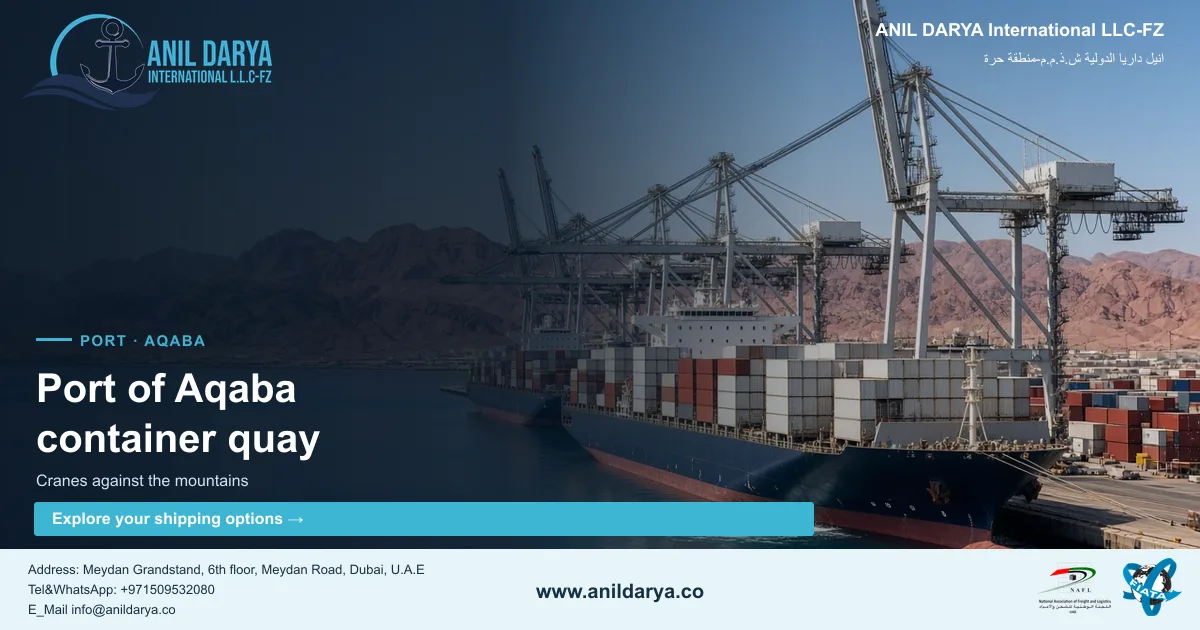
Aqaba port shipping covers almost all sea cargo into and out of Jordan, because the Port of Aqaba is the country's only seaport. Containers go through Aqaba Container Terminal (ACT), run by APM Terminals with the Aqaba Development Corporation (ADC), while bulk, general cargo, oil and gas use other terminals in the same port area. This guide covers the terminals, the port rules for breakbulk and dangerous goods, Jordanian customs and how we ship your cargo from Dubai to Aqaba. We ship both from Dubai to Aqaba and from Aqaba to Dubai.
Aqaba port guide: key facts at a glance
| Item | Detail |
|---|---|
| Owner | Aqaba Development Corporation (ADC), owner of Aqaba's 12 ports and King Hussein International Airport |
| Zone authority | Aqaba Special Economic Zone Authority (ASEZA) |
| Container terminal | Aqaba Container Terminal (ACT), operated by APM Terminals |
| UN/LOCODE | JOAQJ |
| Location | Head of the Gulf of Aqaba, about 285 km south-southwest of Amman |
| Berths across the port | More than 32, in 12 specialised ports |
| ACT berth length | 1,000 m: 3 container berths and 1 Ro-Ro berth |
| ACT depth | 14 to 16.5 m at berth, channel up to 24 m |
| ACT yard | 500,000 m2 terminal area, 800 reefer plugs |
| ACT volume | 472,680 TEU in the first half of 2026; 107,803 TEU across 53 vessels in September 2026 |
| ACT storage free days | Import 6, export 7, dangerous goods 3; none for breakbulk |
| Customs system | Jordan Customs, ASYCUDA World |
| Product conformity | JSMO Southern Region Branch at the Aqaba customs centre |
| Sales tax on imports into Jordan | 16% general rate (some goods 4% or zero) |
| Aqaba Special Economic Zone | Imports exempt from customs duty (vehicles excluded); 7% sales tax only on 12 goods and some services |
| Aqaba to Dubai | Export declared by the shipper or its agent in ASYCUDA World; CEPA origin certificate for the preferential UAE rate |
Who owns and runs the Port of Aqaba?
ADC was set up in 2004 by the Government of Jordan and ASEZA. It owns the Port of Aqaba, its 12 ports and the airport, and brings in private operators under long-term contracts. The Aqaba Special Economic Zone covers 375 square kilometres and all 27 km of Jordan's coastline.
| Operator | Contract type with ADC |
|---|---|
| Aqaba Container Terminal Company | Private sector partnership (APM Terminals holds 50% plus one share) |
| Aqaba Ports Management and Operating Company | Operate and management contract |
| Jordan Industrial Ports Company | Build, operate and transfer |
| Jordan Phosphate Mines Company, phosphate export port | Operate and management contract |
| National Electric Power Company, Sheikh Sabah Port | Operate and management contract |
| Aqaba Marine Services Company | Private sector partnership (pilotage, towage, marine services) |
| Cruise Ship Terminal | Build, operate and transfer |
Pilotage is compulsory for vessels over 50 net registered tonnes, tugs are compulsory for every berthing, and the port has seven tugs from 2,000 to 6,770 hp. These are your carrier's concern, but they explain why berthing windows at Aqaba are planned well ahead.
Which terminals make up Aqaba port?
The port is spread along the coast in several areas. Where your cargo goes depends on what it is.
| Terminal or area | Main cargo | Key facts |
|---|---|---|
| Aqaba Container Terminal (ACT) | FCL and LCL containers, reefers, out-of-gauge, some breakbulk, Ro-Ro | 1,000 m of berths, 14 to 16.5 m depth |
| Main port in the south (Al Durra area) | General cargo, grain, iron, wood, marble, bulk coal, sulphur, Ro-Ro cars | 9 berths, 2,058 m, draft about 12 to 14 m |
| Middle Port | Cement, livestock, rice, Ro-Ro and passenger vessels | Listed as a separate port area |
| Southern Industrial Port | Bulk, chemicals, fertiliser, potash, salt, sulphur, timber | Industrial cargo terminal |
| Oil port | Crude oil, petroleum products, chemicals, mineral oils | Built in 1985, upgraded for imports in 1996 |
| Gas dock | Liquefied petroleum gas | Operating since 1 March 2015 |
Aqaba Container Terminal in detail
ACT has run under a 25-year build-operate-transfer agreement since 2006. Its equipment, as listed by APM Terminals:
| Equipment | Units | Capacity |
|---|---|---|
| Ship-to-shore cranes | 7 | 63 m outreach, 100 t under hook |
| Rubber-tyred gantry cranes | 22 | 50 t |
| Reach stackers | 9 | 45 t, 5 high |
| Empty handlers | 12 | 10 t, 7 high |
| Terminal trucks | 46 | 34 t on the fifth wheel |
In the first half of 2026 ACT handled eight vessels carrying more than 5,000 TEU each, and one call of 10,884 TEU. More than 20 lines call the terminal, including Maersk, MSC, CMA CGM, Hapag-Lloyd, COSCO, ONE, Evergreen, Emirates Shipping Line, Global Feeder Shipping and X-Press Feeders.
What cargo can you ship through Aqaba port?
| Cargo type | How it moves | What to plan |
|---|---|---|
| General goods | FCL or LCL through ACT | Importer, tax number, documents, JSMO status |
| Chilled and frozen food | Reefer containers on ACT's 800 plugs | Set temperature, health certificates, JFDA approval |
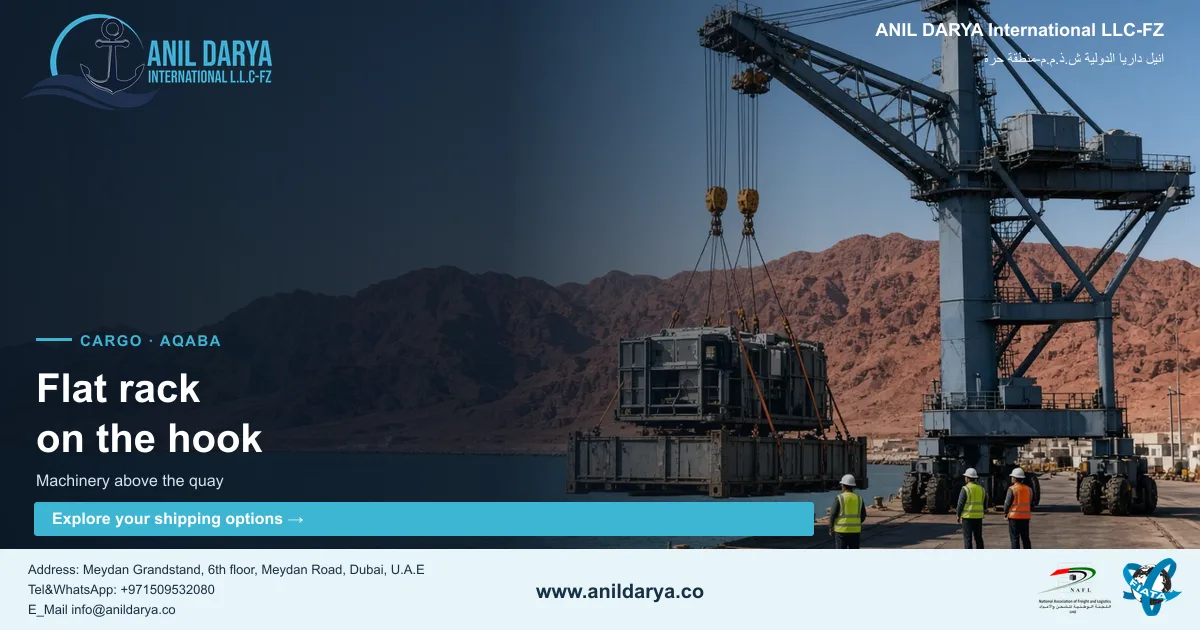
| Machinery and steel | Flat racks, open tops or breakbulk | ACT approval, lifting points, trucks ready on discharge |
| Vehicles and rolling cargo | Ro-Ro or containers | Daily storage charge at ACT from day one |
| Chemicals and other DG | IMDG containers | Approvals, 3 free days, possible direct delivery |
| Grain and dry bulk | Bulk berths in the main port | Discharge plan, trucks or storage |
| Oil and gas | Oil port and gas dock | Receiver's facilities |
FCL and LCL shipping to Aqaba port
ACT delivers and receives both FCL and LCL containers. Its listed services include berthing, loading and discharge, stacking, reefer temperature checks, container condition checks, storage, weighing of containers and trucks, and stuffing and unstuffing.
- FCL (full container load) suits larger shipments and goods you want sealed from origin to door.
- LCL (less than container load) suits a few pallets. The shared box is unpacked first, so your release also depends on the consolidator's papers.
Our guide to FCL vs LCL costs shows where full containers start to pay. For reefers, give us the set temperature at booking, and line up JFDA and health certificates before the box sails.
Breakbulk and out-of-gauge cargo at Aqaba
ACT separates two kinds of oversized cargo:
- Out-of-gauge (OOG): cargo wider, taller or longer than the flat rack or open top, but still moved in a container, such as propellers, flanges or trucks.
- Breakbulk: cargo well beyond a container's size or weight, handled as non-unitised cargo on a bed of flat racks, such as yachts, masts or industrial machines.
Every OOG or breakbulk job needs approval from ACT's breakbulk and OOG team before the vessel arrives, and ACT publishes a price calculator for estimates. Storage is where costs build up. ACT's 2025 tariff gives breakbulk no free days: storage is charged per cubic metre from the day of discharge. Over-dimensional containers pay double the normal full-container storage rate.
The rule that follows: book trucks and permits for the inland move before the ship berths. Our guide to flat racks, open tops and breakbulk helps you pick the equipment, and our break bulk and project cargo team plans lifting and lashing from Dubai.
Dangerous goods at Aqaba: what the port rules say
Aqaba accepts IMDG cargo, with these local rules on top of the code:
| Rule | What it means for you | Source |
|---|---|---|
| Vessels carrying IMO 1.1 explosives, ammonium nitrate, radioactive materials or potassium chloride may not berth alongside | Check with the line before booking these cargoes | Port marine services rules |
| DG containers get 3 free storage days at ACT, then a daily DG storage charge | Clear before arrival | ACT tariff 2025 |
| Some IMO cargo is approved only after port confirmation, with direct delivery from the quay | If direct delivery does not happen, charges fall on the customer | Maersk Jordan import rules |
| Gas lighters and fireworks | Accepted only under special approvals the consignee gets from the authorities | Maersk Jordan import rules |
| Calcium nitrate (UN 1454, Class 5.1) | Import licence and Ministry of Environment approval needed | Maersk Jordan import rules |
| The agent gets prior approval from several Aqaba authorities and gives about 10 days' notice per IMO shipment | Send DG details well before sailing from Dubai | ShipNext port notes |
| Transshipment or shifting of IMO containers is prohibited at Aqaba | Book DG with Aqaba as final discharge, not as a hub | ShipNext port notes |
For any DG booking you need the UN number, proper shipping name, class and packing group, an SDS, a signed DG declaration, UN packaging with labels and placards, and the consignee's Jordanian approvals. Our guide to dangerous goods classes explains the classes, and our dangerous goods shipping team checks carrier acceptance before you commit.
Customs clearance at Aqaba: documents, JSMO and tax
Jordan Customs clears cargo at Aqaba through its Aqaba customs office and an ASEZA customs office, both on the national single window. Declarations are filed on ASYCUDA World by a licensed clearing agent in Jordan for a registered importer. Importers hold an importer's card or pay a customs bond equal to 5% of the goods' value.
What must the bill of lading show?
Maersk's Jordan rules set the standard most lines follow:
- Consignee and notify party with full address, phone, email and a valid 9-digit Jordanian tax number. Without it the container may be retained on board.
- Place of delivery naming Jordan, and any free zone (for example the Aqaba Special Economic Zone) written in the cargo description.
- Full manifest to customs 4 days before arrival; later changes need customs approval and fees.
- Originals surrendered in Jordan for "to order" bills.
Which documents does Aqaba customs need?
| Document | Notes |
|---|---|
| Commercial invoice | Importer supplies an Arabic translation |
| Packing list | Must match the invoice and bill of lading |
| Bill of lading and delivery order | Delivery order from the line once charges are paid |
| Certificate of origin | Needed for CEPA duty exemption; checked by JSMO |
| Clearing agent mandate, company registration | From the importer |
| Import licence or approval | For example telecoms and security equipment, some foods, DG approvals |
| Conformity lab result | If JSMO puts the shipment in its red lane |
How do lanes and JSMO checks work at Aqaba?
ASYCUDA routes each declaration to a lane: green (release), yellow (document and quantity check) or red (physical inspection, with lab samples where needed). Customs, JSMO and other agencies each set their own lane, and goods leave when all are green or against a guarantee. JSMO's Southern Region Branch controls imported goods through the Aqaba customs centre. For regulated products, it checks the certificate of origin, the invoice and the labels, and may send samples to an approved lab in Jordan. Goods that fail are re-exported or destroyed, with a retest possible within one month.
How much duty and tax do you pay at Aqaba?
UAE-origin goods that meet the rules of origin can enter duty-free under the UAE-Jordan CEPA, in force since 15 May 2025 and covering more than 98% of tariff lines. Goods made elsewhere pay Jordan's tariff for their HS code. Jordan's general sales tax of 16% applies on import, with 4% or zero on some goods.
What changes if the consignee is in the Aqaba Special Economic Zone?
ASEZA exempts all imports into the zone from customs duty, except vehicles. The general sales tax is not applied in the zone, apart from a 7% sales tax on 12 goods and on catering, hotel and tourist car services. Goods sold on from the zone into the rest of Jordan pay the duties and taxes due when they enter the customs area. Clearance runs through ASEZA's customs department, and ASEZA confirms that goods admitted to the zone still need standards and metrology approval, so JSMO rules still apply.
How to ship from Dubai to Aqaba: step by step
This is how we handle a typical container from the UAE to Aqaba. We book space, prepare documents and clear export in the UAE, and work with your clearing agent in Jordan.
- Send cargo details: commodity, HS code, weight, volume or dimensions, pickup point in the UAE, final destination in Jordan and the Incoterm.
- Confirm the importer, the 9-digit tax number and the clearing agent in Jordan.
- Check JSMO, JFDA and licence requirements, and start any approvals.
- Book space from Jebel Ali Port; for DG, reefer or OOG cargo we get carrier and ACT acceptance first.
- Check documents before sailing so names, weights and the tax number match the draft bill of lading.
- Clear export in the UAE and load the container.
- Before arrival, your agent prepares the ASYCUDA declaration and you pay line charges to get the delivery order.
- After clearance, the truck collects the container from ACT inside the storage free days, and the empty goes back within the line's free time.
[AMIR-FACT: the carriers or feeder services we actually use from Jebel Ali to Aqaba, direct or transshipped, and our typical port-to-port days]
How to ship from Aqaba to Dubai
We also handle the other direction: shipping from Aqaba to Dubai, with arrival at Jebel Ali, Khalifa Port or Sharjah port. We book the space and run the UAE side. The Jordanian export papers stay with the shipper or its Jordanian clearance agent.
The Jordan export side
- The shipper or its Jordanian clearance agent lodges the export declaration with Jordan Customs, which runs paperless clearance in ASYCUDA World.
- The UAE-Jordan CEPA has been in force since 15 May 2025 and covers more than 98% of tariff items, with about 2% exempted. Ask the shipper for a certificate of origin under the CEPA so the UAE declaration can claim the preferential rate.
- The shipper or its trucker delivers the box to Aqaba Container Terminal before the cut-off. Breakbulk goes to the berth the carrier names.
The UAE import side
On arrival, the declaration goes to Dubai Customs with the commercial invoice, the packing list, the certificate of origin and any permit for restricted goods. For sea cargo the GCC customs guide also lists the bill of lading and the delivery order. Customs duty in Dubai is 5% of the CIF value for most goods, with 50% on alcohol and 100% on cigarettes. Import VAT is 5%. A VAT-registered importer accounts for it on its VAT return, while an importer that is not registered pays it before Customs releases the goods.
- Send us the shipper's details in Jordan, the cargo, the HS code and the UAE delivery address.
- We book space and send the booking and cut-off to the shipper.
- The shipper or its trucker loads the container and delivers it to ACT.
- The shipper or its clearance agent files the Jordanian export declaration and gets the CEPA certificate of origin if the goods qualify.
- We check the draft bill of lading against the invoice and packing list.
- We file the UAE declaration before the vessel arrives.
- We arrange payment of the duty and VAT and collect the delivery order.
- We truck the cargo to your site and return the empty container inside free time.
[AMIR-FACT: the carriers we actually use from Aqaba to Jebel Ali, Khalifa or Sharjah and our real transit days in this direction]
Storage, free time and trucks at Aqaba
Two clocks run on every import container:
| Charge | Who sets it | Free days | Starts |
|---|---|---|---|
| Terminal storage (full container) | ACT, payable by consignee or clearing agent | 6 days import, 7 days export, 3 days DG | Import: day of discharge |
| Combined demurrage and detention | Shipping line (Maersk example) | 6 days dry; 3 days reefer, flat rack, open top and IMO | Day of discharge until the empty is returned |
Vehicles and rolling equipment at ACT pay a daily storage charge, and breakbulk pays from discharge with no free days. Our article on demurrage and detention shows how the line charges add up.
Trucks move through ASEZA's truck control and monitoring system, now run with Maqta Ayla Digital Solutions, which handles 3,500 to 4,000 trucks a day. ACT recorded 188,927 truck gate movements in the first half of 2026. ACT's online services let agents check import availability, issue electronic delivery order invoices and extend storage, so ask your agent to use them to avoid waiting at the gate.
[AMIR-FACT: typical number of days from vessel arrival at Aqaba to delivery in Amman on our recent shipments]
Checklist before you ship to Aqaba
- Registered Jordanian importer with importer's card or customs bond.
- 9-digit tax number and full addresses on the booking and bill of lading.
- HS code, duty, sales tax and CEPA origin checked.
- JSMO, JFDA and licence status confirmed, labels compliant.
- Free zone destination written in the cargo description, if any.
- For DG: SDS, DG declaration, packaging, carrier and port approvals.
- For OOG or breakbulk: ACT approval, drawings and trucks ready on discharge.
- Delivery planned inside ACT's free days and the line's free time.
Common mistakes at Aqaba port
- Missing tax number. The container can be kept on board, and Maersk charges USD 1,000 per 20ft or USD 1,500 per 40ft when the delivery order is not collected.
- Free zone named in the wrong field. ASEZA or other zones belong in the cargo description, not marks and numbers.
- Breakbulk without a truck plan. Storage starts the day it is discharged.
- DG left in the yard. Three free days go fast.
- Claiming CEPA on re-exports. Goods made outside the UAE pay Jordan's normal tariff.
- Late manifest changes. After the 4-day deadline, customs approval and fees apply.
Aqaba port or another route into Jordan?
| Your situation | Route | Why |
|---|---|---|
| Full containers, heavy or bulk cargo, DG by sea | Sea to Aqaba | Only seaport; container, bulk and breakbulk terminals |
| Consignee in the Aqaba Special Economic Zone | Sea to Aqaba | Imports exempt from customs duty except vehicles |
| Full truckload for Amman or the north | Road through Saudi Arabia to Al Omari | Door to door, no port handling |
| Urgent or small high-value cargo | Air to Amman or Aqaba | Fastest option |
We can price sea and road side by side so you compare the total cost to the door. Our sea freight service covers the container options from the UAE.
Frequently asked questions
Who operates Aqaba port?
The Aqaba Development Corporation owns the port and its 12 terminals and brings in operators. Aqaba Container Terminal is operated by APM Terminals, which holds 50% plus one share.
What is the port code for Aqaba?
The UN/LOCODE for the Port of Aqaba is JOAQJ. You will see it on bookings, bills of lading and tracking.
How deep is the water at Aqaba Container Terminal?
APM Terminals gives 14 to 16.5 m at berth and up to 24 m in the channel, over 1,000 m of berths with three container berths.
How many free storage days does ACT give?
Under ACT's 2025 tariff, full import containers get 6 free days, export containers 7, and dangerous goods containers 3. Breakbulk has no free days.
Can I ship dangerous goods to Aqaba?
Yes, with approvals. Some IMO cargo needs port confirmation and direct delivery, and gas lighters, fireworks and calcium nitrate need special approvals from the Jordanian authorities.
What documents do I need to clear cargo at Aqaba?
A commercial invoice with Arabic translation, packing list, bill of lading, certificate of origin, the clearing agent's mandate and any licence or JSMO result the goods need.
Is there duty on goods shipped from Dubai to Aqaba?
UAE-origin goods meeting the CEPA rules of origin can enter duty-free. Other goods pay Jordan's tariff, and 16% sales tax applies on import unless the goods are exempt.
Is the Aqaba Special Economic Zone duty-free?
Largely. ASEZA exempts imports into the zone from customs duty, except vehicles, and charges sales tax only at 7% on 12 goods and some services. Goods moved on into the rest of Jordan pay normal duty and tax. Put the zone name in the bill of lading cargo description.
How do I ship from Aqaba to Dubai?
The shipper or its Jordanian clearance agent files the export declaration and, where the goods qualify, provides a certificate of origin under the UAE-Jordan CEPA. We book the space, file the Dubai Customs declaration before arrival, arrange payment of any duty and the 5% import VAT, and deliver.
Get a quote for Aqaba port shipping
Send us your cargo details and we will come back with a routing and price from the UAE to Aqaba. Use our freight rate inquiry form, or contact our team to talk through a breakbulk, project or DG shipment first. You can also read more about our Dubai freight forwarding team.
Sources
- APM Terminals: Aqaba Container Terminal, our terminal (berths, depth, equipment, ownership)
- APM Terminals: Aqaba Container Terminal home (shipping lines calling, e-services)
- APM Terminals: ACT container services
- APM Terminals: ACT breakbulk and OOG
- APM Terminals: Aqaba marine services (pilotage, tugs, berthing restrictions)
- Aqaba Container Terminal: service charges 2025 (storage free days)
- APM Terminals: ACT performance in H1 2026
- APM Terminals: ACT September 2026 volume
- Aqaba Development Corporation: about us (ownership, 12 ports, zone size)
- Aqaba Development Corporation: subsidiaries and partnerships (port operators)
- Aqaba Development Corporation: transport and logistics (berths, ASYCUDA World)
- Aqaba Development Corporation: why invest in Aqaba (duty-free imports into the zone)
- ASEZA: investment incentives (customs duty, 7% sales tax; archived copy, January 2026)
- ASEZA: FAQ (ASEZA customs department, standards approval; archived copy, June 2026)
- ShipNext: Aqaba port data (IMO cargo notice and transshipment rules)
- Aqaba Development Corporation: Maqta Ayla truck control launch (June 2026)
- Logistics Cluster: Jordan Port of Aqaba (main port berths, oil port, gas dock)
- Findaport: Port of Aqaba (port areas, distance to Amman)
- Wikipedia: Port of Aqaba (UN/LOCODE)
- Maersk: Jordan import information (bill of lading rules, free time, DG approvals)
- US International Trade Administration: Jordan import requirements and documentation
- International Trade Centre: Jordan import and export procedures guide (customs offices, lanes)
- Jordan Customs trade portal: obtaining the approval of JSMO (archived copy)
- JSMO: Southern Region Branch, Aqaba (archived copy)
- Income and Sales Tax Department: general sales tax guide
- UAE Ministry of Economy and Tourism: UAE-Jordan CEPA
- Dubai Customs: Submit customs declaration (import, export and re-export documents)
- Dubai Customs: FAQ (duty of 5% of CIF value, CIF definition)
- UAE Government portal: Clearing customs and paying customs duty
- Federal Tax Authority: VAT (5% rate)
- Federal Tax Authority: VAT guide (import VAT, reverse charge and payment before release)
- GCC Unified Guide for Customs Procedures at First Points of Entry (import and export documents)
Reviewed: 10 November 2026