
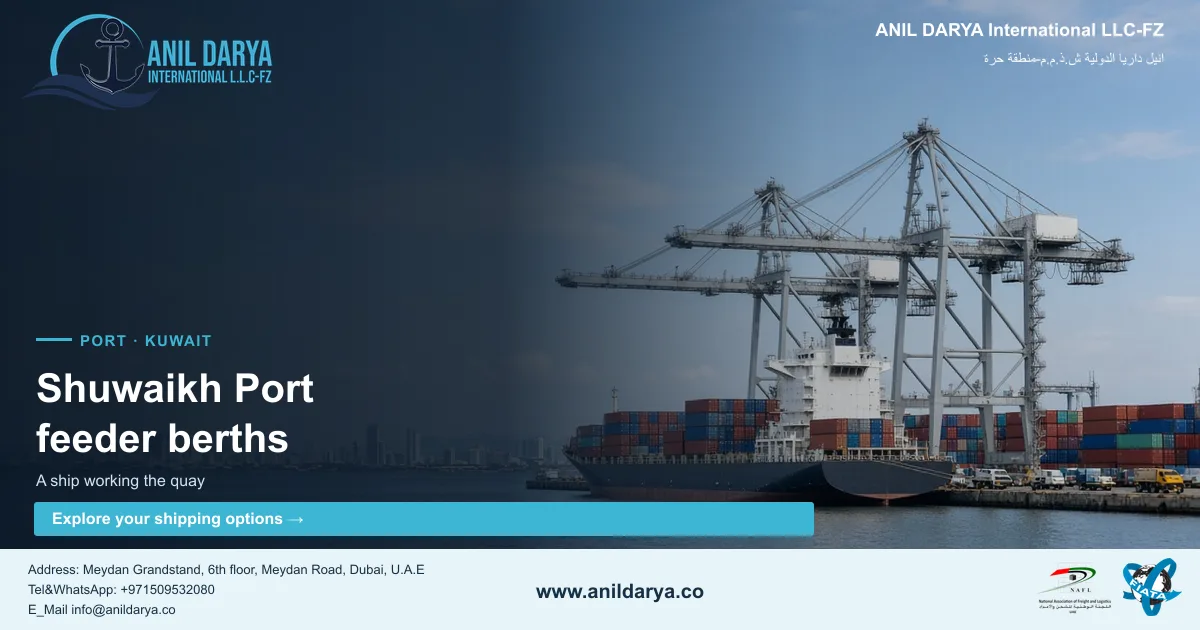
Shuwaikh port shipping covers most of the containers, consumer goods, cars and livestock that arrive in Kuwait by sea. Shuwaikh is Kuwait's main commercial port, run by Kuwait Ports Authority (KPA) next to Kuwait City, and cargo is cleared by Kuwait's General Administration of Customs. This guide covers the berths and draft limits, the cargo the port handles, the DG rules, customs, and how we move your cargo from Dubai to Shuwaikh. We ship both from Dubai to Shuwaikh and from Shuwaikh to Dubai.
Shuwaikh port guide: key facts at a glance
| Item | Detail |
|---|---|
| Operator | Kuwait Ports Authority (KPA), which took over management in 1977 |
| Role | Kuwait's main commercial port |
| Customs authority | General Administration of Customs (KGAC) |
| UN/LOCODE | KWSWK |
| Location | Shuwaikh industrial area, southern shore of Kuwait Bay, just west of Kuwait City |
| Total area | 4.4 million m², with a 1.2 million m² basin |
| Berths | 21 |
| Storage area | More than 600,000 m² |
| Access channel | About 8 km, dredged to 8.5 m at low tide |
| Maximum arrival draft | 9.5 m |
| Containers handled, 2024 | 613,093 TEU |
| General cargo, 2024 | 3,230,749 tonnes |
| Cars, 2024 | 177,394 |
| Vessel calls, 2024 | 1,419 |
| Nearest airport | Kuwait International Airport, about 15 km |
| Customs duty | 5% of CIF value for most goods, no VAT in Kuwait |
| Shuwaikh to Dubai | GCC national products with an attested certificate of origin are duty-free in the UAE; import VAT 5% applies |
Where is Shuwaikh Port and how does cargo reach it?
Shuwaikh Port sits in the Shuwaikh industrial area on the southern shore of Kuwait Bay, immediately west of central Kuwait City. KPA describes it as the central hub for storing and distributing goods in Kuwait. For most consignees in and around Kuwait City, the truck leg from the quay is short.
Ships reach the port through a dredged channel in Kuwait Bay about 8 km long. Pilotage is available 24 hours a day, except during the shift change between about 06:00 and 09:00, and ships call Harbour Control on VHF channel 16 or 11. These points matter to your carrier, but they also explain why berthing times can slip by a few hours.
Kuwait International Airport is about 15 km away, which helps if you split a shipment between sea and air. Kuwait's other main port, Shuaiba, is in Al Ahmadi Governorate in the south, around 40 km away by road.
Berths and draft: which ships can call at Shuwaikh?
Shuwaikh has 21 berths. Depth sets the limit here. Sources that cite World Port Source give 14 berths at 10 m, 4 at 8.5 m and 3 at 6.7 m, with 4,055 m of berth in total. Ships of 7.5 m draft can enter at any tide and up to 9.5 m at high tide. That rules out large mainline container ships, so Shuwaikh is served by feeder vessels, mostly through Jebel Ali and other regional hubs.
How the berths are used
A Kuwait shipping agent publishes this berth list. It shows where your cargo type is normally worked.
| Berths | Main use | Max LOA |
|---|---|---|
| 1 | Grain | 186 m |
| 2 to 4, 6, 7 | General cargo | 180 m |
| 5 | Ro-Ro or general cargo | 180 m |
| 8 | Bulk cement | 210 m |
| 10, 12, 13 | Containers, 2 quay cranes each | 180 to 200 m |
| 11, 14 | General cargo or self-geared container ships | 200 m |
| 15, 17 | General cargo, draft restricted | 185 to 200 m |
| 16 | Passenger | 140 m |
| 18 | Ro-Ro | 185 m |
| 19, 20 | Reefers and general cargo | 200 m |
| 21 | Livestock and general cargo | 200 m |
Only a few berths have quay cranes, so many general cargo and some container calls rely on the ship's own gear. If your cargo is heavy, ask the carrier whether the vessel is geared and what its crane limit is before you book.
Maximum ship length by type
| Ship type | Maximum LOA |
|---|---|
| Container | 225 m |
| Breakbulk | 220 m |
| Bulk | 200 m |
| Ro-Ro | 175 m |
Berth upgrades under way
KPA awarded a contract to rehabilitate berths one to seven, giving 1,330 m of berth length for bulk and general cargo, equipped with 600 t mobile cranes, reach stackers and heavy trucks. While works run, some general cargo may be moved between berths, so confirm the berth with the carrier's agent close to arrival.
What cargo does Shuwaikh handle?
KPA's 2024 figures show the mix clearly: mostly imported containers and general cargo for the local market, plus cars and livestock.
| Cargo | 2024 volume | How it moves | What to plan |
|---|---|---|---|
| Containers | 613,093 TEU | Feeder ships at the container berths | Free time, delivery order, truck to consignee |
| General cargo | 3,230,749 tonnes | Breakbulk at general cargo berths, often ship's gear | Lifting points, lashing, trailer type |
| Cars | 177,394 units | Ro-Ro berths or cars in containers | Vehicle documents and inspection |
| Livestock | 143,629 head | Livestock carriers at berth 21 | Veterinary approvals before arrival |
| Chilled and frozen food | Part of container volume | Reefer containers, reefer berths 19 and 20 | Food authority clearance, set temperature |
| Dangerous goods | Restricted | IMDG containers under Kuwait approvals | Approval before loading, summer limits |
KPA also lists the government bodies present at the port, including customs, the Ministries of Health, Interior, Commerce and Industry, and Communications, Kuwait Municipality, the Environment Public Authority, the Public Authority for Industry and the Public Authority for Agriculture Affairs and Fish Resources. Depending on the goods, any of them may need to approve your shipment before release.
Container shipping to Shuwaikh: FCL, LCL and reefer
Containers on the Dubai to Shuwaikh lane move on feeder services. One published example is Emirates Shipping Line's weekly Gulf Pakistan Shuttle, launched in February 2024. Its rotation ran Jebel Ali, Karachi, Jebel Ali, Kuwait (Shuwaikh), Dammam and back, on a 14-day round trip, with 2 days from Jebel Ali to Shuwaikh, and it named Shuwaikh Container Terminal as its berth. Feeder rotations change often, so check the current schedule at booking.
You have two main options:
- FCL (full container load). You book a whole 20ft or 40ft box. It suits full loads and goods you do not want handled with other cargo.
- LCL (less than container load). Your cargo shares a container that is unpacked at a warehouse in Kuwait. Your release then depends on the whole container's paperwork, so send documents early and match carton marks to the packing list.
Reefer and food cargo
Berths 19 and 20 are listed for reefers and general cargo. Chilled and frozen food is also checked by the Public Authority for Food and Nutrition. The importer files a clearance request on the authority's Raqeb portal, quoting the customs temporary declaration number and invoice details, and attaches the health certificate from origin and any halal slaughter certificate or product licence. Once approved, the importer downloads the inspection report and the food can be released. Start this request as soon as the declaration number exists, because the reefer keeps drawing power and storage time while it waits.
Our guide to FCL and LCL costs explains where the break-even usually sits. For reefers, tell us the set temperature and ventilation at booking. KPA runs a container tracking e-service on its website that the consignee can use once the box is discharged. See our sea freight service for container types we book.
Breakbulk, Ro-Ro and project cargo at Shuwaikh
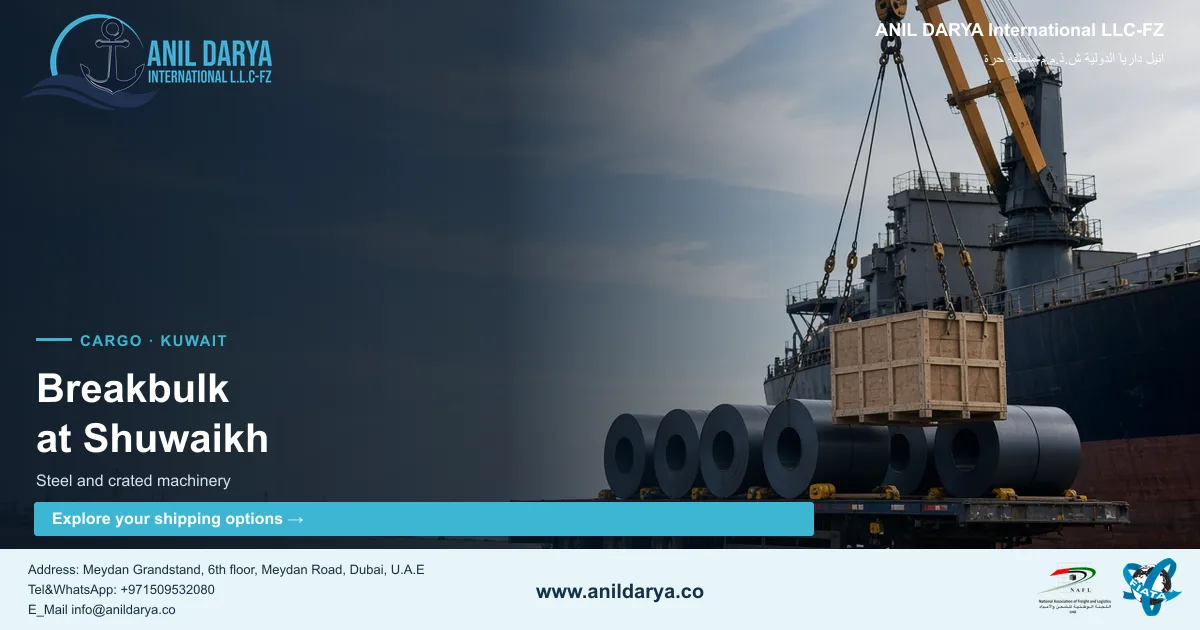
Shuwaikh handled more than 3.2 million tonnes of general cargo in 2024, worked at the general cargo berths. Because few berths have shore cranes, heavy pieces often depend on the vessel's own gear, and Shuwaikh's draft limit caps the size of ship that can bring it. For very heavy or industrial cargo, Shuaiba Port in the south is often the better fit.
When we plan breakbulk or project cargo to Shuwaikh, we work in this order:
- Collect drawings, weights, dimensions and lifting points for each piece.
- Pick the equipment: flat rack or open top on a feeder, or a geared general cargo vessel.
- Check the vessel's draft and crane limit against Shuwaikh's 9.5 m arrival draft and the berth plan.
- Agree lashing and discharge with the carrier and its Kuwait agent.
- Line up the consignee's trailer and road permits for the move from the quay.
A decision rule: if the piece fits a 40ft flat rack, a container feeder from Jebel Ali gives you more sailings. If it does not, compare Shuwaikh and Shuaiba on the vessel that can actually carry it. Our article on flat rack, open top and out-of-gauge cargo covers the equipment, and our break bulk and project cargo team handles the planning.
Dangerous goods at Shuwaikh: direct delivery and summer limits
Kuwait handles IMDG cargo under tight rules, and Shuwaikh has extra limits. Carrier notices for Kuwait say:
| Rule | What it means for you |
|---|---|
| Classes 1, 2, 6 and 7 and radioactive material need Kuwait authority approval before loading | No approval, no loading at Jebel Ali |
| Other DG classes must be reported to the port authority before arrival | The carrier's Kuwait agent needs your DG details early |
| IMDG containers are discharged on direct delivery at Shuaiba Port in all seasons | DG boxes may be routed to Shuaiba, not Shuwaikh |
| Summer season restriction at Shuwaikh | Expect DG to be refused or diverted in summer months |
| Cargo without approvals stays on board | Costs go back to the port of loading |
| Containers must carry the correct hazard labels | Placards and package labels checked on arrival |
The Kuwait agent asks for an advance DG manifest with the vessel and voyage, ETA, ports of loading and discharge, IMDG class and group, technical name, UN number, flash point, IMDG Code page, number of packages and weights. It also asks whether the cargo discharges in Kuwait or stays on board.
Direct delivery means the consignee's truck must be at the quay when the container comes off the ship. Customs and approvals must be done before arrival. If you are unsure which class your product falls under, our guide to dangerous goods classes explains the nine classes, and our dangerous goods shipping team checks SDS, packaging and carrier acceptance before you book.
Shuwaikh or Shuaiba: which Kuwait port fits your cargo?
Both ports are run by KPA. Your carrier's service usually decides the port, but the choice matters for DG, heavy cargo and the inland leg.
| Item | Shuwaikh Port | Shuaiba Port |
|---|---|---|
| KPA description | Main commercial port | Main industrial port |
| Location | Next to Kuwait City | Al Ahmadi Governorate, south |
| KPA management since | 1977 | 1986 |
| Total area | 4.4 million m² | 2.2 million m² |
| Berths | 21 | 20 |
| Containers, 2024 | 613,093 TEU | 282,870 TEU |
| General cargo, 2024 | 3,230,749 tonnes | 23,688,110 tonnes |
| Best for | Consumer goods, food, cars, deliveries in and around Kuwait City | Heavy equipment, raw materials, chemicals, DG on direct delivery |
Customs clearance at Shuwaikh Port
The General Administration of Customs (KGAC) clears cargo at Shuwaikh. Import declarations are filed by licensed customs brokers authorised by KGAC, with offices at the ports. The importer must be registered with the Ministry of Commerce and Industry, and goods under import licensing can only be imported by Kuwaiti nationals or Kuwait-based brokers with that registration.
Since 1 January 2025, the GCC tariff uses 12-digit codes, with more than 13,400 lines. For sea freight, the broker should have the documents at least five days before the vessel arrives. In January 2026 KGAC started an electronic customs link with the GCC Customs Union Authority to exchange declarations between member states.
Which documents does Kuwait customs need?
| Document | Copies | Notes |
|---|---|---|
| Commercial invoice | Original plus two | Description, marks, metric weights, value, origin, shipping details |
| Certificate of origin | Original plus two | Legalised as required |
| Packing list | Original plus three | Contents of each package, exporter's or forwarder's stamp |
| Bill of lading | Original | Consignee name and address, port of destination |
| Delivery order | From the carrier's agent | Issued after local charges are paid |
| Import licence | As issued | Held by the registered importer |
Kuwait expects the invoice and certificate of origin to be legalised by a chamber of commerce in the exporting country and certified by the Kuwaiti embassy, then verified on arrival. Ask the consignee's broker which steps apply before you ship.
Extra approvals at the port
| Cargo | Authority | What is needed |
|---|---|---|
| Food | Public Authority for Food and Nutrition | Clearance request on the Raqeb portal with health certificate and, by product, halal slaughter certificate or import licence |
| Building materials, detergents, water fittings, toys | Public Authority for Industry | Clearance certificate based on a technical inspection report |
| Industrial machinery and spare parts | Public Authority for Industry | Import licence |
| Pharmaceuticals, firearms, explosives | Relevant ministry | Import licence before shipping |
Duty and taxes on goods landed at Shuwaikh
Kuwait charges the GCC common external tariff of 5% of CIF value on most goods. Tobacco pays 100%. Basic foodstuffs, medicines, fresh plants and animals, gold and printing materials are at 0%. Kuwait has no VAT and no excise tax.
Goods that qualify as GCC national products, with at least 40% value added in GCC states and a certificate of origin attested by the competent authority, are exempt. Non-GCC goods from a UAE free zone such as Jafza are treated as a new import into the GCC and pay 5% at Shuwaikh. Prohibited goods include alcohol, pork and pork products, narcotics and gambling equipment.
How to ship from Dubai to Shuwaikh Port step by step
This is how we handle a typical FCL shipment from Dubai to Shuwaikh. We book space, prepare documents and handle the UAE side, and we work with the consignee's customs broker in Kuwait.
- Send us the cargo details: commodity, 12-digit HS code, weight, volume or dimensions, pickup address in the UAE and the Incoterm.
- We check the routing. We confirm which feeder calls Shuwaikh, or whether Shuaiba fits better for DG or heavy cargo.
- The consignee confirms its registration, import licence and broker in Kuwait.
- Approvals are requested before loading: Raqeb for food, Public Authority for Industry certificates, DG approval for restricted classes.
- We prepare the invoice, packing list and certificate of origin, and check that weights, codes and consignee details match.
- We arrange the empty container, stuffing, trucking to Jebel Ali and the UAE export or re-export declaration.
- The container loads at Jebel Ali and the bill of lading is released.
- Documents reach the Kuwait broker at least five days before arrival. The broker files the declaration, duty is paid and the agent issues the delivery order.
- The consignee collects the container from Shuwaikh and returns the empty within free time.
[AMIR-FACT: Our real door-to-door transit Jebel Ali to Shuwaikh for FCL, and which feeder carriers we actually book to Shuwaikh]
Our Jebel Ali port guide covers the export side in Dubai, including gate bookings and cut-offs.
How to ship from Shuwaikh Port to Dubai
We also handle the other direction: shipping from Shuwaikh to Dubai, with arrival at Jebel Ali, Khalifa Port or Sharjah port. We book the space and run the UAE side. The Kuwaiti export papers stay with the shipper or its Kuwaiti customs broker.
The Kuwait export side
- Under the GCC unified customs guide, the export declaration for national products is completed electronically by the exporter, its representative or a licensed customs broker, with an original invoice showing the country of origin and a packing list with HS codes.
- Foreign goods leaving Kuwait go out under the separate re-export procedure in the same guide.
- To claim GCC treatment in the UAE, Kuwaiti-made goods need a certificate of origin attested by the competent government authority. Under the 1981 GCC Economic Agreement, industrial goods qualify with at least 40% value added in GCC states and a factory at least 51% owned by GCC citizens.
- The shipper or its trucker delivers the box to Shuwaikh before the cut-off.
The UAE import side
On arrival, the declaration goes to Dubai Customs with the commercial invoice, the packing list, the certificate of origin and any permit for restricted goods. For sea cargo the GCC customs guide also lists the bill of lading and the delivery order. Customs duty in Dubai is 5% of the CIF value for most goods, with 50% on alcohol and 100% on cigarettes. Import VAT is 5%. A VAT-registered importer accounts for it on its VAT return, while an importer that is not registered pays it before Customs releases the goods.
Goods that qualify as GCC national products are exempt from customs duty under the GCC Economic Agreement, and the GCC customs guide applies that exemption at the first point of entry. Foreign goods re-exported from Kuwait do not get this treatment. The 5% import VAT still applies in both cases.
- Send us the shipper's details in Kuwait, the cargo, the HS code and the UAE delivery address.
- We book space and send the booking and cut-off to the shipper.
- The shipper or its trucker loads the container and delivers it to the terminal.
- The shipper or its broker files the Kuwaiti export or re-export declaration and gets the attested certificate of origin for GCC goods.
- We check the draft bill of lading against the invoice and packing list.
- We file the UAE declaration before the vessel arrives.
- We arrange payment of the duty and VAT and collect the delivery order.
- We truck the cargo to your site and return the empty container inside free time.
[AMIR-FACT: the carriers we actually use from Shuwaikh to Jebel Ali, Khalifa or Sharjah and our real transit days in this direction]
Shuwaikh by sea or Kuwait by road?
Not every Dubai shipment to Kuwait needs to go through Shuwaikh. Trucks can run from the UAE through Saudi Arabia, leaving the UAE at Ghuwaifat, entering Saudi Arabia at Al Batha and entering Kuwait at Nuwaiseeb or Salmi. In Saudi Arabia a licensed broker files a transit transport declaration on ZATCA's Fasah platform.
| Your cargo | Usually better via | Why |
|---|---|---|
| Full containers already at Jebel Ali or in Jafza | Shuwaikh by sea | Feeder from the hub, no border crossings |
| Pallets at a UAE warehouse for a Kuwait door | Road | Door-to-door on one truck |
| Restricted DG classes | Sea, often Shuaiba on direct delivery | Port approvals and direct delivery rules |
| Heavy single pieces | Sea, Shuwaikh or Shuaiba | Avoids road permits in three countries |
Free time, storage and demurrage at Shuwaikh
Shipping lines give a number of free days for their containers at the Kuwait end. After that, demurrage runs while the full box stays in the port and detention while the consignee keeps it outside. KPA also publishes its own port tariffs and fees for storage and handling. Free days and rates differ by carrier and container type, so read them on the quote and arrival notice.
Three habits keep these costs down: send documents to the broker before arrival, have approvals ready before the vessel berths, and book the truck before free time starts. Our article on demurrage and detention shows how the charges build up.
Checklist before you ship to Shuwaikh
- 12-digit HS code confirmed for every invoice line.
- Invoice, packing list and bill of lading show the same weights, package counts and consignee.
- Certificate of origin issued and legalised if the broker asks.
- Consignee registered with the Ministry of Commerce and Industry, with any import licence needed.
- Kuwait customs broker named.
- Food, industry or medicine approvals applied for before loading.
- For DG: Kuwait approval for Classes 1, 2, 6 and 7, SDS, DG declaration, labels and carrier acceptance.
- Vessel draft and gear checked for heavy or breakbulk cargo.
- Free time agreed with the carrier.
- Cargo insurance arranged.
Common mistakes at Shuwaikh
- Assuming a big ship can call. Shuwaikh's 9.5 m arrival draft means feeders, so plan transshipment at Jebel Ali.
- Booking DG to Shuwaikh in summer. DG may be refused or moved to Shuaiba on direct delivery.
- Loading restricted DG classes without Kuwait approval. The box stays on board and costs come back to the shipper.
- Sending scanned documents only. Kuwait asks for originals of the invoice and certificate of origin.
- Old 8-digit HS codes on the invoice.
- Treating Jafza goods as duty-paid GCC goods.
- No truck ready for a direct delivery container.
- Late food approvals on reefer cargo, which run up plug-in and storage costs.
Frequently asked questions
Who runs the port at Shuwaikh?
Kuwait Ports Authority (KPA) manages and operates Shuwaikh Port. It has run the port since 1977 and also runs Shuaiba Port.
What is the port code for Shuwaikh?
The UN/LOCODE for Shuwaikh is KWSWK. You will see it on bookings, bills of lading and tracking systems.
How many berths does Shuwaikh Port have?
Shuwaikh has 21 berths. Berths 10, 12 and 13 work containers with quay cranes, and the rest handle general cargo, Ro-Ro, reefers, bulk, livestock and passengers.
What is the maximum draft at Shuwaikh?
The access channel is dredged to 8.5 m at low tide, and the maximum arrival draft is 9.5 m. Ships of 7.5 m draft can enter at any tide.
How long does it take to ship from Dubai to Shuwaikh?
The sea leg is short. Emirates Shipping Line's 2024 schedule for its weekly GPS service showed 2 days from Jebel Ali to Shuwaikh. Add time for export clearance, Kuwait customs and delivery.
Can I ship dangerous goods to Shuwaikh Port?
Only with approvals and limits. Classes 1, 2, 6 and 7 need Kuwait approval before loading, Shuwaikh has a summer restriction, and IMDG containers are discharged on direct delivery at Shuaiba.
What is the customs duty on goods imported through Shuwaikh?
Most goods pay 5% of CIF value and tobacco pays 100%. Basic foodstuffs and medicines are at 0%, and Kuwait has no VAT.
How do I ship from Shuwaikh to Dubai?
The shipper or its Kuwaiti broker files the export declaration and, for Kuwaiti-made goods, gets an attested certificate of origin so the goods enter the UAE free of customs duty as GCC national products. We book the space, file the Dubai Customs declaration, arrange payment of the 5% import VAT and any duty, and deliver.
Do I need a customs broker in Kuwait?
Yes. Import declarations are filed by licensed brokers authorised by the General Administration of Customs, on behalf of a registered Kuwait importer.
Can cargo from Dubai reach Kuwait by road instead of Shuwaikh?
Yes. Trucks leave the UAE at Ghuwaifat, cross Saudi Arabia under a transit declaration and enter Kuwait at Nuwaiseeb or Salmi. Road suits palletised door-to-door loads, while full containers and heavy cargo usually go by sea.
Get a quote for Shuwaikh port shipping
Send us your cargo details and we will come back with a routing and a price to Shuwaikh. Use our freight rate inquiry form, or contact our team to talk through DG, breakbulk or a first shipment to Kuwait. You can also read more about our Dubai freight forwarding team.
Sources
- Kuwait Ports Authority: Shuwaikh Port (2024 statistics, area, berths, agencies)
- Kuwait Ports Authority: Shuaiba Port (2024 statistics)
- Kuwait Ports Authority: home page (e-services, tariffs)
- Wikipedia: Shuwaikh Port (location, berths, depths, UN/LOCODE)
- Al-Rashed Group: Shuwaikh Port (berth details, pilotage, draft)
- Findaport: Port of Shuwaikh (maximum vessel size, airport distance)
- Fluent Cargo: Shuwaikh KWSWK (distance to Shuaiba)
- Middle East Construction News: Shuwaikh berths rehabilitation contract
- Emirates Shipping Line: GPS and JBX service launches (rotation, transit, terminal)
- Emirates Shipping Line: Restricted cargo (Kuwait DG rules)
- US International Trade Administration: Kuwait import requirements and documentation
- US International Trade Administration: Kuwait import tariffs
- Middle East Briefing: Kuwait customs tariffs, taxes and exemptions (August 2025)
- PwC Worldwide Tax Summaries: Kuwait other taxes
- LexisNexis Middle East: Kuwait launches GCC customs link system (January 2026)
- Public Authority for Industry: GCC Economic Agreement 1981
- Goods Across Borders: GCC customs union explainer
- Public Authority for Food and Nutrition: Raqeb customs clearance request guide
- Public Authority for Industry: Conformity of imported products
- Wikipedia: Ghuwaifat border crossing
- Saudipedia: Al-Batha Port
- Wikipedia: Kuwait and Saudi Arabia border crossings
- ZATCA: Submit transit transport declaration (Fasah)
- Dubai Customs: Submit customs declaration (import, export and re-export documents)
- Dubai Customs: FAQ (duty of 5% of CIF value, CIF definition)
- UAE Government portal: Clearing customs and paying customs duty
- Federal Tax Authority: VAT (5% rate)
- Federal Tax Authority: VAT guide (import VAT, reverse charge and payment before release)
- GCC Unified Guide for Customs Procedures at First Points of Entry (import and export documents)
Reviewed: 10 November 2026