
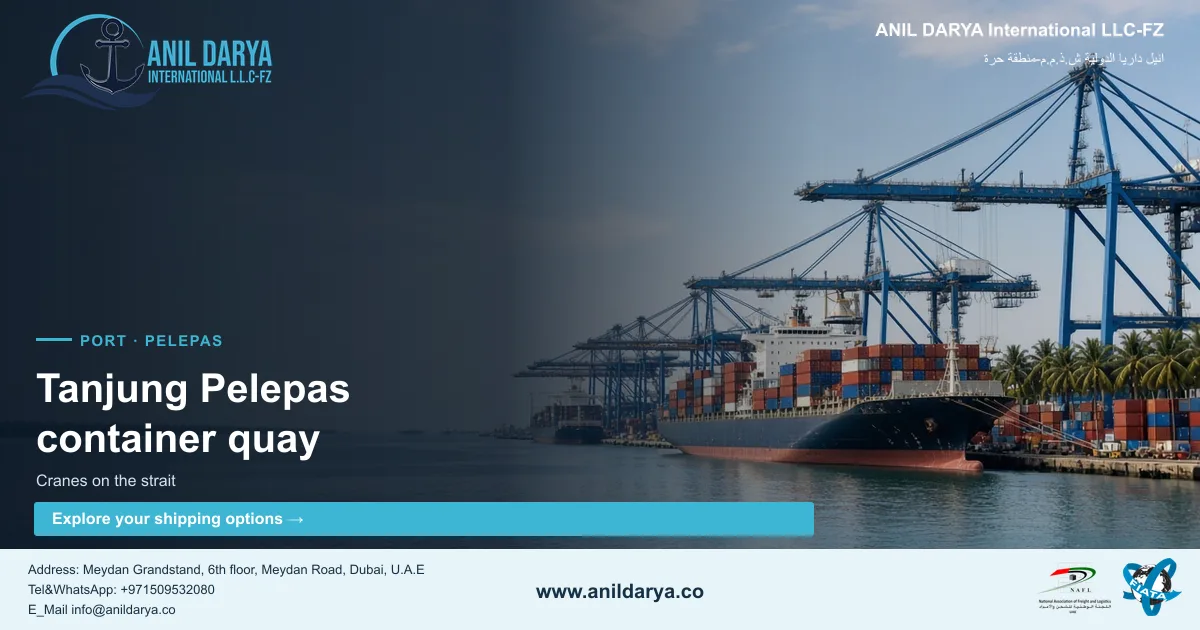
Port of Tanjung Pelepas shipping is mostly about one thing: a very large, single-operator container terminal in southern Johor that handled about 14 million TEU in 2025, most of it cargo changing ships. If your goods are going to Johor, the far south of Peninsular Malaysia or the PTP free zone, this guide shows what the port can handle, what is different about clearing cargo here, and how we ship from Dubai to Tanjung Pelepas step by step. We ship both ways: from Dubai to Tanjung Pelepas, and from Tanjung Pelepas to Dubai.
Port of Tanjung Pelepas shipping: key facts at a glance
| Item | Detail |
|---|---|
| Common names | Port of Tanjung Pelepas, PTP, Pelabuhan Tanjung Pelepas (Tanjong Pelepas on some carrier systems) |
| UN/LOCODE | MYTPP |
| Location | Gelang Patah, Iskandar Puteri, Johor; east bank of the Pulai River mouth, about 30 km from Johor Bahru |
| Operator | Port of Tanjung Pelepas Sdn Bhd, a joint venture of MMC's ports division and APM Terminals (30%) |
| Port authority | Johor Port Authority |
| Opened | 13 March 2000 |
| Berths and quay | 14 linear berths, 5.04 km of quay |
| Draft | 15 to 19 m |
| Access channel | 12.6 km, two-way traffic; no tide restrictions |
| Quay cranes | 66 Super Post Panamax cranes with twin-lift, 24 of them with 24-box outreach |
| Yard | 1.8 million sq m, 48,374 TEU ground slots, 172 RTG cranes, 12 gate lanes |
| Reefer plugs | 4,445 |
| Stated annual capacity | 12.5 million TEU |
| Containers handled in 2025 | 14.03 million TEU, up 14% on 2024 |
| Share of transshipment | Over 90% of traffic |
| Rail | Connected to the national rail grid running from Singapore to southern Thailand |
| Customs authority | Royal Malaysian Customs Department |
| Tanjung Pelepas to Dubai | Malaysian export declaration (K2) by the exporter or its forwarding agent; Dubai duty 5% of CIF for most goods, plus 5% VAT |
Note that 2025 volume is higher than the stated capacity figure. Capacity numbers on operator pages tend to lag expansion, so treat 12.5 million TEU as a design figure, not a ceiling.
What is the Port of Tanjung Pelepas and who uses it?
PTP is a container port. It is not a multipurpose port like Port Klang or Penang, and the operator lists only container facilities. It opened in 2000 and was built to compete for transshipment business in the southern Strait of Malacca. Today more than 90% of its boxes arrive on one ship and leave on another.
For you as a shipper, that has two effects:
- Big mainline ships call here often, so the port is well connected to long-haul trades.
- Local import and export boxes are a small share of the total. The terminal, the carriers and the free zone are set up mainly for relay cargo and for companies located next to the port.
APM Terminals says shipping lines lose only about 45 minutes of deviation time by calling here, which is why so many long-haul services use it. Independent tracking by Cogoport for March 2026 showed Maersk with about 55% of the operator capacity at PTP, followed by Hapag-Lloyd and CMA CGM. That mix changes, so check the carriers on your own booking.
A simple decision rule: book to PTP if your consignee is in southern Johor or in the PTP free zone, or if your carrier's service discharges there for Johor delivery. If the cargo is going to the Klang Valley or central Malaysia, compare a booking to Port Klang first.
Terminal facilities at Tanjung Pelepas
All container berths sit on one straight wharf run by one operator. You do not need to pick a terminal on the booking, which removes a common source of trucking mistakes at multi-terminal ports.
Quay, draft and cranes
The 14 berths give 5.04 km of quay with a draft of 15 to 19 m. The access channel is 12.6 km long and allows two-way traffic, and the operator describes the harbour as naturally sheltered with no tide restrictions. The 66 quay cranes can twin-lift, and 24 of them have a 24-box outreach.
Yard, gates and reefers
The yard covers 1.8 million sq m with 48,374 TEU ground slots and 172 rubber-tyred gantry cranes. Trucks use 12 gate lanes. There are 4,445 reefer plugs, which matters if you ship chilled or frozen food into Johor.
What is being built: Berth Zero
In October 2025 PTP awarded the contract for Berth Zero, a new 360 m berth along the existing wharf with four quay cranes, including dredging and land reclamation. The chairman's stated goal is about 16 million TEU of handling capacity within two and a half years. MMC Port Holdings also reported 11 new ultra-large container vessel cranes and 41 new electric RTG cranes in its January 2026 update.
| Measure | Figure | Why it matters to you |
|---|---|---|
| Draft 15 to 19 m | Deep enough for the largest container ships | Your box is unlikely to be relayed because of vessel size |
| One terminal, 14 berths | Single operator | No terminal choice on the truck booking |
| 4,445 reefer plugs | Large reefer capacity | Chilled and frozen cargo can be plugged in on arrival |
| Over 90% transshipment | Relay hub | Import boxes share yard space with relay cargo, so plan collection early |
What cargo can you ship through Tanjung Pelepas?
| Cargo | Works at PTP? | How it moves |
|---|---|---|
| General goods in dry containers | Yes | FCL, or LCL through a consolidator |
| Chilled and frozen food | Yes | Reefer containers on the terminal's plug-in slots |
| Dangerous goods in containers | Yes, subject to approval | IMDG containers, with carrier and port approval before loading |
| Out-of-gauge pieces | Possible | Flat racks or open tops on a container service, if the carrier accepts them |
| Conventional breakbulk and heavy lift | Not the usual route | The operator lists container facilities only; compare multipurpose Malaysian ports |
| Liquid bulk | Not at the container terminal | Handled at the separate Tanjung Bin tanker terminal nearby, not by PTP |
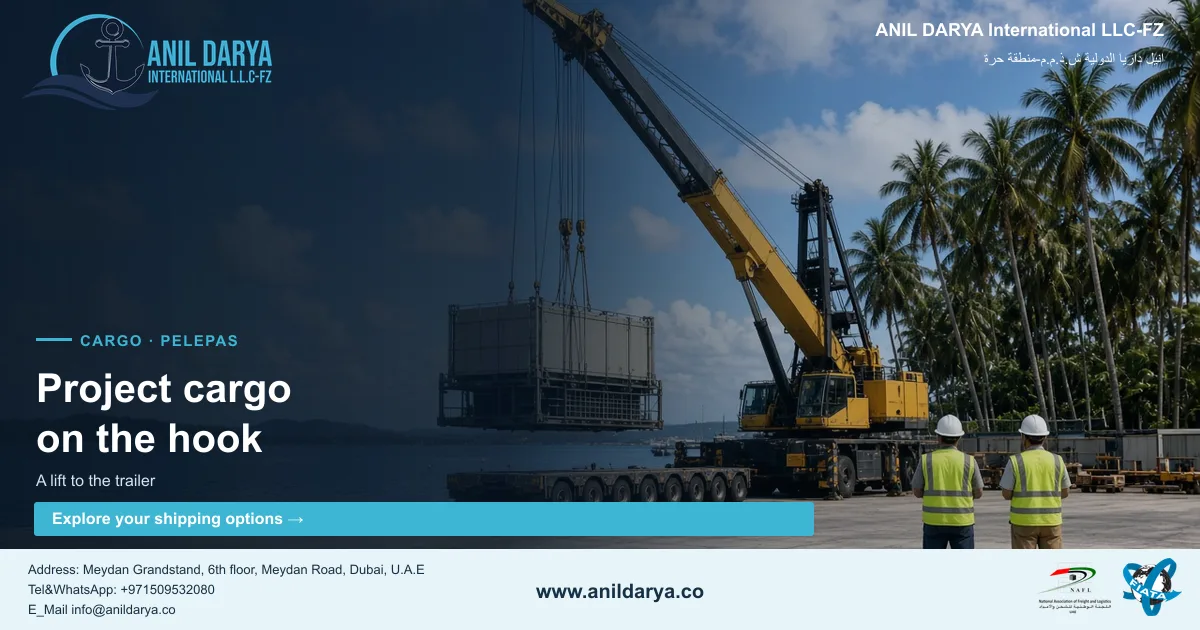
The decision rule for heavy pieces: if it fits a 40ft flat rack by size and weight, a container service into PTP can work. If it needs a breakbulk or heavy-lift vessel, route it to a multipurpose port. Our guide to flat rack, open top and out-of-gauge cargo explains the limits.
Shipping from Dubai to Tanjung Pelepas: FCL or LCL?
Most cargo we look at for this port moves FCL. A full 20ft or 40ft box goes from Jebel Ali to PTP and is trucked to your consignee in Johor, or moved into the free zone.
- FCL suits most commercial loads, reefer cargo and anything you do not want handled with other goods.
- LCL is possible, but the shared box may be discharged at a different Malaysian port and trucked or relayed. Ask where the consolidator unpacks before you book.
Our article on FCL vs LCL costs shows where the break-even usually sits. On the UAE side, most boxes for this lane load at Jebel Ali Port. Some services use Khalifa Port in Abu Dhabi, which can save trucking if your cargo is stuffed there.
[AMIR-FACT: our real port-to-port transit time Jebel Ali to Tanjung Pelepas, whether it is a direct call or relayed, and the carriers we usually book on this lane]
Dangerous goods through Tanjung Pelepas
PTP handles IMDG dangerous goods in containers. Every DG box needs approval from the carrier and the terminal before loading, under the IMDG Code and local Johor port rules. We did not find a public PTP rulebook with class-by-class storage limits, so we confirm acceptance for each booking rather than assume.
One Malaysian rule matters here because so much cargo at PTP is in transit. Section 9 of Malaysia's Strategic Trade Act 2010 says no person shall export, tranship or bring in transit strategic items without a permit issued under the Act. Strategic items include certain explosives, chemicals and dual-use goods. If your product could be on the strategic list, check it before you book, even if the box only changes ships at PTP.
| Your DG situation | What to check first |
|---|---|
| Import into Johor | Carrier and terminal acceptance, any Malaysian import permit for the product, consignee's storage licence if required |
| Box relayed at PTP to another country | Whether the goods are strategic items needing a transit or transhipment permit |
| Explosives, oxidisers, some precursor chemicals | Long lead time for permits; do not book a sailing until approval is in hand |
| Lithium batteries, paints, aerosols, cleaning chemicals | Correct UN number, packing group, labels and SDS; carrier acceptance |
What you need to provide for any DG booking:
- UN number, proper shipping name, class and packing group for each product.
- A Safety Data Sheet for each product.
- A signed Dangerous Goods Declaration, UN-approved packaging, and marks, labels and placards to the IMDG Code.
- Any permit Malaysian authorities require for the product.
Our dangerous goods shipping team gets carrier acceptance and checks the paperwork before you commit to a sailing. If you need a refresher on classes, see dangerous goods classes explained.
Malaysian customs at Tanjung Pelepas: a short summary
Customs rules are national, so they are the same at PTP as at Port Klang. Here is the short version. Our Port Klang guide covers them in full.
| Topic | Rule |
|---|---|
| Import declaration | Customs Form No. 1 (K1), usually filed by a Malaysian customs or forwarding agent for the importer |
| Core documents | K1, commercial invoice, bill of lading, packing list |
| Preferential duty | Proof of origin (certificate or declaration of origin) that matches the K1, invoice and bill of lading |
| Import duty | Set per HS code, can be zero |
| Sales tax | 5% or 10% on discretionary and non-essential goods since 1 July 2025; essential goods exempt |
| Prohibited and restricted goods | Customs (Prohibition of Imports) Order 2023, P.U. (A) 117/2023 |
What is specific to PTP is the destination of the goods after discharge:
- Local import into Johor. The agent files the K1 and pays duty and sales tax before the box leaves the port.
- Delivery into the PTP free zone. Goods move under free zone procedures and duty applies only if they later enter the Malaysian customs area.
- Relay to another country. The box stays in transit and is not imported into Malaysia, but strategic goods still need their permit.
We do not file Malaysian declarations. We send the consignee's agent a complete, matching document set before the vessel arrives, so the K1 can be lodged on time.
The PTP free zone: when to deliver there
Next to the terminal is the PTP free zone, where companies run warehouses and other operations under free zone rules. A 2019 report put Phases 1 and 2 at 350 acres with 41 companies and warehouses and 95% occupancy, and PTP was then planning a further 141.64 hectares in phases. Treat those figures as dated and ask the free zone tenant for its current set-up.
When to deliver into the free zone rather than the Malaysian mainland:
- Your consignee holds a free zone licence and will store, repack or assemble the goods.
- The goods will be re-exported to other markets in Southeast Asia, so paying Malaysian duty at import makes no sense.
- You want stock close to the port for regional distribution by sea.
If the consignee is outside the zone and will sell the goods in Malaysia, deliver as a normal import. Getting this wrong at the start means amendments or refunds later.
Hinterland, road and rail from PTP
PTP sits at the south-west tip of Johor, about 30 km from Johor Bahru. Most import boxes leave by truck to industrial areas around Iskandar Puteri, Johor Bahru and the wider state. The port is also linked to the national rail grid that runs the length of Peninsular Malaysia, from Singapore to southern Thailand. Ask us to check whether a rail leg is offered for your box before you assume it.
| Final delivery | Usual port choice | Why |
|---|---|---|
| Iskandar Puteri, Johor Bahru, PTP free zone | Tanjung Pelepas | Shortest truck leg |
| Eastern Johor (Pasir Gudang industrial area) | Compare PTP and Johor Port | Depends on which port your carrier calls |
| Klang Valley, Selangor, Kuala Lumpur | Port Klang | Avoids a long truck or rail leg from Johor |
| Northern Peninsular Malaysia | Penang Port | Closest container terminal to the north |
How to ship from Dubai to Tanjung Pelepas: step by step
This is how we handle an export from the UAE to PTP. We book space, prepare documents and arrange the UAE side. The consignee's agent handles Malaysian clearance.
- Tell us about the cargo. Commodity, HS code, weight, volume or dimensions, the delivery address in Malaysia, and the Incoterm agreed with your buyer.
- Confirm where the box ends. Local import, PTP free zone or relay to a third country. This decides the documents and the declaration in Malaysia.
- Check permits. For controlled goods, DG or possible strategic items, the consignee applies for the Malaysian licence or permit before we book.
- Get a quote and pick the service. We compare carrier services from Jebel Ali or Khalifa Port that discharge at PTP.
- Book space and get the cut-offs. For reefer, DG or out-of-gauge cargo we get carrier acceptance first.
- Collect the empty, stuff and seal. Stuffing at your site or a warehouse, VGM declared, DG packed and placarded to the IMDG Code.
- Clear UAE export. We file the export or re-export declaration and gate the box in before the cut-off.
- Check the bill of lading. Consignee name, HS codes, weights and marks must match the invoice and packing list, because the K1 will be checked against them.
- Send documents to the Malaysian agent. Invoice, packing list, bill of lading, proof of origin and any permit, before the vessel arrives.
- Arrival and release. The agent files the K1, pays duty and tax, collects the delivery order and books the truck out of PTP.
See our sea freight service for what is included on the UAE side, and our Incoterms 2020 guide to agree who pays for what at PTP.
How to ship from Tanjung Pelepas to Dubai
We also handle the other direction: shipping from Tanjung Pelepas to Dubai, for exporters in Johor and for goods leaving the PTP free zone, with arrival at Jebel Ali, Khalifa Port or Sharjah port. We book the space with the carrier and run the UAE side. The Malaysian export papers stay with the shipper or its Malaysian forwarding agent.
The Malaysia export side
- The exporter or its forwarding agent declares the goods online to Royal Malaysian Customs on the K2 export declaration (K8 is used for some movements).
- The declaration asks whether the goods are controlled under the Strategic Trade Act 2010. If they are, the permit number must be entered, and the customs system checks it before the K2 is accepted.
- Strategic trade permits are applied for online and issued by agencies such as MITI, the Atomic Energy Licensing Board or the Pharmaceutical Services Division.
- For goods leaving the PTP free zone, the tenant's agent confirms which declaration applies before the box gates in.
- The shipper or its trucker delivers the box to PTP inside the carrier's cut-off.
The UAE import side
On arrival in Dubai, the declaration goes to Dubai Customs with the commercial invoice, packing list, bill of lading, certificate of origin and any permit for restricted goods. Customs duty in Dubai is 5% of the CIF value for most goods, with 50% on alcohol and 100% on cigarettes. Import VAT is 5%.
- Send us the shipper's details in Malaysia, the cargo, the HS code and the UAE delivery address.
- We book space from PTP and send the booking and cut-offs to the shipper.
- The shipper or its trucker picks up the cargo and delivers the box to the terminal.
- The shipper or its forwarding agent files the K2, with a strategic trade permit if one is needed.
- We check the draft bill of lading against the invoice and packing list.
- We file the Dubai Customs declaration before arrival, and we arrange payment of the duty and VAT.
- We collect the delivery order, truck the box to your site and return the empty inside free time.
[AMIR-FACT: the carriers we actually use from Tanjung Pelepas to Jebel Ali, Khalifa Port or Sharjah and our real transit days in this direction]
Free time and demurrage at Tanjung Pelepas
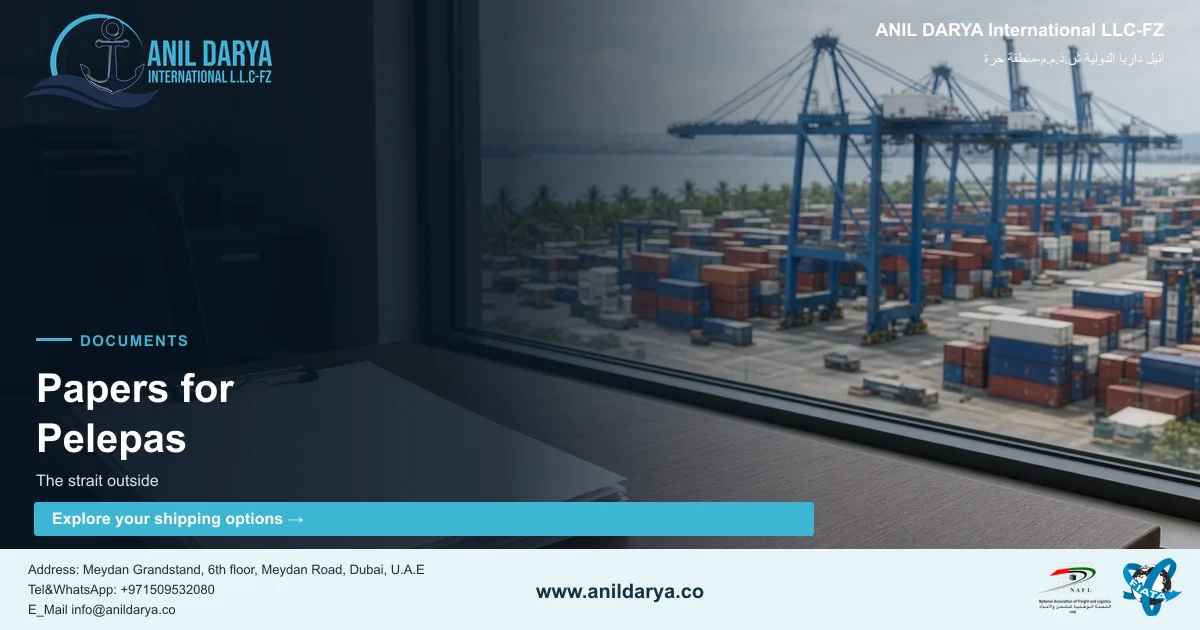
Carriers set free days and daily charges for their containers at PTP, and they differ by line and box type. Read them on your quote and the arrival notice. Because the yard is busy with relay cargo, an import box that sits after free time quickly costs money.
Three habits keep these costs down: file the K1 before arrival, have every permit approved before the vessel berths, and book the truck and the empty return before free time starts. Our article on demurrage and detention explains how the charges are calculated.
Checklist before you ship to Tanjung Pelepas
- Final delivery point confirmed: Johor mainland, PTP free zone or relay to another country.
- HS code confirmed by the Malaysian agent for every item.
- Import licence or permit approved if the goods are listed in the 2023 prohibition order.
- Strategic trade check done for chemicals, explosives and dual-use goods.
- Proof of origin ready if you claim a preferential duty rate, with details that match the invoice and bill of lading.
- Invoice, packing list and bill of lading show the same consignee, weights and piece counts.
- For reefers: set temperature, ventilation and pre-cooling agreed with the carrier.
- For DG: SDS, DG declaration, packaging, labels and carrier acceptance in hand.
- Consignee's agent has the document set before the vessel arrives.
- Free time agreed, and truck and empty return planned.
Common mistakes on Tanjung Pelepas shipments
- Booking to PTP for a Kuala Lumpur consignee. The long inland leg often costs more than a booking to Port Klang.
- Assuming a transit box needs no paperwork. Strategic goods need a permit even if they only change ships at PTP.
- Sending breakbulk to a container-only port. Pieces that do not fit a flat rack need a multipurpose port.
- Late permits. A missing Malaysian licence keeps the box in the yard while free time runs out.
- Mismatched proof of origin. If it does not match the K1 and the invoice, the preferential rate is refused.
- Unclear free zone status. Delivering to the mainland when the buyer is a free zone tenant, or the other way round, causes amendments and delays.
Frequently asked questions
What is the port code for Tanjung Pelepas?
The UN/LOCODE for the Port of Tanjung Pelepas is MYTPP. Some carrier systems spell the name Tanjong Pelepas, but the code is the same.
How does shipping from Dubai to Tanjung Pelepas work?
We book space from Jebel Ali or Khalifa Port on a service that discharges at PTP, clear UAE export and send the documents to the consignee's Malaysian agent. The agent files the K1, pays duty and tax and collects the box. Port of Tanjung Pelepas Sdn Bhd, part-owned by APM Terminals, runs the terminal.
How does shipping from Tanjung Pelepas to Dubai work?
The exporter or its forwarding agent files the K2 export declaration, with a strategic trade permit if the goods need one. We book space to Jebel Ali, Khalifa or Sharjah, file the Dubai Customs declaration before arrival and arrange payment of the 5% duty and 5% VAT.
How big is the port and how busy is it?
PTP has 14 container berths on 5.04 km of quay, with a draft of 15 to 19 m and 66 quay cranes. It handled 14.03 million TEU in 2025, the first single container terminal in Malaysia to pass 14 million.
Is Tanjung Pelepas the same as Johor Port?
No. Tanjung Pelepas is in south-west Johor at the Pulai River mouth. Johor Port is a separate port at Pasir Gudang in the east of the state, with its own berths and services.
Can I ship breakbulk or project cargo to Tanjung Pelepas?
PTP is a container port. Out-of-gauge pieces can move on flat racks or open tops if the carrier accepts them. Cargo that needs a breakbulk or heavy-lift vessel is usually routed to a multipurpose port.
Can dangerous goods be shipped to Tanjung Pelepas?
Yes, with carrier and port approval and full IMDG documents. Strategic items such as some explosives and chemicals also need a permit under Malaysia's Strategic Trade Act 2010, even when they are only in transit.
What documents do I need to clear cargo at Tanjung Pelepas?
Malaysian Customs needs the K1 import declaration, commercial invoice, bill of lading and packing list. Add a proof of origin for a preferential duty rate, and any licence for controlled goods.
What tax applies to goods imported through Tanjung Pelepas?
Import duty depends on the HS code and can be zero. Since 1 July 2025, sales tax of 5% or 10% applies to discretionary and non-essential goods, while essential goods are exempt.
Does Tanjung Pelepas have a free zone?
Yes. The PTP free zone sits next to the terminal and hosts companies and warehouses. Goods in the zone pay Malaysian duty only if they later enter the local market.
Get a quote for Port of Tanjung Pelepas shipping
Send us the cargo details, the delivery address and whether the goods stay in Malaysia, and we will come back with a routing and a price from the UAE to PTP. Use our freight rate inquiry form, or contact our team to talk through a reefer, DG or out-of-gauge shipment first. You can also read more about our Dubai freight forwarding team.
Sources
- APM Terminals: Port of Tanjung Pelepas, our terminal (berths, quay, draft, cranes, yard, reefers, capacity, channel, rail, ownership)
- The Star, reporting the Ministry of Transport: Port Klang and PTP 2025 container records
- The Star: MMC Port Holdings 2025 update (Berth Zero, new cranes)
- Dredging Today: Port of Tanjung Pelepas builds Berth Zero (October 2025)
- The Star: PTP looking to expand free trade zone by 141.64 ha (2019)
- Wikipedia: Port of Tanjung Pelepas (location, opening date, UN/LOCODE, transshipment share)
- Findaport: Port of Tanjung Pelepas (terminals in the area, Tanjung Bin tanker terminal)
- Cogoport: Tanjung Pelepas port info (port authority, operator capacity snapshot March 2026)
- Strategic Trade Act 2010 (Act 708), section 9
- Royal Malaysian Customs: Rules of origin FAQ (K1, proof of origin, supporting documents)
- Royal Malaysian Customs: Prohibition of imports
- Royal Malaysian Customs: export procedure (K2/K8 declaration by exporter or forwarding agent, strategic trade permits)
- Dubai Customs: import declaration documents
- Dubai Customs: FAQ (5% of CIF, 50% alcohol, 100% cigarettes)
- UAE Federal Tax Authority: VAT (5%)
- Ministry of Finance Malaysia: Sales tax revision effective 1 July 2025
Reviewed: 10 November 2026