
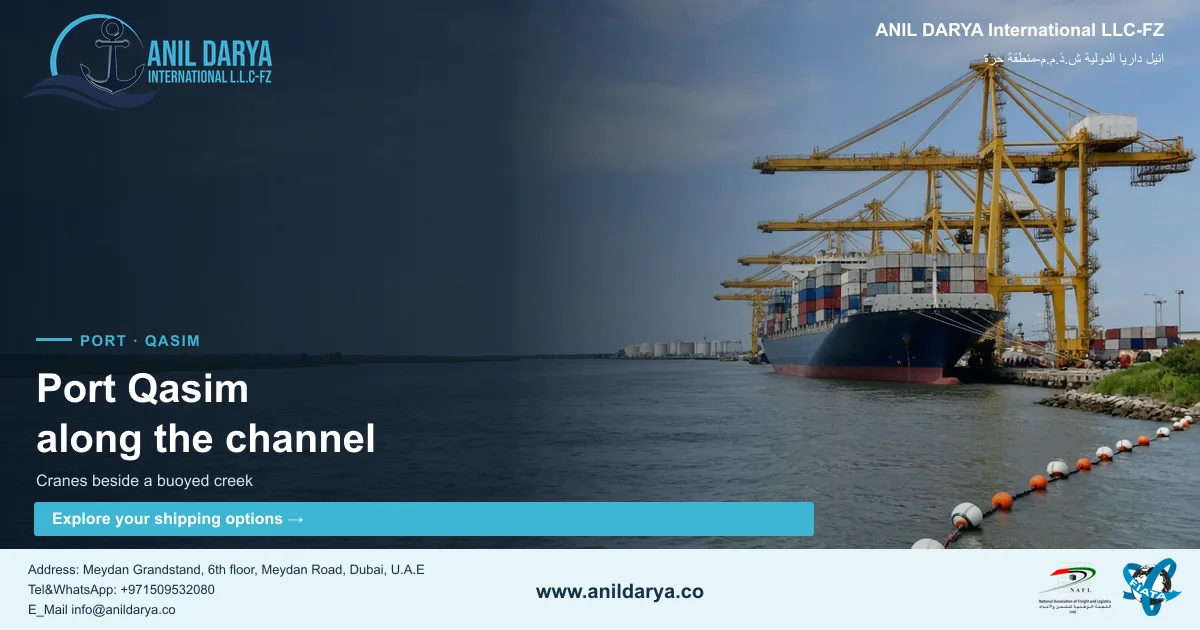
Port Qasim shipping covers Pakistan's second big port in Karachi, officially Port Muhammad Bin Qasim. It is run by Port Qasim Authority (PQA), handles containers at the QICT terminals and a long list of bulk, liquid and energy cargo at private terminals, and clears goods through its own Pakistan Customs collectorates. This guide covers the terminals, the cargo each one takes, customs and documents, and how we ship your cargo from Dubai to Port Qasim. We ship both ways: from Dubai to Port Qasim and from Port Qasim to Dubai.
Port Qasim shipping guide: key facts at a glance
| Item | Detail |
|---|---|
| Official name | Port Muhammad Bin Qasim |
| Port authority | Port Qasim Authority (PQA), set up under the Port Qasim Authority Act, 1973 |
| UN/LOCODE | PKBQM |
| Location | Phitti Creek in the Indus delta, about 35 km east of Karachi city centre |
| Approach channel | 49 km, buoyed, open day and night for ships up to 13 m draught |
| Berths | 18, of which 15 are run by the private sector |
| Annual handling capacity | 89 million tons |
| Share of Pakistan's sea trade | 51% (PQA figure) |
| Container terminals | QICT Terminal 1 and Terminal 2, run by DP World |
| QICT design capacity | 1.4 million TEU a year, stacking capacity 33,182 TEU |
| Rail and road | 14 km rail line to the national network, 26 km main access road |
| Nearest airport | Jinnah International Airport, about 30 km away |
| Industrial zone | 15,474 acres, more than 400 units in operation |
| Customs | Collectorate of Customs Appraisement, Port Muhammad Bin Qasim (imports) and Collectorate of Customs (Exports), Port Muhammad Bin Qasim |
| Sales tax on imports | 18% of the value of goods imported |
| Shipping from Port Qasim to Dubai | Also handled: arrival at Jebel Ali, Khalifa Port or Sharjah, cleared by UAE customs with 5% duty on most goods and 5% VAT |
Where is Port Qasim and how do ships reach it?
Port Qasim sits in Phitti Creek, an old channel of the Indus delta, east of Karachi city. Ships reach the berths through a 49 km buoyed channel that PQA keeps open day and night for vessels with up to 13 m draught. Vessels drawing more than 13 m can anchor 3 miles south-west to west of the Fairway Buoy.
On land, a 14 km railway line links the port to Pakistan's national rail network and a 26 km main access road links it to the highway. PQA says the access road is planned for dualisation. Jinnah International Airport is about 30 km from the port complex, which matters if you split a shipment between sea and air.
Port Qasim and Karachi Port are two different ports in the same city. They have different authorities, terminals and customs collectorates, so the port on your bill of lading decides where the consignee's clearing agent files.
Which terminals does Port Qasim have?
Port Qasim is a cluster of mostly private terminals, each built for one type of cargo. PQA lists the following in its operational complex.
| Terminal | Berths | Quay | Max ship (LOA / draught) | Cargo |
|---|---|---|---|---|
| Marginal Wharf 1 and 2 | 2 | 400 m each | 225 m / 10 m | General bulk, vehicles, machinery and equipment, project cargo |
| Qasim International Container Terminal (QICT-I) | 2 | 712 m (DP World) | 310 m / 12 m | Containers |
| Second container terminal (QICT-II) | 2 | 615 m (DP World) | 310 m / 13 m | Containers; QICT total design capacity 1.4 million TEU |
| Iron Ore and Coal Berth | 1 | 279 m | 230 m / 12 m | Coal, coke and iron ore for Pakistan Steel only |
| FOTCO oil terminal | 1 | 280 m | 245 m / 13 m | Furnace oil, diesel, petrol |
| Engro Vopak chemical terminal (EVTL) | 1 | 325 m | 225 m / 11 m | Chemicals and LPG, 4 million tons |
| Liquid Cargo Terminal (LCT) | 1 | 230 m | 210 m / 10 m | Edible oil |
| FAP grain and fertiliser terminal | 1 | 300 m | 250 m / 13 m | Soya bean, canola, wheat, fertiliser, rice, corn; 4 million tons |
| SSGC LPG terminal | 1 | 230 m | 163 m / 10 m | LPG, 2 million tons |
| PIBT | 1 | 460 m | 230 m / 13 m | Coal, clinker and cement, 8 million tons |
| EETPL and PGPCL LNG terminals | 1 each | 390 m and 400 m | 295 m / 12 m | LNG, 4.5 million tons each |
Two more berths serve power plants with their own coal. Several PQA pages give different capacity figures for the same terminal, so we show only figures that match across PQA's own tables. For QICT we use the operator's figures: DP World gives berth lengths of 712 m and 615 m, where PQA's table shows 610 m and 715 m. Always confirm the current limits with the terminal before booking a large or deep ship.
QICT: the container terminals
QICT opened in August 1997 as Pakistan's first dedicated international container terminal built by the private sector. Its second terminal started commercial operation in January 2011 and was designed for 6,000 TEU ships. DP World runs QICT and calls it Pakistan's leading container terminal. It gives a design capacity of 1.4 million TEU a year and a stacking capacity of 33,182 TEU, with twin-lift cranes at both terminals and a direct connection to the national railway network. DP World also runs block trains and multi-user rail services from QICT, an inland container depot in Lahore, and the NLCCT off-dock facility about 10 km from Karachi Port. The pilot station is about 45 km (24 nautical miles) from the berth, roughly 2.5 hours of sailing. If your carrier's service calls Port Qasim, your container will almost always discharge at QICT.
Marginal Wharf: vehicles, machinery and project cargo
PQA's own Marginal Wharf takes general bulk, vehicles, machinery and equipment, and project cargo, handled by private cargo handling companies. The wharf has a 10,000 sq m covered transit shed at berth 2, and the port has two open storage areas of 118,000 sq m each. This is the berth to look at for breakbulk and heavy pieces into Port Qasim.
What cargo can you ship through Port Qasim?
| Cargo type | Where it goes | What to plan |
|---|---|---|
| General goods in containers | QICT-I or QICT-II | PSW filing before arrival, free time, truck or rail inland |
| Chilled and frozen food | Reefer containers at QICT | Set temperature, health certificates, plug-in time |
| Machinery, steel, project cargo | Marginal Wharf, or flat racks at QICT | Piece list, lifting points, storage at the wharf |
| Vehicles | Marginal Wharf | Import rules for vehicles, storage time |
| Grain and fertiliser | FAP terminal | Receiver's contract with the terminal, surveys |
| Chemicals in bulk | Engro Vopak terminal | Product acceptance, tank space |
| Edible oil | Liquid Cargo Terminal | Tank space, quality survey |
| Coal, clinker, cement | PIBT | Terminal contract, discharge plan |
| Packaged dangerous goods | Containers at QICT | DG documents, carrier and terminal acceptance |
Most bulk terminals at Port Qasim work for specific receivers or under contract. If you are shipping bulk from the UAE, the receiver in Pakistan normally arranges the terminal first. For containers and breakbulk, the carrier and the Marginal Wharf handling company are your main contacts.
FCL and LCL: shipping containers to Port Qasim
- FCL (full container load). You book a whole box, sealed at your site in the UAE and opened only by the consignee or customs.
- LCL (less than container load). Your cargo shares a box with other shippers and is released after the box is unpacked at a container freight station, so the consolidator's paperwork also affects your release.
Containers do not always clear inside QICT. The FBR licenses off-dock terminals under section 78 of the Customs Act, 1969 to take FCL and LCL cargo straight from the wharves of Port Qasim and Karachi Port. One example is a 10-acre off-dock terminal in the South Western Industrial Zone of Port Qasim, working under standing orders of the Port Qasim customs collectorates.
If you are not sure which mode costs less, our guide to FCL vs LCL costs shows the maths. Our sea freight service books both from all UAE ports.
Breakbulk and project cargo at Port Qasim
For cargo that does not fit a container, Port Qasim's Marginal Wharf takes vehicles, machinery, equipment and project cargo on two 400 m berths, with ships up to 225 m long and 10 m draught. Check the draught of your breakbulk vessel early: a heavy-lift ship loading in the UAE has to fit those limits on arrival.
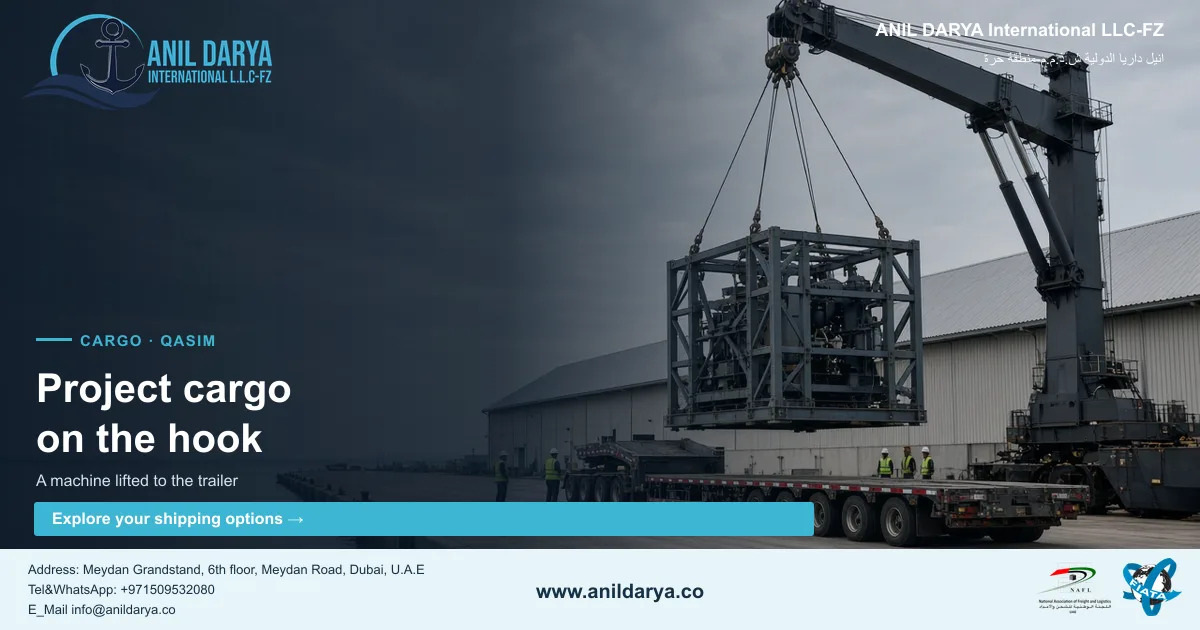
How we plan project cargo from the UAE to Port Qasim:
- Collect drawings, dimensions, weights and centre of gravity for each piece.
- Decide flat rack on a container ship to QICT, or a breakbulk or heavy-lift vessel to the Marginal Wharf.
- Check the vessel's length and draught against the berth limits.
- Agree lifting and lashing with the carrier.
- Send the consignee's clearing agent the piece list and documents before sailing.
- Leave the road move in Pakistan to the consignee's transporter, using our piece list.
Many consignees for heavy equipment are in the Port Qasim industrial zones, which PQA says cover 15,474 acres with more than 400 units in operation. If your site is inside them, the inland leg is short. See our break bulk and project cargo service and our heavy-lift shipping guide.
Dangerous goods at Port Qasim
Port Qasim has dedicated terminals for bulk chemicals, LPG and LNG, but those serve contracted receivers. Packaged dangerous goods from the UAE usually travel in containers to QICT. Acceptance depends on the carrier, the class and the terminal, so we confirm it before you commit to a sailing.
- UN number, proper shipping name, class and packing group.
- Safety Data Sheet for each product.
- Signed Dangerous Goods Declaration.
- UN-approved packaging, labels and container placards.
- Any licence, permit or certificate needed in Pakistan, applied for on PSW before sailing.
Our dangerous goods shipping team checks documents and carrier acceptance on the UAE side.
Customs clearance at Port Qasim: collectorates, PSW and documents
Port Qasim has its own customs collectorates under the FBR: the Collectorate of Customs Appraisement, Port Muhammad Bin Qasim, for imports, and the Collectorate of Customs (Exports), Port Muhammad Bin Qasim, for exports. They also issue the standing orders for off-dock terminals in the area.
Declarations go through Pakistan Customs' WeBOC system or the Pakistan Single Window (PSW):
- Goods that need a licence, permit or certificate from another agency must be declared through a PSW Single Declaration.
- Other goods can be filed on WeBOC or PSW. PSW carries every trader function of WeBOC.
- PSW supports filing and clearance before the ship arrives, which is the best way to protect free time.
The consignee or their licensed clearing agent files. We send the documents from the UAE early so filing can start before arrival.
Which documents do you need?
The US Department of Commerce lists bills of lading, invoices, packing lists, certificates of origin, copies of letters of credit and insurance certificates as the documents for Pakistan imports.
| Cargo type | Core documents | Usually also needed |
|---|---|---|
| Containers | Bill of lading, commercial invoice, packing list, certificate of origin | Letter of credit copy, insurance certificate |
| Food and agricultural goods | Core set | Health or phytosanitary certificates from origin |
| Vehicles and used machinery | Core set | Check against Appendix C of the Import Policy Order, 2022 for used goods |
| Project cargo | Core set with piece list | Drawings and weights for the wharf |
| Dangerous goods | Core set | DG declaration, SDS, PSW licence or permit if required |
Duties and taxes
| Charge | Rate or rule |
|---|---|
| Customs duty | Per PCT code; FY 2025-26 introduced 5%, 10% and 15% slabs and widened 0% |
| Additional customs duty | Linked to the duty slab; cut on thousands of lines in FY 2026-27 |
| Regulatory duty | Listed codes only |
| Sales tax | 18% of the value of goods imported |
| Income tax at import | 1% to 6% for importers on the Active Taxpayers List, 2% to 12% for others |
Ask the consignee's clearing agent for a full estimate on your PCT code. Rates change with each Finance Act, and the importer's tax status changes the income tax.
Shipping from Dubai to Port Qasim: step by step
We book space with carriers, prepare documents and arrange trucking and export clearance in the UAE. The consignee's clearing agent handles import clearance at Port Qasim.
- Send us the cargo details. Commodity, HS code, weight, volume or dimensions, pickup point and Incoterm.
- Confirm import rules with the consignee. PCT code, any Import Policy Order condition, any licence or permit on PSW.
- Choose the service and port. We check which services call Port Qasim (QICT) and compare them with Karachi Port services if your consignee can use either.
- Book and get acceptance. DG, reefer and out-of-gauge cargo need carrier acceptance; breakbulk needs a check against the Marginal Wharf limits.
- Pick up and stuff. We arrange the empty, stuffing, sealing and the truck to the UAE port.
- Clear UAE export. We file the export or re-export declaration and gate in before the cut-off.
- Release the bill of lading. We check the draft against the invoice and packing list, with Port Qasim as the port of discharge.
- Send documents. The clearing agent gets the full set before arrival and files on PSW.
- Arrival and clearance. The ship berths at QICT or the Marginal Wharf; the agent clears, pays duties and taxes and collects the delivery order.
- Delivery and empty return. The consignee's transporter delivers by road, or by rail for inland cities, and returns the empty within free time.
[AMIR-FACT: Our real port-to-port transit time from Jebel Ali to Port Qasim, the carriers we use that call QICT, and one real Port Qasim shipment we can describe]
If your cargo is not yet at a UAE port, see our guides to shipping through Jebel Ali Port and Khalifa Port in Abu Dhabi.
How to ship from Port Qasim to Dubai
We also handle the other direction: shipping from Port Qasim to Dubai, with arrival at Jebel Ali, Khalifa Port or Sharjah port. We book the space with the carrier and run the UAE side. The Pakistani export papers stay with the shipper or its Pakistani agent.
The Pakistani export side
- Export declaration. The exporter or its customs agent files the goods declaration with Pakistan Customs. PSW says traders can file through PSW or WeBOC.
- Regulated goods. Where a regulatory requirement applies, PSW says filing through the PSW Single Declaration is mandatory.
The UAE import side
For a box loaded at QICT and cleared in Dubai, the import declaration goes to Dubai Customs with the commercial invoice, the packing list, the certificate of origin and any permit the controlling authority issues for restricted goods. The bill of lading releases the container from the shipping line. Customs duty in Dubai is 5% of the CIF value on most goods, 50% on alcohol and 100% on cigarettes, and import VAT is 5% of the customs value with freight and insurance included. A VAT-registered importer whose customs number is registered with the Federal Tax Authority pays no VAT at the border and reports it on its next VAT return.
- Send us the shipper's details in Port Qasim, the cargo, the HS code and the UAE delivery address.
- We book space with the carrier from Port Qasim to Jebel Ali, Khalifa Port or Sharjah and send the booking and cut-offs to the shipper.
- The shipper or its trucker picks up the cargo and delivers the container to the QICT terminal before the cut-off.
- The shipper or its Pakistani agent files the export goods declaration through PSW or WeBOC.
- We check the draft bill of lading against the invoice and packing list before the line issues it.
- We file the UAE import declaration before the vessel arrives.
- We arrange payment of the duty and VAT and collect the delivery order from the shipping line.
- We truck the container to your site in the UAE.
- We return the empty container to the line's depot within free time.
[AMIR-FACT: the carriers we actually use from Port Qasim (QICT) to Jebel Ali, Khalifa Port or Sharjah and our real port-to-port transit days in this direction]
What happens after your ship arrives at Port Qasim?
For a container import, the usual order is below. Most holds start before the ship leaves the UAE, which is why we check documents before sailing.
| Stage | Who acts | What can hold it up |
|---|---|---|
| Ship transits the channel and berths at QICT | Carrier, pilot, terminal | Draught above the berth limit, berth waiting time |
| Container goes to the QICT yard or an off-dock terminal | Terminal, under customs control | Off-dock terminal not nominated in time |
| Goods declaration assessed | Clearing agent and the Port Qasim appraisement collectorate | Wrong PCT code, value query, missing PSW permit |
| Examination, if selected | Pakistan Customs | Cargo not matching the packing list |
| Duties and taxes paid | Importer through the agent | Funds or tax status not ready |
| Delivery order and gate-out | Carrier's agent and terminal | Unpaid local charges, original bill of lading not surrendered |
How to track a container at QICT
You need one of three references: the container number (four letters and seven digits), the bill of lading number, or the booking number. One bill of lading can cover several containers, so once the ship has discharged, track each box by its container number. DP World offers digital track and trace for QICT. If a container cannot be found at QICT, check the port of discharge on the bill of lading first: it may be at a Karachi Port terminal instead.
Inland delivery from Port Qasim
Port Qasim has a 14 km rail line into the national network, and PQA says its railway yard can load four trains at a time. For consignees in Lahore, Faisalabad or other inland cities, ask whether the container will move by road or rail, and whether it will be cleared at Port Qasim or moved under customs control to an inland dry port. The answer changes who files, where duty is paid and how long the container is away from the carrier.
Free time, demurrage and detention at Port Qasim
Carriers give free days on their containers. After that, demurrage runs while the full box stays at QICT or an off-dock terminal, and detention while it is out with the consignee. Days and rates differ by carrier, so read them on the quote and arrival notice. For breakbulk, ask the handling company about storage charges at the Marginal Wharf.
File before arrival, have permits ready before sailing, and book the truck early. Our article on demurrage and detention shows how fast the charges add up.
Port Qasim or Karachi Port: which fits your cargo?
| Your situation | Port to look at first | Why |
|---|---|---|
| Consignee in the Port Qasim industrial zones | Port Qasim | Short truck leg |
| Container service calling QICT | Port Qasim | QICT is Port Qasim's container terminal |
| Container service calling KICT, KGTL or SAPT | Karachi Port | Those terminals are at Karachi Port |
| Vehicles, machinery, project cargo | Either; compare Marginal Wharf at Port Qasim with KGTML at Karachi Port | Berth limits and inland route decide |
| Grain, fertiliser, edible oil, chemicals, LNG, LPG, coal | Port Qasim | Dedicated private terminals |
We can price both ports so you can compare the total cost to the consignee's door.
Checklist before you ship to Port Qasim
- Bill of lading shows Port Qasim (PKBQM), not Karachi Port, as port of discharge.
- PCT code confirmed with the consignee's clearing agent.
- Goods checked against the Import Policy Order, including used-goods rules.
- Any licence, permit or certificate applied for on PSW before sailing.
- Clearing agent set up with the Port Qasim collectorate, or the off-dock terminal agreed.
- Invoice, packing list, certificate of origin and bill of lading match.
- For breakbulk: piece list and vessel length and draught checked against the Marginal Wharf limits.
- For DG: SDS, DG declaration, packaging, labels and carrier acceptance.
- Free time agreed with the carrier.
- Cargo insurance arranged.
Common mistakes when shipping to Port Qasim
- Mixing up the two Karachi ports. A bill of lading to Karachi Port when the consignee's agent is set up for Port Qasim causes delays.
- Booking a ship too deep for the berth. The channel takes up to 13 m draught, and some berths less.
- Assuming a bulk terminal is open to anyone. Most specialist terminals work under contract with receivers.
- Filing after arrival. A late goods declaration costs free time.
- No permit for regulated goods. Without the PSW licence or certificate the goods cannot be cleared.
- Mismatched documents. Different weights or names on the invoice and bill of lading cause holds.
Frequently asked questions
Is Port Qasim the same as Port Muhammad Bin Qasim?
Yes. Port Muhammad Bin Qasim is the official name and Port Qasim is the short form. Its UN/LOCODE is PKBQM.
Who runs the port and its terminals?
Port Qasim Authority (PQA), set up under the Port Qasim Authority Act, 1973, runs the port. Of its 18 berths, 15 are run by the private sector, including the QICT container terminals.
What is the container terminal at Port Qasim?
Qasim International Container Terminal (QICT), run by DP World. It has two terminals with a combined design capacity of 1.4 million TEU a year, and DP World gives their berth lengths as 712 m and 615 m.
How deep is the channel at Port Qasim?
PQA says its 49 km buoyed channel is open day and night to ships with up to 13 m draught. Individual berths have their own limits.
Can I ship machinery and project cargo to Port Qasim?
Yes. PQA's Marginal Wharf handles vehicles, machinery, equipment and project cargo on two 400 m berths, for ships up to 225 m long and 10 m draught.
Which customs office clears cargo at Port Qasim?
Imports are cleared by the Collectorate of Customs Appraisement, Port Muhammad Bin Qasim, and exports by the Collectorate of Customs (Exports), Port Muhammad Bin Qasim, both under the FBR.
Is Port Qasim far from Karachi Port?
Port Qasim is about 35 km east of Karachi city centre, in Phitti Creek. Karachi Port is in the city's harbour, so the two are separate ports with separate terminals.
What is the sales tax on imports at Port Qasim?
Imports cleared by the Collectorate of Customs Appraisement at Port Muhammad Bin Qasim pay 18% sales tax on the value, under the Sales Tax Act, 1990. Customs duty and income tax at import are charged on top.
How do I ship from Dubai to Port Qasim?
We book space from Jebel Ali or Khalifa Port on a carrier that calls QICT, prepare the UAE documents and export declaration, and the consignee's clearing agent clears the goods with Pakistan Customs at Port Qasim.
How do I ship from Port Qasim to Dubai?
The Pakistani shipper or its customs agent files the export goods declaration through PSW or WeBOC, and the Collectorate of Customs (Exports), Port Muhammad Bin Qasim, handles it. We book the space from Port Qasim to Jebel Ali, Khalifa Port or Sharjah, file the UAE import declaration and arrange payment of the 5% duty (on the CIF value of most goods) and the 5% import VAT.
Get a quote for Port Qasim shipping
Send us your cargo details and we will come back with a routing and price from the UAE to Port Qasim. Use our freight rate inquiry form, or contact our team to discuss project, breakbulk or DG cargo.
Sources
- Port Qasim Authority: Introduction (channel, berths, capacity, share, rail, road, industrial zone)
- Port Qasim Authority: Port operational complex (terminals, berths, quays, ship limits)
- Port Qasim Authority: Facilities (QICT history, transit shed, storage areas)
- Port Qasim Authority: Key information (anchorage, airport distance)
- FBR: SRO 1788 of 2024 (off-dock terminal, Port Qasim customs collectorates)
- Pakistan Single Window: WeBOC to PSW
- US International Trade Administration: Pakistan import requirements and documentation (February 2026)
- FBR: Sales Tax Act, 1990, updated to 30 June 2026
- FBR: Withholding tax rate card, updated to 30 June 2026
- FBR: Budget 2025-26 salient features (customs)
- FBR: Budget 2026-27 salient features (customs)
- DP World: QICT, Port Qasim (operator, berth lengths, capacity, rail, ICD Lahore, NLCCT)
- Maalbardaar: QICT tracking (container, BL and booking references)
- Wikipedia: Port Qasim (location, UN/LOCODE)
- Wikipedia: Port Qasim Authority (Port Qasim Authority Act, 1973)
- Dubai Customs: Submit customs declaration (invoice, packing list, certificate of origin, permits)
- UAE Government portal: Clearing customs and paying customs duty (5% of CIF, alcohol 50%, cigarettes 100%)
- Federal Tax Authority: VAT (5% rate)
- Federal Tax Authority: VAT guide, section 3.5 on VAT on imports (5%, deferral for VAT-registered importers)
Reviewed: 10 November 2026