
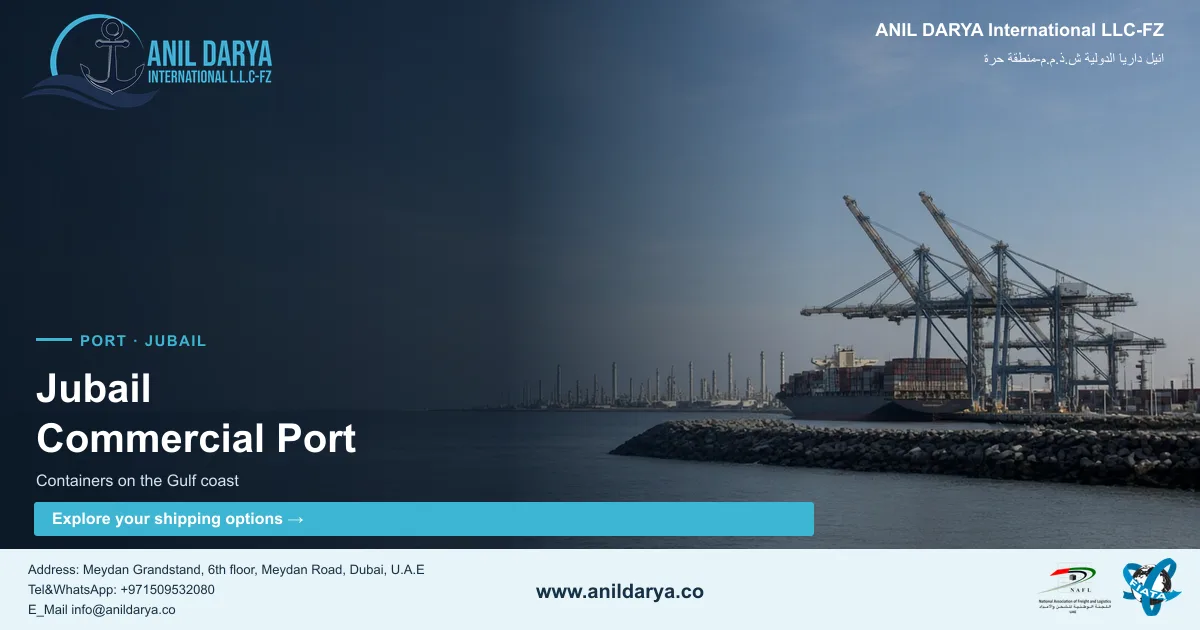
Jubail port shipping means moving cargo through one of two neighbouring ports in Jubail, Saudi Arabia: Jubail Commercial Port for containers, general cargo and bulk, and King Fahd Industrial Port for the petrochemical and heavy industry of Jubail Industrial City. Both are owned by the Saudi Ports Authority (Mawani), and Saudi Global Ports now runs the container terminal. This guide covers the two ports, what each one handles, the DG and project cargo rules, and how we ship your cargo there from Dubai by sea or plan it against a truck. We ship both from Dubai to Jubail and from Jubail to Dubai.
Jubail port guide: key facts at a glance
| Item | Detail |
|---|---|
| Ports | Jubail Commercial Port (south harbour) and King Fahd Industrial Port (north harbour) |
| Owner and port authority | Saudi Ports Authority (Mawani) |
| Customs authority | Zakat, Tax and Customs Authority (ZATCA) |
| UN/LOCODE | SAJUB (Jubail Commercial Port), SAKFH (King Fahd Industrial Port) |
| Location | Jubail, Eastern Province, about 80 to 90 km north of Dammam |
| Commercial port berths | 16: 8 general cargo, 4 bulk, 2 tanker, 4 container |
| Industrial port berths | 34, across five terminals |
| Industrial port capacity | 70 million tonnes a year |
| Container terminal operator | Saudi Global Ports (SGP), 30-year agreement, operations started April 2026 |
| Container terminal plan | Capacity from 1.5 to 2.4 million TEU, quay from 1,000 m to 1,400 m, berth depth from 14 m to 18 m |
| Approach channel | 14 m |
| Rail | Freight trains link both Jubail ports with Dammam port and the national network |
| Nearest airport | King Fahd International Airport, about 62 km |
| Customs declaration | Fasah, at least 48 hours before arrival |
| Duty and import VAT | GCC tariff of at least 5% on most goods, 15% VAT |
| Jubail to Dubai | Shipper or its Saudi broker files the export declaration; GCC-origin goods with an authenticated certificate of origin enter the UAE duty-free, 5% VAT applies |
Two ports in Jubail: commercial port or industrial port?
"Jubail port" on a booking can mean either harbour. Port data from ShipNext describes the layout plainly: King Fahd Industrial Port lies to the north, Jubail Commercial Port to the south, each has its own breakwater, and a central breakwater separates them. The port you need depends on what you ship and who receives it.
| Item | Jubail Commercial Port | King Fahd Industrial Port |
|---|---|---|
| Main role | Containers, general cargo and dry bulk for the market | Raw materials in and petrochemicals out for Jubail Industrial City |
| UN/LOCODE | SAJUB | SAKFH |
| Berths | 16 | 34 (one Saudi agent lists 27, of which 19 operational) |
| Container terminal | Yes, run by Saudi Global Ports | No dedicated container terminal listed |
| Typical exports | Petrochemicals, iron and steel, aluminium, sulphur | Petrochemicals, refined products, fertilisers, sulphur |
| Typical imports | Iron ore concentrate, limestone, fertilisers, alumina, salt, consumer goods | Feedstock and raw materials for local plants |
| Who books it | Shipping lines and container feeders | Mostly plant owners, tanker and bulk charterers |
For a container shipment from Dubai, your cargo almost always arrives at Jubail Commercial Port. King Fahd Industrial Port matters if you ship bulk liquids, chemicals in parcels, or project equipment for a plant that has its own berth arrangement.
Jubail Commercial Port: berths, container terminal and storage
Jubail Commercial Port is a multipurpose port. A Saudi shipping agent, Sharaf Shipping, lists 16 berths: 8 for general cargo, 4 for bulk, 2 for tankers and 4 for containers. The same source lists 589,030 m² of open yard and 78,000 m² of covered storage, a 14 m channel draft and a pilot run of about 4 nautical miles to the berth. Stevedoring is done by the port in two shifts, 07:00 to 18:00 and 19:00 to 06:00, which gives about 20 working hours a day.
The container terminal under Saudi Global Ports
Saudi Global Ports, a joint venture of the Public Investment Fund and PSA International, started running the Jubail container terminal in April 2026 under a 30-year privatisation agreement with Mawani. The investment is about SAR 2 billion (about USD 532 million) over the concession. The published upgrade plan looks like this:
| Item | Before the concession | Planned under SGP |
|---|---|---|
| Annual capacity | 1.5 million TEU | 2.4 million TEU |
| Quay length | 1,000 m | 1,400 m |
| Berth depth | 14 m | 18 m |
| Ship-to-shore cranes | 6 | 10 |
| Rubber-tyred gantries | 13 | 29 |
| Terminal area | About 460,000 m² | |
SGP's own terminal page still shows the current figures: 1,000 m of berth, 14 m quay depth, about 1.6 million TEU, 6 quay cranes and 13 RTGs. It also lists automated truck gates, remote-operated RTGs and an online broker portal. Treat the larger numbers as the target, not today's limit, and ask your carrier which vessel size it actually deploys.
Draft and reefer details from the previous operator
Before SGP, Gulftainer ran the terminal. Its terminal page, which predates the handover, gives the navigation limits shippers still ask about: a maximum inbound draft of 13.5 m at high tide and 12.8 m at low tide, a 500 m turning basin and a tidal range of 1.8 m. It also lists 800 reefer plugs, a container freight station for LCL, a weighbridge, 2 harbour cranes rated at 120 tonnes and 24-hour operation every day of the year. Confirm any of these with the terminal before you plan a heavy lift or a large reefer flow, because equipment is changing under the new operator.
Multipurpose berths under a separate concession
In June 2025 Mawani signed four 20-year concessions with SGP for multipurpose terminals on the east coast. Two are in Jubail: one at Jubail Commercial Port and one at King Fahd Industrial Port. The others are at Dammam and Ras Al-Khair. For you this means the same operator group may handle your container and your breakbulk at Jubail, and both link into SGP's operations in Dammam and Riyadh.
King Fahd Industrial Port: petrochemicals, bulk and project cargo
King Fahd Industrial Port was built to serve Jubail Industrial City, which the Royal Commission for Jubail and Yanbu has managed since 1975. Saudipedia names SABIC as the main owner of the industrial complexes, alongside companies such as SATORP, Advanced Petrochemical Company and Jubail United Petrochemical Company. Industrial investment in the city reached about SAR 525 billion in 2022.
The port has 34 berths across five terminals: general cargo, marine equipment, bulk cargo, petrochemical and petroleum products, and an open sea tanker terminal. Its stated capacity is 70 million tonnes a year, and ShipNext puts annual traffic at about 44.7 million tonnes from about 1,650 vessel calls. Two berth examples show the scale:
| Berth | Max LOA | Draft at high water | Max DWT |
|---|---|---|---|
| Open sea tanker terminal (OSTT) | 330 m | 24.0 m | 360,000 t |
| Petrochemical Quay 1 (PCQ-1) | 280 m | 14.4 to 15.2 m | 80,000 t (LPG ships up to 30,000 t) |
Sharaf Shipping lists 1 project cargo berth, 7 bulk berths and 11 tanker berths among the operational ones. For a reactor, column or skid, ask the plant which port it receives at. That decides the vessel and the road move.
What cargo can you ship through Jubail port?
| Cargo type | Usual port and berth | What to plan |
|---|---|---|
| General goods in containers | Commercial port, SGP container terminal | Free time, truck slot, delivery order |
| Chilled and frozen food | Commercial port, reefer plugs | Set temperature, food registration before sailing |
| Steel, coils and building materials | Commercial port general cargo berths | Lashing, lifting points, trailer type |
| Machinery and plant equipment | Commercial port, or industrial port project berth | Drawings, lift plan, receiving berth agreed with the plant |
| Dry bulk (fertiliser, limestone, salt) | Bulk berths | Discharge rate, receiver, surveys |
| Chemicals in ISO tanks or drums | Container terminal under IMDG rules | Direct delivery, approvals before arrival |
| Liquid bulk and LPG | Industrial port tanker berths | Terminal acceptance, vessel vetting |
Plant deliveries often have their own gate procedures, so get the delivery instructions from the consignee before you ship.
Container shipping to Jubail: FCL, LCL and reefer
Jubail is a smaller container gateway than Dammam. Two examples show how it links to the UAE:
- In January 2023 Mawani announced that MSC added Jubail Commercial Port to a weekly service with vessels of about 8,000 TEU, calling Khalifa Port (Abu Dhabi) and Jebel Ali among 11 ports.
- Fluent Cargo lists X-Press Feeders, Hapag-Lloyd, Maersk and GFS among carriers calling Jubail, with X-Press Feeders every one to two weeks.
We check the current schedule at booking. You have three container options:
- FCL (full container load). A whole 20ft or 40ft container for your cargo. It suits plant supplies, steel and anything that fills most of a box.
- LCL (less than container load). Your cargo shares a box. The previous operator listed a container freight station at the terminal, but a consolidation may also be unpacked at Dammam, so ask where.
- Reefer. Plugs are available at the terminal. Food also needs Saudi registration and import approval before sailing.
If your volume is a few pallets, compare LCL with a groupage truck from the UAE. Our guide to FCL vs LCL costs explains where a full container starts to pay off, and our sea freight service from Dubai covers the container types we book.
Breakbulk and project cargo for Jubail Industrial City
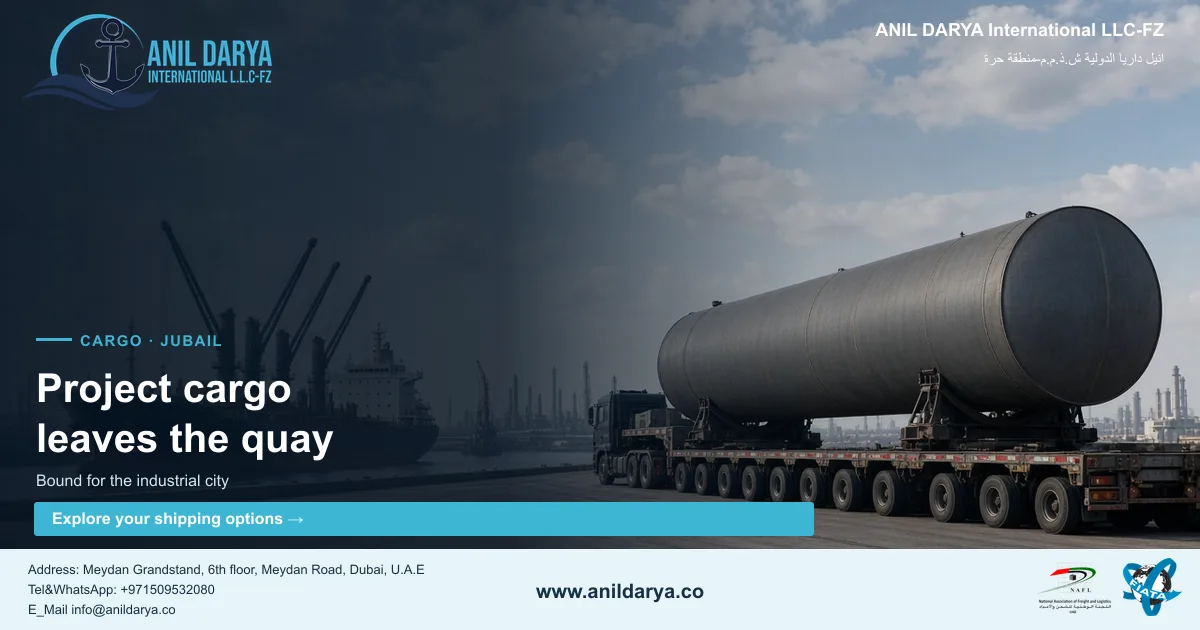
Plant turnarounds and expansions in Jubail bring a steady flow of oversized equipment. Pieces that fit a flat rack or open top travel on container services. Pieces that do not fit move as breakbulk on a geared general cargo or heavy-lift vessel to a general cargo berth or the industrial port's project berth. Our planning order:
- Collect drawings, weights, dimensions and centre of gravity for each piece.
- Confirm the receiving port and berth with the plant: commercial port or King Fahd Industrial Port.
- Choose the equipment: flat rack on a container service, or breakbulk tonnage.
- Check the vessel's draft and crane limits against the berth, and whether shore cranes are needed.
- Line up the Saudi broker, plant gate permits and the road move from quay to site.
If a piece fits a 40ft flat rack, a container service gives you more sailing dates. If not, the breakbulk sailing drives the plan, and a low-bed truck from the UAE may be worth pricing. See our break bulk and project cargo service and the guide to flat rack, open top and out-of-gauge cargo.
Dangerous goods and chemicals at Jubail
Chemicals move both ways at Jubail. Plants export petrochemicals and import catalysts, additives and process chemicals, much of it classed as dangerous goods. ShipNext's port data for Jubail gives these handling rules:
| Rule | What it means for you |
|---|---|
| IMO containers loaded or discharged on direct delivery | The consignee's truck must be ready at the quay when the box comes off |
| Discharge of IMO containers limited to daylight hours | Berthing at night can push your box to the next day |
| Class 1 cargo only under stated conditions | Explosives need specific approvals before booking |
| Cargo documents approved by the authorities at least 7 working days before arrival | Send the packing list and B/L copies to the Saudi side early |
These rules come from a port data provider, not a Mawani circular we could open, so we confirm them with the carrier's Jubail agent for each booking. What you need to provide:
- UN number, proper shipping name, class and packing group.
- A Safety Data Sheet for each product.
- A dangerous goods declaration signed by a trained person.
- UN-approved packaging, labels and placards.
- Any Saudi permit or registration the chemical needs, approved before sailing.
Our dangerous goods shipping team checks carrier acceptance before you commit to a sailing, and our guide to dangerous goods classes helps you check your class.
Rail and road links from Jubail port
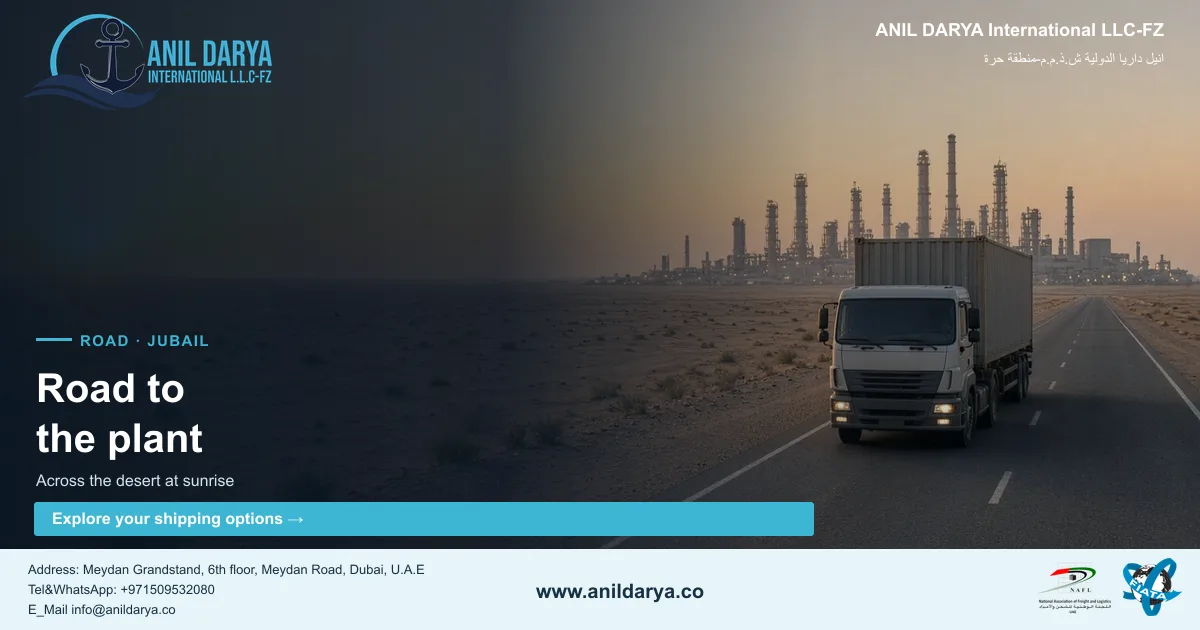
Jubail is connected to the Saudi Arabia Railways network. In March 2026 the railway launched a freight corridor with trains running from King Abdulaziz Port in Dammam, Jubail Commercial Port and King Fahd Industrial Port to the Al-Haditha crossing in the north, more than 1,700 km, with each train carrying more than 400 containers. For most UAE shippers the practical inland leg is still a truck: Fluent Cargo puts Dammam port about 77 km away, and the industrial city's plants are a short drive from the quay.
Customs at Jubail port: a short summary
Jubail follows the same Saudi rules as every other port. ZATCA clears cargo through the Fasah platform, and its import instructions ask for the declaration and documents at least 48 hours before the shipment reaches the port. The core documents are a commercial invoice, a bill of lading and a certificate of origin, plus product-specific certificates where needed.
- Regulated products need SABER certificates (product and shipment) before arrival.
- Most goods from outside the GCC pay at least 5% duty on CIF value, and import VAT is 15%.
- GCC-origin goods can enter duty-free if they meet Saudi origin rules. Non-GCC goods re-exported from Dubai do not qualify.
What is specific to Jubail is the plant side: chemical imports may need the consignee's own registrations, so ask for its broker's name before you ship. Our Dammam port guide covers Saudi customs, SABER and duty in full.
How to ship from Dubai to Jubail port step by step
This is how we handle a typical sea shipment from Dubai to Jubail. We book the space, prepare the UAE side, and work with your Saudi consignee or its clearing agent in Jubail.
- Send the cargo details: commodity, 12-digit HS code, weight, dimensions, UAE pickup point, final delivery address and the Incoterm.
- We confirm the receiving port: Jubail Commercial Port for containers, or the industrial port for plant cargo with its own berth arrangement.
- We check Saudi product rules with you: SABER status, chemical registrations and origin evidence.
- We compare routings: a container from Jebel Ali or Khalifa Port to Jubail, a container to Dammam and truck, or a truck from the UAE.
- We book the space and, for DG, reefer or out-of-gauge cargo, get carrier acceptance.
- We arrange the empty container, stuffing, trucking to the port and the UAE export or re-export declaration.
- The cargo gates in before the carrier's cut-off and loads.
- We send the documents to the Saudi broker so it can file on Fasah at least 48 hours before arrival.
- ZATCA assesses duty and VAT, inspects if selected, and releases the cargo. DG boxes leave on direct delivery.
- The consignee returns the empty within free time.
[AMIR-FACT: our real door-to-door transit time Jebel Ali to Jubail by sea and by truck, and the carriers we actually book to Jubail]
If your cargo starts in Abu Dhabi, we compare a sailing from Khalifa Port. Our Jebel Ali port guide covers the export side in Dubai.
How to ship from Jubail to Dubai
We also handle the other direction: shipping from Jubail to Dubai, with arrival at Jebel Ali, Khalifa Port or Sharjah port. We book the space with the carrier and run the UAE side. The Saudi export filing stays with the shipper or its Saudi customs broker.
The Saudi export side
- Export declaration. ZATCA's export instructions ask for the bill of lading, the invoice and the manifest to complete the export declaration, and ZATCA recommends working with a customs broker. The shipper or its Saudi broker files it.
- Certificate of origin. For duty-free entry in the UAE, each item needs a certificate of origin authenticated by the competent Saudi government agency. Ask the shipper to apply for it before the vessel sails.
- Dangerous goods. Petrochemicals and other DG from Jubail need the shipper's DG declaration and carrier acceptance before booking, as in the DG section above.
The UAE import side
On arrival, the declaration goes to Dubai Customs with the commercial invoice, the packing list, the certificate of origin and any permit from the authority that controls restricted goods. The carrier then releases the cargo against the bill of lading with a delivery order. Customs duty in Dubai is 5% of the CIF value for most goods, with 50% on alcohol and 100% on cigarettes. Import VAT is 5%, charged on the customs value including freight, insurance and customs fees. A VAT-registered importer that meets the Federal Tax Authority conditions accounts for it on its VAT return instead of paying at the border.
Goods of Saudi national origin can enter the UAE free of customs duty. Under the GCC Unified Economic Agreement, agricultural, animal, industrial and natural resource products of national origin are exempt from reciprocal customs charges between member states. For manufactured goods, the value added in the member states must be at least 40% of the final value, and GCC citizens must own at least 51% of the producing plant. Each exempt item must travel with a certificate of origin authenticated by the competent government agency. Import VAT of 5% still applies.
- Send us the shipper's details in Jubail, the cargo, the HS code and the UAE delivery address.
- We book space from Jubail to Jebel Ali, Khalifa Port or Sharjah and send the booking and cut-offs to the shipper.
- The shipper or its trucker delivers the container to the Jubail Commercial Port container terminal before the cut-off.
- The shipper or its Saudi agent files the export declaration with ZATCA before the cut-off.
- We check the draft bill of lading against the invoice and packing list before it is issued.
- We file the UAE declaration before the vessel arrives, so clearance can start when it berths.
- We arrange payment of the duty and VAT and collect the delivery order from the carrier.
- We truck the cargo to your site and return the empty container inside the free time.
[AMIR-FACT: the carriers we actually use from Jubail to Jebel Ali, Khalifa Port or Sharjah, our real transit days in this direction, and whether we also truck Jubail cargo to the UAE]
Shipping from Dubai to Jubail by sea or by road?
Road freight is a real alternative on this lane. Trucks leave the UAE at Ghuwaifat in western Abu Dhabi and enter Saudi Arabia at Al-Batha, which Saudipedia describes as the Kingdom's only land port with the UAE. Cargo for Jubail is then cleared at the border or moved under a transit declaration that a licensed broker files on Fasah. There is no sea leg, no port handling and no container to return.
| Your cargo | Usually better | Why |
|---|---|---|
| Full containers already at Jebel Ali or in Jafza | Sea to Jubail or Dammam | Box is at the port, no border queue |
| A few pallets for a Jubail plant | Road groupage | Door to door on one truck |
| Urgent spare parts | Road, or air to King Fahd International Airport | Fewer handling points |
| Restricted DG classes | Sea, with approvals | Road DG adds permits in two countries |
| Oversized plant equipment | Breakbulk to Jubail, or low-bed truck if permits allow | Depends on size, weight and route permits |
The Saudi rules are the same either way. What changes is cost, time and handling. We can price both side by side.
Jubail or Dammam: which port fits your cargo?
| Your situation | Better starting option |
|---|---|
| Consignee in Jubail Industrial City | Jubail, if your carrier calls there |
| Consignee in Dammam, Al Khobar or Dhahran | Dammam |
| Regular flow to Riyadh | Dammam, with rail to the Riyadh dry port |
| Chemicals or project cargo for a Jubail plant | Jubail, commercial or industrial port as the plant directs |
| LCL for the Eastern Province | Often Dammam, then truck |
If your carrier does not call Jubail, the container may discharge at Dammam and travel north by truck. Make sure free time covers the extra leg.
Free time and demurrage at Jubail
After the line's free days, demurrage runs in the port and detention outside it. Read free days and rates on the quote and arrival notice. At Jubail, plant gate slots and DG direct delivery are the usual time traps. Our article on demurrage and detention shows how the charges build up.
Checklist before you ship to Jubail
- Receiving port confirmed: Jubail Commercial Port, King Fahd Industrial Port or Dammam.
- 12-digit HS code confirmed for every invoice line.
- SABER certificates in place for regulated products.
- Chemical registrations and permits approved before sailing.
- Invoice, packing list and bill of lading match on weights, piece counts and consignee.
- Saudi broker ready to file on Fasah at least 48 hours before arrival.
- Plant delivery instructions, gate pass and site contact received.
- For DG: SDS, DG declaration, labels and a truck ready for direct delivery.
- For project cargo: drawings, lift plan and receiving berth agreed.
Common mistakes when shipping to Jubail
- Writing "Jubail" without saying which port. Commercial and industrial port are separate harbours.
- Planning on the 18 m depth before the upgrade is finished. Check today's draft with the carrier.
- Assuming every service calls Jubail. Many discharge at Dammam and truck north.
- Sending DG without a truck booked. Direct delivery means the box cannot wait in the port.
- Missing the plant's own vendor and gate rules, which hold cargo at the gate.
Frequently asked questions
What are the two ports in Jubail?
Jubail has Jubail Commercial Port in the south, which handles containers, general cargo and bulk, and King Fahd Industrial Port in the north, which serves the plants of Jubail Industrial City. Both are owned by the Saudi Ports Authority (Mawani).
What is the port code for Jubail?
Jubail Commercial Port uses the UN/LOCODE SAJUB. King Fahd Industrial Port in Jubail uses SAKFH.
Who operates the container terminal at Jubail?
Saudi Global Ports started operating the container terminal at Jubail Commercial Port in April 2026 under a 30-year agreement with Mawani. Gulftainer ran it before.
How big is the Jubail container terminal?
Today it has about 1,000 m of quay, 14 m depth and around 1.5 to 1.6 million TEU of capacity. The upgrade plan takes it to 1,400 m, 18 m depth and 2.4 million TEU.
How many berths does King Fahd Industrial Port Jubail have?
It has 34 berths across five terminals, with a stated capacity of 70 million tonnes a year. One Saudi shipping agent lists 27 berths, of which 19 are operational, so check the berth for your cargo.
Can I ship dangerous goods to Jubail?
Yes, with approvals. Port data shows IMO containers are handled on direct delivery and discharged in daylight hours, and documents should be approved at least 7 working days before arrival. Class 1 needs special conditions.
Can I send cargo from Dubai to Jubail by truck?
Yes. Trucks leave the UAE at Ghuwaifat and enter Saudi Arabia at Al-Batha, then drive up the coast to Jubail. Road suits pallets and urgent parts, while full containers and heavy cargo often suit the sea route.
Is Jubail connected by rail?
Yes. Saudi Arabia Railways runs freight trains from both Jubail ports and Dammam port, including a corridor of more than 1,700 km to the northern border launched in March 2026.
How do I ship from Jubail to Dubai?
The shipper or its Saudi broker files the export declaration with ZATCA and delivers the container before the cut-off. We book the space, file the Dubai Customs declaration before arrival and arrange payment of the 5% VAT. Saudi-origin goods with an authenticated GCC certificate of origin are exempt from UAE customs duty.
Get a quote for Jubail port shipping
Send us your cargo details and we will come back with a routing and a price for Jubail by sea, road or both. Use our freight rate inquiry form, or contact our team to talk through DG, project cargo or a plant delivery first.
Sources
- Saudi Global Ports: Jubail container terminal (berth, depth, capacity, equipment)
- Marine Insight: SGP begins operations at Jubail Container Terminal (April 2026; investment, upgrade plan)
- Enterprise: Mawani doubles down on Jubail (April 2026; SGP ownership, upgrade figures)
- The Maritime Executive: SGP begins operations at Jubail Container Terminal
- PSA: SGP awarded four 20-year multipurpose terminal concessions (June 2025)
- Gulftainer: Jubail Commercial Port terminal page (drafts, reefer plugs, CFS, cranes)
- Sharaf Shipping Saudi Arabia: port info (berth split, storage, channel, shifts)
- ShipNext: Jubail SAJUB (harbour layout, commercial port cargo, DG and document rules)
- ShipNext: King Fahd Industrial Port Jubail (berths, OSTT and PCQ-1 limits, traffic)
- Wikipedia: King Fahd Industrial Port (Jubail) (berths, capacity, terminals, UN/LOCODE)
- Saudipedia: Al-Jubayl Industrial City (Royal Commission, companies, investment)
- Ship Technology: MSC service adds Jubail Commercial Port (January 2023)
- Fluent Cargo: Jubail SAJUB (carriers, airport and port distances)
- Arab News: rail freight corridor from Eastern Province ports (March 2026)
- ZATCA: Import instructions (documents, Fasah, 48-hour rule)
- ZATCA: Submit transit declaration (Fasah)
- US International Trade Administration: Saudi Arabia import tariffs (duty, VAT, 12-digit codes)
- Saudipedia: Al-Batha Port
- Wikipedia: Ghuwaifat border post
- ZATCA: Export instructions (bill of lading, invoice, manifest, customs broker)
- GCC Secretariat General: Unified Economic Agreement (Articles 2 and 3, national products and certificate of origin)
- Dubai Customs: Submit customs declaration (invoice, packing list, certificate of origin, permits)
- Dubai Customs: FAQ (5% of CIF value, alcohol and cigarettes)
- UAE Government portal: Clearing customs and paying customs duty (5% of CIF in Dubai)
- Federal Tax Authority: VAT guide, section 3.5 on import VAT (5%, customs value, registered importers)
Reviewed: 10 November 2026