
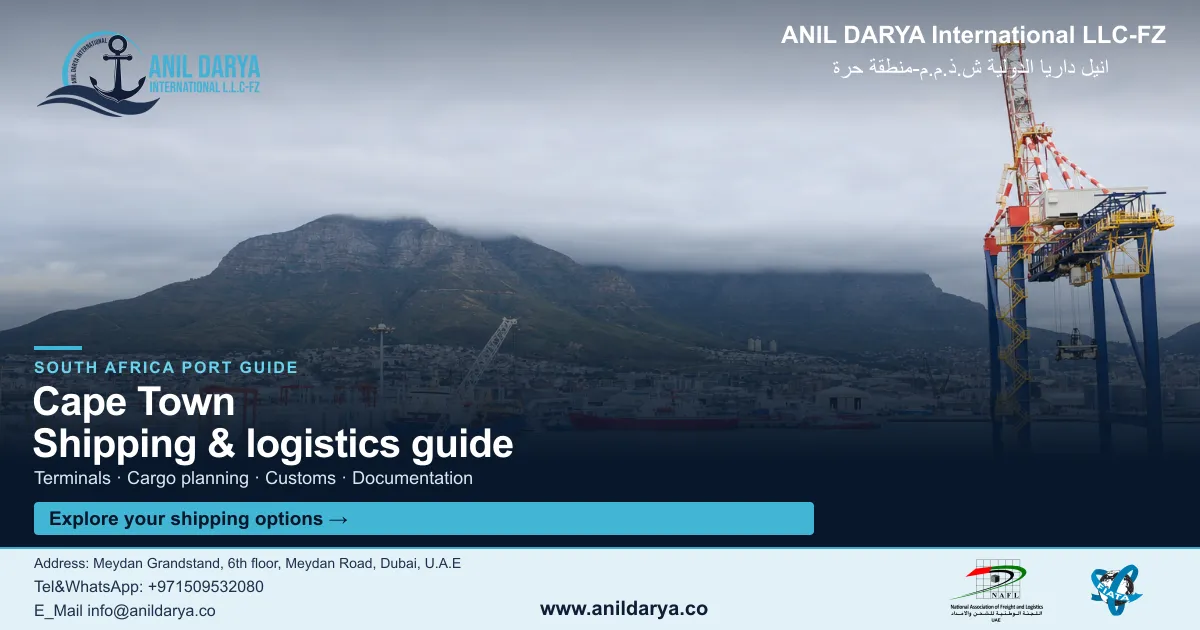
Port of Cape Town shipping covers South Africa's second-largest container port, in Table Bay next to the Cape Town city centre. It handled 843,599 TEU in 2025, leads the country in fresh fruit exports, and is the natural port for consignees in the Western Cape. This guide covers the docks and terminals, the wind that shapes vessel schedules, reefer and breakbulk cargo, SARS clearance at Cape Town, and how to ship there from Dubai. We ship both ways: from Dubai to Cape Town, and from Cape Town to Dubai.
Port of Cape Town at a glance
| Item | Detail |
|---|---|
| Port authority | Transnet National Ports Authority (TNPA) |
| Container terminal operator | Transnet Port Terminals (TPT), Cape Town Container Terminal (CTCT) |
| UN/LOCODE | ZACPT |
| Location | Table Bay, beside the Cape Town central business district |
| Port area | About 9,163 ha of water and 253 ha of land |
| Berths | 42 |
| Main docks | Ben Schoeman Dock (containers) and Duncan Dock (multipurpose, fruit, tankers, repair) |
| Containers handled, 2025 | 843,599 TEU (427,312 landed, 416,287 shipped) |
| Container berth depth after expansion | 15.5 m |
| Commercial vessel calls | Over 1,860 a year |
| Rail inside the port | 178 km of track |
| Main cargo strength | Fresh fruit and other reefer exports, containers, liquid bulk |
| Customs | South African Revenue Service (SARS) |
| Import VAT | 15% of the added tax value |
| Cape Town to Dubai | SARS goods declaration by the registered exporter or its clearing agent; PPECB inspection for perishable exports; Dubai duty 5% of CIF for most goods |
Where is the Port of Cape Town and what is it used for?
The port sits in Table Bay on the south-west coast of South Africa, directly next to the city centre and the V&A Waterfront. It is the largest port in the Western Cape and one of South Africa's eight commercial ports. Port data lists fruit, wine and meat as main exports, and machinery, clothing and tiles among imports.
For a shipper in Dubai, the key point is the delivery address. Cape Town is the natural port for consignees in Cape Town and the rest of the Western Cape. Cargo for Johannesburg and Gauteng usually goes through Durban instead, which we cover in our Durban port guide.
Which docks and terminals does the Port of Cape Town have?
Cape Town has two main commercial docks behind its breakwaters, plus the older Victoria and Alfred Basins, which now serve the V&A Waterfront, small craft and some passenger vessels.
| Dock or terminal | What it handles | Why it matters to you |
|---|---|---|
| Ben Schoeman Dock: Cape Town Container Terminal (CTCT) | Containers, including reefer boxes | Where your FCL or LCL box from Dubai lands |
| Duncan Dock: Multipurpose Terminal (MPT) | Six berths for general cargo, with temperature-controlled facilities for fresh produce and fish | Breakbulk, steel, project pieces and conventional reefer cargo |
| Duncan Dock: tanker basin and liquid bulk | Petroleum products and other liquids | Bulk liquid imports |
| Duncan Dock: dry dock and repair quay | Ship repair | Not used for cargo |
| Cape Town Cruise Terminal | Cruise ships | Not used for cargo |
The container terminal at Ben Schoeman Dock (CTCT)
CTCT is one of four container terminals run by Transnet Port Terminals. Its expansion, started in 2008, rebuilt the container berths 601 to 604 at Ben Schoeman Dock, deepened them to 15.5 m, and replaced the old straddle carrier system with rubber-tyred gantry cranes. TNPA describes the container berth deepening, the widening of three of the four container quays, and ship-to-shore cranes with double-lift capacity and a reach of 19 containers across.
TPT says the terminal operates close to capacity. From 2025 it began taking delivery of a new batch of rubber-tyred gantry cranes to speed up the yard. For you, that means delays at peak times are still possible, so build a few days of slack into any Cape Town delivery promise.
Which carriers call at Cape Town?
Cogoport's capacity snapshot for March 2026 put CMA CGM (29.0%), Maersk (23.0%), Ocean Network Express (16.9%) and MSC (9.4%) as the largest operators at Cape Town, followed by PIL, COSCO and Hapag-Lloyd. Jebel Ali appears among Cape Town's main import port pairs. This tells you a Dubai shipper has several lines to choose from, but most of them route Gulf cargo through a hub port first.
Wind and weather: why Cape Town schedules slip
Table Bay is exposed to strong winds and has a long history of storms. Wind has previously shut port operations for about 1,200 hours a year. When cranes stop, vessels wait at anchor and the whole schedule moves.
The port has taken steps to reduce this. TNPA started a helicopter pilot transfer service in 2023, so pilots can board when the sea is too rough for a pilot boat, and anti-sway equipment is being fitted to cranes. Even so, plan for wind:
- Do not promise a delivery date based only on the vessel's scheduled arrival.
- Ask the carrier for extra free time on imports that cannot wait, to cover a possible wind delay.
- For exports, gate-in early: a wind stop near the cut-off can roll your box to the next vessel.
What cargo can you ship through the Port of Cape Town?
TNPA's 2021 figures give a picture of the cargo mix: 841,609 TEU of containers, 4.9 million kilolitres of liquid bulk, 1.3 million tonnes of dry bulk and 459,383 tonnes of breakbulk. Containers dominate.
| Cargo from the UAE | Where it is handled | What to plan |
|---|---|---|
| General goods (FCL, LCL) | CTCT, Ben Schoeman Dock | Road weight limits, SARS documents, wind slack |
| Chilled and frozen food | CTCT reefer stacks or MPT cold stores | Set temperature, health and import permits |
| Steel, machinery, project cargo | Multipurpose Terminal, Duncan Dock | Lifting plan, road permits, inspection space |
| Used tyres or used clothing | CTCT or MPT | ITAC import permit before shipping |
| Dangerous goods | CTCT under TNPA rules | Carrier acceptance; Class 1 and 7 need prior approval |
| Petroleum and liquid bulk | Duncan Dock tanker basin | Receiving terminal, surveys |
Containers at Cape Town: imports, exports and reefers
Cape Town is an export-led container port. In 2025 it shipped 324,948 TEU of full containers but landed only 231,682 TEU of full containers. Cape Town handles the largest volume of fresh fruit of any South African port, which helps explain the gap. Two things follow for Gulf shippers.
- Reefer traffic is growing. Port reports cited by Wikipedia show refrigerated container volumes up 32% in August 2025, so reefer plugs and equipment are busy in the fruit season. Book reefer imports early.
- Export dwell is longer than import dwell. Cogoport's tracker showed imports averaging 3.7 days in the terminal in February 2026 against 5.9 days for exports.
For imports from Dubai, you choose between FCL and LCL as anywhere else. LCL boxes are unpacked at a depot in Cape Town, so release depends on the whole container clearing. Our guide to FCL vs LCL costs explains when a full box pays off.
Road weight limits for delivery from the port
South African road haulage limits are tighter than many shippers expect. Maersk publishes these maximum gross weights, including the container tare and any reefer genset:
| Container | Maximum gross for road haulage |
|---|---|
| 20ft dry or reefer | 30 tonnes |
| 40ft dry | 31.5 tonnes |
| 40ft reefer | 31.5 tonnes |
| 45ft | Not accepted in South Africa |
A heavy 20ft box of tiles, steel or stone loaded to the maximum in Jebel Ali can be over the road limit in Cape Town. Agree the payload with the consignee before you load.
Breakbulk and project cargo at Cape Town
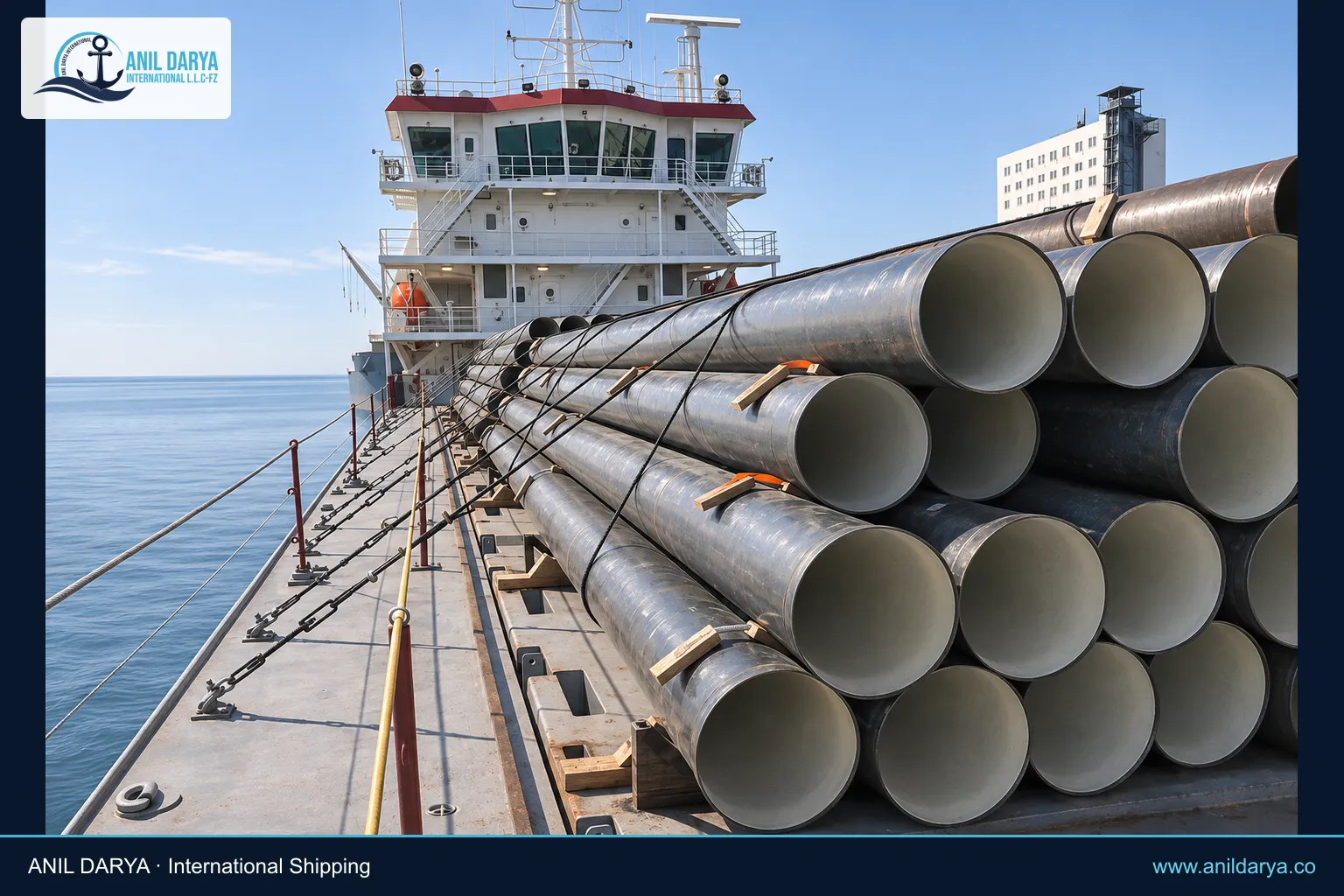
Breakbulk at Cape Town moves through the Multipurpose Terminal in Duncan Dock, which handles cargo such as steel, timber, paper, cement, scrap metal, vehicles and general cargo. Volumes are modest: 459,383 tonnes of breakbulk in 2021. Check conventional breakbulk sailings early, because a project shipment may need a vessel that calls specially.
When we plan a project piece into Cape Town, we work in this order:
- Collect drawings, weights and centre of gravity for each piece.
- Choose flat rack on a container service via a hub, or a breakbulk vessel calling at Duncan Dock.
- Confirm lifting gear: ship's cranes or a hired mobile or floating crane.
- Plan the road move with the consignee's haulier, including abnormal load permits.
- Line up the SARS declaration and any ITAC permit so the cargo leaves the quay quickly.
See our break bulk and project cargo service and our heavy-lift shipping guide.
Dangerous goods through the Port of Cape Town
Dangerous goods to Cape Town move in IMDG containers on the container services. Maersk's South African cargo rules say hazardous Classes 1 and 7 need approval before acceptance, and DG charcoal is not accepted. Other lines have their own lists, so carrier acceptance is the first check, not the last.
What you need for any DG booking to Cape Town:
- UN number, proper shipping name, class and packing group.
- A safety data sheet (SDS) for each product.
- A signed dangerous goods declaration and container packing certificate.
- UN-approved packaging, labels and placards.
- Acceptance from the carrier on every leg, including the transshipment port.
Because wind can delay discharge, ask the consignee to have a truck and a release ready before arrival, so the DG box does not wait long in the terminal. Our dangerous goods shipping team checks the documents and acceptance before you commit to a sailing.
Customs clearance at the Port of Cape Town
SARS clears cargo at Cape Town under the same national rules as every South African port. Here is the short version for Cape Town imports.
- The importer must be registered with SARS. The importer or its agent makes the goods declaration.
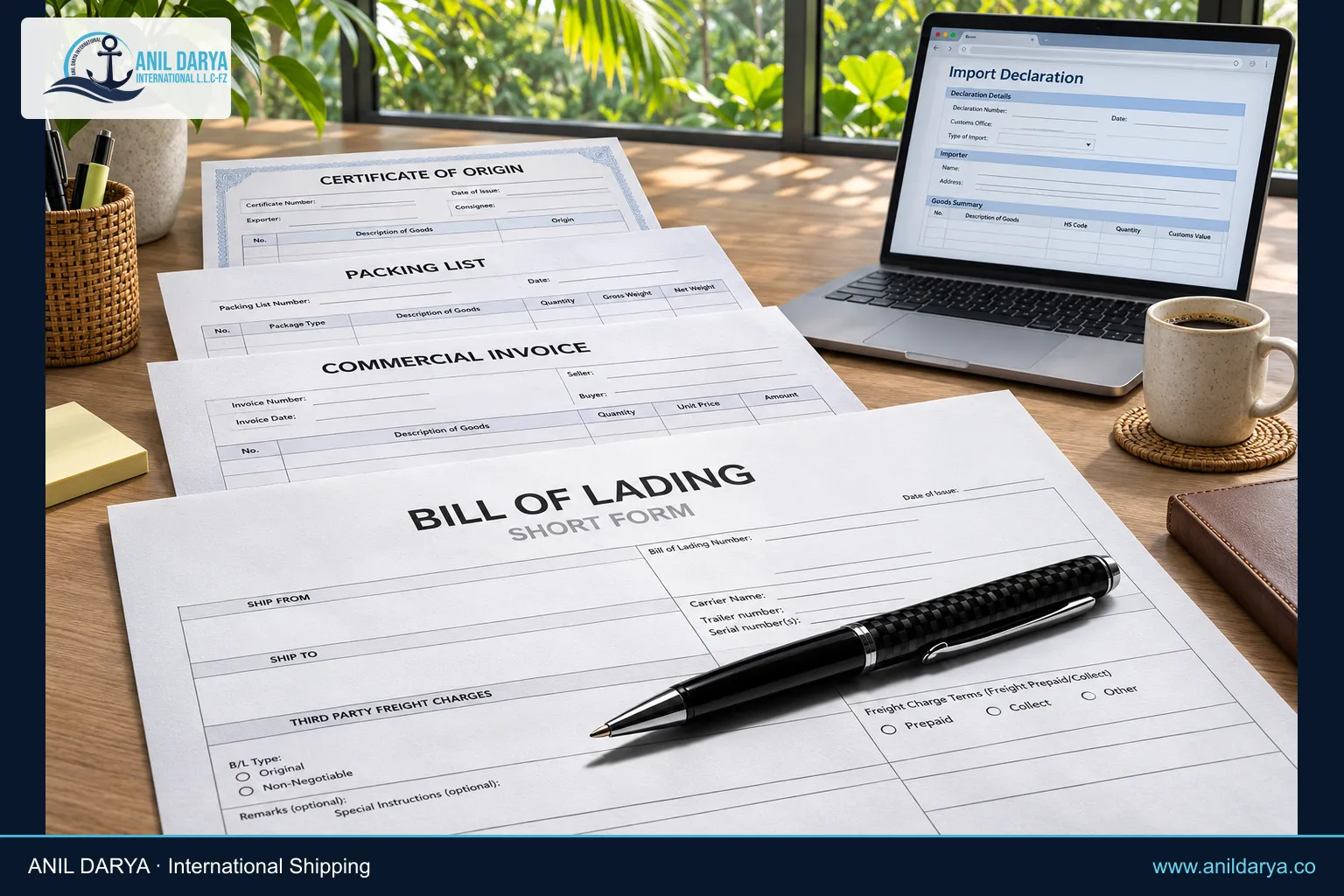
- Customs checks the declaration against the invoice, bill of lading, certificate of origin and any permits.
- Restricted goods need a permit from the International Trade Administration Commission (ITAC), produced at clearance. Maersk's cargo rules name used tyres and textile waste or used clothing as cases that need one.
- SARS may examine the goods, ask for samples, or hold them for another government department.
| Cargo situation at Cape Town | Time to declare after landing |
|---|---|
| Most goods | 7 days |
| Loose or break bulk cargo imported by sea | 14 days |
| Goods in a container depot | 28 days |
Goods not declared in time can be moved to the State Warehouse. If SARS, the police (SAPS) or the NRCS stop a container, it is inspected at a depot, and the clearing agent or a representative should attend.
Import VAT is 15% of the added tax value: the customs value plus 10%, plus any non-rebated duty. Duty depends on the tariff heading.
How long does shipping from Dubai to Cape Town take?
Published figures vary a lot, because most services transship. Crown Relocations gives a direct sailing time of 28 days from Jebel Ali to Cape Town. Fluent Cargo's schedule data shows its quickest option from Khor Fakkan at about 38 days with one transfer, sailing 2 to 4 times a week, on services that connect to Maersk, Hapag-Lloyd, COSCO, ONE, OOCL and ZIM South Africa loops. Treat both as indications and check the arrival date on your booking.
[AMIR-FACT: the carriers or services we actually book from Jebel Ali to Cape Town, the hub they transship at, and our typical port-to-port days on this lane in 2026]
For urgent cargo, Fluent Cargo lists direct flights from Dubai to Cape Town of about 9 hours 38 minutes, 2 to 4 times a day, on passenger aircraft. Our air cargo service handles this, including DG by air.
How to ship from Dubai to the Port of Cape Town: step by step
Sea freight to Cape Town normally loads at Jebel Ali. Our Jebel Ali port shipping guide covers the UAE export side.
- Send us the cargo details: commodity, tariff code, weight, volume or dimensions, origin and the Incoterm agreed with the buyer.
- Confirm the South African side. The consignee is registered with SARS and has a clearing agent in Cape Town, and any ITAC permit is applied for.
- Check the payload against South African road weight limits.
- We compare services into Cape Town, the hub port and the transit time.
- Book space. For DG, reefer or out-of-gauge cargo we get carrier acceptance first.
- We arrange UAE trucking, export clearance and gate-in at Jebel Ali before the cut-off.
- After sailing, we send the bill of lading, invoice, packing list and certificate of origin to the consignee's clearing agent.
- The agent lodges the declaration within the SARS deadline and pays duty and VAT.
- Once SARS releases the box and the line issues the delivery order, the haulier collects it from CTCT.
- The empty goes back to the depot the line names, within free time.
How to ship from the Port of Cape Town to Dubai
We also handle the other direction: shipping from Cape Town to Dubai, with arrival at Jebel Ali, Khalifa Port or Sharjah port. Fruit and other reefer cargo is the obvious fit, given Cape Town's fruit trade. We book the space with the carrier and run the UAE side. The South African export papers stay with the shipper or its clearing agent in South Africa.
The South Africa export side
- Registration. Exporters and their clearing agents must be registered or licensed with SARS before a declaration is made.
- Goods declaration. The exporter or its clearing agent lodges the goods declaration with SARS before the goods leave, unless a specific rule exempts them. Supporting documents must be produced if customs asks for them.
- Permits. Some goods are prohibited for export and others need a permit, for example from ITAC, which must be produced at clearance.
- Perishables. PPECB is South Africa's official certification agency for perishable exports. It inspects the product before export and stamps passed consignments, and it also runs cold chain services for reefer cargo.
- Pickup. The shipper or its haulier collects the empty, loads it and delivers it to CTCT before the carrier's cut-off.
The UAE import side
On arrival, the declaration goes to Dubai Customs with the commercial invoice, packing list, bill of lading, certificate of origin and any permit for restricted goods. For fresh fruit, the consignee should check its UAE food import requirements before the box sails. Customs duty in Dubai is 5% of the CIF value for most goods, with 50% on alcohol and 100% on cigarettes. Import VAT is 5%, and a VAT-registered importer that meets the Federal Tax Authority's conditions can account for it on its VAT return.
- Send us the shipper's details in South Africa, the cargo, the HS code, any reefer setting and the UAE delivery address.
- We book space ex Cape Town and send the booking and cut-offs to the shipper.
- The shipper or its haulier collects the empty, loads it and delivers it to CTCT.
- The shipper or its clearing agent lodges the SARS export declaration and, for perishables, arranges the PPECB inspection.
- We check the draft bill of lading against the invoice and packing list.
- We file the UAE declaration before arrival and arrange payment of the duty and VAT.
- We collect the delivery order, truck the box to your site and return the empty inside free time.
[AMIR-FACT: the carriers we actually use from Cape Town to Jebel Ali, Khalifa Port or Sharjah, and our real transit days in this direction]
Checklist before you ship to Cape Town
- Consignee registered with SARS and a clearing agent named.
- Tariff code checked for duty and VAT.
- ITAC permit in hand for restricted goods such as used tyres or used clothing.
- Gross weight within the South African road limit for the container size.
- Certificate of origin issued.
- For reefer cargo: set temperature and any health certificates.
- For DG: SDS, DG declaration and acceptance on every leg.
- Free time agreed, with a buffer for wind delays.
- Delivery address confirmed as Western Cape. If it is Gauteng, compare Durban.
Common mistakes at the Port of Cape Town
- Booking Cape Town for a Johannesburg consignee. The inland leg is long; Durban is usually closer.
- Promising a delivery date without allowing for wind stops.
- Loading a 20ft box over 30 tonnes gross.
- Shipping restricted goods without an ITAC permit.
- Missing the 7-day declaration window and losing the goods to the State Warehouse process.
- Assuming a DG class is accepted because it was accepted on another lane.
- Nobody attending a customs stop at the depot, which slows the inspection.
Cape Town or another South African port?
TNPA's 2025 figures show how Cape Town compares with the other container ports.
| Port | Containers in 2025 | When to choose it |
|---|---|---|
| Durban | 2,732,190 TEU | Gauteng and KwaZulu-Natal consignees |
| Cape Town | 843,599 TEU | Western Cape consignees, reefer and fruit-related cargo |
| Ngqura | 747,847 TEU | Eastern Cape sites |
| Port Elizabeth | 130,715 TEU | Eastern Cape breakbulk and smaller volumes |
The cheapest sea rate is not always the cheapest landed cost. Price the inland leg from each port to the final address before you choose.
Frequently asked questions
What is the port code for Cape Town?
The UN/LOCODE for the Port of Cape Town is ZACPT. You will see it on bookings, bills of lading and tracking systems.
Who runs the port and its terminals in Cape Town?
Transnet National Ports Authority is the port authority. Transnet Port Terminals runs the Cape Town Container Terminal at Ben Schoeman Dock and the Multipurpose Terminal at Duncan Dock.
How many containers does Cape Town handle?
Cape Town handled 843,599 TEU in 2025, according to TNPA. That makes it South Africa's second-largest container port after Durban.
Why are vessels delayed at Cape Town?
Strong wind in Table Bay is the main reason. Wind has previously stopped port operations for about 1,200 hours a year, so vessels wait at anchor until cranes can work again.
How long does shipping from Dubai to Cape Town take?
Published figures range from a 28-day direct sailing quoted by Crown Relocations to about 38 days with one transfer in Fluent Cargo's data. Your carrier and hub decide the real time.
How do I ship from Cape Town to Dubai?
The shipper or its clearing agent, registered with SARS, lodges the export declaration and delivers the box to CTCT. Perishables also pass a PPECB inspection. We book the space, file the Dubai Customs declaration, arrange payment of the 5% duty and 5% VAT, and deliver the cargo.
What documents do I need to clear cargo at Cape Town?
SARS checks the declaration against the commercial invoice, bill of lading, certificate of origin and any permits. Restricted goods, such as used tyres and used clothing, also need an ITAC permit.
How long can I leave uncleared cargo at Cape Town?
SARS gives 7 days after landing for most goods, 14 days for loose or break bulk cargo by sea, and 28 days for goods in a container depot. After that, goods can be moved to the State Warehouse.
What is the maximum container weight for delivery from Cape Town?
Maersk lists 30 tonnes gross for a 20ft container and 31.5 tonnes for a 40ft, including tare and any genset. 45ft containers are not accepted in South Africa.
Can I ship dangerous goods to Cape Town?
Yes, in IMDG containers with carrier acceptance. Some lines need prior approval for certain classes; Maersk, for example, requires it for Classes 1 and 7.
Get a quote for Port of Cape Town shipping
Send us the cargo details and the delivery address in South Africa, and we will come back with a routing and a price into Cape Town. Use our freight rate inquiry form, or contact our team to talk through a reefer, DG or project shipment first. You can also read more about our Dubai freight forwarding team.
Sources
- Transnet National Ports Authority: Our Ports, Port of Cape Town (area, berths, rail, cargo 2021, expansion, MPT, marine services)
- Transnet National Ports Authority: Port statistics, 2025 calendar year
- Transnet National Ports Authority: Containers handled by port, 2025 (TEU, full and empty, landed and shipped)
- Transnet Port Terminals: Container services (CTCT close to capacity)
- Wikipedia: Port of Cape Town (LOCODE, docks, wind downtime, cranes, fruit)
- MarineLink: Milestone for Cape Town Container Terminal expansion (Transnet, May 2011)
- Ship Technology: Port of Cape Town (docks, Multipurpose Terminal cargo)
- ShipNext: Cape Town port data (cargo mix)
- Cogoport: Cape Town port info (dwell times, operator capacity, port pairs)
- Maersk: South Africa imports (cargo restrictions, road weight limits, customs-stopped containers)
- SARS: Imports (clearance, documents, declaration deadlines)
- SARS: Duties and taxes for importers (VAT and added tax value)
- SARS: Goods declaration (exporters and agents must be registered, declaration before export)
- SARS: Exports (exporter registration, permits from ITAC)
- PPECB: Product inspection services (official certification agency for perishable exports)
- Dubai Customs: Submit customs declaration (documents)
- Dubai Customs: FAQ (5% of CIF, alcohol 50%, cigarettes 100%)
- UAE Government portal: Customs duty
- Federal Tax Authority: VAT guide (import VAT at 5%, deferral to the VAT return)
- Crown Relocations: Relocating from the UAE to South Africa (sailing times)
- Fluent Cargo: Dubai to Cape Town sea and air schedule data
Reviewed: 10 November 2026