
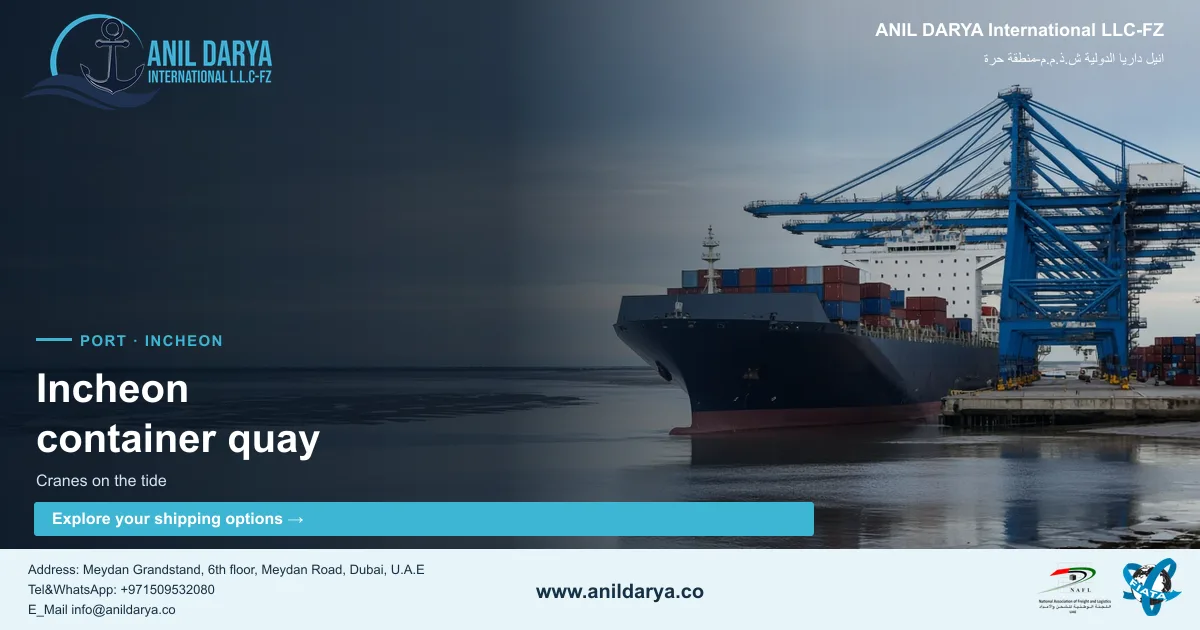
Port of Incheon shipping is the sea gateway to Seoul and the wider capital region. Incheon is Korea's second container port after Busan, with more than 3 million TEU a year, a lock-controlled inner harbour and newer deep-water terminals at Incheon New Port. This guide covers the port areas, tide and size limits, cargo types, a short customs summary and how we move your cargo from Dubai to Incheon. We ship both ways: from Dubai to Incheon, and from Incheon to Dubai.
Port of Incheon shipping: key facts at a glance
| Item | Detail |
|---|---|
| Port authority | Incheon Port Authority (IPA) |
| Customs | Korea Customs Service (KCS), Incheon Main Customs; declarations through UNI-PASS |
| UN/LOCODE | KRINC |
| Location | West coast, mouth of the Han River on the Yellow Sea; roughly 27 to 35 km west of Seoul |
| Incheon International Airport | About 18 km from the port |
| Main areas | Inner Port, South Port, North Port, Incheon New Port, international ferry terminals |
| Container terminals named in port guides | Incheon Container Terminal (ICT), Sun Kwang New Container Terminal (SNCT), Hanjin Incheon Container Terminal (HJIT) |
| Container volume | 3.1 million TEU in 2022; over 3 million TEU in 2023 |
| Largest container ships listed | 10,000 TEU at 14.0 m (tidal) in one port database; New Port berths built for the 12,000 TEU class in another |
| Tidal range | Up to about 10 m |
| Inner Port | Behind lock gates, ships up to 50,000 DWT |
| Bulk volumes (2021) | 54 million tonnes dry bulk, 51 million tonnes liquid bulk |
| Import VAT | 10% on customs value plus duty |
| Trade agreement with UAE | UAE-Korea CEPA, in force since 1 May 2026 |
| Incheon to Dubai | Korean export declaration by the exporter or its broker; Dubai Customs declaration, 5% duty on CIF for most goods and 5% import VAT |
Where is Incheon port and why does the tide matter?
Incheon sits on Korea's west coast where the Han River meets the Yellow Sea. Seoul is roughly 27 to 35 km away, depending on the source and the terminal. About 26 million people live in the Seoul capital region, so Incheon is the closest seaport to Korea's largest consumer market.
The defining feature of Incheon is the tide. The range can reach about 10 m. That is why the old Inner Port sits behind lock gates in a closed basin, and why port data lists different draughts for spring and neap tides.
What this means for you: berth timing at the Inner Port depends on the lock. Normal waiting time for a berth is about 1 to 2 days, subject to the order of lock transits. The newer container terminals at South Port and New Port face open water and do not need the lock.
Size limits for the Inner Port
| Limit | Figure |
|---|---|
| Maximum draught | 11.7 m at spring tide, 10.7 m at neap tide |
| Maximum beam | 32.3 m |
| Maximum length | 250 m |
| Maximum size in the wet basin | 50,000 DWT |
These limits rarely matter for a container booking, because the carrier picks a berth that fits the ship. They matter a lot for a chartered breakbulk or project ship. Check them before you fix a vessel.
Which port areas and container terminals does Incheon have?
Incheon is not one quay. It is a set of separate port areas, each with its own job. Your arrival notice tells you which one your cargo uses.
| Area | Main cargo | Key facts |
|---|---|---|
| Inner Port | Bulk, general cargo, vehicles, passengers | Behind lock gates; 46 berths usable at the same time; Korea's first container pier opened here in 1974 |
| South Port | Containers and coastal shipping | 3 container berths for 4,000 TEU-class ships plus 4 general berths; home of ICT |
| North Port | Timber, steel and other specialised cargo | About 17 berths for lumber, steel and similar cargo |
| Incheon New Port | Deep-sea containers | Phase 1 is a 1.6 km terminal with 6 berths at Songdo; SNCT and HJIT |
| International ferry terminals | Passengers and ferry cargo to China | 2 terminals; 9 shipping companies to 10 cities in northern China |
The New Port container area at Songdo
Incheon New Port is the container area for larger ships. Phase 1 sits at the south-western end of Songdo International Business District. SNCT partly opened in June 2015 and its 800 m terminal fully opened in April 2017. HJIT partly opened in March 2016. The development plan adds 6 more berths in Phase 2, and the final plan lists 13 container berths and 4 general berths.
Songdo is part of the Incheon Free Economic Zone. If your consignee runs a warehouse or plant there, the last-mile truck leg from New Port is short.
South Port and the ICT terminal
South Port has 3 container berths for 4,000 TEU-class ships, so it suits the smaller intra-Asia ships that feed Incheon from regional hubs. If your box is transshipped, ask which terminal the feeder uses, because South Port and New Port are separate sites with separate truck gates.
What cargo moves through the Port of Incheon?
Incheon handles electronics, machinery and chemicals for the Seoul region, plus large bulk flows. Port guides put its container volume at 3.1 million TEU in 2022 and over 3 million TEU in 2023. In 2021 it also moved about 54 million tonnes of dry bulk and 51 million tonnes of liquid bulk.
Port data lists facilities for breakbulk, containers, liquid bulk, dry bulk, passengers, LPG, LNG and multipurpose cargo. One port database gives the largest ships by type as follows.
| Cargo type | Largest ship listed | Depth |
|---|---|---|
| Breakbulk | 50,000 DWT | 12.5 m (tidal) |
| Containers | 10,000 TEU | 14.0 m (tidal) |
| Ro-Ro | 50,000 DWT | 12.5 m (tidal) |
| Dry bulk | 150,000 DWT | 24.5 m (tidal) |
| Tankers | 330,000 DWT | 13.3 m draught |
| Gas carriers | 127,000 DWT | 16.2 m (tidal) |
Incheon is also a big export port for used cars, auto parts and construction equipment to the Middle East. IPA expected a 2023 service to the Gulf to carry about 50,000 TEU a year of these goods.
Carrier capacity tracked at Incheon in March 2026 was led by HMM with 28.2%, then KMTC with 7.2%, CMA CGM with 4.2%, Evergreen with 2.6% and Sinokor with 2.2%. Many smaller intra-Asia lines make up the rest. In 2022 Incheon had 36 regular container services to South-East Asia, and container flows with India grew 37% year on year in January to May 2026.
Shipping from Dubai to Incheon: FCL, LCL and transit times
There is no simple direct line from Jebel Ali to Incheon in published schedule data. Most cargo moves on a mainline ship to a hub, then on a feeder to Incheon.
| Source | Route | Published transit | Notes |
|---|---|---|---|
| Fluent Cargo schedule data | Jebel Ali to Incheon | About 38 days | 2 transfers; every 2-4 weeks; ONE, Evergreen and Wan Hai services listed |
| Shipa Freight guide | Jebel Ali to Incheon | About 27 days | Compared with at least 24 days from Jebel Ali to Busan |
| IPA announcement (June 2023) | Incheon to Busan, six Chinese ports, then Jebel Ali | Not stated | SeaLead FAM service, every two weeks, 8 ships of about 4,300 to 5,600 TEU; eastbound reverse not stated |
The gap between 27 and 38 days shows how much the routing matters. A box that connects well at the hub arrives weeks earlier than one that misses a feeder. Check that any service named above is still running before you rely on it.
[AMIR-FACT: our real transit time from Jebel Ali to Incheon, the hub port we usually tranship through, and the carriers we book on this lane]
For small loads, LCL to Incheon usually means consolidation at a hub and a second handling at the Korean end. Compare it with FCL once you pass about half a 20-foot container. Our guide to FCL vs LCL explains the break-even. Our sea freight service books both.
Air is a real option here because Incheon International Airport is about 18 km from the port. Schedule data shows direct passenger flights from Dubai to Incheon of about 8 hours 20 minutes, 1 to 2 times a day, and freighter routings from Al Maktoum with one connection. See our air cargo service for urgent shipments.
Breakbulk, project cargo and dangerous goods at Incheon
Breakbulk and project cargo
Breakbulk at Incheon mostly works through the Inner Port and North Port, where steel and timber berths sit. The Inner Port lock limits a ship to 250 m length, 32.3 m beam and 50,000 DWT. Plan the vessel around those figures first, then the cargo.
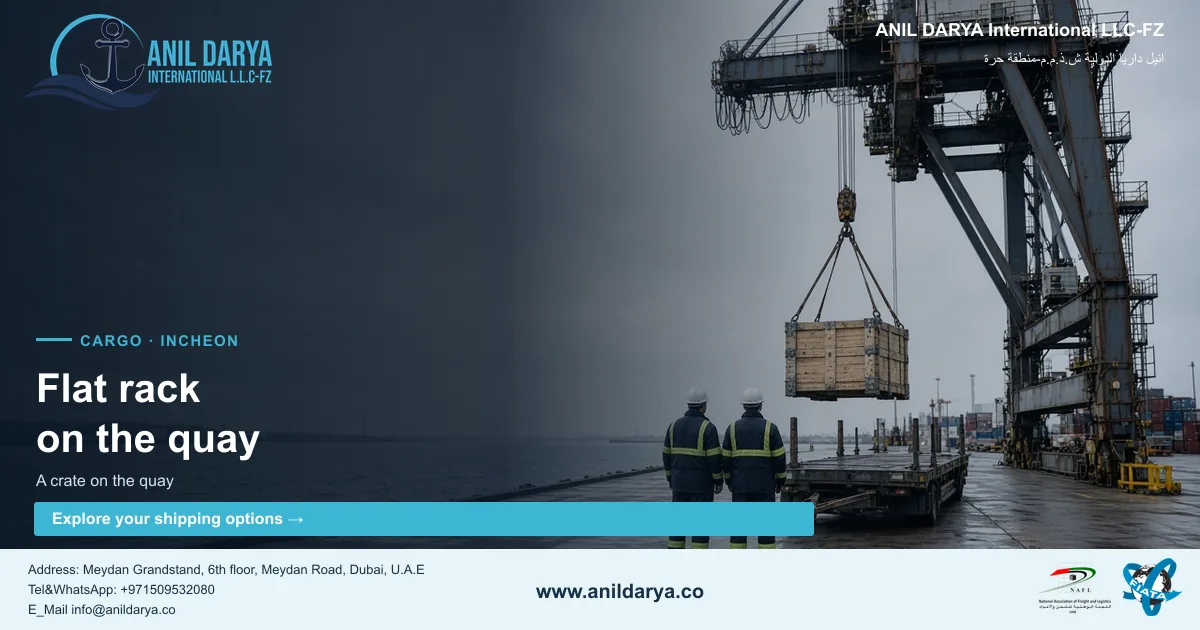
For out-of-gauge cargo that fits a flat rack, a container service to New Port avoids the lock altogether. For heavier pieces we plan the lift, lashing and survey at the UAE end through our break bulk shipping service, and the consignee's agent books the Korean berth and cranes.
Dangerous goods
DG to Incheon moves under the IMDG Code at sea and Korean rules once landed. Our Busan guide covers the Korean DG storage rules in detail. At Incheon, the key point is acceptance. Each carrier and terminal accepts DG class by class, and a feeder line may refuse a class that the mainline accepted. We check acceptance on every leg, including the feeder, before you commit.
You need a correct UN number and proper shipping name, a Safety Data Sheet, a signed DG declaration, UN-approved packaging and the right labels. Our dangerous goods shipping team checks all of it, and our guide to dangerous goods classes explains how each class is handled.
Customs clearance at Incheon in brief
Korean customs rules are the same at every port, and our Busan guide covers them in full. Here is the short version for Incheon.
| Step or rule | What it means |
|---|---|
| Who files | A customs broker or the owner of the goods, through the KCS UNI-PASS system |
| When | Normally after arrival; you may file before arrival to speed up release |
| Documents | Import declaration, invoice, packing list, bill of lading, certificate of origin and any quarantine certificate |
| Duty | Assessed on the CIF value at the rate for your HS code |
| Import VAT | Flat 10% on customs value plus duty |
| Payment | Within 15 days of acceptance of the duty payment declaration |
| Inspection | Selected by risk analysis; the owner of the goods pays the cost |
Incheon Main Customs is the local office for the port. Goods leave the bonded area once the declaration is accepted and duty is paid or secured.
The UAE-Korea CEPA entered into force on 1 May 2026 and covers about 91.2% of tariff lines, some phased in over up to 10 years. It applies only to goods that meet the UAE rules of origin, such as a change in tariff classification or at least 40% value content on the FOB price. Goods simply re-exported through Dubai do not qualify.
Incheon or Busan: which port fits your cargo?
| Your situation | Better fit | Why |
|---|---|---|
| Consignee in Seoul, Gyeonggi or Incheon | Incheon | Short truck leg to the capital region |
| Consignee in Busan, Ulsan or the south-east | Busan | Avoids a long inland truck trip |
| Fastest sea transit from Dubai | Usually Busan | More deep-sea services; Incheon often needs a feeder |
| Consignee in the Songdo free economic zone | Incheon New Port | Terminal sits inside the same district |
| Ship-only cargo for the capital region that cannot fly | Incheon | Saves the cross-country leg |
| Chartered breakbulk ship over 250 m or 50,000 DWT | Check carefully | Incheon Inner Port lock limits apply |
A common choice is to land at Busan and truck or rail to Seoul. Compare that total cost and time with a feeder into Incheon before you book.
How to ship to the Port of Incheon from Dubai: step by step
- Send us the HS code, weight, dimensions, packing, DG status and the consignee's city.
- We compare routings into Incheon and, if useful, via Busan with an inland leg.
- Agree the Incoterm with your buyer, so duty, VAT and the Korean charges are clear.
- Check whether your goods qualify for CEPA origin, and get the right proof of origin.
- We book the space and confirm DG or reefer acceptance on the mainline and the feeder.
- Your exporter prepares the commercial invoice, packing list and certificate of origin.
- We truck the cargo to Jebel Ali Port and handle the UAE export declaration.
- We issue the bill of lading and send copies to the consignee's Korean customs broker.
- The broker files the import declaration in UNI-PASS, ideally before the ship arrives.
- The consignee pays duty and VAT, collects the container and returns the empty on time.
How to ship from Incheon to Dubai
We also handle the other direction: shipping from Incheon to Dubai, with arrival at Jebel Ali, Khalifa Port or Sharjah port. We book the space with the carrier and run the UAE side. The Korean export papers stay with the shipper or its Korean agent.
The Korea export side
- Export declaration. Korea Customs Service says the exporter files the export declaration with the head of the customs house that controls the place where the goods are stored. For cargo leaving Incheon, the shipper or its customs broker in Korea files it.
- Loading deadline. The goods must be loaded within 30 days of the date the declaration is accepted. KCS can extend this period by up to one year.
- Checks. Customs may review the documents or inspect the goods; low-risk cargo gets an expedited clearance. Used cars, used smartphones and goods under export control get extra checks, so allow time for them.
- CEPA origin. Since 1 May 2026 the UAE-Korea CEPA cuts or phases out duty on most tariff lines. The shipper needs an origin document that meets the agreement's rules if the UAE importer wants the CEPA rate.
The UAE import side
On arrival, the declaration goes to Dubai Customs with the commercial invoice, packing list, bill of lading, certificate of origin and any permit for restricted goods. Customs duty in Dubai is 5% of the CIF value for most goods, with 50% on alcohol and 100% on cigarettes, unless a CEPA rate applies. Import VAT is 5% of the customs value including freight and insurance, and a VAT-registered importer can account for it through the reverse charge on its VAT return. The importer needs a Dubai Customs business code, or clears through a licensed clearing agent.
- Send us the shipper's details in Korea, the cargo, the HS code and the UAE delivery address.
- We book space from Incheon New Port or South Port and send the booking and cut-offs to the shipper.
- The shipper or its trucker delivers the loaded box to the terminal inside the cut-off.
- The shipper or its Korean broker files the export declaration and prepares the CEPA origin document if it applies.
- We check the draft bill of lading and track the hub connection.
- We file the UAE declaration before arrival and arrange payment of the duty and VAT.
- We collect the delivery order, truck the box to your site and return the empty inside free time.
[AMIR-FACT: the carriers we actually use from Incheon to Jebel Ali/Khalifa/Sharjah and our real transit days in this direction]
Checklist before you ship to Incheon
- HS code checked and Korean duty rate confirmed.
- CEPA origin checked, with proof of origin ready if it applies.
- Consignee's customs broker named and given the documents early.
- Invoice, packing list and certificate of origin agree on description, quantity and value.
- Korean labels, origin marks and product approvals in place where required.
- Arrival terminal (New Port or South Port) passed to the trucker.
- DG acceptance confirmed on every leg, including the feeder.
- For a chartered vessel, Inner Port lock limits checked.
- Free time at Incheon confirmed with the carrier.
Common mistakes on Incheon shipments
- Expecting a direct Dubai service. Most routings tranship, so plan for a hub connection.
- Comparing only ocean freight between Incheon and Busan. Include the inland leg to the consignee.
- Claiming CEPA rates on goods that were only re-exported through Dubai.
- Booking a chartered ship into the Inner Port without checking the lock and tide windows.
- Assuming a mainline's DG acceptance covers the feeder.
- Sending documents late to the broker, which loses the chance to declare before arrival.
- Letting containers overstay free time. Our guide to demurrage and detention explains the costs.
Frequently asked questions
What is the port code for Incheon?
The UN/LOCODE for Incheon is KRINC. It appears on bookings, bills of lading and tracking pages.
Who manages the port at Incheon?
The Incheon Port Authority (IPA) manages the port. Terminals such as ICT, SNCT and HJIT are run by private operators.
How big is the Port of Incheon?
Incheon is Korea's second container port, with 3.1 million TEU in 2022 and over 3 million TEU in 2023. It also moved about 54 million tonnes of dry bulk and 51 million tonnes of liquid bulk in 2021.
Why does Incheon have lock gates?
The tidal range at Incheon can reach about 10 m. The Inner Port sits behind lock gates in a closed basin for ships up to 50,000 DWT, so berth timing depends on lock transits.
How long does shipping from Dubai to Incheon take?
Published figures range from about 27 days to about 38 days from Jebel Ali, usually with transshipment. Real transit depends on the hub and feeder connection.
Can you handle shipping from Incheon to Dubai?
Yes. We book the space from Incheon and clear and deliver the cargo in the UAE. The Korean exporter or its broker files the export declaration, and the cargo must load within 30 days of acceptance. Dubai charges 5% duty on CIF for most goods and 5% import VAT.
Is Incheon or Busan better for cargo going to Seoul?
Incheon is closer to Seoul, so the truck leg is shorter. Busan has more deep-sea services, so compare total time and cost, including the inland leg, before you book.
What import VAT applies to cargo landed at Incheon?
Korea charges a flat 10% VAT on imports, based on the customs value plus duty. Duty and taxes are paid within 15 days of acceptance of the duty payment declaration.
Does the UAE-Korea CEPA apply to goods shipped to Incheon?
Yes, if the goods meet the UAE rules of origin. The CEPA entered into force on 1 May 2026 and covers about 91.2% of tariff lines.
Get a quote for Port of Incheon shipping
Send us your cargo details and we will come back with a routing and a price to Incheon, with a Busan comparison if it helps. Use our freight rate inquiry form, or contact our team to talk through DG, out-of-gauge or air options first. You can also read more about our Dubai freight forwarding team.
Sources
- ShipNext: Incheon port data (UN/LOCODE, Inner Port limits, port areas, ferries, berth waiting)
- Findaport: Port of Incheon (location, airport distance, maximum ship size by cargo type, customs office)
- MarineLink: Incheon port profile (IPA, distance to Seoul, tidal range, terminals)
- Cogoport: Port of Incheon profile (carrier capacity, channel depth, pilotage)
- iContainers: Port of Incheon (port areas, container terminals)
- Ship4wd: Major container ports in South Korea (2023 volume, capital region population)
- Beacon: Largest cargo ports in South Korea (2022 TEU, 2021 bulk, commodities)
- Invest Korea: Incheon New Port container terminals (SNCT, HJIT, phases)
- Enterprise: New service connects Incheon to Jebel Ali (June 2023)
- Hellenic Shipping News: New Incheon to South-East Asia service (July 2022)
- The Loadstar: Incheon aims to boost flows with Malaysia and India (July 2026)
- Fluent Cargo: Dubai to Seoul schedule data (Jebel Ali to Incheon)
- Fluent Cargo: UAE to South Korea schedule data (air routes)
- Shipa Freight: UAE to Korea shipping guide
- Korea Customs Service: Export-import clearance
- Korea Customs Service: Tax payment reporting
- US International Trade Administration: Korea import tariffs (CIF basis, 10% VAT)
- UAE Ministry of Economy and Tourism: UAE-Korea CEPA
- Korea Customs Service: Export clearance (who files, 30-day loading rule, checks)
- Dubai Customs: Submit customs declaration (invoice, packing list, certificate of origin, permits)
- Dubai Customs: FAQ (5% of CIF, alcohol 50%, cigarettes 100%, business code, licensed clearing agents)
- UAE Government portal: Clearing the customs and paying customs duty
- UAE Federal Tax Authority: VAT guide, import VAT at 5% and reverse charge
Reviewed: 10 November 2026