
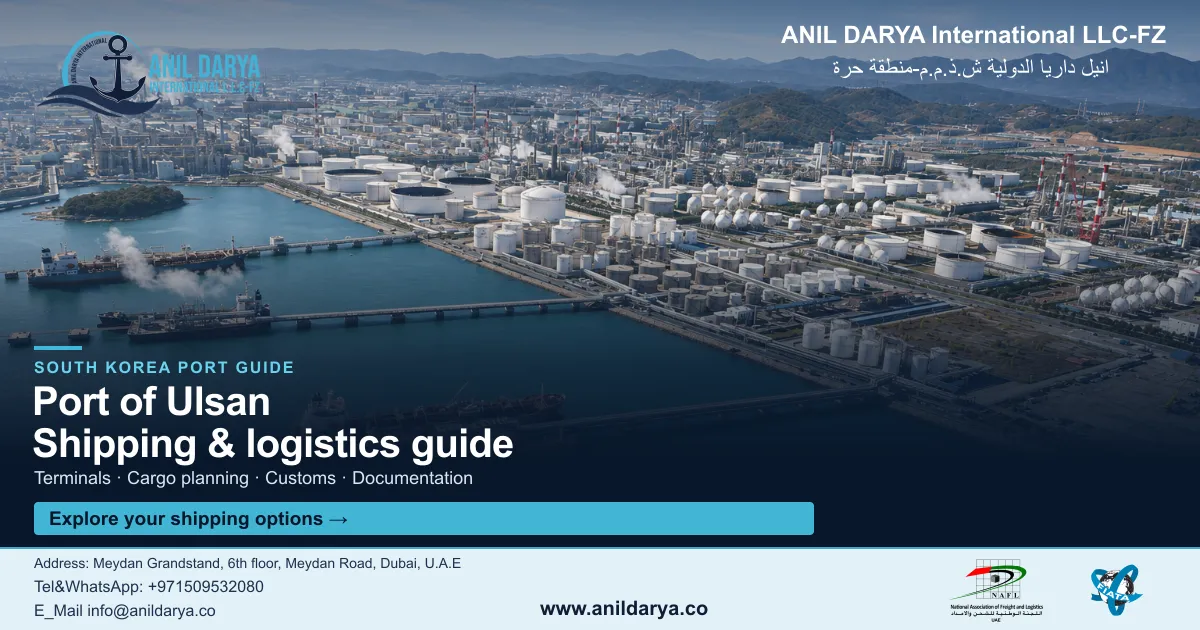
Ulsan port shipping is mostly about liquids: crude oil, refined products, chemicals and gas for the refineries and plants on Korea's southeast coast. The same port also has Hyundai Motor's car export pier, two container terminals and bulk berths that serve shipyards and steel users. This guide covers the four sub-ports, what each handles, customs in brief and how we ship your cargo from Dubai to Ulsan step by step. We ship both from Dubai to Ulsan and from Ulsan to Dubai.
Ulsan port shipping: key facts at a glance
| Item | Detail |
|---|---|
| Port authority | Ulsan Port Authority (UPA) |
| Customs authority | Korea Customs Service |
| UN/LOCODE | KRUSN |
| Location | Ulsan, southeast Korea, about 25 nautical miles northeast of Busan |
| Sub-ports | Ulsan Main Port, Ulsan New Port, Onsan Port, Mipo Port |
| Berths and quay | 123 berths, 22,427 m of quay, 4,785,500 DWT berthing capacity |
| Rated handling capacity | 77.98 million tons a year (1.187 million TEU) |
| Liquid cargo berths | 67 berths on 35 wharves and 5 buoys |
| Tank storage | 802 tanks, about 4.54 million kl (January 2026) |
| Container terminals | UNCT at Ulsan New Port and JUCT at Onsan, 1.18 million TEU capacity in total |
| Car export pier | Automobile Pier, Main Port: 830 m, 11.5 m deep, three 40,000 DWT berths (Hyundai Motor) |
| Cargo, January to September 2026 | 136.9 million tons, of which 109.5 million tons oil and liquid bulk; 244,078 TEU |
| National rank | First in Korea for liquid cargo; third for total cargo |
| Import VAT | 10% on customs value plus duty |
| Ulsan to Dubai | Also handled: Korean export declaration by the shipper or its broker, UAE clearance at Jebel Ali, Khalifa Port or Sharjah by us |
Where is Ulsan port and what makes it different?
Ulsan is an industrial city on Korea's southeast coast, about 25 nautical miles northeast of Busan. Ulsan Airport is about 15 km from the port and Busan's airport about 60 km. The port is built around heavy industry rather than consumer imports, and that is its main difference from Busan.
The port authority calls Ulsan a liquid logistics hub for Northeast Asia. KOTRA's investment profile describes it as Korea's main industry-supporting port, with the country's largest industrial cluster and liquid bulk storage. The port ranks third in Korea for cargo volume and second for vessel entries. In 2025 it handled 158 million tons of liquid cargo, first in Korea, according to a report on the port's energy hub plans.
A simple rule: if your cargo feeds a refinery, chemical plant, car plant or shipyard in the Ulsan area, Ulsan is usually the right port. For general consumer goods going anywhere else in Korea, Busan is the default.
The four sub-ports of Ulsan and what each handles
| Sub-port | Berths | Quay length | Rated capacity (tons a year) | Main use |
|---|---|---|---|---|
| Ulsan Main Port | 60 | 10,085 m | 32.28 million | Oil and chemical piers, Hyundai car pier, coal, grain, general cargo |
| Ulsan New Port | 29 | 7,059 m | 26.45 million | UNCT container terminal, oil and chemical piers, general cargo |
| Onsan Port | 33 | 5,073 m | 18.27 million | Refinery and chemical piers, crude buoy, JUCT containers, ore and cement |
| Mipo Port | 1 | 210 m | 0.99 million | Steel for the Hyundai Heavy Industries shipyard |
The sub-port on your booking decides the gate, the terminal and sometimes the pilot station. Check it before you plan the delivery.
Liquid bulk at Ulsan: berths, tank terminals and what to plan
Liquid bulk is the core of the port. In the first nine months of 2026, oil and liquid bulk made up 109.5 million of the 136.9 million tons handled, about 80%.
Liquid cargo berths by area
| Area | Wharves and buoys | Berths | Quay length | Capacity (DWT) |
|---|---|---|---|---|
| Main Port | 15 wharves, 2 buoys | 31 | 4,465 m | 1,352,500 |
| Onsan | 12 wharves, 3 buoys | 26 | 3,733 m | 1,704,000 |
| New Port | 6 wharves | 6 | 1,060 m | 260,000 |
| Breakwater transshipment | 2 wharves | 4 | 1,043 m | 180,000 |
| Total | 35 wharves, 5 buoys | 67 | 10,301 m | 3,496,500 |
Refinery piers at Onsan include the S-Oil piers and a Korea National Oil Corporation buoy. The Main Port has SK Energy oil piers and buoys. Findaport lists the largest ships by cargo type as 350,000 DWT for crude, 169,500 DWT for products, 120,000 DWT for chemicals and 70,000 DWT for gas.
Tank terminals
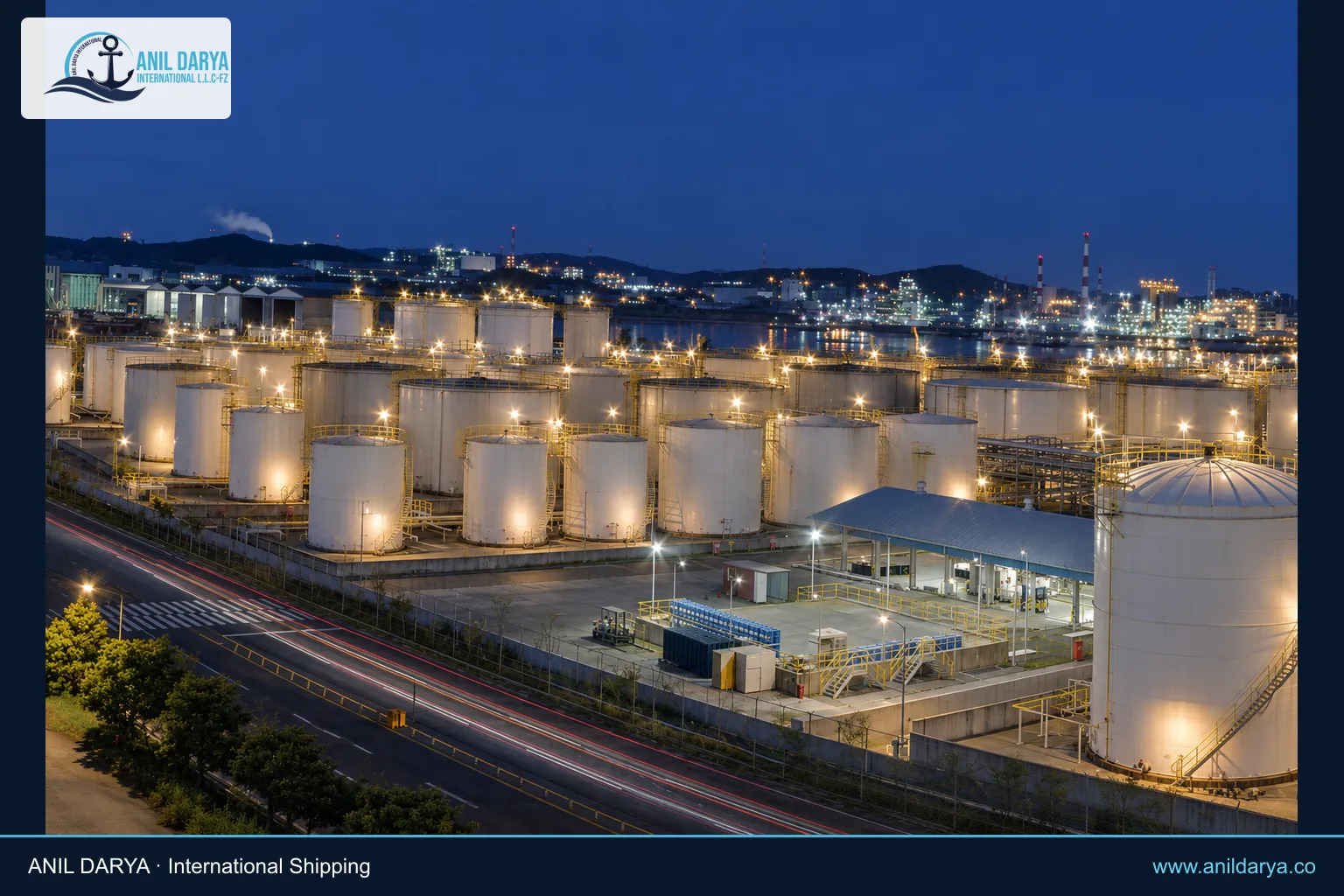
UPA lists 802 storage tanks with about 4.54 million kl of capacity as of January 2026. The largest is Jeong-il Stolthaven Ulsan, with 244 tanks and 1,655,700 kl for products such as gasoline, methanol and ethanol. Other operators include Odfjell Terminal Korea, Hyundai Oil Terminal, Korea Energy Terminal, KPX Global and an LNG terminal. More space is coming: Central Terminal Korea plans 23 new tanks with 103,200 kl in the Mipo industrial complex by the end of 2027.
How a liquid shipment from the UAE usually moves
| Volume | Usual option | What to plan |
|---|---|---|
| Small lots, up to a few containers | ISO tanks or flexitanks on a container service into UNCT or JUCT | Tank cleaning certificate, DG status, a receiver who can discharge the tank |
| Larger lots | Parcel space on a chemical or product tanker | Receiving tank terminal, berth window, cargo surveys, quality certificates |
| Full cargo | Chartered tanker to a refinery or terminal pier | Terminal acceptance, ship size against the berth, pilot and tugs |
For any liquid cargo, name the receiving terminal before you fix the ship or the tank. The terminal decides the berth, the draft and the paperwork. Our dry and liquid bulk shipping service covers how we plan these moves.
Container shipping to Ulsan: UNCT and JUCT
Ulsan has two container terminals. Both were built as private investment projects and are run by their own operators.
| Item | UNCT (Ulsan New Port) | JUCT (Onsan) |
|---|---|---|
| Full name | Ulsan New Port Container Terminal | Jeong-il Ulsan Container Terminal |
| Opened | July 2009 | November 1997 |
| Quay | 920 m, 4 berths, 12 to 14 m deep | 220 m, 1 berth, 12 m deep |
| Gantry cranes | 4 | 2 |
| Capacity | 962,000 TEU a year | 220,000 TEU a year |
| Container yard | 289,334 m2, 19,842 TEU | 77,348 m2, 6,200 TEU |
| CFS area | 6,104 m2 | 3,225 m2 |
| Reefer plugs | 648 | 42 |
| Outdoor DG container storage | 375 TEU | 100 TEU |
Container volume is small next to the liquids. Ulsan handled 244,078 TEU from January to September 2026, 6.0% less than a year earlier, though September alone was up 8.5%. Findaport lists the largest container ships at Ulsan as 30,000 DWT with a 12.7 m draft. That is feeder and intra-Asia tonnage, not deep-sea mainline ships.
Cogoport's March 2026 snapshot puts Maersk at about 79.5% of tracked container capacity at Ulsan and Hapag-Lloyd at about 15.7%. The same page reports export dwell times of 11 to 20 days a month from September 2025 to February 2026, so agree free time with care.
FCL, LCL and reefer
FCL is the simpler option, because the box stays sealed from Jebel Ali until it reaches Ulsan. LCL is harder: few consolidators run a box straight to Ulsan, so many LCL lots are unpacked in Busan and trucked on. Ask where the box will be unpacked before you book. Our article on FCL vs LCL costs explains the trade-off. For reefers, UNCT has 648 plugs. Confirm the set point and plug-in at the transhipment port too.
Shipping from Dubai to Ulsan: routes and transit
We found no published direct service from Jebel Ali Port to Ulsan. Container cargo usually reaches Ulsan in one of these ways:
| Routing | How it works | When it fits |
|---|---|---|
| Via Busan by feeder | Mainline ship to Busan, then a feeder to UNCT or JUCT | Most FCL from the Gulf |
| Via Busan by truck | Land at Busan and truck the cargo up the coast | When the feeder date does not suit, or for LCL |
| Via another Asian hub | Mainline to a hub such as Singapore or Shanghai, then an intra-Asia service calling Ulsan | When the carrier's network runs that way |
| Tanker or breakbulk ship direct | Chartered or parcel tonnage straight to the receiving pier | Liquid bulk and large project cargo |
Shipa Freight publishes at least 24 days from Jebel Ali to Busan for FCL, so add the feeder or truck leg and connection time for Ulsan. Treat published figures as a guide only.
[AMIR-FACT: our real Jebel Ali to Ulsan transit time for containers, the hub we route through and the carriers we use on this lane]
Automotive cargo at Ulsan: the Hyundai car pier
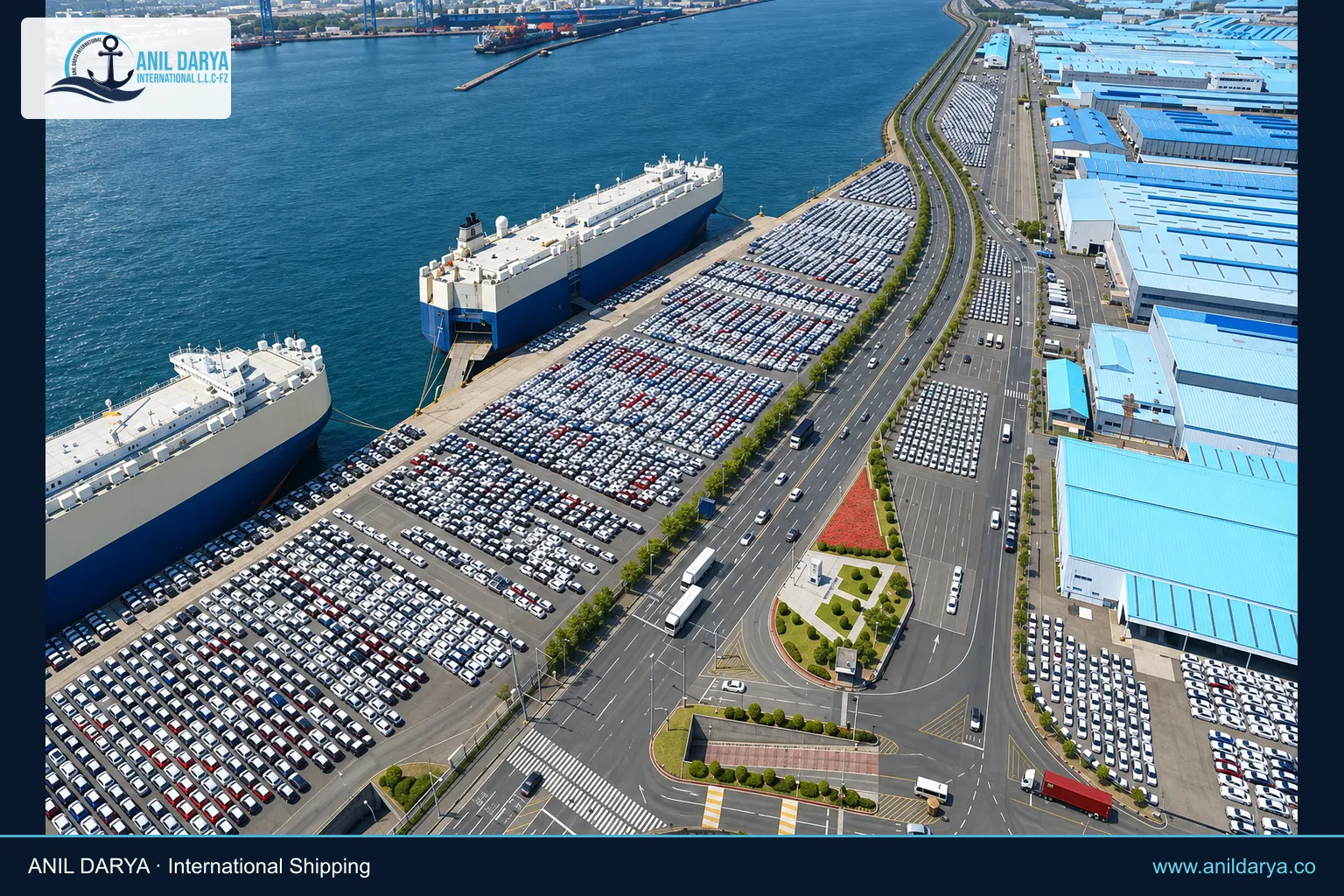
The Automobile Pier at Ulsan Main Port belongs to Hyundai Motor Company. It is 830 m long and 11.5 m deep, with three berths for 40,000 DWT car carriers, and UPA lists about 9.57 million tons against it. Findaport gives 40,000 DWT and a 10.5 m draft as the largest Ro-Ro ships at Ulsan.
For a Dubai shipper this pier matters in two ways. Vehicles from Ulsan to the UAE usually load here on car carriers. In the other direction, parts, tooling and equipment for the car plant arrive by container at UNCT or JUCT, or as breakbulk at a general cargo pier. The car pier is a private facility, so plan general vehicle imports through a carrier that calls Ulsan or through Busan.
Breakbulk, project and dry bulk cargo at Ulsan
Ulsan's industry creates a steady flow of heavy pieces: refinery and chemical plant equipment, shipyard components and steel. The general and bulk piers include:
- General cargo piers at the Main Port, plus Yeompo Pier for iron and mixed cargo.
- New Port general cargo piers, including berths run by CJ Logistics and Hanjin.
- A coal pier (12 m) and a grain pier (13 m, 50,000 DWT) at the Main Port.
- Ore and cement piers at Onsan.
- Mipo Pier (210 m, 9 m, 20,000 DWT), run by Hyundai Heavy Industries for steel.
Findaport lists the largest breakbulk ships at 12.6 m draft and bulk carriers at 60,000 DWT and 210 m. When we plan project cargo for Ulsan, we work in this order:
- Collect drawings, weights and the centre of gravity for each piece.
- Pick the mode: flat rack on a container service via Busan, or a breakbulk or heavy-lift ship straight to an Ulsan general cargo pier.
- Agree lifting, lashing and the discharge berth with the carrier and the receiving stevedore.
- Plan the road move from the pier to the plant, with any permits the route needs.
- Get customs documents to the consignee's broker before the ship arrives.
See our break bulk and project cargo service and our guide to the project cargo logistics process.
Dangerous goods at Ulsan
Ulsan handles more hazardous cargo than most Korean ports, because so much of its trade is oil and chemicals. UPA runs its own safety framework: countermeasures for explosions and hazardous-materials incidents, a standard information exchange between terminals and tankers, safety checklists and joint drills with the Ministry of Oceans and Fisheries.
For containerised DG, both terminals have outdoor DG storage, 375 TEU at UNCT and 100 TEU at JUCT. Space is limited, so plan delivery soon after discharge. Before loading in Dubai you need:
- The UN number, proper shipping name, class and packing group.
- A Safety Data Sheet and a signed Dangerous Goods Declaration.
- UN-approved packaging, labels and container placards.
- Carrier acceptance for every leg, including the Busan feeder.
- Any Korean permit or approval for the product, held by the importer.
Our dangerous goods shipping team checks classification and acceptance before you commit to a sailing.
Customs at Ulsan port in brief
Korean customs rules are national, and our Busan guide covers them in full. Here is the short version for cargo landed at Ulsan.
| Rule | What it means |
|---|---|
| Authority | Korea Customs Service |
| Core documents | Commercial invoice, packing list, bill of lading, certificate of origin |
| Extra documents | Licences, permits or certificates for restricted goods such as chemicals and DG |
| Duty basis | CIF value, at the rate for your HS code |
| Import VAT | Flat 10% |
| Special excise tax | 10% to 20% on certain luxury and durable consumer goods |
| Payment | In Korean won, within 15 days after clearance |
The UAE-Korea CEPA entered into force on 1 May 2026. It covers about 91.2% of tariff lines, with some cuts phased in over up to 10 years. It applies only to goods that meet the UAE rules of origin, such as a change in tariff classification or at least 40% value content on the FOB price. Petrochemicals made in the UAE may qualify. Goods only re-exported through Dubai do not, so check origin before you price the duty.
Ulsan, Busan or Gwangyang: which Korean port fits your cargo?
| Your situation | Better fit | Why |
|---|---|---|
| Liquid bulk for a refinery, chemical plant or tank terminal in Ulsan | Ulsan | The berths and tanks are next to the plants |
| Equipment for a plant, car factory or shipyard in Ulsan | Ulsan | Short road move from the pier |
| General FCL for Seoul or the rest of Korea | Busan or Incheon | More deep-sea services |
| Small LCL lot | Usually Busan | Most consolidators unpack there |
| Steel or chemicals for the south coast | Gwangyang | Serves POSCO and the Yeosu complex |
| Vehicles from Hyundai's Ulsan plant | Ulsan | Car carriers load at the plant's own pier |
We can price Ulsan direct against Busan plus truck, so you see the total cost to the door.
How to ship to Ulsan port from Dubai: step by step
- Send us the commodity, HS code, weight, dimensions, packing, DG status and the receiving site or terminal in Ulsan.
- We compare routings: feeder into UNCT or JUCT, Busan plus truck, or a direct ship for bulk and project cargo.
- Agree the Incoterm with your buyer, so duty, VAT and Korean charges are clear. Our Incoterms 2020 guide for sea freight explains the options.
- Check whether the goods meet CEPA origin, and get the right proof of origin.
- We book space and confirm DG, reefer, tank or out-of-gauge acceptance on every leg.
- Your exporter prepares the commercial invoice, packing list and certificate of origin.
- We truck the cargo to Jebel Ali and handle the UAE export declaration.
- We send the bill of lading and copies to the consignee's Korean customs broker.
- The broker files the import declaration, ideally before the ship arrives.
- The consignee pays duty and VAT, collects the cargo and returns the empty or the tank on time.
How to ship from Ulsan port to Dubai
We also handle the other direction: shipping from Ulsan to Dubai, with arrival at Jebel Ali, Khalifa Port or Sharjah port. We book the space with the carrier and run the UAE side. The export papers at origin stay with the shipper or its Korean customs broker.
The Korean export side
- The export declaration. Korea Customs Service says the exporter makes it to the head of the customs office with jurisdiction over the place where the goods are stored.
- Electronic filing. Declarations go through UNI-PASS, the customs online system, which needs a certificate from an accredited certification body.
- Loading deadline. The goods must be loaded within 30 days of the date the declaration is accepted. The period can be extended by up to a year.
- Controlled goods and vehicles. Goods under special export controls need approval first, and a used car must have its registration cancelled before export. That matters for vehicles shipped from Ulsan.
The UAE import side
On arrival, the declaration goes to Dubai Customs with the commercial invoice, packing list, certificate of origin and any permit for restricted goods. The bill of lading is what the line needs before it issues the delivery order. Customs duty in Dubai is 5% of the CIF value for most goods, with 50% on alcohol and 100% on cigarettes. Import VAT is 5% of the customs value, which includes freight and insurance. A VAT-registered importer whose customs number is linked with the Federal Tax Authority accounts for that VAT on its VAT return instead of paying it at release.
- Send us the shipper's details in Ulsan, the cargo, the HS code and the UAE delivery address.
- We book space from UNCT or JUCT, or on a bulk or project ship, and send the cut-offs to the shipper.
- The shipper or its trucker delivers the cargo to the terminal before the cut-off.
- The shipper or its Korean customs broker files the export declaration and loads within the 30-day limit.
- We check the draft bill of lading against the invoice and packing list before the carrier issues it.
- We file the Dubai Customs declaration before the ship arrives.
- We arrange payment of the duty and VAT, or the VAT deferral if you are VAT-registered, and collect the delivery order from the line.
- We truck the cargo to your site in the UAE and return the empty inside free time.
[AMIR-FACT: the carriers and hub we actually use from Ulsan to Jebel Ali, Khalifa Port or Sharjah, and our real port-to-port transit days in this direction]
Checklist before you ship to Ulsan
- HS code checked and the Korean duty rate confirmed.
- CEPA origin checked, with proof of origin ready if it applies.
- Receiving terminal, tank farm or plant named on the booking.
- Arrival terminal (UNCT or JUCT) passed to the trucker for containers.
- For liquids: tank cleaning certificate, quality certificate and terminal acceptance.
- DG acceptance confirmed on every leg, including the hub connection.
- For project cargo: drawings, lifting points and a road route plan.
- Free time agreed with the carrier, allowing for dwell time.
- Cargo insurance arranged, which matters most for liquids and heavy lifts.
Common mistakes on Ulsan shipments
- Assuming every carrier calls Ulsan. Many deep-sea services stop only at Busan.
- Comparing ocean freight only. Include the feeder or truck leg from Busan.
- Booking liquid cargo before the receiving terminal has accepted it.
- Sending the wrong sub-port to the trucker. UNCT and JUCT are in different parts of the city.
- Claiming CEPA rates on goods that were only re-exported through Dubai.
- Letting boxes overstay free time. Our guide to demurrage and detention explains the costs.
Frequently asked questions
What is the port code for Ulsan?
The UN/LOCODE for Ulsan is KRUSN. You will see it on bookings, bills of lading and tracking systems.
Who manages Ulsan port?
The Ulsan Port Authority (UPA) manages the port. It covers four sub-ports: Ulsan Main Port, Ulsan New Port, Onsan Port and Mipo Port.
What is Ulsan port known for?
Liquid bulk. Ulsan is Korea's largest liquid cargo port, with 67 liquid berths and about 4.54 million kl of tank storage. It also has Hyundai Motor's car export pier and two container terminals.
How big is Ulsan port?
Ulsan has 123 berths, 22,427 m of quay and a rated capacity of about 78 million tons a year. It handled 136.9 million tons from January to September 2026.
Is there a direct ship from Dubai to Ulsan?
We found no published direct container service from Jebel Ali to Ulsan. Containers usually tranship at Busan or another Asian hub, while tankers and project ships can sail direct to the receiving pier.
Which container terminals does Ulsan have?
Ulsan New Port Container Terminal (UNCT), with 920 m of quay and 962,000 TEU capacity, and Jeong-il Ulsan Container Terminal (JUCT) at Onsan, with 220 m and 220,000 TEU.
Can you ship from Ulsan to Dubai?
Yes. The shipper or its Korean customs broker files the export declaration with Korea Customs Service. We book the space, clear the cargo with Dubai Customs and arrange payment of the 5% duty on most goods and the 5% import VAT.
Can I ship dangerous goods to Ulsan?
Yes. Both container terminals have outdoor DG storage, 375 TEU at UNCT and 100 TEU at JUCT. You need full DG paperwork, carrier acceptance on every leg and any Korean permit for the product.
What import VAT applies at Ulsan?
Korea charges a flat 10% VAT on imports. Duty is assessed on the CIF value, and taxes are paid in Korean won within 15 days after clearance.
Does the UAE-Korea CEPA apply to goods shipped to Ulsan?
Yes, if the goods meet the UAE rules of origin. The CEPA entered into force on 1 May 2026 and covers about 91.2% of tariff lines.
Get a quote for Ulsan port shipping
Send us your cargo details and we will come back with a routing and a price to Ulsan, with a Busan comparison if it helps. Use our freight rate inquiry form, or contact our team to talk through liquid bulk, DG or project cargo first.
Sources
- Ulsan Port Authority: Ulsan port facilities (sub-ports, piers, depths, car pier, container pier)
- Ulsan Port Authority: Port facility status (berths, quay, capacity by sub-port)
- Ulsan Port Authority: Liquid cargo facilities (liquid berths, tank terminals, January 2026)
- Ulsan Port Authority: Container terminals (UNCT and JUCT)
- Ulsan Port Authority: Port statistics (January to September 2026)
- Ulsan Port Authority: Home (liquid logistics hub, energy hub project)
- Invest Korea (KOTRA): Ulsan port profile (sub-ports, national rank, liquid cargo share)
- The Herald Business: Ulsan port targets Northeast Asia energy logistics hub status (October 2026)
- The Herald Business: Central Terminal Korea to invest in Ulsan tank terminal (September 2026)
- World Ports Sustainability Program: Ulsan port safety framework
- Findaport: Port of Ulsan (maximum vessel size by cargo type, distances, airports)
- Cogoport: Ulsan port statistics (operator capacity, dwell times)
- Wikipedia: Port of Ulsan (UN/LOCODE)
- Shipa Freight: UAE to Korea (Jebel Ali to Busan transit, documents)
- US International Trade Administration: Korea import tariffs (CIF basis, 10% VAT, payment)
- UAE Ministry of Economy and Tourism: UAE-Korea CEPA
- Korea Customs Service: Export declaration guideline (who declares, 30-day loading, used cars)
- Invest KOREA: Customs clearance procedures (export clearance, UNI-PASS)
- Dubai Customs: Submit customs declaration (documents for import, export and re-export declarations)
- UAE Government portal: Customs duty (5% of CIF in Dubai, alcohol 50%, cigarettes 100%)
- Federal Tax Authority: VAT guide, section 3.5 (5% import VAT, customs value, deferral to the VAT return)
Reviewed: 10 November 2026