
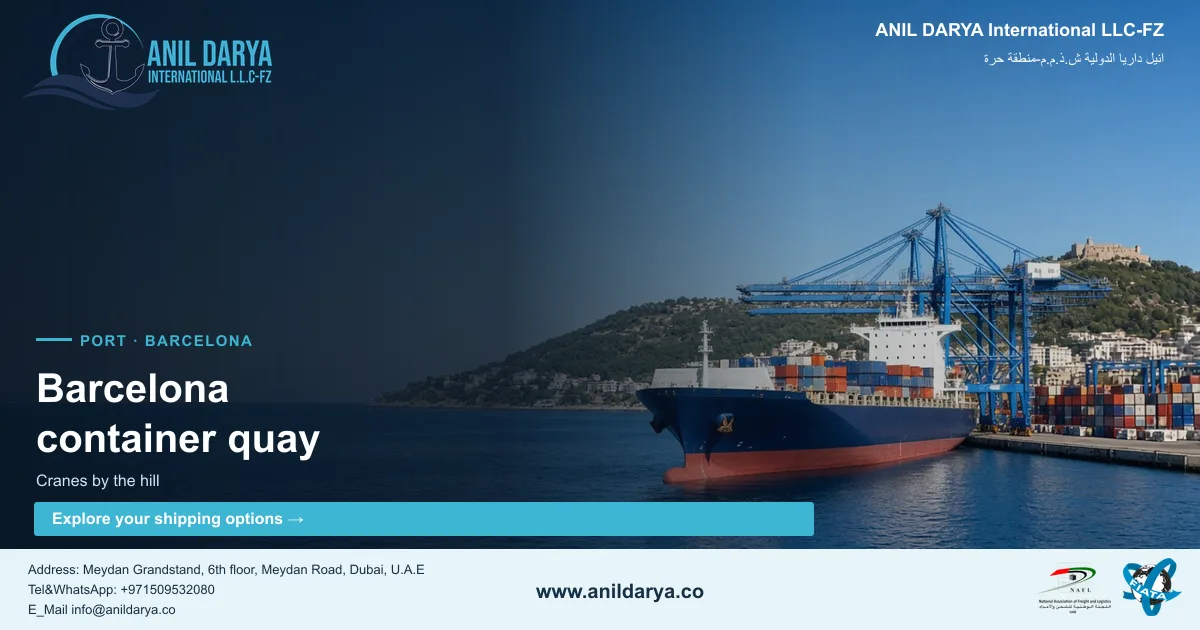
Port of Barcelona shipping runs through two big container terminals, APM Terminals Barcelona and Hutchison Ports BEST, plus a small multipurpose terminal, with rail straight from the quay into Spain and southern France. The port handled 3.7 million TEU and 69.5 million tonnes in 2025. This guide covers what is specific to Barcelona: terminals, rail, the logistics zone, dangerous goods rules, the inspection post and how we ship your cargo there from Dubai. We ship both ways: from Dubai to Barcelona and from Barcelona to Dubai.
Port of Barcelona at a glance
| Item | Detail |
|---|---|
| Port authority | Port Authority of Barcelona (APB), owned by Puertos del Estado |
| UN/LOCODE | ESBCN |
| Customs authority | Spanish Tax Agency (AEAT), under EU customs law |
| Containers handled, 2025 | 3.7 million TEU, 4.2% lower than 2024 |
| Containers handled, 2024 | 3,885,736 TEU, up 18.5% |
| Total traffic, 2025 | 69.5 million tonnes |
| Container terminals | APM Terminals Barcelona, Hutchison Ports BEST, Terminal Berge (multipurpose) |
| Maximum draught at container terminals | Up to 16.5 m |
| Container terminal capacity | More than 5 million TEU a year, over 160 ha |
| Reefer connections | More than 3,500 |
| Rail connections at container terminals | 14 |
| Main container trading partners, 2025 | China 28%, United States 6%, Turkey 5% |
| Logistics zone and free zone | ZAL (over 230 ha) and Zona Franca (over 1,000 ha) next to the port |
| Import VAT in Spain | 21% standard, 10% reduced |
| Shipping to Dubai | EU export declaration in the AEAT's AES by the shipper or its representative; arrival at Jebel Ali, Khalifa Port or Sharjah |
Where is the Port of Barcelona and who runs it?
The port lies on the south side of Barcelona, between the city and El Prat de Llobregat. The Port Authority of Barcelona (APB) manages it, and APB is owned by Puertos del Estado, the state ports body. The port has three zones: Port Vell (the old port, now mostly leisure and cruise), the commercial and industrial port, and the logistics port with the ZAL and the free zone.
APB says the port carries 24% of Spain's maritime trade and moves goods worth about 113,343 million euros a year. It counts more than 30 specialised terminals for all cargo types.
For shippers in the UAE, Barcelona is the natural port when the consignee is in Catalonia, Aragon or southern France, or when goods will be distributed across Europe from a warehouse near the port.
Port of Barcelona traffic in 2025
The port's results for 2025, published on 3 February 2026, show a year of steady tonnage but a different container mix.
| Segment | 2025 result | What it means for you |
|---|---|---|
| Total traffic | 69.5 million tonnes (69.7 million in 2024) | Stable port, no capacity squeeze |
| Containers | 3.7 million TEU, down 4.2% | The fall came from transshipment, not from local import and export |
| Full import containers | Up 4%, an all-time high | Strong import demand, busy import yards at peaks |
| Full export containers | Up 3% | Good empty supply for return cargo to the Gulf |
| Liquid bulk | 16.6 million tonnes, up 21.7% | Large tank terminals for fuels and chemicals |
| Dry bulk | Nearly 4.1 million tonnes, down 15% | Bulk berths available |
| Ro-ro | 430,406 units, up 0.6% | Short sea links to the Balearics and Italy |
| New cars | 716,657 units, up 5.1%, imports up 44% | Large vehicle terminals, about 12% electric |
China, the United States and Turkey are the port's main container trading partners, with shares of 28%, 6% and 5%.
Which terminals handle containers at the Port of Barcelona?
Three terminals handle containers. Your carrier's service decides which one your box uses, and the gate, the booking slot and the free time all follow from that.
| Terminal | Operator | Quay and depth | Key equipment |
|---|---|---|---|
| BEST (Barcelona Europe South Terminal) | Hutchison Ports | 1,500 m of berth, 16.5 m water depth | 15 Super Post-Panamax quay cranes, 68 automated yard cranes, 40 shuttle carriers, eight-track rail terminal |
| APM Terminals Barcelona, South East Pier | APM Terminals | 1,155 m, 14 to 16 m depth | 11 quay cranes, ships up to 16,000 TEU (upgrade to 18,000 TEU under way) |
| APM Terminals Barcelona, North East Pier | APM Terminals | 350 m, 12 to 14 m depth | 3 quay cranes, ships up to 3,000 TEU |
| Terminal Berge | Berge (multipurpose) | 450 m, 14 m depth | 8 ha, more than 50,000 TEU a year |
Across the container terminals the port lists 27 gantry cranes, 18 of them Super Post-Panamax, more than 3,000 m of berthing line and 14 rail connections. Three container depots (Barcelona Container Depot Service, Transportes Portuarios and Delta Depot Barcelona) handle empty returns.
Work under way at the two big terminals
BEST took delivery of two new ship-to-shore cranes in mid-2026, built for ships up to 26 containers wide. It reports more than 30 weekly vessel calls and is adding six automated yard blocks, due by the end of 2027.
APM Terminals Barcelona is investing more than 156 million euros to create two berths for mega ships at the same time and to deepen the quay to 15 m. Works started in mid-August 2025 and are due to finish in the third quarter of 2028. The terminal says it keeps working at full capacity during the works, but berth windows can still shift. Check the arrival terminal on each booking.
What cargo can you ship through Barcelona?
Barcelona is a full multipurpose port. Here is how each cargo type usually moves.
| Cargo | Where it moves | What to plan |
|---|---|---|
| General goods, FCL | BEST or APM Terminals | Terminal on the booking, free time, BCN Booking slot for the truck |
| Small shipments, LCL | Consolidators' warehouses, many in the ZAL | Carton marks, CFS charges, release after unpacking |
| Chilled and frozen food | Reefer plugs at the terminals, checks at the PIF | Health certificates, advance notice to the border control post |
| Chemicals and other DG | Container terminals with APB authorisation | DG Department authorisation before the box moves |
| Machinery and project cargo | Multipurpose and general cargo berths, flat racks on container ships | Drawings, lift plan, road permits |
| Vehicles | Ro-ro and vehicle terminals | Ownership and technical papers, EU type approval |
FCL and LCL shipping to Barcelona
Most cargo from the UAE to Barcelona moves in containers. Pick FCL when your cargo fills most of a 20ft or 40ft box, or when you do not want it handled with other goods. Pick LCL for small volumes, and accept that release depends on the consolidator unpacking the shared container first. Our guide to choosing between FCL and LCL shows where the break-even usually falls.
A few Barcelona rules matter for both:
- Truck access to APM Terminals and BEST is booked through the port's BCN Booking system. The last authorised company in the telematic transport order makes the reservation.
- Land operations at APM Terminals and BEST run Monday to Friday from 06:00 to 02:00 the next day, and Saturday from 08:00 to 14:00. There are no operations on 1 January, 1 May and 25 December.
- Hauliers who are not Portic clients need a PIN code to collect or deliver a container.
Reefer cargo is well served, with more than 3,500 reefer connections across the container terminals. Give us the set temperature and ventilation at booking.
Rail, the ZAL and the free zone: moving cargo inland from Barcelona
Rail is what sets Barcelona apart from many Mediterranean ports. BEST runs an eight-track rail terminal on the quay, and the container terminals have 14 rail connections in total. The port also tariffs rail services on UIC (European standard) gauge, so trains can run on toward France without changing wheels.
APB lists regular rail services for containers, cars and bulk to Aragon, Madrid, La Rioja, Navarra, Castilla y Leon, Tarragona, Lleida and southern France. In March 2024 APB and Adif set up Train Port Barcelona to grow rail freight, and in November 2025 the plan for a new south railway node was approved.
| Your consignee is in | Usual inland leg | Decision rule |
|---|---|---|
| Barcelona metro area or Catalonia | Truck from the terminal | Book the truck slot before the vessel berths |
| Aragon, Madrid, Navarra, La Rioja | Rail from the quay, last mile by truck | Ask for a rail-inclusive routing at quote stage |
| Southern France | Rail or truck | Check whether the carrier offers a through bill of lading |
The ZAL (Logistics Activities Zone) sits next to the port and covers more than 230 ha of warehouses run by logistics operators. The Zona Franca, the Barcelona free zone, lies alongside on more than 1,000 ha. If your buyer wants to store, repack or distribute goods across Europe, a ZAL warehouse keeps the first move short. APB says the port can reach more than 200 million customers in a dozen European and African countries within 24 to 48 hours, and that on the Far East to Europe route Barcelona saves 3 to 4 days of transit against northern European ports.
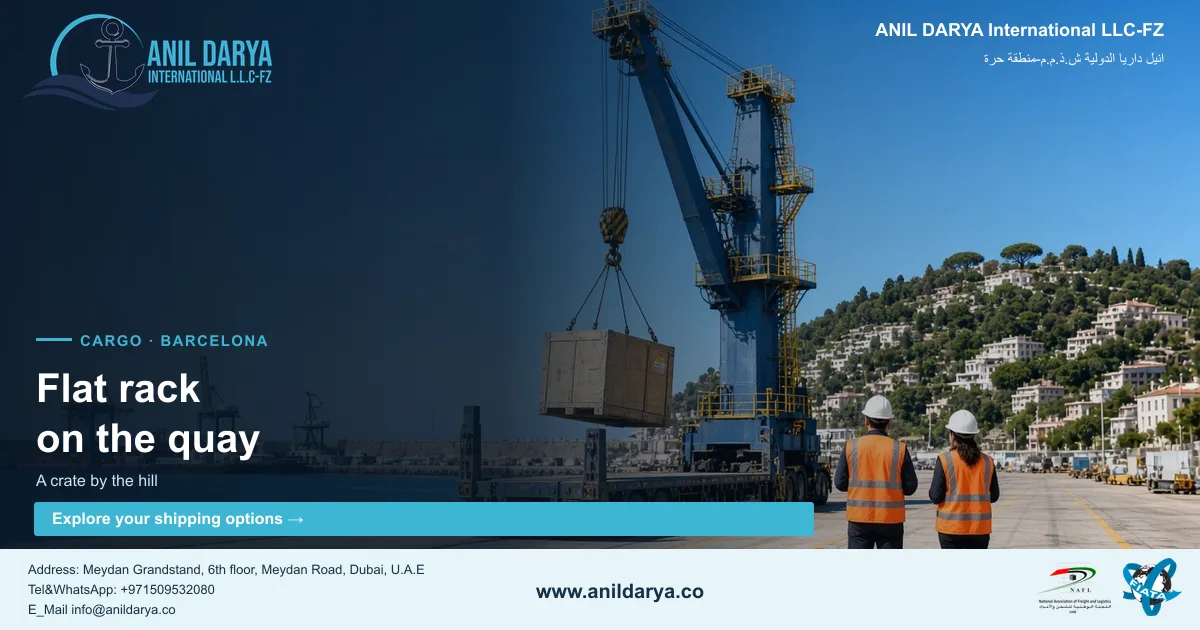
Breakbulk, project cargo and vehicles through Barcelona
Barcelona handles general cargo, project pieces and vehicles alongside containers. For machinery and steel from the UAE, there are two ways in:
- Flat rack or open top on a container service, landing at BEST or APM Terminals. This gives you the most sailings if the piece fits the box by size and weight.
- Conventional breakbulk or heavy-lift tonnage to a multipurpose berth. This is the route for pieces that do not fit any container. The sailing date then drives the whole plan.
APB has also put the multipurpose terminal at the Princep d'Espanya wharf out to tender, so check which berth and stevedore the carrier names for breakbulk calls. For pieces that need lift plans and road permits, our break bulk and project cargo team collects drawings, weights and centre of gravity before we ask the carrier for acceptance.
Vehicles are a large trade here. In 2025 the port handled 716,657 new cars, and imports rose 44%. Cars from the UAE can move ro-ro where a service exists, or in containers. Ask the buyer to confirm EU type approval before shipping, because a car without it is hard to register in Spain.
Dangerous goods at the Port of Barcelona: the APB authorisation
Barcelona adds a local step on top of the IMDG Code. Any dangerous goods entering or leaving the port area need a valid authorisation from the Port Authority, issued with the Maritime Captaincy. For imports, the consignee's agent requests it from APB's Dangerous Goods Department (MMPP). The authorisation sets the validity and the safety conditions for the transport.
For high-risk dangerous goods (MPAR), the consignee must request the admission authorisation and confirm with the terminal that transport will be ready at the moment the unit is loaded or discharged. In practice this means direct delivery, so the truck must be booked before the ship arrives.
| Step | Who does it | When |
|---|---|---|
| Carrier DG acceptance at Jebel Ali | We request it with the DG declaration and SDS | Before booking is confirmed |
| APB authorisation (MMPP) | The consignee's agent in Barcelona | Before the vessel arrives |
| Admission and direct delivery for MPAR cargo | Consignee, with the terminal | Before discharge |
| Renewal if the authorisation expires | Consignee's agent | As soon as the date slips |
The MMPP office answers Monday to Thursday from 08:30 to 17:00 and Friday from 08:00 to 15:00, so a request sent on Friday afternoon may wait until Monday. Our dangerous goods shipping team prepares the IMDG paperwork in Dubai and passes it to the Barcelona agent early. Our guide to IMDG segregation in containers explains how mixed DG loads are stowed.
Customs at the Port of Barcelona: what is specific to this port
Spanish customs rules are the same in every port, so here is the short version, then the Barcelona details.
- The carrier files the EU entry summary declaration at least 24 hours before your container is loaded at Jebel Ali.
- The importer needs an EORI number and usually appoints a customs representative.
- The declaration goes to the AEAT and gets a green channel (release once duty is paid or guaranteed), orange (document check) or red (documents and physical inspection).
- Duty comes from the EU tariff for your goods code. There is no EU-UAE trade agreement in force (talks were launched on 28 May 2025), so UAE-origin goods pay the normal third-country rate.
- Import VAT in Spain is 21%, with a 10% reduced rate for some goods.
- From 1 January 2026, an importer bringing more than 50 tonnes a year of steel, aluminium, cement, fertilisers or hydrogen into the EU must be an authorised CBAM declarant.
The PIF inspection area and the scanner
Barcelona's Border Inspection Post (PIF) is in the ZAL at El Prat. It opens Monday to Friday from 08:00 to 20:00 and hosts customs, animal health, foreign health, plant health and the SOIVRE export quality service. Food, plant and animal products from the UAE are checked here, so the health certificates and the advance notice must be in order before the box is moved from the terminal. Users pay the approved PIF rates.
The port also runs an Eagle M60 mobile X-ray scanner that sends images to customs remotely. If customs picks your container for inspection, the consignee can download the inspection label from the port's Sostrat system with the container number, a company tax number and the request number.
How long can your container stay in the terminal?
Goods with no customs destination assigned can stay in the terminal for no more than 90 days. The port's client service FAQ says charges start after the first 5 days from discharge, and the terminal tariffs set the rates. The shipping line's own free time for the container runs separately, so check both. Our article on demurrage and detention shows how these add up.
How to ship from Dubai to the Port of Barcelona: step by step
This is how we handle a typical export from the UAE to Barcelona. We book the space, prepare the documents and handle UAE clearance and trucking. In Barcelona we work with your consignee's customs representative or a clearing agent they appoint.
- Send us the cargo details. Commodity, HS code, weight, volume or dimensions, pickup point in the UAE and the Incoterm agreed with your buyer.
- Confirm the buyer's set-up. Importer of record, EORI number, VAT number and the Barcelona customs representative.
- Choose the service. We compare carrier services from Jebel Ali to Barcelona and confirm whether the box lands at BEST or APM Terminals.
- Book space. For DG, reefer or out-of-gauge cargo we get carrier acceptance first, and we flag the APB authorisation to the consignee's agent.
- Pick up and stuff. We arrange the empty, stuffing at your site or a warehouse, the seal and the VGM. DG is packed and placarded to the IMDG Code.
- Clear UAE export. We file the export or re-export declaration with Dubai Customs and gate the container in at Jebel Ali port before the cut-off.
- Send documents early. Bill of lading, invoice, packing list, certificate of origin and any health or DG papers go to the consignee and its customs representative before the vessel arrives.
- Release in Barcelona. The representative files the import declaration with the AEAT, the line releases the container and the haulier books a BCN Booking slot to collect it.
[AMIR-FACT: the carriers or services we actually book from Jebel Ali to Barcelona, which Barcelona terminal each uses (BEST or APM), and our typical port-to-port days]
How to ship from the Port of Barcelona to Dubai
We also handle the other direction: shipping from Barcelona to Dubai, with arrival at Jebel Ali, Khalifa Port or Sharjah port. We book the space with the carrier and run the UAE side. The Spanish export papers stay with the shipper or its Spanish agent.
The Spanish export side
- Export declaration. Spain is in the EU, so the declaration is filed electronically in the Automated Export System (AES), at the customs office where the exporter is established. In Spain this is the AEAT's AES P1 system, filed by the declarant or its customs representative. Paper export forms are gone, and AES has run in its definitive phase since 15 December 2025.
- EORI. The exporter, or the representative that lodges the declaration, needs an EORI number. The EU calls it mandatory for all types of customs operations.
- Exit. The customs office of exit supervises the departure of the goods and tells the office of export that they have left the EU.
- Pickup. The shipper or its haulier delivers the box to BEST or APM Terminals Barcelona on a booked slot, or by rail from inland Spain.
The UAE import side
For cargo landing at Jebel Ali, the import declaration goes to Dubai Customs with the commercial invoice, the packing list, the bill of lading, a certificate of origin and any permit needed for restricted goods. Customs duty is 5% of the CIF value for most goods, with 50% on alcohol and 100% on cigarettes. Import VAT is 5%, and a VAT-registered importer can account for it on its VAT return.
- Send us the shipper's details in Barcelona, the cargo, the HS code, the Incoterm and the UAE delivery address.
- We book space with a carrier from BEST or APM Terminals Barcelona and send the booking and cut-offs to the shipper.
- The shipper or its trucker picks up the empty, stuffs it and delivers the box to the terminal before the cut-off.
- The shipper or its Spanish customs representative files the export declaration in AES.
- We check the draft bill of lading against the invoice and packing list before it is issued.
- We file the UAE customs declaration before the vessel arrives.
- We arrange payment of the duty and VAT and collect the delivery order from the line.
- We truck the box to your site and return the empty inside the free time.
[AMIR-FACT: the carriers we actually use from Barcelona to Jebel Ali/Khalifa/Sharjah and our real transit days in this direction]
Checklist for Port of Barcelona shipping
- HS code confirmed and duty checked in the EU tariff.
- Buyer's EORI and Spanish VAT number on file.
- Customs representative in Barcelona named before sailing.
- Invoice, packing list and bill of lading show the same weights, piece counts and consignee.
- Certificate of origin issued in the UAE.
- For food and plant products: health certificates and advance notice to the PIF.
- For DG: SDS, DG declaration, IMDG packing, carrier acceptance and the APB authorisation requested by the consignee's agent.
- For steel and aluminium: buyer's CBAM declarant status checked.
- Arrival terminal (BEST or APM) confirmed and truck slot planned.
- Wood packaging treated and marked to ISPM 15.
- Line free time and terminal storage days agreed.
Common mistakes on the Dubai to Barcelona lane
- Leaving the DG authorisation to the last day. Without APB authorisation the container cannot move in the port, and the MMPP office does not work weekends.
- Booking the truck at the wrong terminal. BEST and APM Terminals are separate gates with separate slots.
- Shipping food without the advance notice. The PIF check cannot start, and the box waits in the yard.
- No EORI on the buyer's side. The declaration cannot be filed.
- Ignoring rail for inland buyers. A buyer in Zaragoza or Madrid may save a long truck leg with rail from the quay.
Barcelona or Valencia: which Spanish port fits your cargo?
Both ports have direct deep-sea services and both can take cargo from the UAE. The choice usually comes down to where the cargo ends up.
| Your situation | Port to use | Why |
|---|---|---|
| Consignee in Catalonia, Aragon or southern France | Barcelona | Short truck leg or rail from the quay on UIC gauge |
| Cargo for European distribution from a port warehouse | Barcelona | ZAL and free zone next to the terminals |
| Consignee in the Valencia region, Madrid or central Spain | Valencia | Often a shorter inland leg |
| Not sure | Both | We price both and compare the cost to the door |
Frequently asked questions
Who runs Barcelona's port?
The Port Authority of Barcelona (APB) manages the port, and it is owned by Puertos del Estado. Container terminals are run by private operators: Hutchison Ports BEST, APM Terminals Barcelona and the multipurpose Terminal Berge.
What is the port code for Barcelona?
The UN/LOCODE for the Port of Barcelona is ESBCN. You will see it on bookings, bills of lading and tracking tools.
How many containers does the Port of Barcelona handle?
The port handled 3.7 million TEU in 2025, 4.2% less than in 2024, when it moved 3,885,736 TEU. Full import containers reached an all-time high in 2025.
How deep is Barcelona port?
The container terminals take ships with a draught of up to 16.5 m. BEST has 16.5 m of water along its 1,500 m berth, and APM Terminals' South East Pier has 14 to 16 m.
Can I ship dangerous goods to Barcelona?
Yes, but dangerous goods need an authorisation from the Port Authority's Dangerous Goods Department, requested by the consignee's agent. High-risk dangerous goods also need direct delivery arranged with the terminal before discharge.
Can containers leave the Port of Barcelona by train?
Yes. The container terminals have 14 rail connections, BEST has an eight-track rail terminal on the quay, and regular services run to Aragon, Madrid, Navarra and southern France.
What is the import VAT for goods arriving in Barcelona?
Spain's standard VAT rate is 21%, with a 10% reduced rate for some goods. It is charged at import on top of any customs duty.
Where are food imports inspected in Barcelona?
At the Border Inspection Post (PIF) in the ZAL at El Prat, open Monday to Friday from 08:00 to 20:00. Customs, animal, plant and foreign health inspectors work there.
How do I ship from Dubai to the Port of Barcelona?
We book space from Jebel Ali, arrange stuffing, UAE export clearance and gate-in, and send the documents early. The consignee's customs representative files the import declaration with the AEAT and books the collection slot.
Can you ship cargo from Barcelona to Dubai?
Yes. The shipper or its Spanish representative files the export declaration in AES. We book the space, file the UAE declaration, arrange payment of the 5% duty and 5% VAT, and deliver from Jebel Ali, Khalifa Port or Sharjah.
Get a quote for Port of Barcelona shipping
Send us your cargo details and we will come back with a routing and a price from the UAE to Barcelona. Use our freight rate inquiry form, or contact our team to talk through a DG, reefer or project shipment first. You can also read about our sea freight service and our Dubai freight forwarding team.
Sources
- Port of Barcelona press release, 3 February 2026: 2025 results and traffic
- Port of Barcelona: 2024 results (3,885,736 TEU)
- Port of Barcelona: home page (share of Spanish trade, value of goods)
- Port of Barcelona: Container terminals and depots
- Port of Barcelona: Containers (transit advantage, market reach)
- Port of Barcelona: Logistics (ZAL, free zone, terminals)
- Port of Barcelona: Intermodal services
- Port of Barcelona: Railway infrastructure (UIC gauge services)
- Port of Barcelona client service FAQ (DG authorisation, access hours, storage limits, inspections)
- Port of Barcelona: PIF area and scanner
- APM Terminals Barcelona: General information (piers, depths, cranes)
- APM Terminals Barcelona: Two mega-ship berths (September 2025)
- Hellenic Shipping News: Hutchison Ports BEST adds two quay cranes (September 2026)
- Wikipedia: Port of Barcelona (ownership, zones, UN/LOCODE)
- AEAT: Customs declaration and control channels
- European Commission Access2Markets: Customs clearance documents and procedures (ENS timing, EORI)
- Your Europe: VAT rates in EU countries (Spain)
- European Commission: EU-UAE agreement negotiations
- European Commission: CBAM definitive regime
- European Commission: What is exportation (export declaration, AES, exit)
- European Commission: EORI number
- AEAT: Electronic export system AES P1
- Dubai Customs: Submit customs declaration (documents)
- UAE Government portal: Customs duty (5% of CIF, alcohol 50%, cigarettes 100%)
- Federal Tax Authority: VAT guide (5% rate, import VAT)
Reviewed: 10 November 2026