
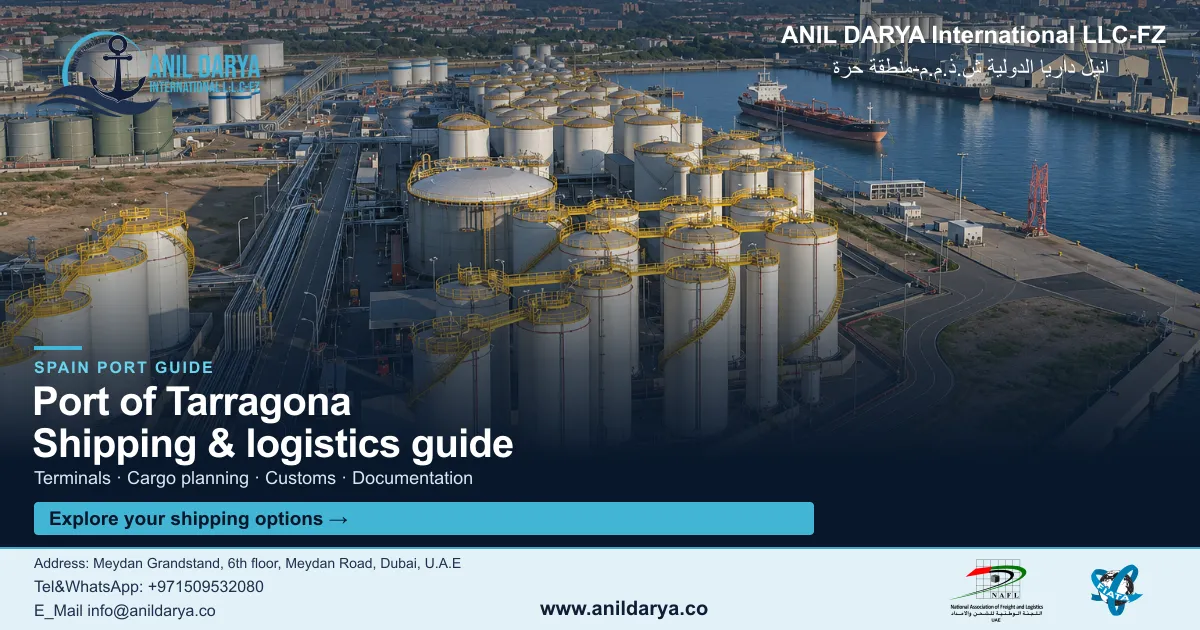
Port of Tarragona shipping is mainly about bulk liquids, chemicals, agri-food, vehicles and project cargo, not containers. The port in southern Catalonia handled 29.25 million tonnes in 2025, but its container terminal lost its operator in 2023 and container traffic has been very scarce since, so most boxes for the area move through Barcelona or Valencia. This guide covers what Tarragona handles, the new terminal planned from late 2026, rail links and customs at the port, then the steps for shipping from Dubai to Tarragona and for shipping from Tarragona to Dubai.
Port of Tarragona at a glance
| Item | Detail |
|---|---|
| Port authority | Port Authority of Tarragona (Autoritat Portuària de Tarragona) |
| UN/LOCODE | ESTAR |
| Location | Tarragona, Catalonia, about 100 km south-west of Barcelona |
| Total traffic 2025 | 29.25 million tonnes, 2,165 ship calls |
| Liquid bulk 2025 | 18.82 million tonnes, of which 8.97 million tonnes crude oil |
| Solid bulk 2025 | 8.48 million tonnes, of which 5.79 million tonnes cereals, flours and feed |
| General cargo 2025 | 1.95 million tonnes |
| Vehicles 2025 | 215,873 units |
| Project cargo berths | 3,500 m of berthing line, maximum draft 16 m, 11 ro-ro ramps |
| Container terminal | No operator since 2023; new COSCO and PTP terminal at Moll d'Andalusia due to start at the end of 2026 |
| Rail | 46 km of internal track, mixed gauge, La Boella intermodal terminal |
| Customs | Spanish Tax Agency (AEAT), under EU customs law |
| Import VAT in Spain | 21% standard, 10% reduced |
Where is the Port of Tarragona and who runs it?
The port lies on the Mediterranean coast of Catalonia, next to the city of Tarragona and about 100 km south-west of Barcelona. The Port Authority of Tarragona manages the land and water, from its office on Passeig de l'Escullera, and private companies run the terminals under concession.
Tarragona is an industrial port. It sits beside a large chemical and petrochemical cluster, and the port's own figures put the local chemical and petrochemical industry at 20 million tonnes of output a year, about 50% of Catalonia's and 25% of Spain's. Its other big trade is agri-food: grain, flour and animal feed for the farms of Catalonia, Aragon and the Ebro valley.
If your buyer is a chemical plant, a feed mill or a carmaker's logistics hub in this area, Tarragona may be the right port. If your buyer simply needs a container of goods, read the next section first.
Can you still ship containers to the Port of Tarragona?
Not in the usual way, at least until the new terminal opens. Here is what happened, from local press and the port authority's concession news:
- In 2008 DP World and ZIM bought Contarsa, the container terminal at Moll d'Andalusia.
- At its best the terminal handled up to 250,000 TEU a year.
- In 2023 the Port Authority withdrew DP World's concession because the terminal missed its agreed traffic targets.
- Diari de Tarragona reported in April 2026 that container traffic at the port had been very scarce for at least three years.
So for a standard FCL or LCL shipment from Dubai, price Barcelona or Valencia first and truck the box to Tarragona. Barcelona is about 100 km away by road. Fluent Cargo's route data for Dubai to Tarragona also uses Barcelona as the sea arrival port, which tells you how the market routes this cargo today.
[AMIR-FACT: how we actually route containers from Jebel Ali for Tarragona consignees (via Barcelona or Valencia and by truck), with the carriers we use and our real door-to-door days]
The new multipurpose terminal at Moll d'Andalusia
Containers should come back. In May 2026 the port authority awarded a new 50-year concession at Moll d'Andalusia to a joint venture of Rapport Investment (51%, owned by COSCO Shipping Ports and COSCO Shipping Bulk) and PTP Ibérica (49%). It was the only bidder.
| Item | Figure |
|---|---|
| Concession area | 510,586 m2, of which over 452,000 m2 at Moll d'Andalusia and about 58,400 m2 at La Boella |
| Term | 50 years |
| Investment | About EUR 116.8 million |
| Cargo | Containers, general cargo, ro-ro, vehicles and cold-chain cargo |
| Maximum capacity | About 680,000 TEU-equivalent a year at full operation |
| Minimum from 2031 | 360,000 TEU-equivalent a year, including at least 200,000 containers |
| Timeline | Start of activity by the end of 2026, works in 2027 and 2028, full operation at the end of 2028 |
In June 2026 the award was still subject to setting up the project company and signing the concession contract. Before you book a box direct to Tarragona, ask the carrier whether it calls the new terminal, how often and from which hub. Until there is a regular call, Barcelona or Valencia remains the safer plan.
What does the Port of Tarragona handle?
The port authority's 2025 summary shows how the traffic splits. Liquid bulk is almost two thirds of the total.
| Traffic, 2025 | Volume |
|---|---|
| Total | 29.25 million tonnes (23.25 million unloaded, 6 million loaded) |
| Liquid bulk | 18.82 million tonnes |
| Of which crude oil | 8.97 million tonnes |
| Solid bulk | 8.48 million tonnes |
| Cereals, flours, feed and fodder | 5.79 million tonnes |
| General cargo | 1.95 million tonnes |
| Vehicles | 215,873 units |
| Ship calls | 2,165 |
| Trucks | 823,137 |
The port authority groups its trades as agri-food, live animals, minerals, fruit, liquid bulk, paper and forest products, project cargo, iron and steel, vehicles and cruises. For UAE shippers the most relevant are liquid bulk and chemicals, project cargo and breakbulk, and steel.
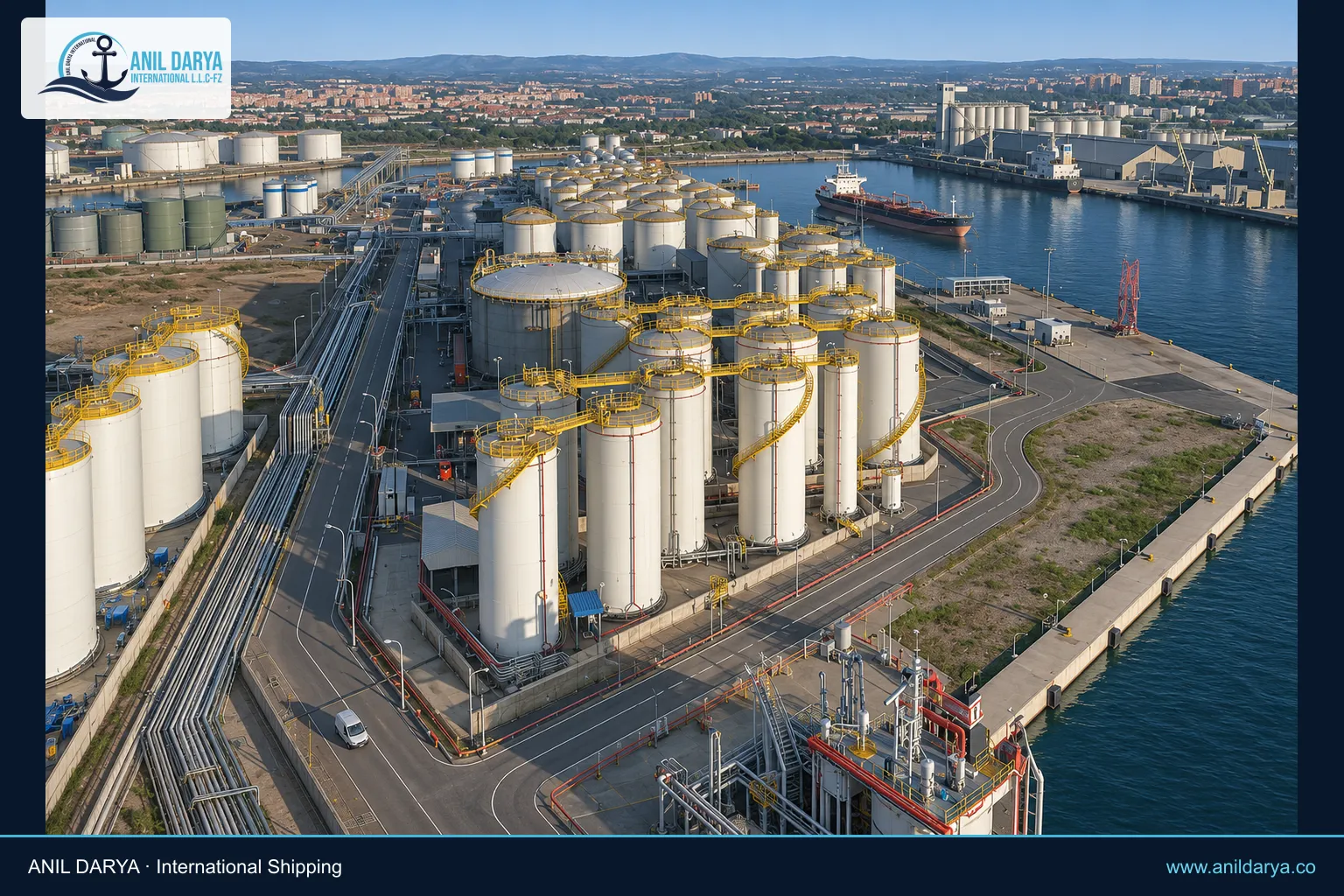
Liquid bulk and chemicals at Tarragona
Liquid bulk is the port's core business. The port authority publishes these figures for its liquid bulk area:
| Item | Figure |
|---|---|
| Berth line | 1,600 m |
| Operating draft | 15.1 m |
| Chemical pipelines | 71 |
| Storage capacity | Over 900,000 m3, with 1.1 million m3 planned |
| Storage area | Expanded from 18 ha to 36 ha |
| Independent tank terminals | Euroenergo, Tepsa and Vopak Terquimsa |
| Industrial users in the port | Asesa, BASF, Dow Chemical Ibérica and Repsol |
| Service | 24 hours, 365 days |
If you ship a chemical parcel from the UAE by tanker, the receiving tank terminal decides most of the plan: tank allocation, surveys, the berth and the pipeline. Chemicals in drums, IBCs or ISO tanks are a different case. They travel as packed dangerous goods in containers, which today means landing in Barcelona or Valencia and trucking to the plant. Our bulk cargo service covers liquid and dry bulk planning from the UAE side.
Breakbulk and project cargo through Tarragona
This is where Tarragona is strongest for shippers from the Gulf. The port authority markets a dedicated project cargo offer:
- 3,500 m of berthing line for project cargo.
- A maximum draft of 16 m, deep enough for specialised heavy-lift ships.
- 11 ro-ro ramps.
- Large operating areas for pre-assembly and storage.
The port lists Noatum Terminal Tarragona, Euroports, Bergé Marítima, Ership, the Linde group and Schwartz Hautmont among the companies it works with on project cargo. Its own material describes modules that take up to 12 months to build and assemble, with up to 1.5 million work hours, shipped out to North Africa, northern Europe, the United States, Australia and China.
For a heavy or oversized shipment from the UAE to Tarragona, plan these points:
- A breakbulk or heavy-lift ship direct to Tarragona, or flat racks to Barcelona or Valencia and an abnormal road move.
- Weight, dimensions, centre of gravity and lifting points for each piece.
- Whether ship's gear or a hired mobile crane will discharge it.
- The stevedore and the berth, agreed before the ship sails.
- Road permits in Catalonia for the move to site.
Our break bulk and project cargo service handles the UAE side, and our guide to the project cargo logistics process walks through the planning steps. For single pieces above standard crane limits, see our heavy lift shipping guide.
Vehicles, steel and agri-food bulk
Vehicles and ro-ro
Three terminals handle vehicles at Tarragona. The port authority gives storage for 47,000 vehicles on 530,000 m2, five ro-ro ramps, berth space for six ships and drafts of 12 m to 16 m. More than 40% of the port's vehicles move by rail, and rail vehicle traffic rose 52% in 2023 to more than 500 trains.
Agri-food and dry bulk
Tarragona describes itself as the leading agri-food port in Spain and the Mediterranean. It moved a record 7.6 million tonnes of agri-food products in 2023. Its agri-food quays run to 2,500 m with a maximum draft of 14 m, worked by four terminal operators: Euroports Ibérica, Bergé Marítima, Ership and Noatum Terminal Tarragona. Covered storage totals 260,000 m2, storage capacity 1.3 million tonnes and unloading capacity 8,200 tonnes per hour. The hinterland covers Catalonia, Aragon, much of Navarra and eastern Castile, an area that makes more than 40% of Spain's animal feed.
Truck collection from the agri-food terminals runs through the port's SEA delivery system, which hauliers use to book pick-up.
Rail links from the Port of Tarragona
Rail is a real advantage at Tarragona. The port authority's intermodal figures:
| Rail asset | Detail |
|---|---|
| Internal track | 46 km, Iberian gauge across the port, 10.3 km of mixed Iberian and UIC gauge |
| Links to the national network | 2 connection points, 3 branches; main lines to Zaragoza-Madrid, Valencia and Barcelona |
| La Boella intermodal terminal | 4 ha, public, 5 mixed-gauge loading tracks, trains up to 750 m, capacity 250,000 TEU |
| La Boella services | Containers, swap bodies, vehicles and trailers; authorised for dangerous goods |
| PortTarragona Terminal Guadalajara-Marchamalo | 150,000 m2 inland terminal about 70 km from Madrid, on ADIF Line 200 |
| Moll de la Química station | 3 tracks of 200 m, linked to the Vopak Terquimsa liquids terminal |
La Boella sits close to the non-intrusive container scanner and the border inspection point, which helps when cargo needs checks. The port also sits on the Mediterranean rail corridor, which runs over 3,000 km from Algeciras to the French border and on into central Europe. The new Moll d'Andalusia concession includes La Boella, so rail will be part of the container offer once the terminal is working.
Dangerous goods to Tarragona
Most DG cargo at Tarragona arrives in bulk, by tanker, into the chemical terminals. Packed DG from the UAE, such as drums or IBCs in containers, must be packed, marked and declared under the IMDG Code and accepted by the carrier and every port on the route. While Tarragona has no regular container call, that means the receiving port is Barcelona or Valencia and the box is trucked under road DG rules (ADR) to the plant.
For bulk chemical parcels, the tank terminal and the berth must accept the product before the ship is fixed. Our dangerous goods shipping team prepares the DG declaration, checks the SDS and secures carrier approval from the UAE.
Customs at the Port of Tarragona: the short version
Customs at Tarragona follows the same EU and Spanish rules as every Spanish port. Our Valencia guide covers the full process. Here is what matters for Tarragona.
- The carrier lodges the entry summary declaration (ENS) at least 24 hours before loading for containers, and at least 4 hours before arrival for bulk cargo.
- The importer needs an EORI number.
- The import declaration (DUA) is lodged with the Spanish Tax Agency (AEAT), by the importer or a customs representative.
- AEAT assigns a channel: green (release once duties are paid or guaranteed), orange (document check) or red (documents and physical inspection).
- Duty comes from the EU TARIC tariff. EU-UAE trade agreement talks were launched on 28 May 2025 and the agreement is not in force, so UAE-origin goods pay the normal third-country rate.
- Import VAT in Spain is 21% standard and 10% reduced.

| Document | Why it matters at Tarragona |
|---|---|
| Commercial invoice and packing list | Value, HS code and quantities for the DUA |
| Bill of lading | Data for the ENS and the manifest |
| Certificate of origin | Non-preferential origin proof |
| SDS and DG declaration | Tank terminal, carrier and port acceptance |
| Cargo plan and lifting drawings | Berth and stevedore planning for project cargo |
| Licences and certificates | Needed for controlled goods or goods under quota |
In the UAE we handle export clearance. In Spain, the importer or its customs representative clears the cargo, and we work with them so the documents match before arrival.
How to ship from Dubai to the Port of Tarragona, step by step
- Decide the cargo route: containers usually via Barcelona or Valencia and truck; tanker or breakbulk direct to Tarragona.
- Agree the Incoterm and who pays port and terminal charges in Spain. Our guide to Incoterms 2020 for sea freight explains the split.
- Check the importer's EORI number and any licence the goods need.
- Send us the HS code, weight, dimensions and cargo type. For project cargo, include drawings and lifting points.
- We book space with a carrier, or work with the charterer's ship for breakbulk, and confirm the berth or the receiving port.
- We truck the cargo to the UAE port, file the export declaration and submit the VGM for containers. Our Jebel Ali port guide covers the export side.
- We send the draft bill of lading for checking so the ENS data and the importer's details match.
- The importer's customs representative lodges the DUA and pays duty and VAT.
- The cargo is released and trucked or railed to the buyer.
How to ship from Tarragona to Dubai
We also handle the import direction, shipping from Tarragona to Dubai and other UAE ports. The port loaded 6 million tonnes in 2025, and its project cargo partners build large modules that leave by sea. The routing rule is the same as for imports into Spain: containers usually leave through Barcelona or Valencia, while breakbulk, heavy lifts and bulk parcels can load at Tarragona.
- Agree the Incoterm with your Spanish supplier. On FCA or FOB, you control the main freight and can book through us.
- Send us the supplier's details, the HS code, weights and dimensions. For project cargo, add drawings and lifting points.
- We book space with a carrier from Barcelona or Valencia for containers, or plan a breakbulk or heavy-lift sailing from Tarragona, to Jebel Ali, Khalifa Port or Sharjah.
- The supplier or its customs representative files the EU export declaration with AEAT and arranges pickup or delivery to the port. We do not have an office in Spain; we work with the supplier's forwarder or an agent they appoint.
- For DG, the supplier provides the SDS and the IMDG declaration, and we confirm carrier acceptance for discharge in the UAE.
- We check the draft bill of lading, invoice, packing list and certificate of origin before sailing.
- On arrival we clear the cargo with UAE customs. Dubai Customs asks for the invoice, packing list, certificate of origin and any permit from a controlling authority.
- We deliver to your site or warehouse in the UAE, or into a free zone.
For heavy pieces arriving in the UAE, see our Khalifa Port guide for Abu Dhabi deliveries.
Tarragona, Barcelona or Valencia: which port should you choose?
| Your cargo | Port to price first | Reason |
|---|---|---|
| Standard containers for Tarragona or southern Catalonia | Barcelona | Regular deep-sea services, about 100 km by road |
| Containers for inland Spain or the Valencia region | Valencia | Regular deep-sea container services |
| Bulk liquids and chemicals by tanker | Tarragona | Tank terminals and pipelines to the chemical plants |
| Project cargo and heavy lifts | Tarragona | 16 m draft, 3,500 m of project cargo berths, ro-ro ramps |
| Grain, feed and agri bulk | Tarragona | Spain's leading agri-food port |
| Containers once the new terminal has a regular call | Tarragona | Check service and frequency first |
What drives the cost of shipping to Tarragona?
- Ocean freight to Barcelona or Valencia plus the truck leg, for containers.
- Charter or breakbulk freight and stevedoring, for project cargo.
- Tank terminal fees and surveys, for liquid bulk.
- DG and out-of-gauge surcharges.
- EU duty from TARIC and Spanish import VAT.
- Storage, demurrage and detention if clearance or collection is slow.
We do not publish fixed rates because they change with each sailing. Ask us for a quote on your actual cargo.
Checklist before you ship to Tarragona
- Routing confirmed: direct to Tarragona, or via Barcelona or Valencia.
- If direct by container, the carrier's call at the new terminal confirmed in writing.
- Importer's EORI number and customs representative confirmed.
- HS code agreed between shipper and importer.
- Invoice, packing list and bill of lading match on names, weights and values.
- For DG: SDS, DG declaration and acceptance by carrier, ports and tank terminal.
- For project cargo: drawings, lifting plan, berth and road permits agreed.
Common mistakes
- Booking a container "to Tarragona" without checking whether any carrier calls there.
- Relying on old directory figures for container capacity that predate the 2023 loss of the terminal operator.
- Expecting preferential duty on UAE goods: the EU-UAE agreement is not in force.
- Sending a chemical parcel before the tank terminal has accepted the product.
- Planning a heavy lift without agreeing the stevedore, crane and berth in advance.
- Forgetting that packed DG trucked from Barcelona must also meet road DG rules.
Frequently asked questions
Does the Port of Tarragona handle containers?
Very few at present. The container terminal lost its operator in 2023 and local press reported container traffic as very scarce since. A new terminal run by a COSCO and PTP joint venture is due to start at the end of 2026, so check carrier calls before booking.
Where should a container for Tarragona land when shipping from Dubai?
Price Barcelona first, about 100 km away by road, or Valencia for inland Spain. The box is then trucked to Tarragona after clearance at the port of arrival.
What is the port code for Tarragona?
The UN/LOCODE for Tarragona is ESTAR. You will see it on bookings, bills of lading and tracking systems.
Can you ship from Tarragona to Dubai?
Yes. Containers from the Tarragona area usually load at Barcelona or Valencia, while project cargo and bulk can load at Tarragona itself. The supplier handles the Spanish export declaration, and we book the freight and clear and deliver the cargo in the UAE.
What cargo is Tarragona best for?
Liquid bulk and chemicals, agri-food bulk, vehicles and project cargo. In 2025 liquid bulk was 18.82 million tonnes of the port's 29.25 million tonnes total.
Can heavy-lift project cargo go direct to Tarragona?
Yes. The port offers 3,500 m of berthing line for project cargo with a maximum draft of 16 m and 11 ro-ro ramps, used by specialised heavy-lift ships.
Does Tarragona have rail links?
Yes. The port has 46 km of internal track, mixed-gauge sections, the La Boella intermodal terminal for trains up to 750 m, and its own inland terminal near Madrid at Guadalajara-Marchamalo.
Is there a trade agreement that lowers EU duty on UAE goods?
Not yet. EU-UAE negotiations were launched on 28 May 2025 and no agreement is in force, so the normal EU tariff applies.
What is the import VAT rate in Spain?
The standard rate is 21% and the reduced rate is 10%.
Get a quote for Port of Tarragona shipping
Send us your cargo details and we will come back with a routing and a price, whether that is a container via Barcelona or a project shipment direct to Tarragona. Use our freight rate inquiry form, or contact our team to talk through a DG or heavy-lift shipment first.
Sources
- Port of Tarragona: Statistics, 2025 summary
- Port of Tarragona: About the port (address, traffic types)
- Port of Tarragona: Project cargo (berthing line, draft, ro-ro ramps, partners)
- Port of Tarragona: Liquid bulk (berths, draft, pipelines, storage, terminals, chemical cluster)
- Port of Tarragona: Vehicles (storage, ramps, rail share)
- Port of Tarragona: Agri-food (volumes, quays, operators, storage, hinterland)
- Port of Tarragona: Intermodality (rail network, La Boella, Guadalajara-Marchamalo)
- APD Notícies: The concession requires 360,000 TEUs annually, 29 May 2026
- APD Notícies: Cosco enters Tarragona, 29 April 2026 (DP World history, sole bidder)
- Diari de Tarragona: Cosco bid and the state of container traffic, April 2026
- Catalonia Trade and Investment: COSCO and PTP to invest EUR 116 million, 1 June 2026
- Trans.info: COSCO invests in Tarragona, 9 June 2026 (areas, timeline)
- ShipNext: Tarragona port data (LOCODE, distance from Barcelona)
- iContainers: Port of Tarragona
- Fluent Cargo: Dubai to Tarragona (arrival port used for sea freight)
- Dubai Customs: Import declaration documents
- AEAT: Customs declaration and control channels
- European Commission Access2Markets: Customs clearance documents and procedures (ENS timing, EORI)
- European Commission: EU Customs Tariff (TARIC)
- European Commission: EU-UAE agreement negotiations
- Your Europe: VAT rates in EU countries
Reviewed: 10 November 2026