
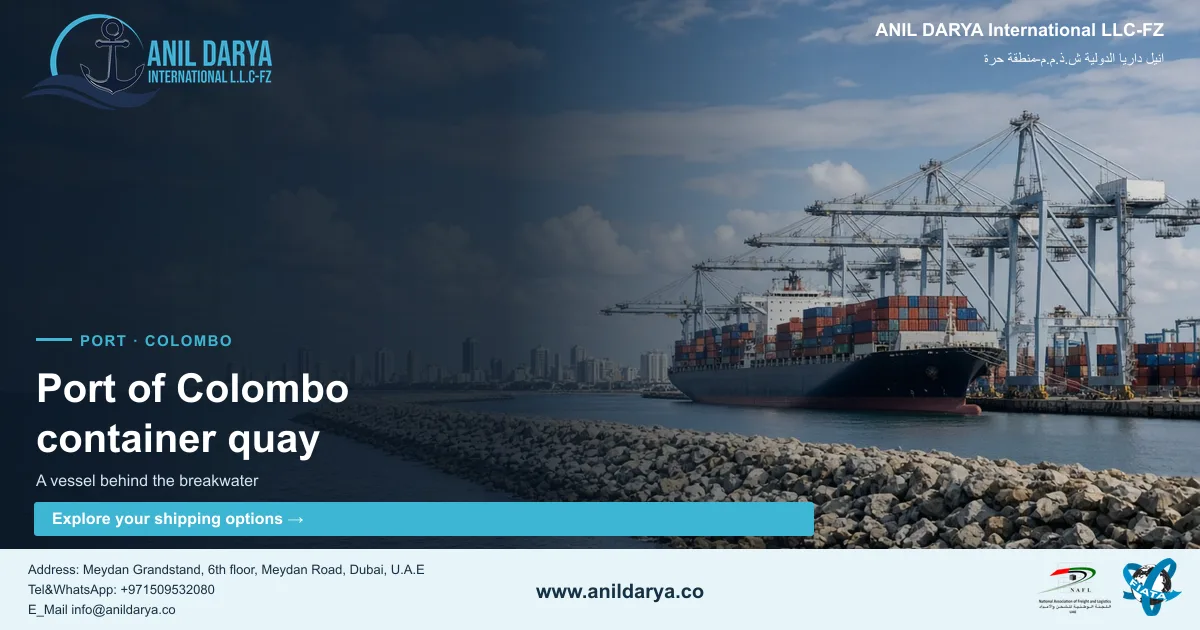
Port of Colombo shipping covers almost all of Sri Lanka's container trade and most of its breakbulk. The port is run by the Sri Lanka Ports Authority (SLPA), with container terminals operated by SLPA and by private partners, and cargo is cleared by Sri Lanka Customs through a CusDec lodged in ASYCUDA World. This guide covers the terminals, the cargo types, customs at the port, and how we move your cargo from Dubai to Colombo. We ship both from Dubai to Colombo and from Colombo to Dubai.
Port of Colombo shipping: key facts at a glance
| Item | Detail |
|---|---|
| Port authority | Sri Lanka Ports Authority (SLPA), set up on 1 August 1979 under Act No. 15 of 1979 |
| Customs authority | Sri Lanka Customs |
| UN/LOCODE | LKCMB |
| Location | West coast of Sri Lanka, in Colombo city |
| Container terminals | JCT, ECT, SAGT, CICT and CWIT, plus SLPA's Unity Container Terminal |
| Containers handled in 2025 | 8,291,178 TEU, up from 7,792,069 TEU in 2024 |
| Containers handled, first half of 2026 | 4,444,034 TEU, up 11.9% on the same period of 2025 |
| Deepest container berths | 20 m at CWIT, 18 m at CICT and ECT |
| Main breakwater | 6,830 m |
| Entrance channel (South Harbour) | Two-way, 20 m initial depth, 570 m wide |
| LCL warehouse | SLPA CFS Peliyagoda, 19,500 m² stacking area |
| Import declaration | CusDec in ASYCUDA World, lodged by a Customs House Agent after the delivery order |
| Inward manifest deadline | 72 hours before arrival at the first Sri Lankan port |
| Import VAT and SSCL | 18% and 2.5% on most tariff lines |
| Colombo to Dubai | Export CusDec by the exporter or its Customs House Agent; UAE duty 5% of CIF and VAT 5% |
Where is the Port of Colombo and who runs it?
The Port of Colombo sits on the west coast of Sri Lanka, next to the city centre. SLPA was formed on 1 August 1979 by merging the Colombo Port Commission with two statutory corporations, and it runs on its own revenue rather than government allocations. SLPA operates its own terminals and is a partner in the privately run ones.
For shippers this split matters. SLPA terminals and the private terminals each have their own gate rules and tariffs, so the terminal named on your arrival notice tells your Customs House Agent and trucker where to go. Bandaranaike International Airport, the main cargo airport, is at Katunayake, which helps if you split a shipment between sea and air.
Harbour layout: the old harbour and the South Harbour
SLPA describes Colombo as primarily a container port. The original harbour covers 184 hectares. The South Harbour, developed from 2008 on 285 hectares for deep-water berths and mainline vessels, is reached by a two-way channel with an initial depth of 20 m and a width of 570 m. It was planned for three terminals of 2.4 million TEU each, and CICT was the first, built and operated on a build, operate and transfer basis. For your cargo the practical point is depth: CWIT, CICT and ECT offer 18 m to 20 m, against 12 m to 15 m at JCT and 15 m at SAGT, so the largest mainline ships use the deeper berths.
Which container terminals does the Port of Colombo have?
Colombo has five large container terminals and one smaller SLPA terminal. Your carrier's service decides which one handles your box.
| Terminal | Operator | Quay and berths | Depth | Other published facts |
|---|---|---|---|---|
| Jaya Container Terminal (JCT) | SLPA | 1,292 m, 4 main container berths | 12 m to 15 m | 14 quay cranes; 45,000 TEU dry and 1,260 TEU reefer stacking |
| East Container Terminal (ECT) | SLPA | Stage I: 450 m | 18 m | Built for vessels up to 18,000 TEU; twin-lift quay cranes |
| South Asia Gateway Terminals (SAGT) | Private partnership | 940 m, 3 berths | 15 m | 540 reefer slots; 20 ha site; operating since 1999 |
| Colombo International Container Terminals (CICT) | Private partnership | 4 berths | 18 m alongside | 2.4 million TEU design capacity; 58 ha yard |
| Colombo West International Terminal (CWIT) | Adani Ports, John Keells Holdings and SLPA | 1,400 m | 20 m | About 3.2 million TEU a year; fully automated |
| Unity Container Terminal (UCT) | SLPA | Not published by SLPA | Not published by SLPA | Listed among SLPA's terminals |
Colombo West International Terminal (CWIT)
CWIT is the newest terminal. It was built under a 35-year build, operate and transfer agreement between Adani Ports, John Keells Holdings and SLPA, and started operations in 2025. Adani Ports describes it as the first fully automated terminal at the port. A second phase, reported in October 2026, doubled capacity from 1.6 million to 3.2 million TEU a year, and the terminal reports 2 million TEU handled in its first 18 months.
How busy is the port?
| Period | Containers handled | Source |
|---|---|---|
| 2024 | 7,792,069 TEU | SLPA, as reported in 2026 |
| 2025 | 8,291,178 TEU | SLPA, as reported in 2026 |
| First half of 2026 | 4,444,034 TEU (+11.9%) | SLPA, as reported in 2026 |
| CICT, 2024 | 3.3 million TEU | Press report, January 2025 |
| SAGT, 2024 | 2.0 million TEU | Press report, January 2025 |
High volume means plenty of services, but also busy yards in peak weeks. Send documents early so your box does not wait in the stack for paperwork.
What cargo can you ship through the Port of Colombo?
Here is how each main cargo type usually moves through the port.
| Cargo type | How it moves | What to plan |
|---|---|---|
| General goods in containers | FCL through JCT, ECT, SAGT, CICT or CWIT | Terminal on the arrival notice, free time, truck |
| Small shipments | LCL, unpacked at a container freight station | Consolidator's paperwork, carton marks |
| Chilled and frozen food | Reefer containers on plug-in slots | Set temperature, health and food approvals |
| Steel, machinery, equipment | Breakbulk, flat racks or open tops | Lifting points, lashing, direct delivery |
| Project and heavy-lift pieces | Breakbulk or heavy-lift vessels | Drawings, lift plan, road route out of Colombo |
| Chemicals and other DG | IMDG containers, or general cargo stations that take DG | Classification, carrier acceptance, licences |
| Vehicles | Ro-Ro or containers | Current vehicle import rules, Customs valuation |
FCL and LCL at the Port of Colombo
Most cargo through Colombo moves in containers. You have two main options.
- FCL (full container load). You book a whole 20ft or 40ft box. It suits larger shipments and cargo you do not want handled with other goods.
- LCL (less than container load). Your cargo shares a box and is unpacked at a container freight station (CFS) in Colombo. It suits small volumes but adds handling and a few extra steps.
SLPA's main LCL warehouse is CFS Peliyagoda, on about 7 acres, with a 260 m by 75 m warehouse and 19,500 m² of stacking area. SLPA also lists bonded warehouses, CFS V at 1,450 m² with a 150 m² cool room and CFS III at 1,400 m². Sri Lanka Customs examines LCL cargo at the New Nuge Road warehouse, Bandaranayake Quay and Jaya Container Terminal.
With LCL, your release also depends on the other shippers in the box. Send documents early and make sure carton marks match the packing list. Our guide to FCL vs LCL costs shows where the break-even point sits.
Breakbulk, project cargo and dangerous goods at Colombo
SLPA runs a bulk and breakbulk direct delivery service through its e-systems, and Sri Lanka Customs has examination officers for bulk at JCT and for Guide Pier, Kochchikade and Prince Vijaya Quay. Direct delivery means the goods go straight from ship to truck, so customs papers, trucks and permits must be ready when the vessel berths.
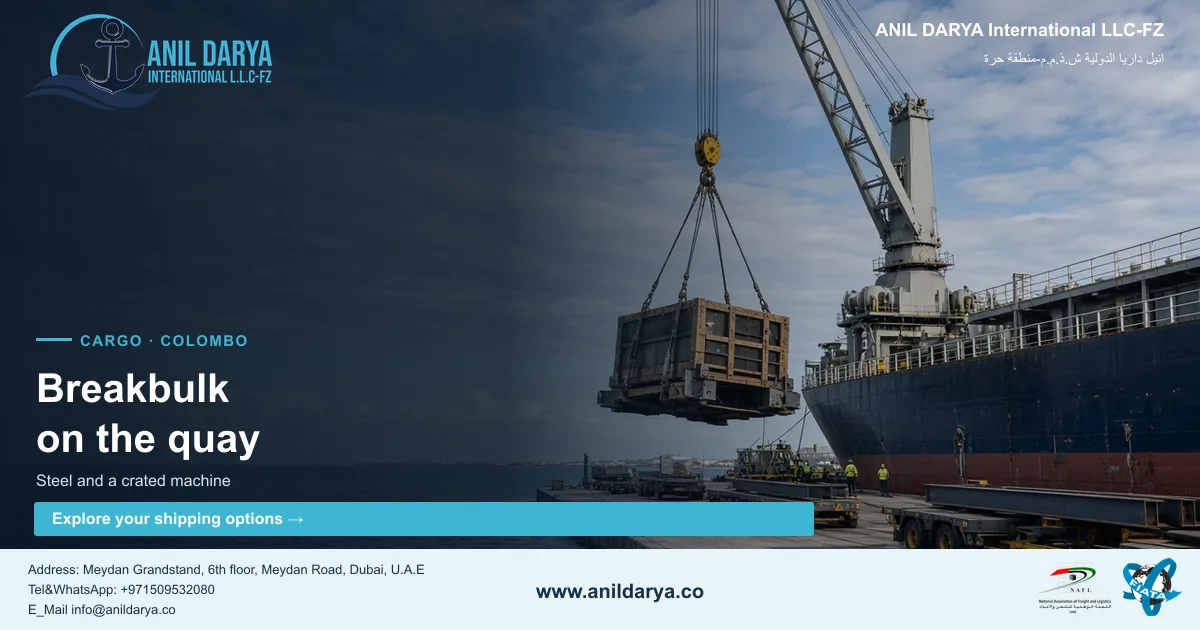
When you ship project cargo to Colombo with us, we plan it in this order:
- Collect drawings, dimensions, weights and centre of gravity for every piece.
- Decide between flat rack, open top and conventional breakbulk.
- Confirm carrier acceptance and the discharge method at Colombo.
- Agree with the consignee's agent who books trucks and road permits on the Sri Lankan side.
- Arrange lashing, survey and loading in the UAE.
See our break bulk and project cargo service for what we handle on the UAE side.
For dangerous goods, SLPA lists CFS II as handling general cargo and dangerous cargo. Most of the DG work still happens before loading: correct UN number and class, an SDS, a signed Dangerous Goods Declaration, UN packaging, labels and placards, and carrier acceptance. Sri Lanka also restricts toxic and hazardous chemicals and pesticides, so check the licence before you book. Our dangerous goods team checks classification first, and our guide to IMDG segregation in containers covers mixed loads.
Customs clearance at the Port of Colombo
Sri Lanka Customs clears all cargo landed at Colombo. The rules below come from Customs' own pages.
How the CusDec works
Import consignments are declared through a Customs House Agent, who submits the CusDec online in ASYCUDA World. The CusDec goes in after the goods arrive and after the shipping agent issues the delivery order. Customs value is the actual transaction value, and the importer must pay the correct duty before release. Payment is made at Bank of Ceylon or People's Bank, in a branch or online.
If your buyer has no clearing agent yet, SLPA's shipping directory lists cargo clearing and forwarding agents, container shipping agencies, breakbulk agencies and certified container inspectors in Colombo.
The carrier side runs first. Under Gazette No. 1886/55, the inward cargo report must reach Customs 72 hours before arrival at the first Sri Lankan port, and only licensed shipping agents, freight forwarders or NVOCCs may file it.
Which documents does Customs check?
At examination, Customs asks for the delivery copy of the CusDec with:
- Bill of lading and delivery order.
- Commercial invoices and a value declaration.
- Packing list.
- Catalogues, literature or manufacturing details where needed.
- Relevant licences, certificates and approvals.
Examination channels at Colombo
| Risk level | Where the cargo goes |
|---|---|
| High-risk FCL | High Risk Cargo Unit at Grayline Yard I |
| Medium-risk FCL | Grayline Yard I or II |
| Low-risk FCL | Rank Container Terminal (RCT), may be scanned only |
| LCL | New Nuge Road warehouse, Bandaranayake Quay or JCT |
| Single-commodity bulk in many containers | May be released through the Green Channel from the main office |
Four scanners work 24 hours at Colombo Port and RCT. Customs also lists fixed charges of Rs. 250 per declaration, Rs. 100 seal charge per container and Rs. 1,600 overtime for FCL cargo.
Duty, levies, licences and SLSI
Duty and levies are set per HS code in the Sri Lanka Customs National Imports Tariff Guide 2026. From 1 April 2026 the general duty bands are 0%, 10%, 20% and 30%. Most lines also carry VAT at 18% and SSCL at 2.5%, and some carry the Ports and Airports Development Levy, EDB Cess, excise or a surcharge. VAT and SSCL are worked out on CIF plus 10%, plus duty and the other levies.
The same tariff guide has an ICL/SLSI column. An "L" means an Import Control Licence is needed, and an "S" means the product falls under the Sri Lanka Standards Institution import inspection scheme. SLSI accepts certificates from accredited laboratories or the exporting country's standards body, or products from SLSI-registered plants, and recommends release to Customs. Uncertified goods are sampled and tested, which costs time at the port.
How to ship from Dubai to the Port of Colombo, step by step
This is how we run a sea shipment from Dubai to Colombo. We handle the UAE side and work with the consignee's Customs House Agent in Colombo.
- Share the cargo details. Commodity, HS code, weight, volume or dimensions, value, Incoterm and the delivery point in Sri Lanka.
- Check the Sri Lankan rules. The buyer's agent checks the duty band and the ICL/SLSI column, and starts any licence or SLSI certificate.
- Choose the service. We compare container or breakbulk services from Jebel Ali Port and confirm the Colombo terminal, transit and free days.
- Book and load. We truck the empty, load and seal, and gate in before the cut-off. For DG and project cargo we confirm acceptance first.
- File the UAE export declaration with Dubai Customs.
- Release the bill of lading. We check the draft against the invoice and packing list, so the manifest filed 72 hours before arrival is correct.
- Delivery order and CusDec. The shipping agent in Colombo issues the delivery order and the Customs House Agent lodges the CusDec.
- Examination, payment and release. Customs routes the box by risk, the importer pays, and the trucker collects from the terminal.
[AMIR-FACT: our real port-to-port transit Jebel Ali to Colombo for FCL and LCL, and the carriers or services we actually book to Colombo]
Our sea freight service covers FCL and LCL bookings from the UAE to Colombo.
How to ship from the Port of Colombo to Dubai
We also handle the other direction: shipping from Colombo to Dubai, with arrival at Jebel Ali, Khalifa Port or Sharjah port. We book the space and run the UAE side. The Sri Lankan export papers stay with the shipper or its Customs House Agent.
The Sri Lanka export side
- Either the exporter or a Customs House Agent can be the declarant. The export CusDec is filed online in ASYCUDA World, and the goods must leave within 30 days of the CusDec registration date.
- FCL export cargo is handled at the Export Facilitation Centre, and LCL at the Export Office at Customs headquarters.
- Some goods carry export levies set by HS code, such as the EDB cess, Tea Board cess, coconut cess or rubber cess. Any permit from another agency must be in hand before the CusDec.
- Sri Lanka Customs charges Rs. 550 per declaration, a Rs. 250 computer fee and a Rs. 300 examination fee.
The UAE import side
On arrival, the declaration goes to Dubai Customs with the commercial invoice, the packing list, the certificate of origin and any permit for restricted goods. For sea cargo the GCC customs guide also lists the bill of lading and the delivery order. Customs duty in Dubai is 5% of the CIF value for most goods, with 50% on alcohol and 100% on cigarettes. Import VAT is 5%. A VAT-registered importer accounts for it on its VAT return, while an importer that is not registered pays it before Customs releases the goods.
- Send us the shipper's details in Sri Lanka, the cargo, the HS code and the UAE delivery address.
- We book space and send the booking and cut-off to the shipper.
- The shipper or its trucker loads the container and delivers it to the terminal named in the booking.
- The shipper or its Customs House Agent files the export CusDec and pays any cess.
- We check the draft bill of lading against the invoice and packing list.
- We file the UAE declaration before the vessel arrives.
- We arrange payment of the duty and VAT and collect the delivery order.
- We truck the cargo to your site and return the empty container inside free time.
[AMIR-FACT: the carriers we actually use from Colombo to Jebel Ali, Khalifa or Sharjah and our real transit days in this direction]
Checklist before you ship to Colombo
- HS code checked in the 2026 tariff guide.
- Import Control Licence or SLSI certificate in hand if the line needs one.
- Importer has a TIN and is registered with Sri Lanka Customs.
- Customs House Agent appointed in Colombo.
- Invoice, packing list and bill of lading match on value, weight, marks and consignee.
- Bill of lading shows Colombo as port of discharge.
- Technical literature ready for machinery and parts.
- For LCL: carton marks match the packing list.
- For DG: SDS, DG declaration, packaging, labels and carrier acceptance.
- For breakbulk: drawings, lifting points, direct delivery trucks and permits.
Common mistakes at the Port of Colombo
- Wrong description on the bill of lading. The manifest goes in 72 hours before arrival, so errors surface early and are slow to fix.
- Shipping without the licence or SLSI paperwork. The cargo waits in Colombo while storage runs.
- Late CusDec. It can only be lodged after the delivery order, so chase the shipping agent as soon as the vessel arrives.
- Ignoring free time. Terminal storage and container detention start after the free days. Our article on demurrage and detention explains how they add up.
- Breakbulk with no trucks ready. Direct delivery cargo needs trucks at the quay when the ship works.
Frequently asked questions
Who operates Colombo's port?
The Sri Lanka Ports Authority runs the port. It operates JCT, ECT and UCT itself and is a partner in the privately run SAGT, CICT and CWIT terminals.
What is the port code for Colombo?
The UN/LOCODE for the Port of Colombo is LKCMB. Use it on bookings and bills of lading.
How many containers does the Port of Colombo handle?
SLPA reports 8,291,178 TEU in 2025, up from 7,792,069 TEU in 2024. In the first half of 2026 the port handled 4,444,034 TEU, 11.9% more than a year earlier.
Which is the deepest terminal at Colombo?
CWIT has a 20 m depth along a 1,400 m quay. CICT has 18 m alongside, and ECT has 18 m at its stage I quay.
What documents do I need to clear cargo at Colombo?
Customs checks the CusDec with the bill of lading, delivery order, invoices, value declaration, packing list, technical literature where needed, and any licences, certificates or approvals.
Who files the customs declaration at Colombo?
A Customs House Agent files the CusDec online in ASYCUDA World on the importer's behalf, after the goods arrive and the shipping agent issues the delivery order.
Can I ship LCL cargo to Colombo?
Yes. LCL boxes are unpacked at a container freight station such as SLPA's CFS Peliyagoda, and Customs examines LCL cargo at New Nuge Road, Bandaranayake Quay or JCT.
Can I ship dangerous goods to the Port of Colombo?
Yes. You need correct classification, an SDS, a DG declaration, UN packaging and carrier acceptance, plus any Sri Lankan licence for restricted chemicals or pesticides.
How do I ship from Dubai to Colombo?
We book a container or breakbulk service from Jebel Ali, file the UAE export declaration and check the bill of lading so the manifest filed 72 hours before arrival is right. In Colombo, the consignee's Customs House Agent lodges the CusDec and the importer pays duty and taxes.
How do I ship from Colombo to Dubai?
The exporter or its Customs House Agent files the export CusDec in ASYCUDA World and ships within 30 days of registration. We book the space, file the Dubai Customs declaration before arrival, arrange payment of the 5% duty on the CIF value and the 5% import VAT, and deliver.
Get a quote for Port of Colombo shipping
Send us your cargo details and we will come back with a routing and a price to Colombo. Use our freight rate inquiry form, or contact our team if you want to talk through a breakbulk, project or DG shipment first. You can also read about our Dubai freight forwarding team.
Sources
- Sri Lanka Ports Authority: Port of Colombo (history, services)
- Sri Lanka Ports Authority: About Colombo Port (harbour areas, South Harbour, channel)
- Sri Lanka Ports Authority: Shipping directory (clearing agents, shipping agencies)
- Sri Lanka Ports Authority: Port of Colombo terminals (JCT, ECT, SAGT, CICT, WCT, UCT)
- Sri Lanka Ports Authority: General cargo services (CFS Peliyagoda, bonded warehouses, CFS II)
- Sri Lanka Ports Authority: Bulk and break bulk (direct delivery)
- Baird Maritime: Colombo West terminal doubles capacity, with SLPA volumes (October 2026)
- Adani Ports: Colombo West International Terminal commences operations (April 2025)
- John Keells Group: Colombo West International Terminal commences operations
- South Asia Gateway Terminals: About SAGT
- Daily Mirror: Colombo terminal volumes for 2024 (January 2025)
- Sri Lanka Customs: Import procedures (CusDec, charges, payment, manifest rule)
- Sri Lanka Customs: Central Cargo Examination Directorate (documents, channels, scanners)
- Sri Lanka Customs: FAQ
- Sri Lanka Customs: Computation of import levies
- Sri Lanka Customs National Imports Tariff Guide 2026, Chapter 52 (VAT, SSCL, ICL/SLSI columns)
- Daily FT: Customs duty bands from 1 April 2026 (July 2026)
- Sri Lanka Standards Institution: Import inspection
- US International Trade Administration: Sri Lanka prohibited and restricted imports
- Wikipedia: Port of Colombo (terminal ownership, SLPA stakes, location)
- iContainers: Port of Colombo (UN/LOCODE)
- Sri Lanka Customs: Exporting goods (declarant, CusDec, export offices, levies, fees)
- Dubai Customs: Submit customs declaration (import, export and re-export documents)
- Dubai Customs: FAQ (duty of 5% of CIF value, CIF definition)
- UAE Government portal: Clearing customs and paying customs duty
- Federal Tax Authority: VAT (5% rate)
- Federal Tax Authority: VAT guide (import VAT, reverse charge and payment before release)
- GCC Unified Guide for Customs Procedures at First Points of Entry (import and export documents)
Reviewed: 10 November 2026