
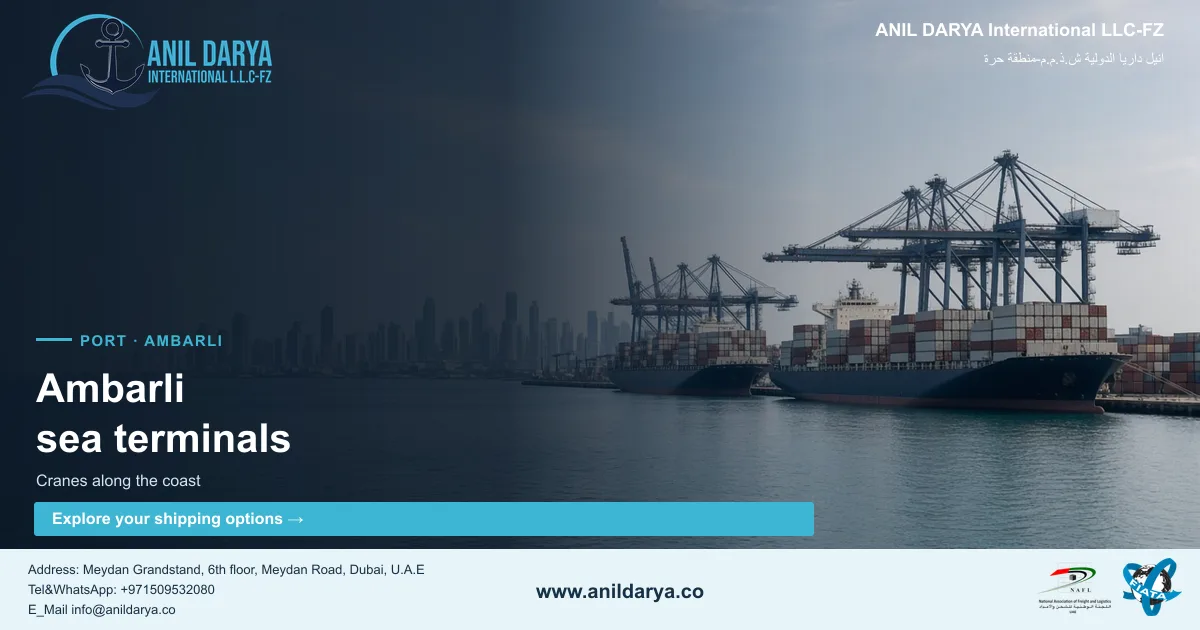
Ambarli port shipping means using the cluster of private terminals at Ambarli, on the European side of Istanbul, which together form Turkey's busiest container port area. Port facilities there handled 3.43 million TEU in 2025, mostly through the Marport, Kumport and Mardas terminals. This guide explains what each terminal handles, the dangerous goods limits, Turkish customs and duty, and how we ship to Ambarli from Dubai. We ship both from Dubai to Ambarli and from Ambarli to Dubai.
Ambarli port guide: key facts at a glance
| Item | Detail |
|---|---|
| Location | Beylikduzu district, European side of Istanbul, on the Sea of Marmara |
| UN/LOCODE | TRAMR |
| Structure | Several privately run terminals inside one port authority area |
| Main container terminals | Marport, Kumport, Mardas |
| Containers handled in 2025 | 3,428,048 TEU, the most of any Turkish port area |
| Share of 2025 volume | 67.3% import and export, 29.2% transit, 3.4% domestic coastal |
| Cargo types | Containers, general cargo, project cargo, bulk, Ro-Ro |
| Maximum depth at the main terminals | 16 m (Marport) to 16.5 m (Kumport, Mardas) |
| Customs | Ministry of Trade, BILGE declaration system |
| Import VAT | 20% general rate |
| Trade agreement with the UAE | UAE-Türkiye CEPA, in force since 1 September 2023 |
| Ambarli to Dubai | Export declared by a registered exporter or its broker; CEPA proof of origin for the preferential UAE rate |
Where is Ambarli port and which areas does it serve?
Ambarli lies in Beylikduzu, on the north shore of the Sea of Marmara and the European side of Istanbul. The terminals sit next to each other along the coast, with addresses on the same Liman Caddesi (port road).
Ambarli suits consignees in Istanbul, Thrace and the western Marmara industrial area. Marport describes its hinterland as the Western Marmara industrial region. For buyers on the Asian side of Istanbul or around Izmit, Kocaeli ports can be closer. For southern and central Turkey, Mersin is usually the better choice.
Which terminals make up Ambarli port?
Ambarli is not one terminal with one operator. It is a port authority area with several private terminals. The terminal on your booking decides where the truck goes, which tariff applies and which dangerous goods are accepted. The three container terminals publish these figures:
| Terminal | Container capacity | Max depth | Area | Cargo |
|---|---|---|---|---|
| Marport | 2.3 million TEU a year | 16 m | 530,000 m2 | Containers |
| Kumport | 2.1 million TEU a year | 16.5 m | 482,000 m2 | Containers, general cargo, Ro-Ro, project cargo |
| Mardas | 2,000,000 TEU a year, plus 3,000,000 tonnes of general cargo | 16.5 m | 265,415 m2 | Containers, general cargo, bulk |
Ambarli also has bulk and cement piers, such as Akcansa, which are not used for container cargo from the UAE.
Marport
Marport is run by Marport Terminal Operators. It lists an annual capacity of 2,300,000 TEU, a 530,000 m2 site, a maximum draft of 16 m and 41 rubber-tyred gantry cranes. The terminal runs the Navis N4 operating system and is linked to the Ministry of Trade customs systems. Its online services include container and plate queries, import web reservations, vehicle entry requests, VGM queries and online registration for its customs-bonded CFS area.
Marport's published quay length differs between its own pages and the port association listing, so check the berth with the carrier if vessel size matters.
Kumport
Kumport lists a 2,234 m quay, 16.5 m water depth, 482,000 m2 of terminal area and 2.1 million TEU of capacity. Its cranes lift up to 104 tonnes. Services include container and ship handling, hold work, non-bonded storage and project cargo. The Turkish port operators' association lists container, general cargo and Ro-Ro cargo at Kumport.
Mardas
Mardas Maritime Management runs a multi-purpose terminal with a 1,115 m quay and 16.5 m maximum depth. It lists container, general cargo, bulk and solid bulk handling. On site there is a 5,000 m2 CFS, a 9,369 m2 customs warehouse and 123,074 m2 of customs area. Equipment includes 3 ship-to-shore cranes, 6 mobile cranes of 100 to 140 tonnes, 12 RTGs and 21 reach stackers. That crane range makes Mardas a natural option for heavy breakbulk into Istanbul.
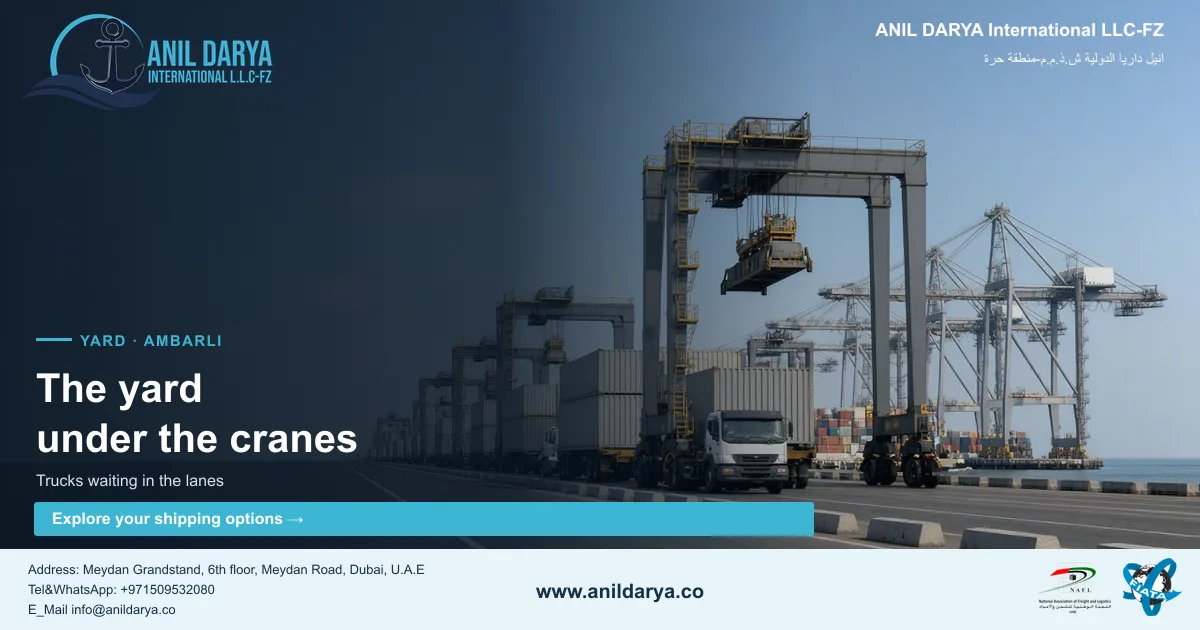
How busy is Ambarli?
The Ministry of Transport and Infrastructure reports that port facilities in the Ambarli port authority area handled 3,428,048 TEU in 2025, the most in Turkey. Of that, 2,308,164 TEU (67.3%) were import and export containers, 1,002,071 TEU (29.2%) were transit and 117,814 TEU (3.4%) were domestic coastal cargo. Turkey as a whole handled 13,996,579 TEU in 2025.
Busy terminals mean truck slots and gate times matter. Book the truck as soon as the cargo is cleared, and use the terminal's online services to check the container's status before sending a truck.
What cargo can you ship through Ambarli?
| Cargo type | Typical terminal | What to plan |
|---|---|---|
| General goods in containers | Marport, Kumport or Mardas, set by the carrier | GTIP code, TAREKS if listed, truck booking |
| LCL cargo | The consolidator's CFS | Matching carton marks, early documents |
| Reefer cargo | Container terminals | Set temperature, food control certificates |
| Machinery, steel, project pieces | Kumport or Mardas | Crane capacity, lifting points, road permits |
| Vehicles | Ro-Ro at Kumport, or cars in containers | Letter of Conformity, permission if used, special consumption tax |
| Dangerous goods | Only terminals that accept the class | Terminal acceptance before booking |
Container shipping to Ambarli: FCL and LCL
Most cargo from the UAE to Istanbul moves in containers. You can book:
- FCL (full container load). A whole 20ft, 40ft or 40ft high cube for your cargo only. It suits larger volumes and goods you do not want handled with others.
- LCL (less than container load). Your cargo shares a box and is unpacked at a CFS in Istanbul. Release then also depends on the rest of the box being cleared.
Your carrier's service decides which Ambarli terminal the box uses. Check the terminal on the arrival notice before the consignee books a truck. Our guide to FCL vs LCL costs shows where the break-even usually sits, and our sea freight service page explains what we book from Dubai.
[AMIR-FACT: the carriers or services we actually book from Jebel Ali to Ambarli, which Ambarli terminal each uses, and our typical port-to-port days]
Breakbulk and project cargo into Istanbul
Heavy pieces for Istanbul usually go to a multi-purpose terminal. Mardas lists mobile cranes of 100 to 140 tonnes and general cargo capacity of 3 million tonnes a year. Kumport lists project cargo services and cranes up to 104 tonnes. Pieces above those weights need a vessel with its own heavy-lift gear or a floating crane, which the carrier arranges.
When you ship project cargo from the UAE to Ambarli with us, we:
- Collect drawings, weights, dimensions and centre of gravity for each piece.
- Choose flat rack, open top or breakbulk tonnage, depending on size.
- Confirm the discharge terminal and its crane capacity with the carrier.
- Agree lifting and lashing, and plan the UAE road move to the load port.
- Send the piece-by-piece packing list to the consignee's broker early, so clearance is ready when the vessel berths.
Oversized road moves from the terminal need permits, so the consignee should start that planning before the ship sails. See our break bulk and project cargo service.
Vehicles and reefer cargo into Istanbul
Vehicles
Kumport lists Ro-Ro among its cargo types, and cars can also travel inside containers. Before you book, check that the vehicle can be cleared:
- Used vehicles need Ministry permission before import.
- Passenger cars are classed under heading 87.03 and commercial vehicles under 87.04, and the subheading sets the taxes.
- A Letter of Conformity from the Ministry of Industry and Technology, or an authorised body, is submitted when the declaration is registered.
- Special consumption tax applies on top of duty and VAT, and the rate on cars can be very high.
A vehicle that cannot be cleared still runs up terminal storage, so the consignee should confirm permission and the full tax cost first.
Reefer and food cargo
Chilled and frozen food moves in reefer containers to the container terminals. Animal and plant products fall under the agriculture ministry's controls. Some animal products are inspected at the border, and listed products need a Certificate of Conformity with the customs declaration. Depending on the tariff code, food may also need control, health, phytosanitary or veterinary certificates. Have the origin certificates issued in the UAE before loading, and give us the set temperature and ventilation at booking.
Dangerous goods at Ambarli: check the terminal first
Under Turkish maritime rules, a shore facility that handles dangerous cargo must hold a Dangerous Cargo Compliance Certificate, and each terminal publishes its own dangerous cargo handling guide. The rules differ between terminals.
- Marport's guide, revised 26 June 2025, says Class 1, Class 6.2 and Class 7 cargo is not handled in any way in its port area. The terminal keeps a measuring station to detect Class 7 cargo.
- Kumport publishes its own dangerous cargo handling guide. Check the current version for your class before booking.
If your carrier calls at a terminal that refuses your class, the container can be rolled or rerouted. That is why we confirm terminal acceptance with the carrier before you commit to a sailing. For any DG booking you need the UN number, proper shipping name, class and packing group, an SDS, a signed DG declaration and UN-approved packaging, labels and placards. Our guide to dangerous goods classes explains each class, and our dangerous goods shipping team handles the booking.
Customs clearance at Ambarli: documents, duty and VAT
Turkish customs is part of the Ministry of Trade. Clearance at Ambarli follows the national process, with the terminal's bonded area as the temporary storage place.
How clearance works
- A summary declaration for the cargo is lodged before the vessel arrives.
- The container is discharged and held in temporary storage at the terminal.
- A customs treatment must be assigned within 45 days of the summary declaration for sea cargo, for example release for free circulation, transit or re-export.
- The release declaration is filed electronically in BILGE. A BILGE username and password are needed, so most importers use a licensed customs broker.
- Duty and taxes are paid, and any permit or conformity certificate is attached.
- Customs checks documents or inspects the cargo, then releases it, and the consignee books the truck.
Which documents do you need?
| Cargo type | Core documents | Usually also needed |
|---|---|---|
| General cargo | Commercial invoice, packing list, bill of lading, certificate of origin | Importer's Turkish tax number; TAREKS approval if the GTIP is listed |
| UAE-origin goods claiming CEPA rates | Core set | Proof of origin under the agreement |
| Food and agricultural goods | Core set | Control, health, phytosanitary or veterinary certificates |
| Medicines and cosmetics | Core set | Ministry of Health certificates |
| Dangerous goods | Core set | DG declaration, SDS, terminal acceptance |
| Vehicles | Core set | Letter of Conformity; Ministry permission if used |
| Used or refurbished goods | Core set | Ministry permission unless exempt |
The importer needs a Turkish tax number. Goods are classified with the 12-digit GTIP code, and the first 6 digits are the HS code on your UAE invoice. Ask the broker to confirm the full code before shipping, because duty, VAT, TAREKS and permits all follow it. The Ministry also issues free Binding Tariff Information, valid for 6 years, if you need a firm ruling.
TAREKS product safety checks
TAREKS is the Ministry of Trade's risk-based import control system. Under the 2026 Product Safety and Inspection Communiqués, every GTIP listed in their annexes needs a TAREKS application, even products not subject to a safety inspection. Toys, radio equipment, construction products, batteries and machinery have their own communiqués, and for some of them photos taken in the bonded area must be uploaded. Some applications go to a physical inspection with sampling, so start early.
How much duty and VAT will you pay?
Turkey's tariff follows the EU Common Customs Tariff for industrial goods, with rates set in the annual Import Regime Decision. Some products from some countries also carry additional customs duty.
Goods of UAE origin can use the UAE-Türkiye CEPA, which covers 80% of tariff lines, if you provide valid proof of origin. Goods made elsewhere and re-exported from Dubai pay duty for their country of origin. Import VAT is 20% for most goods, with reduced rates of 10% and 1%, charged on the CIF value plus duty and other charges. Special consumption tax is added for fuel, vehicles, tobacco and alcohol, and luxury goods.
How to ship to Ambarli port from Dubai: step by step
This is how we handle shipping from Dubai to Ambarli. We book space with carriers, prepare UAE documents and export clearance, and work with the consignee's customs broker in Istanbul.
- Send us the cargo details. Commodity, HS code, weight, volume or dimensions, UAE pickup address, Istanbul delivery address and Incoterm.
- Confirm the Turkish side. The consignee confirms its tax number, its broker and the full GTIP, and starts TAREKS or permits if needed.
- Check origin. If you claim CEPA rates, prepare the proof of UAE origin before loading.
- Get a quote and book. We compare services from Jebel Ali to Ambarli and confirm which terminal each uses. For DG we check that terminal's acceptance first.
- Pickup and export clearance. We truck the cargo or the empty container, file the UAE export declaration and gate in at the Jebel Ali container terminals before the cut-off.
- Bill of lading. We check the draft against the invoice and packing list and release the final bill.
- Pre-arrival. The Istanbul broker gets all documents before the vessel arrives and prepares the BILGE declaration.
- Clearance and collection. The consignee pays duty and VAT, books the truck at the right terminal and returns the empty within free time.
How to ship from Ambarli port to Dubai
We also handle the other direction: shipping from Ambarli to Dubai, with arrival at Jebel Ali, Khalifa Port or Sharjah port. We book the space and run the UAE side. The Turkish export papers stay with the shipper or its Turkish customs broker.
The Turkey export side
- Exports are declared to Turkish customs with a customs declaration. To export, a company needs a tax ID number and membership of the related exporter association.
- The exit summary declaration is normally lodged by the carrier or its representative.
- The UAE-Türkiye CEPA has been in force since 1 September 2023, with 80% of tariff lines in its concessions. Ask the shipper for the CEPA proof of origin so the UAE declaration can claim the preferential rate.
- The shipper or its trucker delivers the box to Marport, Kumport or Mardas, as named in the booking, before the cut-off.
The UAE import side
On arrival, the declaration goes to Dubai Customs with the commercial invoice, the packing list, the certificate of origin and any permit for restricted goods. For sea cargo the GCC customs guide also lists the bill of lading and the delivery order. Customs duty in Dubai is 5% of the CIF value for most goods, with 50% on alcohol and 100% on cigarettes. Import VAT is 5%. A VAT-registered importer accounts for it on its VAT return, while an importer that is not registered pays it before Customs releases the goods.
- Send us the shipper's details in Turkey, the cargo, the HS code and the UAE delivery address.
- We book space and send the booking and cut-off to the shipper.
- The shipper or its trucker loads the container and delivers it to the terminal.
- The shipper or its customs broker files the Turkish export declaration and provides the CEPA proof of origin if the goods qualify.
- We check the draft bill of lading against the invoice and packing list.
- We file the UAE declaration before the vessel arrives.
- We arrange payment of the duty and VAT and collect the delivery order.
- We truck the cargo to your site and return the empty container inside free time.
[AMIR-FACT: the carriers we actually use from Ambarli to Jebel Ali, Khalifa or Sharjah and our real transit days in this direction]
Free time, storage and demurrage at Ambarli
Carriers give free days on their containers. After that, demurrage runs while the full box stays at the terminal and detention while it is outside. Terminal storage follows each terminal's own tariff, so the same delay can cost a different amount at Marport, Kumport or Mardas. Read the free time on the quote and the arrival notice.
Three things keep costs down: send documents before arrival, start TAREKS and permits early, and book the truck as soon as the cargo is released. Our article on demurrage and detention explains how the charges build up, and our guide to Incoterms 2020 for sea freight shows who pays at each stage.
Ambarli or another Turkish port?
| Your situation | Port to compare | 2025 containers |
|---|---|---|
| Consignee in Istanbul (European side) or Thrace | Ambarli | 3.43 million TEU |
| Consignee around Izmit, Gebze or the Asian side | Kocaeli | About 2.50 million TEU |
| Consignee in Tekirdag or Corlu | Tekirdag | About 2.14 million TEU |
| Consignee in southern or central Turkey | Mersin | About 1.97 million TEU |
| Consignee in the Aegean region | Aliaga (Izmir) | About 1.70 million TEU |
The right port depends on the final delivery address, the carriers on the lane and the cargo type. We can price more than one port so you can compare the cost to the door.
Checklist before you ship to Ambarli
- Consignee's Turkish tax number and broker confirmed.
- Full 12-digit GTIP confirmed for every line.
- TAREKS application or permit started, if needed.
- Proof of UAE origin ready, if claiming CEPA rates.
- Invoice, packing list and bill of lading match on weights, pieces and names.
- Discharge terminal at Ambarli known before the truck is booked.
- For DG: that terminal accepts your class.
- For heavy pieces: crane capacity at the terminal confirmed.
- Free time agreed with the carrier.
- Cargo insurance arranged.
Common mistakes
- Treating Ambarli as one terminal. Marport, Kumport and Mardas have different tariffs, gates and DG rules.
- Booking Class 1, 6.2 or 7 cargo to a terminal that refuses it. Marport does not handle these classes at all.
- Only using the 6-digit HS code. Duty and controls follow the 12-digit GTIP.
- Claiming CEPA rates on re-exported goods. Only goods of UAE origin qualify.
- Starting TAREKS after arrival. The container waits in storage while it runs.
- Sending a truck before release. The truck is turned away and the slot is lost.
Frequently asked questions
Where is Ambarli port?
Ambarli is in the Beylikduzu district on the European side of Istanbul, on the north shore of the Sea of Marmara. It serves Istanbul, Thrace and the western Marmara industrial region.
What is the port code for Ambarli?
The UN/LOCODE for Ambarli is TRAMR. You will see it on bookings, bills of lading and tracking systems.
Which terminals are at Ambarli port?
The main container terminals are Marport, Kumport and Mardas, each run by its own private operator. Ambarli also has bulk and cement piers. Your carrier's service decides which terminal your container uses.
How many containers does Ambarli handle?
Port facilities in the Ambarli port authority area handled 3,428,048 TEU in 2025, the most of any port area in Turkey, according to the Ministry of Transport and Infrastructure.
Can I ship dangerous goods to Ambarli?
Yes, for most classes, if the carrier and the discharge terminal accept them. Marport does not handle Class 1, 6.2 or 7 cargo at all, so check the terminal's dangerous cargo guide before booking.
What documents do I need to clear cargo at Ambarli?
The core set is a commercial invoice, packing list, bill of lading and certificate of origin, filed in BILGE by the importer or its broker. Some goods also need TAREKS approval, health certificates or a permit.
What is the import VAT in Turkey?
Most imported goods pay 20% VAT, charged on the CIF value plus duty and other charges. Reduced rates of 10% and 1% apply to some goods.
Can heavy machinery be discharged at Ambarli?
Yes. Mardas lists mobile cranes of 100 to 140 tonnes and Kumport lists cranes up to 104 tonnes and project cargo services. Heavier pieces need ship's gear or a floating crane.
Can I ship a used car from Dubai to Istanbul through Ambarli?
Only with permission. Turkey requires Ministry permission for used vehicle imports, a Letter of Conformity at declaration, and payment of duty, VAT and special consumption tax. Confirm these before booking.
How do I ship from Ambarli to Dubai?
The Turkish exporter or its customs broker files the export declaration and, where the goods qualify, provides proof of origin under the UAE-Türkiye CEPA. We book the space, file the Dubai Customs declaration before arrival, arrange payment of any duty and the 5% import VAT, and deliver.
Get a quote for Ambarli port shipping
Send us your cargo details and the Istanbul delivery address, and we will come back with a routing and price to Ambarli. Use our freight rate inquiry form, or contact our team to plan a DG or project shipment first. You can also read more about our Dubai freight forwarding team.
Sources
- Ministry of Transport and Infrastructure: Maritime statistics bulletin 2025 (Ambarli 3,428,048 TEU and split, other port areas)
- Marport: Terminal details (capacity, area, draft, equipment, systems)
- Marport: Online services
- Marport: Dangerous cargo handling guide, revision 26 June 2025
- TURKLIM: Marport facts
- Kumport: Terminal facts and services
- TURKLIM: Kumport facts (cargo types)
- TURKLIM: Mardas facts (quay, depth, capacity, areas, equipment)
- iContainers: Port of Ambarli (UN/LOCODE, terminals)
- Ministry of Trade: Import regime FAQ (summary declaration, 45 days, tax number, restrictions)
- Ministry of Trade: Tariff FAQ (12-digit GTIP, Binding Tariff Information)
- Ministry of Trade: Digital customs FAQ (BILGE access)
- Ministry of Trade: UAE CEPA
- Investment Office of the Presidency of Türkiye: Tax guide (VAT, special consumption tax)
- US International Trade Administration: Türkiye import tariffs
- US International Trade Administration: Türkiye import requirements and documentation
- EY: Türkiye 2026 product safety and inspection changes (TAREKS)
- Turkish Ministry of Trade: Export regime FAQ (exporter conditions, export declaration)
- Dubai Customs: Submit customs declaration (import, export and re-export documents)
- Dubai Customs: FAQ (duty of 5% of CIF value, CIF definition)
- UAE Government portal: Clearing customs and paying customs duty
- Federal Tax Authority: VAT (5% rate)
- Federal Tax Authority: VAT guide (import VAT, reverse charge and payment before release)
- GCC Unified Guide for Customs Procedures at First Points of Entry (import and export documents)
Reviewed: 10 November 2026