
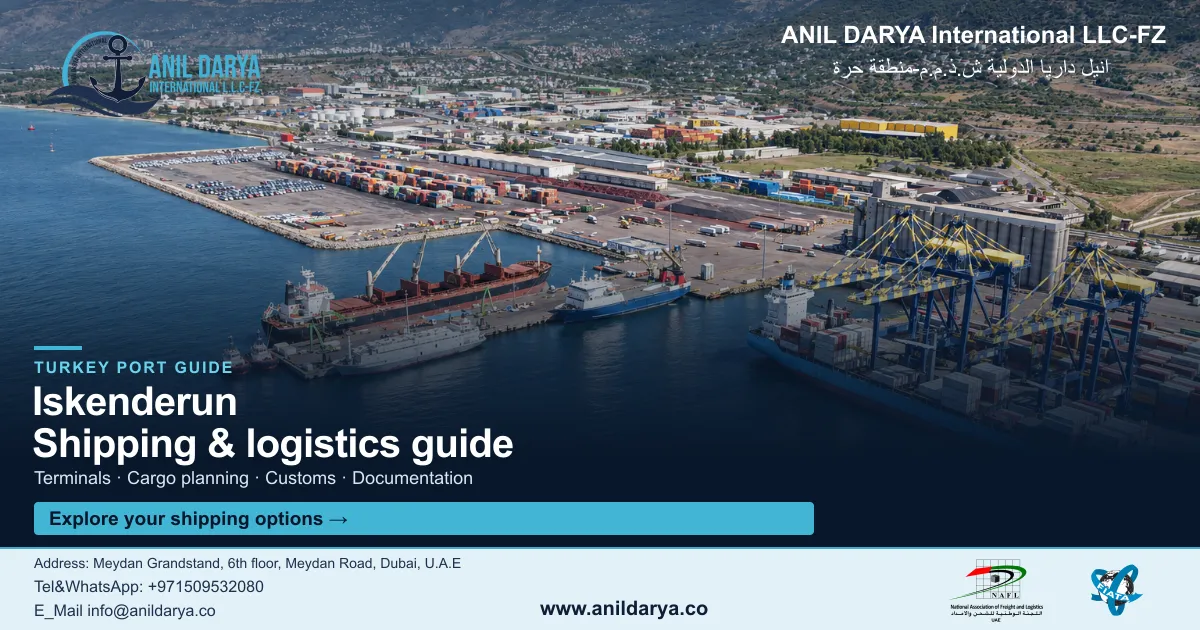
Iskenderun port shipping usually means LimakPort Iskenderun, the main container and multipurpose terminal on the Gulf of Iskenderun in Hatay province, southern Turkey. LimakPort lists a capacity of 1,000,000 TEU and a 15.5 m container berth, and the gulf also has a second container terminal at Assan Port and several large bulk and steel terminals. This guide explains which terminal fits your cargo and how we ship from Dubai to Iskenderun. We ship both from Dubai to Iskenderun and from Iskenderun to Dubai.
Iskenderun port guide: key facts at a glance
| Item | Detail |
|---|---|
| Location | Gulf of Iskenderun, eastern Mediterranean, Hatay province |
| UN/LOCODE | TRISK |
| Main container terminal | LimakPort Iskenderun (36-year operating rights from December 2011) |
| LimakPort container capacity | 1,000,000 TEU a year |
| LimakPort containers in 2024 | 525,360 TEU, up 9% on 2023 |
| Container berths | 920 m long, 15.5 m water depth |
| Second container terminal | Assan Port, 500,000 TEU a year, 17 m maximum depth |
| Total cargo in 2025 (Iskenderun port authority area) | 70.91 million tonnes, third in Turkey |
| Other terminals in the gulf | Atakas, Isdemir, Tosyali, Yazici, Ekinciler, Gubretas, MMK and others, mostly bulk and steel |
| Rail | LimakPort has a national railway connection |
| Nearest airport | Hatay Airport, about 32 km |
| Customs | Turkish Ministry of Trade, electronic declarations through a broker |
| Import VAT | 20% general rate, reduced rates of 10% and 1% |
| Iskenderun to Dubai | Turkish export declaration by the shipper or its broker; UAE duty 5% of CIF for most goods, plus 5% VAT |
Where is Iskenderun port and which region does it serve?
Iskenderun is at the eastern end of Turkey's Mediterranean coast, on a deep bay that bends south of the Adana plain. The town is in Hatay province, and the terminals stretch along the gulf shore through the organised industrial zones north of the city.
LimakPort describes its hinterland as running from Mersin to Sirnak and from Malatya to Kilis, covering imports and exports for Central Anatolia, the Mediterranean region and East and Southeast Anatolia. In practice the main users are factories and traders in Hatay, Adana, Osmaniye, Gaziantep and Kahramanmaras. Its rail service reaches industrial zones in Ankara, Adana, Karaman, Konya, Kayseri, Gaziantep and Kahramanmaras.
The gulf is also one of Turkey's heaviest industrial coasts. Steel plants and bulk terminals line the shore, which is why the Iskenderun port authority area handled 70.91 million tonnes in 2025, more than Mersin or Ambarli by weight.
A simple rule: if your consignee is in Hatay, Gaziantep, Kahramanmaras or Osmaniye, Iskenderun usually means a shorter truck leg than Mersin, which port data sites place about 140 km away.
Which terminals make up Iskenderun port?
There is no single public port at Iskenderun. The port authority area is a string of private terminals, and the one on your booking decides the truck gate, the tariff and the cargo accepted.
| Terminal | Main cargo | Published figures |
|---|---|---|
| LimakPort Iskenderun | Containers, Ro-Ro, Ro-Pax, project, dry bulk and general cargo | 8 berths, 1,000,000 TEU and 3,247,000 tonnes of conventional cargo a year |
| Assan Port | Containers, general and project cargo | 2 x 336 m quay, 17 m depth, 500,000 TEU and 1,000,000 tonnes a year |
| Atakas Port | Dry bulk, general and project cargo | 716 m pier, 8,000,000 tonnes of bulk and 2,000,000 tonnes of general cargo a year, 1,500 m of rail track |
| Isdemir | Iron ore and scrap for the steel plant | 3 berths, 600 m of quay |
| Tosyali, Yazici, Ekinciler, MMK | Dry bulk, steel raw materials and products | Mostly industrial cargo for their own plants and third parties |
| Gubretas | Fertiliser and most dry bulk | Ships up to 60,000 DWT |
LimakPort Iskenderun
LimakPort is the terminal most container services use. Limak took over the operating rights for 36 years in December 2011 and started container operations in March 2013. The site covers about 1,000,000 m2 behind a breakwater, with 920 m of container berths at 15.5 m depth and 732 m of general cargo berths.
Published equipment includes 4 ship-to-shore cranes of 65 t, 14 electric RTGs, 2 Liebherr 550 mobile harbour cranes of 120 t, 4 Sennebogen material handlers and a mobile X-ray unit. The terminal lists 600 reefer plugs and a 1,000 m2 reefer cross-dock built to veterinary control standards.
The terminal was damaged in the February 2023 earthquake and was rebuilt in stages. Limak reports that 2024 container volume reached 525,360 TEU, above its pre-earthquake level. Limak names Maersk, CMA CGM, Hapag-Lloyd and COSCO among the lines that connect it to world ports.
Assan Port
Assan Port sits in the organised industrial zone at Sariseki, north of the city. It is the second container option in the gulf, with two 336 m berths plus a 30 m dolphin, 17 m maximum depth and a published capacity of 500,000 TEU. Its cranes include two 150 t and two 100 t mobile harbour cranes, so it also handles general and project cargo.
Atakas and the bulk and steel terminals
Atakas Port handles dry bulk, general and project cargo on a 716 m pier, with mobile harbour cranes of up to 144 t and 1,500 m of rail track in three lines. One local agent says Atakas lifts single pieces of up to 280 t. The other terminals along the gulf mainly serve the steel and fertiliser industry and take ships up to Capesize. If you ship steel products, scrap or raw materials, your cargo may berth at one of these instead of LimakPort.
What cargo can you ship through Iskenderun?
| Cargo type | Terminal to look at | What to plan |
|---|---|---|
| General goods in containers (FCL) | LimakPort or Assan, set by the carrier's service | Terminal on the booking, free time, truck slot |
| Small shipments (LCL) | LimakPort CFS, or a consolidator's warehouse | Carton marks that match the packing list |
| Chilled and frozen goods | LimakPort (600 reefer plugs, reefer cross-dock) | Set temperature, veterinary or health certificates |
| Machinery and project cargo | LimakPort, Assan, Atakas | Drawings, lift plan, road permits |
| Steel, pipes and plates | LimakPort general cargo berths, steel terminals | Lashing, open storage, discharge rate |
| Grain, fertiliser and dry bulk | LimakPort (ships up to 70,000 DWT), Atakas, Gubretas | Discharge plan and receiver's storage |
| Vehicles | LimakPort Ro-Ro, or cars in containers | Ministry permission and conformity papers |
| Dangerous goods in containers | The terminal that accepts your class | Terminal acceptance before booking |
Container shipping to Iskenderun port: FCL and LCL
Most cargo from the UAE to Iskenderun moves in containers. You choose between two options.
- FCL, a full 20ft or 40ft container. It suits factory consignees, regular volumes and cargo you do not want mixed with other goods.
- LCL, a shared container. It suits small or trial shipments. LimakPort's CFS stuffs and unstuffs containers, but your release still depends on the consolidator's paperwork.
Fluent Cargo lists 20 carriers serving the Iskenderun LOCODE, including MSC, CMA CGM, Maersk, Hapag-Lloyd, COSCO, Evergreen, ONE, ZIM and Turkon. Many services from the Gulf reach Iskenderun through a transshipment hub in the Mediterranean or via another Turkish port. Check that the bill of lading names Iskenderun as the port of discharge, not Mersin with an inland leg.
[AMIR-FACT: Our real port-to-port transit time from Jebel Ali to Iskenderun, and the carriers and transshipment hubs we actually use on this lane]
Our FCL vs LCL cost guide shows where the break-even point usually falls, and our sea freight service can price both for the same cargo.
Project cargo, steel and breakbulk at Iskenderun
The gulf's steel mills, power plants and factories import heavy equipment, and the terminals publish real lifting capacity:
- LimakPort: two Liebherr 550 cranes that handle project pieces up to 180 t, and ship's gear for pieces up to 600 t. Cargo can be assembled or taken apart inside the port on request.
- Assan Port: two 150 t and two 100 t mobile harbour cranes.
- Atakas Port: cranes up to 144 t and rail track on the terminal.
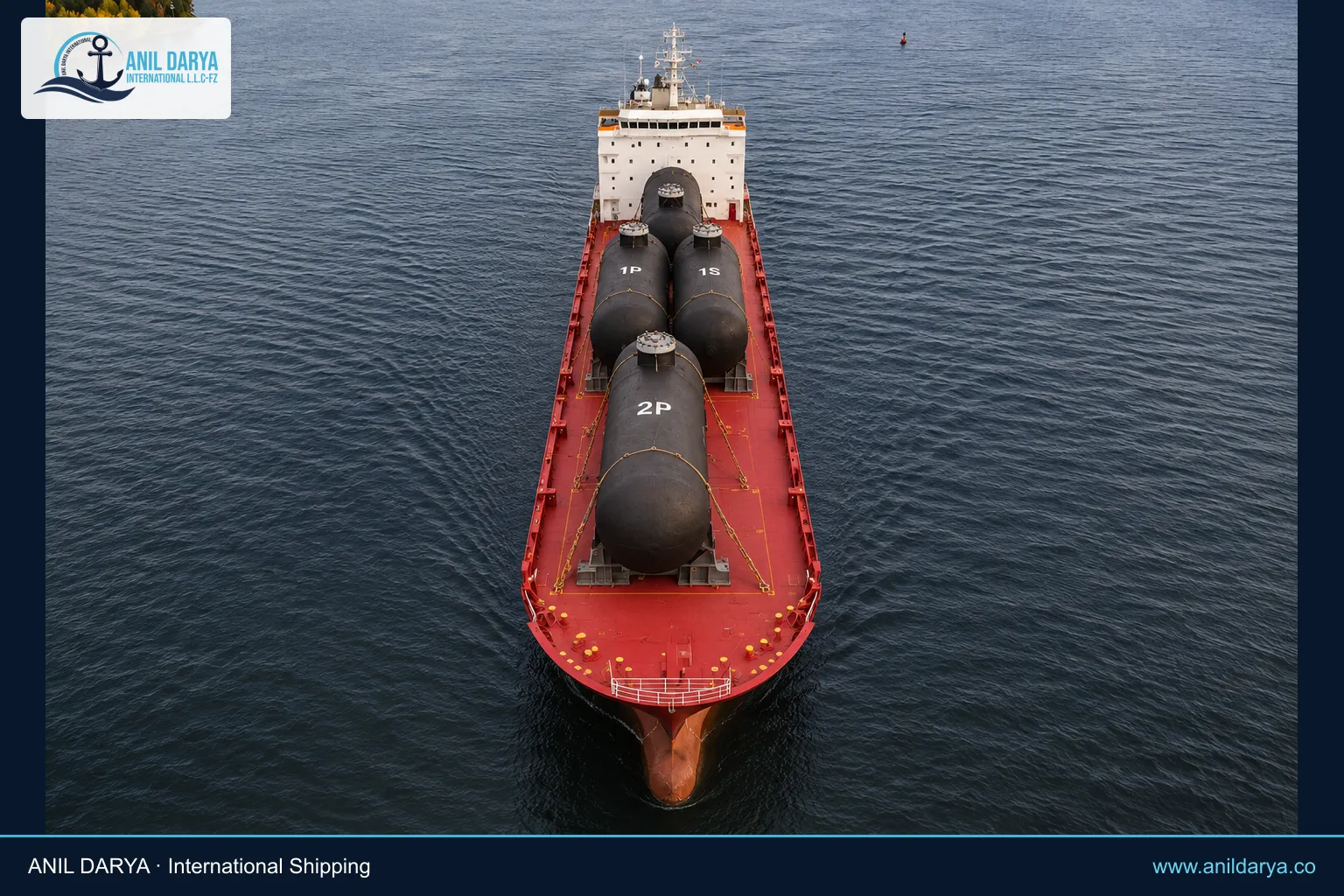
How we plan a heavy piece from the UAE to Iskenderun:
- Collect drawings, dimensions, weights and centre of gravity for every piece.
- Choose between a flat rack or open top on a container service, or conventional breakbulk tonnage with its own gear.
- Confirm the discharge terminal's crane capacity, or plan a tandem lift or a ship's gear lift.
- Check the road route from the quay to the site, including permits and escorts.
- Line up the consignee's broker so the cargo leaves the customs area quickly.
A decision rule: up to 180 t, a LimakPort shore lift is an option. Above that, you need a vessel with heavy gear, and its sailing date drives the plan. Our break bulk and project cargo service covers the UAE side, and our heavy-lift shipping guide explains lift planning in more detail.
Ro-Ro, Ro-Pax and reefer cargo at LimakPort
LimakPort lists Ro-Ro capacity of 120,000 vehicles a year and Ro-Pax capacity of 30,000 trucks a year. It handles cars, self-propelled machines and pick-ups, and vehicles can stay in the port until customs clearance is done. LimakPort also lists direct Ro-Pax services to Duba in Saudi Arabia.
For reefers, the 600 plugs, PTI service and a 1,000 m2 reefer cross-dock make LimakPort the main choice for chilled and frozen food. Health or veterinary certificates must be ready before the vessel arrives, or the box waits on power.
Cars, pick-ups and self-propelled machines landed at LimakPort can wait in the port until clearance, but check Turkey's import rules before they ship. Ministry of Trade permission is needed for used goods, including used vehicles. At declaration, vehicles need a letter of conformity, and motor vehicles pay special consumption tax as well as duty and VAT.
Dangerous goods to Iskenderun port
Chemicals, paints and industrial gases move into the gulf's industrial zones every year. Each Turkish terminal sets its own accepted classes and storage limits for DG containers, and LimakPort does not publish a DG page on its main site. If the carrier discharges at a terminal that refuses your class, the box can be rolled or rerouted.
What you need for any DG booking from the UAE:
- UN number, proper shipping name, class and packing group.
- A Safety Data Sheet for each product.
- A signed Dangerous Goods Declaration.
- UN-approved packaging, labels and container placards.
- Any Turkish permit the product needs, arranged by the consignee.
Our dangerous goods shipping team checks the papers and gets acceptance from the carrier and the discharge terminal before booking.
Customs clearance at Iskenderun port: a short summary
Clearance at Iskenderun follows the national Turkish process, the same as at Mersin or Ambarli. What changes is the terminal's customs area and the local customs office.
- A summary declaration is lodged before the goods arrive in Turkey.
- For sea cargo, the goods must get a customs treatment within 45 days of the summary declaration, for example release for free circulation or re-export.
- The importer needs a Turkish tax number. The declaration is filed electronically, in practice by a licensed customs broker.
- Goods are classified with the 12-digit Turkish tariff code (GTIP). The first 6 digits match the HS code on your UAE invoice.
- Products in TAREKS, the Ministry of Trade's risk-based control system, need a check before release. Machinery, electrical and electronic equipment, construction products and many consumer goods are covered.
Which documents does the consignee need?
| Cargo | Core documents | Often also needed |
|---|---|---|
| General cargo | Commercial invoice, packing list, bill of lading, certificate of origin | TAREKS check if the GTIP is listed |
| UAE-origin goods | Core set | Proof of origin to claim CEPA rates |
| Machinery and electrical goods | Core set | CE certificate or declaration of conformity |
| Chemicals and DG | Core set | SDS, DG declaration, any permit for the product |
| Food and reefer cargo | Core set | Health, phytosanitary or veterinary certificates |
| Used goods and vehicles | Core set | Ministry of Trade permission, letter of conformity for vehicles |

Duty and VAT in brief
Turkey's tariff for industrial goods follows the EU Common Customs Tariff, and that is the basis for steel, machinery and other industrial goods cleared at Iskenderun. UAE-origin goods can use the UAE-Turkiye CEPA, in force since 1 September 2023 and covering 80% of tariff lines, if valid proof of origin travels with them. Anything made elsewhere and shipped via Dubai pays the rate for its real origin. Import VAT for most goods is 20%, calculated on the CIF value plus duty and other charges.
How to ship from Dubai to Iskenderun port: step by step
This is how we handle shipping from Dubai to Iskenderun. We book space with carriers, prepare the UAE documents and export clearance, and work with the consignee's customs broker in Turkey.
- Send us the cargo details. Commodity, HS code, weight, volume or dimensions, the consignee's town and the Incoterm. Our Incoterms 2020 guide for sea freight explains who pays what.
- Pick the terminal. We check whether the carrier's service discharges at LimakPort or Assan, or whether breakbulk tonnage goes to a bulk terminal.
- Confirm Turkish requirements. The consignee's broker checks the GTIP, duty, TAREKS and any permit before you ship.
- Book space. For DG, reefer or out-of-gauge cargo we get carrier and terminal acceptance first.
- Collect and export from the UAE. We arrange trucking to Jebel Ali port, UAE export clearance and gate-in before the cut-off.
- Issue documents. Invoice, packing list, certificate of origin or CEPA proof of origin, and the bill of lading, all checked for matching names, weights and HS codes.
- Arrival and clearance. The summary declaration is lodged, the broker files the declaration and the consignee pays duty and VAT.
- Delivery and empty return. The consignee's trucker or a rail service collects at the terminal, and the empty goes back within free time.
[AMIR-FACT: A real shipment we moved from Dubai/UAE to Iskenderun (cargo, terminal, how long it took, any lesson)]
How to ship from Iskenderun port to Dubai
We also handle shipping from Iskenderun to Dubai, with arrival at Jebel Ali, Khalifa Port or Sharjah port. Steel products from the plants on the gulf and goods from the LimakPort hinterland in southern and eastern Turkey are typical loads. We book space with the carrier from LimakPort or Assan Port and run the UAE side. The Turkish export papers stay with the shipper or its Turkish agent, as we have no office in Turkey.
The Turkish export side
- Who can export. Any person or company with a Turkish tax ID number can export, but the Ministry of Trade says the exporter must be a member of the related exporters' association.
- Export declaration. The goods are declared to the authorised customs office on a customs declaration, lodged electronically in the Ministry's BILGE system. The shipper or its Turkish customs broker files it.
- Permits. Licences and approvals that other agencies issue for customs go through the Ministry's Single Window System, and the e-document number goes on the declaration. Military items need Ministry of Defence permission, and dual-use items need an export permit.
- Exit. The carrier or its representative lodges the exit notification at the customs office of exit, here Iskenderun.
- Origin. Turkish-origin goods may qualify for a lower UAE duty under the UAE-Turkiye CEPA, in force since 1 September 2023, if the shipper provides the proof of origin the agreement requires.
The UAE import side
For a box loaded at LimakPort or Assan Port, the UAE import declaration goes to Dubai Customs with the Turkish shipper's commercial invoice, packing list and certificate of origin, and any permit from the authority that controls restricted goods. The bill of lading issued at Iskenderun is what the carrier releases the cargo against. The importer needs a Dubai Customs business code, or a licensed clearing agent files with its own code and the owner's authorisation. Dubai customs duty is 5% of the CIF value for most goods, rising to 50% on alcohol and 100% on cigarettes. Import VAT is 5%. An importer that is VAT-registered and has linked its customs registration number with the Federal Tax Authority reports the VAT on its return rather than paying at release, and other importers pay before the goods are released.
- Send us the shipper's details in Hatay, Adana, Gaziantep or another hinterland town, the cargo, the HS code, the Incoterm and the UAE delivery address.
- We book space from LimakPort or Assan Port to Jebel Ali, Khalifa Port or Sharjah and send the booking and cut-offs to the shipper.
- The shipper or its trucker collects the empty, stuffs it and delivers the box to the terminal before the cut-off.
- The shipper or its Turkish customs broker files the export declaration and any permit, and customs releases the cargo for loading.
- We check the draft bill of lading against the invoice and packing list, with the UAE consignee named correctly.
- We file the UAE declaration before the vessel arrives.
- We arrange payment of the duty and VAT.
- We collect the delivery order from the carrier.
- We truck the box to your site, free zone or warehouse, and return the empty within free time.
[AMIR-FACT: the carriers and hubs we actually use from Iskenderun to Jebel Ali, Khalifa Port or Sharjah, and our real port-to-port transit days in this direction]
Free time, storage and tariffs at Iskenderun
Carriers give free days on their containers, and terminals charge storage once their own free period ends. LimakPort publishes its current tariff on its website, so the consignee's broker can check storage charges in advance. Ask for extra free time at booking if TAREKS or a permit may slow clearance. Our guide to demurrage and detention shows how these charges add up.
Iskenderun port or another Turkish port: which fits your cargo?
| Consignee or cargo | Port to compare | Why |
|---|---|---|
| Hatay, Gaziantep, Kahramanmaras or Osmaniye | Iskenderun | Shortest truck leg, rail to inland industrial zones |
| Adana, Mersin, Konya or central Turkey | Mersin | More container services, larger container port area |
| Steel, scrap or bulk for a gulf plant | The plant's own terminal in the gulf | Cargo discharges next to the receiver |
| Istanbul or Thrace | Ambarli | Largest container port area in Turkey |
| Kocaeli, Bursa or the Aegean | Izmit Bay, Gemlik or Izmir | Closer to northwestern and Aegean industry |
We can price more than one port so you can compare the total cost to the factory gate.
Checklist before you ship to Iskenderun
- Port of discharge on the booking is Iskenderun, and the terminal is known.
- Consignee has a Turkish tax number and a licensed customs broker.
- 12-digit GTIP confirmed and TAREKS status checked.
- CEPA proof of origin ready if the goods are of UAE origin.
- Invoice, packing list and bill of lading show the same weights and piece counts.
- Health or veterinary certificates ready for food and reefer cargo.
- Permits for used goods, vehicles or chemicals applied for in time.
- DG class accepted at the discharge terminal.
- Lift plan agreed for pieces over 180 t, or a geared vessel booked.
- Free time agreed, truck or rail booked, cargo insurance arranged.
Common mistakes
- Booking to Mersin for a Hatay or Gaziantep consignee without comparing Iskenderun. The extra road leg can cost more than the freight saving.
- Assuming LimakPort and Assan are the same gate. Each has its own tariff, gate and acceptance rules.
- Using only the 6-digit HS code. Duty, TAREKS and permits follow the 12-digit GTIP.
- Claiming CEPA rates for goods that are not of UAE origin. Re-exported goods pay the rate for their real origin.
- Late veterinary or health papers for reefers, which keep the box on power and in storage.
- Shipping a heavy piece without checking the shore crane limit. Over 180 t at LimakPort you need ship's gear.
Frequently asked questions
Where is Iskenderun port?
Iskenderun port is on the Gulf of Iskenderun in Hatay province, at the eastern end of Turkey's Mediterranean coast. Hatay Airport is about 32 km away.
What is the port code for Iskenderun?
The UN/LOCODE for Iskenderun is TRISK. You will see it on bookings, bills of lading and tracking systems.
Who operates Iskenderun port?
The main multipurpose and container terminal is LimakPort Iskenderun, run by Limak under 36-year operating rights secured in December 2011. Assan Port, Atakas and several steel and bulk terminals operate separately in the same gulf.
How deep is Iskenderun port?
LimakPort's container berths have 15.5 m of water depth on 920 m of quay. Assan Port lists a maximum depth of 17 m. The draft for a given call is set by the terminal and the carrier.
How does shipping from Dubai to Iskenderun work?
We book space from Jebel Ali to LimakPort or Assan Port, or to a steel or bulk terminal for that cargo, and handle UAE export clearance. The consignee's Turkish broker files the import declaration, and the consignee pays duty and import VAT before release.
Can I ship heavy machinery to Iskenderun?
Yes. LimakPort handles project pieces up to 180 t with two Liebherr 550 cranes and up to 600 t with ship's gear. Assan and Atakas also have mobile harbour cranes of 140 t and more.
Is Iskenderun port connected to rail?
Yes. LimakPort has a national railway connection to industrial zones in Ankara, Adana, Karaman, Konya, Kayseri, Gaziantep and Kahramanmaras, and Atakas has 1,500 m of track on its terminal.
What is the import VAT on goods arriving at Iskenderun?
Goods cleared at Iskenderun pay import VAT at 20% in most cases, with reduced rates of 10% and 1% for some products. It is charged on the CIF value plus duty and other charges, so the freight cost from the UAE is part of the base.
Do UAE goods pay less duty in Turkey?
Only goods of UAE origin. With valid proof of origin they can claim lower rates at Iskenderun under the UAE-Turkiye CEPA, which covers 80% of tariff lines. Goods produced in a third country and shipped via Dubai pay the rate that applies to their real origin.
Can you handle shipping from Iskenderun to Dubai?
Yes. We book the space from Iskenderun, the shipper or its Turkish broker files the export declaration, and we clear the cargo through UAE customs and deliver it. Most goods pay 5% duty on the CIF value plus 5% import VAT in Dubai.
Get a quote for Iskenderun port shipping
Send us the cargo details and the consignee's address in Turkey, and we will come back with a routing and price to the right Iskenderun terminal. Use our freight rate inquiry form, or contact our team to talk through a project, DG or reefer shipment. You can also read more about our Dubai freight forwarding team.
Sources
- LimakPort: Port technical features (berths, depth, capacities, reefer plugs, Ro-Ro and Ro-Pax)
- LimakPort: Equipment (STS, E-RTG, mobile harbour cranes)
- LimakPort: Container services (CFS, reefer cross-dock, X-ray, rail)
- LimakPort: Bulk, general and project cargo (70,000 DWT, 180 t and 600 t lifts)
- LimakPort: Ro-Ro and Ro-Pax services
- LimakPort: Railway connected terminal services
- LimakPort: Geographical location (hinterland)
- Limak: LimakPort Iskenderun (operating rights, 2024 volume, lines)
- Daily Sabah: Iskenderun port recovery after the 2023 earthquake (February 2024)
- TURKLIM: Assan Port (quay, depth, capacity, cranes)
- TURKLIM: Atakas Port (pier, capacity, cranes, rail track)
- Heisenberg Shipping: Terminals in Iskenderun (cargo by terminal)
- Ministry of Transport and Infrastructure: Maritime statistics bulletin 2025 (Iskenderun 70.91 million tonnes)
- Fluent Cargo: Iskenderun TRISK (airport, carriers, distance to Mersin)
- Wikipedia: Iskenderun Harbor (berths, depth)
- Ministry of Trade: Import regime FAQ (summary declaration, 45 days, tax number, used goods, vehicles)
- Ministry of Trade: UAE CEPA (in force 1 September 2023, 80% of tariff lines)
- Investment Office of the Presidency of Turkiye: Tax guide (VAT rates, special consumption tax)
- US International Trade Administration: Turkiye import tariffs (EU CCT basis, VAT base and rate)
- US International Trade Administration: Turkiye import requirements (documents, TAREKS, CE)
- Ministry of Trade: Export regime FAQ (tax ID, exporters' association membership, declaration, exit notification, controlled items)
- Ministry of Trade, Directorate General of Customs: Information sheet on the Single Window System, SEBIS and BILGE
- Dubai Customs: Submit customs declaration (invoice, packing list, certificate of origin, permits)
- Dubai Customs: FAQ (customs business code, clearing agents with owner authorisation, 5% of CIF)
- UAE Government portal: Clearing customs and paying customs duty (5% of CIF in Dubai, alcohol 50%, cigarettes 100%)
- UAE Federal Tax Authority: VAT guide, import VAT at 5% and deferral for registered importers
Reviewed: 10 November 2026