
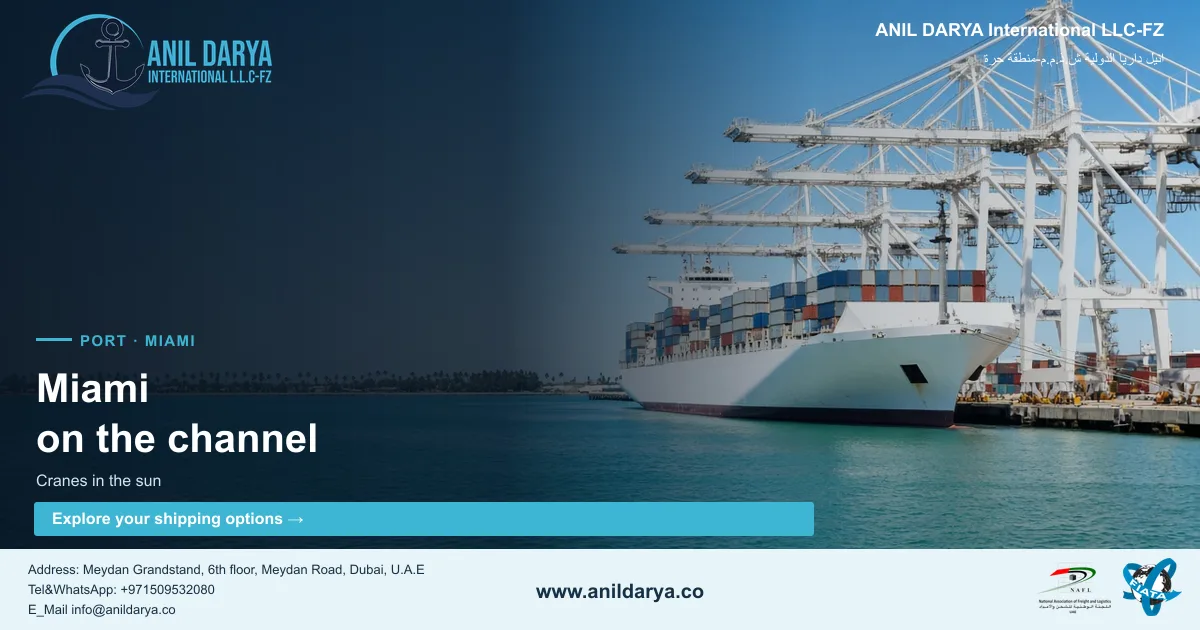
Port of Miami shipping means landing your cargo at one of three container terminals on Dodge Island, run by private operators under Miami-Dade County. PortMiami handled 1,115,058 TEU in 2025, has a 50 ft channel after its Deep Dredge project, and links straight to the interstate by tunnel and to the rest of Florida by on-dock rail. This guide covers the terminals, free time and DG rules, how cargo leaves the island, US customs in short, and how we ship your cargo from Dubai. We ship both ways: from Dubai to Miami, and from Miami to Dubai with UAE clearance on arrival.
Port of Miami at a glance
| Item | Detail |
|---|---|
| Official name | PortMiami (Dante B. Fascell Port of Miami) |
| Owner and model | Miami-Dade County; landlord port that leases terminals to operators |
| Location | Dodge Island in Biscayne Bay, next to downtown Miami |
| UN/LOCODE | USMIA |
| CBP port code | 5201 (Miami seaport) |
| Container terminal operators | South Florida Container Terminal (SFCT), Port of Miami Terminal Operating Company (POMTOC), Seaboard Marine |
| Channel depth | 50 ft after the Deep Dredge project (from 42 ft) |
| Containers 2025 | 1,115,058 TEU (2024: 1,089,443; peak 1,254,062 in 2021) |
| Cargo ships 2025 | 911 |
| Tonnage 2025 | 9,863,003 tons: 6,396,994 inbound, 3,466,009 outbound |
| Road | Port of Miami Tunnel to the interstate system |
| Rail | Florida East Coast Railway (FEC) on-dock intermodal rail |
| Foreign-trade zone | FTZ No. 281 |
| Also known for | Cruise: more cruise passengers than any other port in the world |
| Miami to Dubai | We book from PortMiami and clear at Jebel Ali, Khalifa Port or Sharjah; the US EEI stays with the shipper or its agent |
What is PortMiami and who runs it?
PortMiami sits on an artificial island in Biscayne Bay at the mouth of the Miami River, built from the former Dodge, Lummus and Sam's Islands. Miami-Dade County runs it as a landlord port. The county leases land to cargo terminal operators, and they provide wharfage, dock, warehouse and other terminal services.
The port calls itself the "Cargo Gateway of the Americas" because of its position where north-south trade with Latin America and the Caribbean meets east-west trade through the Panama Canal. It shares the island with the world's busiest cruise operation, so cargo and cruise traffic are kept apart by the tunnel and port roads.
Two things set Miami apart from the larger US container ports. First, it is a compact island port, so every box leaves by the tunnel, the bridge or the rail line. Second, most of its trade runs to Latin America and the Caribbean, so cargo from the UAE usually reaches it by transshipment.
Which container terminals does the Port of Miami have?
Three operators handle containers at PortMiami. Your ocean carrier decides which one your box uses.
| Terminal | Who runs it | What to know |
|---|---|---|
| South Florida Container Terminal (SFCT) | Joint venture of Terminal Link Miami, a CMA CGM subsidiary (51%), and APM Terminals (49%) | Common user terminal for all lines. 71 acres, 15 m draft, ships over 15,000 TEU, 480 reefer connections, 18 electric RTGs. Truck appointments through TERMPoint |
| POMTOC | Port of Miami Terminal Operating Company | The only non-carrier-owned terminal operator at the port, operating since 1994. 635 Australia Way. Publishes its own tariff, demurrage rules and hours |
| Seaboard Marine | Seaboard Marine | Carrier terminal for Seaboard's own regular services between North America, the Caribbean Basin, and Central and South America |
SFCT lists these lines on its site: CMA CGM, Hapag-Lloyd, COSCO, MSC, Evergreen, OOCL, Maersk, ZIM, ONE and Yang Ming. Its yard densification project gives about 2.5 times more usable container yard, and trucks pass through touchless gate kiosks with weigh-in-motion scales.
A practical rule: check the terminal on every arrival notice. The same supplier's cargo can land at different terminals on different sailings, and a trucker sent to the wrong gate loses the appointment.
Port of Miami free time: confirm your last free day
Free time depends on the terminal, cargo type and applicable terms. APM Terminals now lists an SFCT tariff effective 1 October 2026, so the April 2024 allowances should not be used to plan a current shipment. Obtain the current tariff and written last-free-day confirmation for your container.
Check when the clock starts, whether weekends and holidays count, reefer storage and power charges, and the separate carrier detention terms. POMTOC and Seaboard have their own rules. Arrange clearance and trucking before arrival, then book collection as soon as the container is released and available. Our article on demurrage and detention explains the different charges.
Dangerous goods at PortMiami
The April 2024 SFCT tariff described the following hazardous-cargo conditions. Confirm them against the current tariff and obtain shipment-specific acceptance before booking:
- SFCT will not load or discharge IMO Class 1.1, 1.2 and 1.5 explosives or Class 7 radioactive cargo without its prior written consent.
- Hazardous containers must be documented, labelled and secured to the IMDG Code.
- Export hazardous cargo needs an electronic pre-advice (COPRAR) before the box reaches the terminal.
- The terminal runs an online system where users upload documents and pre-announce hazardous cargo.
- The delivery papers must show full shipper and consignee details and an emergency contact.
From the UAE side you need a correct UN number, proper shipping name, class and packing group where assigned, a Safety Data Sheet, a signed dangerous goods declaration and IMDG packaging, marks and labels. If the routing includes transshipment, acceptance is needed on every leg. Our dangerous goods shipping team checks this before you commit to a sailing, and our guide to dangerous goods classes explains what each class means.
Tunnel, rail and trucks: how cargo leaves Dodge Island
PortMiami's island location means every box takes one of a few routes off the port.
| Link | What it does | What to plan |
|---|---|---|
| Port of Miami Tunnel | Direct link to the interstate system via State Road 836. Used by more than 23 million vehicles, it takes about 80% of port traffic off downtown streets | Truck routing and height of the load |
| FEC on-dock intermodal rail | Rail from the port that the county says reaches 70% of the US population within four days | Rail booking and inland point on the bill of lading |
| FEC transload near Miami International Airport | Cross-dock about 12 miles from the port with double-stack service | Transload into domestic trailers |
| Truck | Drayage to South Florida warehouses and onward | Terminal appointment, port credentials, free time |
The tunnel opened in 2014 as a USD 1 billion project. The rail link to FEC's Hialeah yard was restored with a federal grant after hurricane damage in 2005, and the port re-established on-dock rail.
Decision rule: if your consignee is in South Florida, truck from the terminal. If it is in central or north Florida or beyond, ask us to price FEC rail against a truck, and against a port closer to the consignee.
Perishables, FTZ 281 and the air link
PortMiami markets a "Perishables Express Lane" for chilled and frozen food entering the US. Confirm the reefer last free day and power charges with the terminal. Food cargo needs the applicable FDA or USDA paperwork ready before arrival and a cold store booked.
Foreign-Trade Zone No. 281 offers approved zone procedures. Duties on admitted foreign goods are generally deferred until domestic entry, and re-exported goods can avoid US import duty. Processing and any duty reduction depend on the approved activity, merchandise status and applicable rules. It suits UAE exporters who sell into the Americas from stock in Miami.
Miami International Airport, a short drive from the port, ranks first among US airports for international cargo. That makes sea-air splits practical: urgent goods by air, the rest by sea. Our air cargo service can quote both.
US customs at the Port of Miami: the short version
CBP rules are the same at every US seaport. At Miami the CBP office for the seaport is port code 5201, at 1435 North Cruise Blvd, Terminal D.
- ISF 10+2. For containerized US imports, the ISF Importer or authorized agent generally submits eight importer data elements at least 24 hours before loading on the US-bound vessel. Container stuffing location and consolidator details are due as early as possible, no later than 24 hours before arrival. Four elements permit specified initial estimates followed by updates. Bulk and qualifying breakbulk cargo have different rules; the broker should confirm the requirements for the shipment.
- Penalties. CBP may issue liquidated damages of USD 5,000 per violation for a late, inaccurate or incomplete ISF, and can withhold release or refuse a permit to unlade.
- Entry. Entry documents are due within 15 calendar days of arrival, and the entry summary with estimated duties within 10 working days of entry. Goods not entered within 15 days can go to a general-order warehouse at the importer's cost.
- Bond. Formal entries generally require a customs bond; informal entries usually do not, subject to commodity and CBP requirements. Ask the US broker to confirm the entry type and arrange the appropriate importer bond coverage.
- Harbor maintenance fee. 0.125% of cargo value, paid at entry on imports.
- Duty. Set by the HTSUS code and origin of each product. Check the official tariff for your code when the goods arrive.
Prepare the entry before arrival and confirm release and the actual last free day before arranging collection. If CBP orders an exam, the box moves for inspection and the clock keeps running.
What we need from you before sailing
| Document or data | Why Miami needs it | Who provides it |
|---|---|---|
| Commercial invoice and packing list | CBP entry and duty | Seller (you) |
| Seller, manufacturer, HS code, country of origin | ISF, due 24 hours before loading on the US-bound ship | Seller, sent to the US broker |
| Bill of lading | Release from the carrier | Carrier, through us |
| UAE export declaration | Export clearance in the UAE | Us or our clearing agent |
| DG declaration and SDS | Carrier and terminal acceptance, COPRAR pre-advice | Shipper, checked by us |
| Food documents and permits | FDA and USDA release for perishables | Shipper and US importer |
Shipping from Dubai to Miami: routes and transit
Routing and transit time depend on the carrier, departure date and cargo acceptance. Confirm any transshipment ports, the discharge terminal and the estimated arrival in a dated quotation:
Compare PortMiami with nearby Port Everglades using current carrier schedules and the total cost to the delivery address. For urgent cargo, request an air-freight alternative with its own handling and clearance time.
A quoted transit is an estimate. Check connection time, terminal availability and the inland delivery leg before choosing a service.
Ask for a dated quotation identifying the carrier, loading and discharge ports, any transshipment hubs, terminal and estimated transit for your shipment.
How to ship from Dubai to the Port of Miami: step by step
We book space and handle the UAE side. The US importer's customs broker clears the cargo at Miami.
- Send us the cargo details. Commodity, HS code, weight, volume or dimensions, pickup point, the Incoterm and the final US delivery point.
- Choose the routing. We compare UAE loading ports, hubs and carriers, and check Miami against Port Everglades for your dates.
- Decide FCL or LCL. LCL to Miami is deconsolidated at a bonded warehouse near the port. Our guide to FCL vs LCL costs shows where the break-even sits.
- Book space. For DG, reefer or out-of-gauge cargo we get carrier acceptance on every leg first.
- Send ISF data to the US broker at booking, so the filing is in 24 hours before the US-bound loading.
- Pick up, stuff and clear export. We truck the empty, stuff and seal the box, and file the UAE export declaration. Our Jebel Ali port guide covers that side.
- Track the sailing and any hub connection. We update the ETA so the broker can prepare entry before arrival.
- Arrival and release. The carrier releases the box, and a trucker books an appointment at the terminal before the confirmed last free day, or the box goes to FEC rail.
How to ship from the Port of Miami to Dubai
We also handle the other direction: shipping from Miami to Dubai, with arrival at Jebel Ali, Khalifa Port or Sharjah port. We book the space with the carrier and run the UAE side. The US export filings stay with the shipper or its US agent.
The US export side
- Electronic Export Information (EEI). The US Principal Party in Interest (USPPI) or its authorized agent files it in the AES. When filing is required, the filing citation must reach the carrier within the applicable deadline, generally 24 hours before vessel loading at the US port; otherwise provide the appropriate exemption citation.
- Low-value lines. EEI is generally not needed when each Schedule B or HTS number from one USPPI to one consignee is worth $2,500 or less, subject to the conditions in the rules. The shipper's agent confirms this for each shipment.
- Our part. We do not file US export data. We send the shipper the booking and cut-offs, and we start the UAE side once the cargo is loaded.
The UAE import side
On arrival in Dubai, the import declaration goes to Dubai Customs with the commercial invoice, the packing list, the certificate of origin and any permit for restricted goods. The carrier's agent also needs the bill of lading before it issues the delivery order. Customs duty in Dubai is 5% of the CIF value for most goods, with 50% on alcohol and 100% on cigarettes. Standard-rated import VAT is generally 5% of the customs value, including freight and insurance, plus applicable customs duty and excise tax; exemptions and special treatment may apply. A VAT-registered importer whose customs number is registered with the Federal Tax Authority accounts for it on its VAT return. An importer that is not registered pays it before the goods are released.
- Send us the shipper's details in Miami, the cargo, the HS code and the UAE delivery address.
- We book space from Miami and send the booking, cut-offs and terminal details to the shipper.
- The shipper or its trucker delivers the cargo to the PortMiami terminal named on the booking inside the carrier's receiving window.
- When EEI is required, the shipper or its authorized US agent files it and supplies the filing citation before the applicable cut-off; otherwise it provides the appropriate exemption citation.
- We check the draft bill of lading against the invoice and packing list before it is issued.
- We arrange the declaration with the customs authority for the UAE port of entry: Dubai Customs for Jebel Ali, Abu Dhabi Customs for Khalifa Port, or Sharjah Customs for a Sharjah arrival.
- We arrange payment of the duty and VAT and collect the delivery order from the carrier's agent.
- We truck the cargo to your site and return the empty container inside the free time.
Ask for a dated quotation identifying the carrier, loading and discharge ports, any transshipment hubs, terminal and estimated transit for your shipment.
Checklist before you ship to Miami
- HS code confirmed for every item, and the same code on invoice, packing list and ISF data.
- Importer of record, US customs broker and bond confirmed.
- ISF data sent to the broker at booking.
- Carrier, Miami terminal and any transshipment hub known before sailing.
- Entry filed before arrival so the box can leave within free time.
- For DG, acceptance on every leg, and COPRAR pre-advice for exports.
- For Class 1.1, 1.2, 1.5 or Class 7, the terminal's written consent before booking.
- For food, FDA and USDA paperwork checked with the broker, and a cold store booked.
- Truck appointment or FEC rail booking ready.
- Carrier free time, demurrage and detention terms read.
Common mistakes when shipping to the Port of Miami
- Assuming a standard free-time allowance. Confirm the current terminal terms and last free day for your cargo, especially reefers.
- Sending the trucker to the wrong terminal. Three operators share the island. Check the arrival notice every time.
- Late ISF data. Most importer data is due before US-bound loading; the stuffing-location and consolidator deadlines and permitted updates differ. Confirm the applicable deadlines with the broker.
- Booking restricted DG without consent. Explosives in Classes 1.1, 1.2 and 1.5 and Class 7 cargo need the terminal's written approval.
- Assuming a direct sailing without checking the booking. Confirm the actual routing and allow for connection time if transshipment is included.
- Ignoring Port Everglades. A nearby port can offer a better routing for some sailings.
Miami or another US port?
| Your situation | Port to look at | Why |
|---|---|---|
| Consignee in South Florida, or re-export to Latin America and the Caribbean | Miami | Short truck leg, FTZ 281 and north-south services |
| Faster routing on your dates to South Florida | Port Everglades | Different hubs and services, short truck to Miami |
| Consignee in Georgia or the Southeast | Savannah | Shorter inland leg |
| Consignee in the Northeast | New York and New Jersey or Norfolk | Avoids a long truck or rail move from Florida |
| Consignee in Texas, or heavy project cargo | Houston | Gulf location and breakbulk berths |
We can price more than one US port so you compare total cost to the consignee's door. Our sea freight service covers FCL and LCL on all of them.
Frequently asked questions
Who operates the port of Miami cargo terminals?
PortMiami is run by Miami-Dade County as a landlord port. Three companies run the container terminals: South Florida Container Terminal, POMTOC and Seaboard Marine.
How many TEU does the Port of Miami handle?
PortMiami handled 1,115,058 TEU in 2025, up from 1,089,443 in 2024. Its highest year in the last decade was 2021, with 1,254,062 TEU.
What is the port code for Miami?
The UN/LOCODE for PortMiami is USMIA. The CBP port code for the Miami seaport is 5201, while Port Everglades is 5203.
How deep is the Miami port channel?
The Deep Dredge project took the port from 42 ft to 50 ft. SFCT lists a 15 m draft and can work ships of more than 15,000 TEU.
How much free time do containers get at PortMiami?
Check the current tariff and your container’s confirmed last free day. SFCT lists updated terms effective 1 October 2026; POMTOC and Seaboard set their own terms. Confirm calendar rules, reefer charges and separate carrier detention.
Can I ship dangerous goods to the Port of Miami?
Acceptance depends on the cargo and current carrier and terminal rules. Obtain written approval for restricted classes and confirm the export pre-advice requirements before sending cargo to the terminal.
How long does shipping from Dubai to Miami take?
Ask for a dated carrier schedule for your loading port and cargo. Confirm any transshipment, terminal and estimated transit; compare Port Everglades where it offers a suitable alternative.
Does PortMiami have rail?
Yes. Florida East Coast Railway runs on-dock intermodal rail from the port, and there is an FEC transload site about 12 miles away near Miami International Airport.
Can you handle shipping from Miami to Dubai?
Yes. We arrange the booking, documents, UAE entry-port clearance, delivery order and trucking. Duty and VAT depend on classification, origin and applicable relief. The US shipper or authorized agent provides required EEI filing evidence or an appropriate exemption citation within the applicable vessel cut-off.
Get a quote for Port of Miami shipping
Send us your cargo details and the final US delivery point, and we will come back with a routing to Miami and a price. Use our freight rate inquiry form, or contact our team to talk through a reefer, DG or FTZ shipment first. You can also read about our Dubai freight forwarding team.
Sources
- APM Terminals: current SFCT tariff listing, effective 1 October 2026
- 19 CFR 149.2: ISF element deadlines and updates
- FDA: formal and informal entry and bond requirements
- US International Trade Administration: foreign-trade zone procedures
- US International Trade Administration: EEI requirements and exemptions
- UAE Federal Tax Authority: VAT importers guide
- 15 CFR 30.4 (Foreign Trade Regulations): EEI filed by the USPPI or authorized agent; vessel cargo 24 hours before loading
- 15 CFR 30.37(a): EEI exemption at $2,500 or less per Schedule B or HTS number
- Dubai Customs: Submit customs declaration (invoice, packing list, certificate of origin, permits)
- UAE Government portal: Customs duty (5% of CIF in Dubai, alcohol 50%, cigarettes 100%)
- Federal Tax Authority: VAT (5% rate)
- Federal Tax Authority: VAT guide, section 3.5 (import VAT at 5% on customs value, VAT return or payment before release)
- PortMiami (Miami-Dade County): Cargo (TEU and tonnage 2016-2025, tunnel, FEC rail, FTZ 281, perishables, airport)
- PortMiami: Container terminals (landlord model, operators, POMTOC since 1994)
- PortMiami: About (county operation, cruise, Deep Dredge and tunnel)
- South Florida Container Terminal: Our terminal (71 acres, 15 m draft, 480 reefer connections, e-RTGs, ownership)
- South Florida Container Terminal: Home (lines served, TERMPoint, hazardous cargo system)
- SFCT public tariff, 1 April 2024 (free time, hazardous cargo rules, restricted classes)
- POMTOC: Port of Miami Terminal Operating Company (address, tariff and demurrage sections)
- Wikipedia: PortMiami (location, UN/LOCODE, tunnel, FEC rail link)
- Wikipedia: PortMiami Deep Dredge Project (42 ft to 50 ft)
- Florida Ports Council: PortMiami truck, rail and transload options (FEC transload 12 miles from the port)
- CBP: Ports of entry in Florida (Miami 5201, Port Everglades 5203)
- CBP: Importer Security Filing and Additional Carrier Requirements (24 hours, USD 5,000)
- CBP: Importing into the United States (15 days, 10 working days, bond, general order, harbor maintenance fee)
- Fluent Cargo: Dubai to Miami schedules (transit, frequency, routing)
- Go-Freight: PortMiami terminal guide for importers (bonded CFS deconsolidation, free time)
- iContainers: Port of Miami (operators, UN/LOCODE)
Reviewed: 16 November 2026