
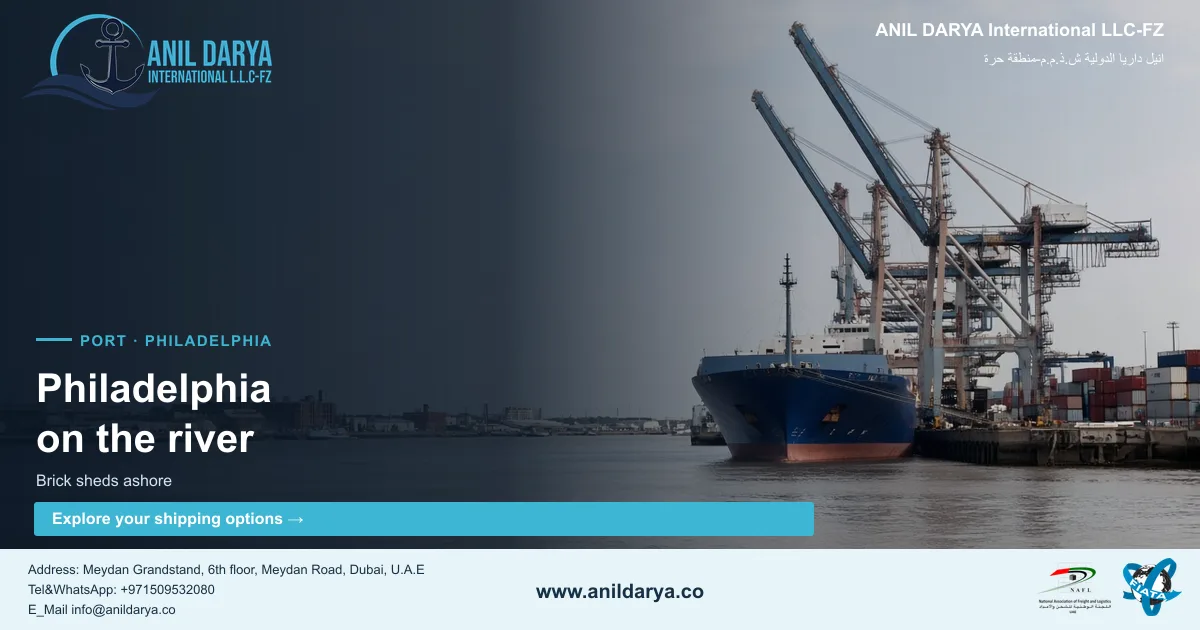
Port of Philadelphia shipping runs through PhilaPort, the state port authority that owns the public terminals on the Delaware River in Philadelphia, Pennsylvania. Containers go mainly through Packer Avenue Marine Terminal on a 45-foot channel, and the port is known for refrigerated cargo, breakbulk, forest products, cocoa and vehicles. This guide covers each terminal, the cold chain, rail and road links, the short version of US customs, and how we ship your cargo from Dubai to Philadelphia. We ship both from Dubai to Philadelphia and from Philadelphia to Dubai.
Port of Philadelphia at a glance
| Item | Detail |
|---|---|
| Port authority | PhilaPort, an independent agency of the Commonwealth of Pennsylvania (formerly the Philadelphia Regional Port Authority, renamed in 2017) |
| Model | Landlord port: PhilaPort owns the terminals, private operators run them |
| Location | West bank of the Delaware River, Philadelphia, Pennsylvania |
| UN/LOCODE | USPHL |
| CBP port code | 1101, 200 Chestnut Street, Philadelphia |
| Main channel depth | 45 ft, deepened from 40 ft between 2010 and 2017 |
| Air draft | 188 ft at the Delaware Memorial Bridge; 143 ft at the Benjamin Franklin Bridge |
| Containers in 2025 | 889,268 TEU, a record, up 6% |
| Refrigerated share | 64% of containerized imports in 2025 |
| New vehicles in 2024 | 281,819 units, a record |
| Largest ship to date | CMA CGM Marco Polo, 16,200 TEU, at Packer Avenue in 2024 |
| Main terminals | Packer Avenue (containers), Tioga (multipurpose), Piers 82 and 84, Forest Products Center, SouthPort Auto |
| Rail | CSX and Norfolk Southern, plus CN service at Packer Avenue |
| Highways | I-95 alongside the port, I-76 close by |
| Foreign-trade zone | FTZ 35, granted to PhilaPort, covering Southeastern Pennsylvania |
| Advance filing for ocean cargo | ISF 10+2, no later than 24 hours before loading at the UAE port |
| Shipping from Philadelphia to Dubai | EEI filed in the AES by the USPPI or its agent; UAE duty 5% of CIF for most goods, import VAT 5% |
What is PhilaPort, and how does the Port of Philadelphia work?
PhilaPort is the trading name of the Philadelphia Regional Port Authority, created under a state law in July 1989 and renamed PhilaPort in May 2017. It is an independent agency of the Commonwealth of Pennsylvania. It manages, maintains and markets the publicly owned port facilities along the Delaware River in Philadelphia.
It is a landlord port. PhilaPort owns the land and terminals, and private companies run them: Greenwich Terminals (part of Holt Logistics) at Packer Avenue, Delaware River Stevedores at Tioga, Glovis at SouthPort Auto, and other operators at the piers. PhilaPort itself does not track cargo. Its own FAQ tells importers to ask their forwarder or shipping line about cargo status.
For you, this means the terminal on your arrival notice is the party that holds your box, sets the gate rules and releases the cargo. PhilaPort is the landlord and the planner.
Philadelphia is a river port at the top of a 103-mile main channel up the Delaware. That channel was deepened to 45 ft, and the port now takes ships of over 16,000 TEU. The bridges matter more than at most ports: the Delaware Memorial Bridge allows 188 ft of air draft, and the Benjamin Franklin Bridge allows 143 ft. Tioga Marine Terminal is upriver of the Ben Franklin Bridge, so tall deck cargo bound there needs a height check.
Which terminals does the Port of Philadelphia have?
Your cargo type decides the terminal. Containers go to Packer Avenue in South Philadelphia. Breakbulk, project and some container cargo use Tioga in the north. The piers in between are specialists.
| Terminal | Operator | Main cargo | Size and berths | Depth (MLW) |
|---|---|---|---|---|
| Packer Avenue Marine Terminal | Greenwich Terminals (Holt) | Containers, steel, frozen meat, fruit, heavy lift, project, paper | 160 acres, 6 berths (3,800 ft) plus 1 Ro-Ro berth (800 ft) | 45 ft |
| Tioga Marine Terminal | Delaware River Stevedores | Forest products, containers, steel, over-dimensional, project, breakbulk | 116 acres, 6 berths (3,822 ft) | 36 ft and 41 ft |
| Pier 82 | Horizon Stevedoring | Fruit and vegetables, breakbulk, project, paper | 13.3 acres, 2 berths | 32 ft |
| Pier 84 | Dependable Distribution Services | Cocoa beans and cocoa products | 13.9 acres, 1 berth | 32 ft |
| Forest Products Center (Piers 74A, 78, 80) | Penn Warehousing and Distribution | Paper, wood pulp, forest products, other breakbulk | 44.4 acres, 2 berths with Ro-Ro ramps at Pier 80 | 32 ft |
| SouthPort Auto Terminal | Glovis | Autos, Ro-Ro, heavy machines | 155 acres, served by Pier 122 and Packer Avenue | Inland site |
| Tioga Liquid Bulk Terminal | Kinder Morgan | Industrial chemicals and liquid bulk | 2 acres, linked to a tank farm | 36 ft |
Container shipping through Packer Avenue Marine Terminal
Packer Avenue is the main container terminal on the Delaware River, next to the Walt Whitman Bridge. These are the figures PhilaPort publishes.
| Packer Avenue item | Published figure |
|---|---|
| Cranes | 5 Super Post-Panamax (24 wide) and 2 Post-Panamax (17 wide) |
| Reefer plugs | 2,500 (PhilaPort); the operator's own site lists 4,600 |
| Refrigerated warehouse | 157,000 sq ft, 2.2 million cu ft |
| Dry warehouse | 35,000 sq ft |
| Inspection building | 44,000 sq ft |
| Yard equipment | 29 reach stackers and 5 top loaders of 95,000 lb, 63 forklifts |
| Gates | 8 inbound and 6 outbound container lanes, a separate breakbulk gate, LTL gates, 52 loading docks |
| Rail | CSX, Norfolk Southern and CN |
| Gate hours (operator) | Monday to Friday, 7:00 am to 4:00 pm |
PhilaPort's container import schedule (February 2026) lists weekly services at Packer Avenue from Australia and New Zealand, the east coast of South America, Northern Europe, Central America and the Mediterranean, with lines such as MSC, Maersk, Hapag-Lloyd, CMA CGM and ZIM. It shows no direct service from the Gulf. Cargo from the UAE therefore reaches Philadelphia by transshipment onto one of these loops, or through another East Coast port.
FCL or LCL to Philadelphia?
- FCL suits a full 20ft or 40ft load and any cargo going inland by rail or needing a reefer. The box stays sealed to the consignee.
- LCL suits small volumes. The box is unpacked at a warehouse near the port first, which adds handling, another party to the release and a few days.
With LCL, each house bill needs its own ISF. Our article on FCL vs LCL shipping costs shows where the break-even point usually sits.
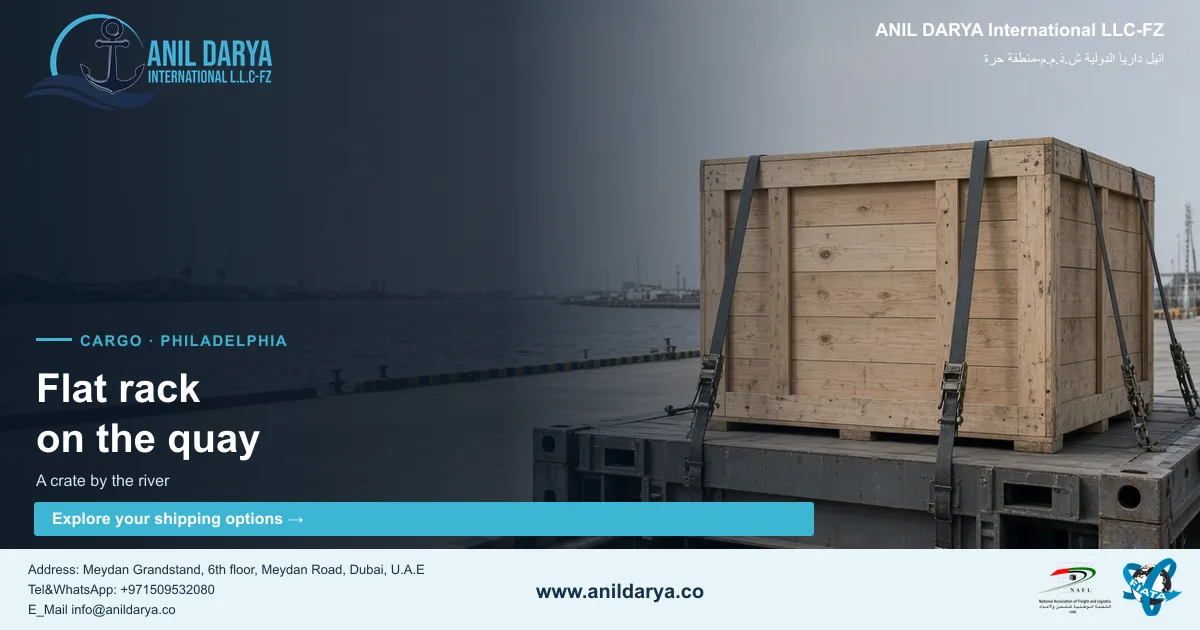
Refrigerated and food cargo: Philadelphia's speciality
If you ship food, the cold chain is the main reason to pick Philadelphia. PhilaPort says 64% of its containerized imports in 2025 were refrigerated. Holt reports that its Philadelphia-area terminals handled over 88% of the Chilean fruit arriving on the US East Coast in 2024.
| Cold chain facility | What it offers |
|---|---|
| Packer Avenue on-dock cold store | 157,000 sq ft refrigerated warehouse at the terminal |
| Pier 82 | 130,000 sq ft heated and chilled warehouse with humidity control, 112 reefer plugs |
| Tioga II | 90,000 sq ft of cold storage, 116 reefer plugs at Tioga |
| PhilaPort Distribution Center | 201,621 sq ft for frozen, temperature-controlled and food-grade dry cargo, 1 mile from Packer Avenue |
| New refrigerated warehouse | 165,500 sq ft, final phase of the Distribution Center, slated for 2026 |
| Reefer trucking | PhilaPort says local truckers handle up to 1,500 reefer trucks a week |
For food from the UAE, such as dates, spices, sweets or frozen products, you need the US food agency requirements sorted before the ship sails. Ask the US broker to confirm them for your exact product. Tell us the set temperature at booking, and plan pickup early in the free time, because reefer plug charges start when free time ends.
Breakbulk, project and forest products at Tioga and the piers
Tioga Marine Terminal in Port Richmond is the multipurpose terminal. It has six berths, over 740,000 sq ft of dry and heated warehouses across Tioga I to V and Pier 179, fumigation, and 3,000 ft of rail siding. Truck turns are under 40 minutes, according to PhilaPort.
| Lifting equipment | Where | Published capacity |
|---|---|---|
| Liebherr LHM 400 mobile harbor crane | Tioga | 114 short tons heavy lift |
| Kocks container gantry crane | Tioga | 45 short tons |
| Liebherr LHM 400 mobile harbor crane | Pier 82 | 114 short tons |
| Top lifts for containers | Tioga | 50 tons each |
| Forklifts | Tioga | Four of 30 tons and four of 20 tons |
Scheduled breakbulk lines on PhilaPort's March 2025 list include G2 Ocean, Saga Welco, Spliethoff and Wagenborg, mostly on Northern Europe and Brazil trades, with Chipolbrok calling occasionally on a round-the-world service. None comes from the Gulf, so project cargo from the UAE usually needs a heavy-lift or breakbulk ship booked for the voyage, or a transshipment in Europe.
For heavy pieces, we plan in this order:
- Collect drawings, weights, dimensions and centre of gravity for each piece.
- Pick the vessel: flat rack on a container ship, or breakbulk or heavy-lift tonnage.
- Check the heaviest lift against the 114 short ton cranes, or plan for the vessel's own gear.
- Check the height against the bridges if the cargo goes to Tioga.
- Line up road permits. The City of Philadelphia and the Commonwealth of Pennsylvania each issue hauling permits for oversize loads.
Our break bulk and project cargo service handles the UAE side, and our heavy-lift shipping guide explains lift plans and vessel choice.
Vehicles and Ro-Ro cargo at the SouthPort auto terminal
SouthPort Auto Terminal opened in 2019 on a 155-acre site just south of Packer Avenue. It has 24,000 parking stalls, can take 350,000 autos a year, and has a 108,000 sq ft vehicle processing center with car washes and a body shop. It is built above the 100-year floodplain. PhilaPort's Ro-Ro list shows Glovis and Eukor services, mainly from South Korea and Mexico. Vehicles from the UAE would normally go in a container or on a Ro-Ro ship via another hub. US safety and emissions rules for imported vehicles are separate from duty, so the US broker should check them before you ship.
Rail and road links from the Port of Philadelphia
PhilaPort says two Class I railroads serve its facilities, CSX and Norfolk Southern, and Packer Avenue also lists CN.
| Rail facility | Operator | Published service |
|---|---|---|
| CSXI Greenwich, 3400 S. Columbus Blvd (next to Packer Avenue) | CSX Intermodal | Jacksonville, Miami, Port Everglades, New Orleans, Chicago, St. Louis, Houston, and interline service via Chicago |
| Morrisville, Langhorne PA | Norfolk Southern | Daily double-stack to St. Louis, Chicago and Kansas City |
By road, I-95 runs right beside the terminals and I-76 has ramps nearby. Pennsylvania allows overweight sealed international containers on permit:
- Program 1: up to 90,000 lb gross for a sealed seagoing container, with axle and route limits. PhilaPort's typical example leaves about 59,000 lb of cargo.
- Program 2: up to 107,500 lb gross for containerized refrigerated meat, on annual permits in Philadelphia and the surrounding counties.
That matters if you ship dense cargo, such as stone, tiles or metals. Tell us the gross weight early so the box is loaded to a legal road weight.
Shipping from Dubai to Philadelphia: routes and transit
No direct liner service runs from the UAE to Philadelphia. Container cargo moves on a routing with at least one transshipment. One route search site does not quote Philadelphia directly. Its quickest UAE routing ends in New York: about 35 days from Khor Fakkan with one transfer (Maersk, Hapag-Lloyd), sailing every 1 to 2 weeks. From New York, the box would continue by truck or rail, or a carrier may offer a through routing into Packer Avenue. For air, the same site shows Dubai to Philadelphia International at about 21.5 hours with one transfer, every 1 to 2 days.
[AMIR-FACT: the carrier and transshipment hub we actually use from Jebel Ali to Philadelphia (Packer Avenue), and our real transit days on this lane]
Our sea freight team compares a through routing to Philadelphia against discharge in New York with a truck leg, on the total cost to the door.
US customs at the Port of Philadelphia: the short version
US customs rules are the same at every US seaport. For the full ISF data list and entry tables, see our Port of Los Angeles guide. These are the points that matter at Philadelphia.
| Step | Rule | Who acts |
|---|---|---|
| ISF 10+2 | No later than 24 hours before loading in the UAE for containers; for exempt breakbulk, no later than 24 hours before arrival in the US | ISF importer, usually through a customs broker |
| Entry documents | Within 15 calendar days of arrival | Importer of record or licensed customs broker |
| Entry summary and estimated duty | Within 10 working days of entry | Importer of record or broker |
| Bond | Needed for the entry; ISF failures can bring liquidated damages of $5,000 per violation | Importer of record, or the broker's bond |
| Fees on imports | Harbor maintenance fee 0.125% of cargo value; merchandise processing fee 0.21% ad valorem on formal entries | Importer of record |
Philadelphia specifics: entries are filed at CBP port 1101, open Monday to Friday, 8:00 am to 4:00 pm. CBP lists a CES East Coast Warehouse open Monday to Friday, 8:00 am to 5:00 pm. A forwarder guide says exams are done in the 44,000 sq ft inspection building at Packer Avenue or at this examination station. Food cargo can also be held by other agencies, so ask the broker early how a hold affects free time. Duty depends on the HTSUS code and origin of each product.
To defer duty, FTZ 35 covers Southeastern Pennsylvania. PhilaPort is the grantee and handles applications to the FTZ Board for new zone sites.
Dangerous goods to Philadelphia
For dangerous goods, the IMDG Code covers the sea leg and US hazardous materials rules cover the truck and rail legs. You need the UN number, proper shipping name, class and packing group, a Safety Data Sheet, a signed DG declaration and UN-approved packaging with labels and placards. Every carrier and every transshipment port on the route must accept the class. Liquid chemicals in bulk go to the Tioga Liquid Bulk Terminal, not to Packer Avenue. Our dangerous goods shipping team checks acceptance for the whole route before you commit to a sailing.
How to ship from Dubai to the Port of Philadelphia: step by step
- Send us the cargo details: commodity, HS code, weight, dimensions, temperature if reefer, cargo ready date, UAE pickup address and your Incoterm.
- Give us the final US address. That decides whether Philadelphia, New York or Baltimore is the better discharge port.
- Confirm the US side: importer of record, customs broker, bond and any food or product approvals.
- Choose the routing: a through service to Packer Avenue, or discharge at another East Coast port and truck to Philadelphia.
- Book space. For DG, reefer or out-of-gauge cargo we get carrier acceptance first.
- Send ISF data to the US broker well before loading.
- Clear export in the UAE. We file the declaration with the invoice, packing list, certificate of origin and any permit for restricted goods, and deliver to the terminal before the cut-off.
- Check the bill of lading against the invoice and ISF, then release it after sailing.
- Track the transshipment and warn you if the box rolls to a later ship.
- US entry and pickup. The broker files the entry, and the trucker collects from Packer Avenue or Tioga within free time.
Most of our US cargo starts at Jebel Ali Port. Free days and charges come from the carrier and terminal tariff; our article on demurrage and detention explains how they build up.
How to ship from the Port of Philadelphia to Dubai
We also handle the other direction: shipping from Philadelphia to Dubai, with arrival at Jebel Ali, Khalifa Port or Sharjah port. We book the space with the carrier and run the UAE side. The export papers at origin stay with the shipper or its agent there.
The US export side
- Electronic Export Information (EEI). The US Principal Party in Interest (USPPI) or its authorized agent files it in the AES. For vessel cargo the filing citation must reach the carrier 24 hours before the cargo is loaded at the US port.
- Exemptions. EEI is generally not needed when the goods under each Schedule B number are worth $2,500 or less, subject to the conditions in the rules. The shipper's agent confirms this for each shipment.
- Pickup. The shipper or its trucker delivers the box to Packer Avenue Marine Terminal inside the carrier's receiving window and cut-off.
The UAE import side
For cargo discharged at Jebel Ali, the import declaration goes to Dubai Customs. It asks for the commercial invoice, the packing list, a certificate of origin and, for restricted goods, the approval of the authority that controls them. The carrier's agent releases the cargo against the bill of lading with a delivery order. Customs duty in Dubai is 5% of the CIF value for most goods, with 50% on alcohol and 100% on cigarettes. Import VAT is 5% of the customs value, which takes in insurance and freight, plus customs fees and any excise tax. A VAT-registered importer whose customs number is registered with the Federal Tax Authority can account for that VAT on its VAT return instead of paying it at clearance.
- Send us the shipper's details in Philadelphia, the cargo, the HS code and the delivery address in the UAE.
- We book space from Philadelphia with the carrier and send the booking and cut-off dates to the shipper.
- The shipper or its trucker delivers the cargo to Packer Avenue Marine Terminal inside the receiving window.
- The shipper or its US agent files the EEI in the AES.
- We check the draft bill of lading against the invoice and packing list before the carrier issues it.
- We file the UAE import declaration before the ship arrives.
- We arrange payment of the duty and VAT and collect the delivery order from the carrier's agent.
- We truck the cargo to your site in the UAE.
- We return the empty container to the carrier's depot inside free time.
[AMIR-FACT: the carriers and hub we actually use from Philadelphia (Packer Avenue) to Jebel Ali, Khalifa or Sharjah, and our real port-to-port transit days in this direction]
Philadelphia, New York or Baltimore: which port fits your cargo?
| Your situation | Port to look at first | Why |
|---|---|---|
| Food or reefer cargo for Pennsylvania, New Jersey or Delaware | Philadelphia | Large on-dock cold storage and reefer trucking |
| Distribution center in eastern Pennsylvania | Philadelphia | Shorter truck leg than from New York and New Jersey |
| Containers for New York, New Jersey or New England | New York and New Jersey | More direct services and shorter inland leg |
| Ro-Ro machinery or heavy pieces for the Mid-Atlantic | Baltimore | Large Ro-Ro and heavy-lift terminal at Dundalk |
Checklist before you ship to Philadelphia
- Final US address confirmed, and discharge port chosen.
- Importer of record named, customs broker appointed and bond in place.
- HS code checked against the HTSUS; food and product approvals confirmed.
- ISF filed at least 24 hours before loading.
- Commercial invoice, packing list and certificate of origin issued in the UAE.
- Reefer set temperature and ventilation on the booking.
- Gross weight within the Pennsylvania road limits, or an overweight permit planned.
- For breakbulk: drawings, weights, lifting points and bridge height checked.
- For DG: SDS, DG declaration, packaging, labels and acceptance at every port on the route.
Common mistakes when shipping to Philadelphia
- Assuming a direct sailing. UAE cargo transships, so plan the extra days.
- Asking PhilaPort for cargo status. The port does not hold that data; ask the carrier, terminal or your forwarder.
- Loading a box too heavy for Pennsylvania roads without a permit.
- Leaving food approvals until arrival, when the reefer is already using up free time.
- Booking tall deck cargo to Tioga without checking the Ben Franklin Bridge clearance.
- Late ISF data. A late or wrong ISF can cost $5,000 per violation.
Frequently asked questions
What is PhilaPort?
PhilaPort is the Port of Philadelphia, an independent agency of the Commonwealth of Pennsylvania. It owns and manages the public terminals on the Delaware River in Philadelphia, which private operators run.
Which terminal handles containers in Philadelphia?
Packer Avenue Marine Terminal, operated by Greenwich Terminals (Holt). It has six berths at 45 ft, seven container cranes and 2,500 reefer plugs. Tioga Marine Terminal also handles some containers.
How deep is the Port of Philadelphia channel?
The Delaware River main channel is 45 feet, deepened from 40 feet between 2010 and 2017. Packer Avenue is 45 feet at mean low water, Tioga 36 and 41 feet, and the older piers 32 feet.
What is the port code for Philadelphia?
The UN/LOCODE is USPHL, used on bookings and bills of lading. The CBP port code for customs entries is 1101.
How long does shipping from Dubai to Philadelphia take?
There is no direct service. One route search site shows about 35 days from Khor Fakkan to New York with one transfer, plus the leg to Philadelphia. Ask for live sailings for your cargo ready date.
Why is Philadelphia known for refrigerated cargo?
In 2025, 64% of PhilaPort's containerized imports were refrigerated. Packer Avenue has a 157,000 sq ft on-dock cold store, and the port has more cold storage at Pier 82, Tioga and its Distribution Center.
Can my container go inland by rail from Philadelphia?
Yes. CSX has an intermodal yard next to Packer Avenue, and Norfolk Southern runs daily double-stack trains from Morrisville to Chicago, St. Louis and Kansas City.
Do I need an ISF for cargo shipped from Dubai to Philadelphia?
Yes for container cargo. The ISF must be filed no later than 24 hours before loading at the UAE port, and CBP can claim $5,000 per violation.
Can you ship from Philadelphia to Dubai?
Yes. We book the space out of Packer Avenue, the shipper or its US agent files the EEI and delivers the box, and we clear the cargo at Jebel Ali, Khalifa or Sharjah and deliver it. Duty in Dubai is 5% of CIF value for most goods, and import VAT is 5%.
Get a quote for Port of Philadelphia shipping
Send us your cargo details and final US address, and we will come back with routing options and a price from the UAE to Philadelphia. Use our freight rate inquiry form, or contact our team to talk through a reefer, DG or project shipment. You can also read about our Dubai freight forwarding team.
Sources
- PhilaPort: About the port (state agency, 1989 act, 2017 rebrand)
- PhilaPort: Packer Avenue Marine Terminal (berths, depth, cranes, reefer plugs, warehouses, gates, rail, operator)
- PhilaPort: Tioga Marine Terminal (berths, depths, warehouses, cranes, rail siding, truck turns)
- PhilaPort: Pier 82
- PhilaPort: Pier 84
- PhilaPort: Philadelphia Forest Products Center
- PhilaPort: SouthPort Auto Terminal
- PhilaPort: Tioga Liquid Bulk Terminal
- PhilaPort: Distribution Center
- PhilaPort: Container import services (February 2026)
- PhilaPort: Breakbulk services (March 2025)
- PhilaPort: Ro-Ro and barge services
- PhilaPort: Railroad (CSX, Norfolk Southern, intermodal yards)
- PhilaPort: Truck access (highways, reefer trucks, hauling permits, overweight programs)
- PhilaPort: Foreign-Trade Zone 35
- PhilaPort: FAQ (cargo status)
- PhilaPort: Record 2025 container volume (889,268 TEU, 64% reefer imports)
- PhilaPort: 2024 milestones (Marco Polo, 2024 volumes, new refrigerated warehouse)
- Holt Logistics: Packer Avenue Marine Terminal (reefer plugs, gate hours)
- Wikipedia: Port of Philadelphia (landlord model, channel deepening, air draft, Chilean fruit share)
- iContainers: Port of Philadelphia (UN/LOCODE)
- CBP: Port of Philadelphia (port code 1101, hours, examination station)
- Goodhope Logistics: Port of Philadelphia guide (exam locations)
- Fluent Cargo: Dubai to Philadelphia (published transit indications)
- CBP: ISF frequently asked questions 2.0 (24-hour timing, breakbulk rule, $5,000 liquidated damages)
- CBP: Importing into the United States (entry deadlines, bond, harbor maintenance and merchandise processing fees)
- Dubai Customs: Submit customs declaration (export documents)
- 15 CFR 30.4: EEI filing timeframes (24 hours before loading for vessel cargo)
- 15 CFR 30.37: EEI exemptions ($2,500 per Schedule B number)
- UAE Government portal: Customs duty (5% of CIF, alcohol 50%, cigarettes 100%, GCC-origin goods)
- Federal Tax Authority: VAT (5% rate)
- Federal Tax Authority: VAT guide, section 3.5 (import VAT at 5%, accounting on the VAT return)
Reviewed: 10 November 2026