
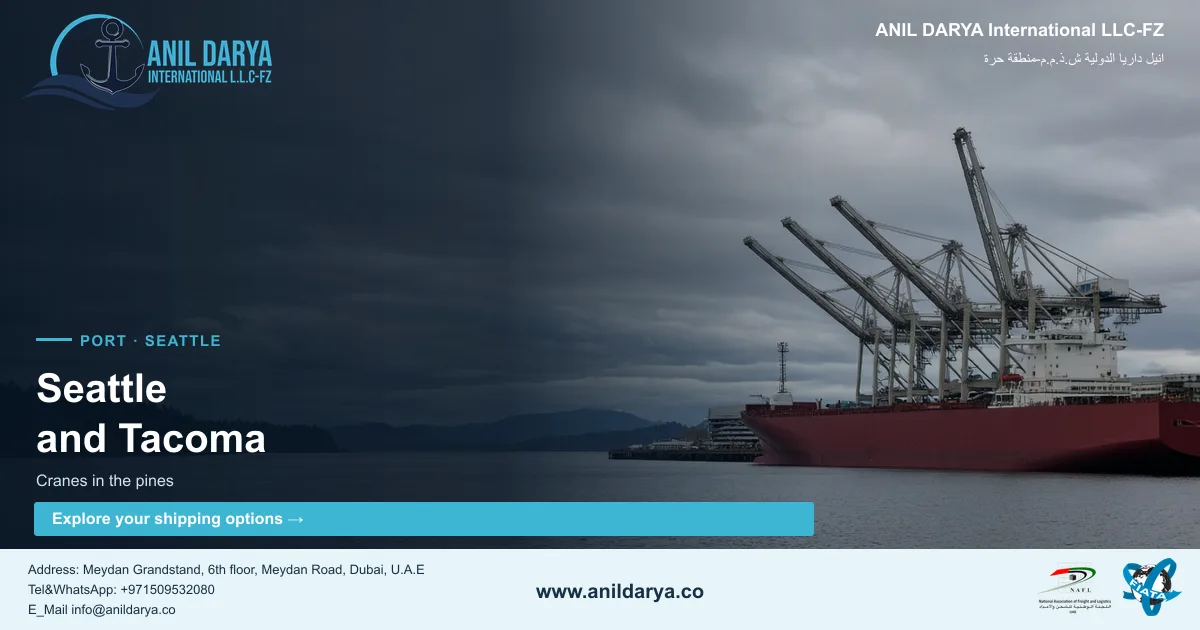
Seattle Tacoma port shipping runs through The Northwest Seaport Alliance (NWSA), which manages the cargo terminals of the Port of Seattle and the Port of Tacoma as one gateway. Your container can land at Terminal 5 or Terminal 18 in Seattle, or at Husky, Washington United or Pierce County Terminal in Tacoma, and most inland cargo then moves east by rail. This guide covers each terminal, breakbulk and autos, rail, US customs in short, and how we ship your cargo from Dubai. We ship both ways: from Dubai to Seattle and Tacoma, and from Seattle and Tacoma to Dubai.
Seattle and Tacoma port shipping at a glance
| Item | Detail |
|---|---|
| Who runs the cargo terminals | The Northwest Seaport Alliance, a port development authority formed in 2015 by the Ports of Seattle and Tacoma |
| Two harbors | North Harbor (Seattle) and South Harbor (Tacoma), about 30 miles apart on Puget Sound |
| UN/LOCODEs | USSEA (Seattle), USTIW (Tacoma) |
| CBP port codes | 3001 Seattle, 3002 Tacoma |
| International container terminals | Seattle: Terminal 5, Terminal 18 (Terminal 30 paused since 1 January 2025). Tacoma: Husky, Washington United Terminals (WUT), Pierce County Terminal (PCT) |
| Berth depth at container terminals | 50 ft (T18) to 55 ft (T5) at MLLW; 51 ft at the Tacoma terminals |
| Largest ship listed | Up to 24,000 TEU at Husky Terminal |
| Breakbulk and autos | Terminal 46 (Seattle), East Blair One and Terminal 7 (Tacoma) |
| International containers 2024 | 1,289,198 TEU imports, 636,507 TEU exports, 684,540 TEU empties |
| Waterborne trade 2025 | Nearly USD 68 billion with 175 trading partners |
| Railroads | BNSF and Union Pacific, with Tacoma Rail as shortline |
| Rail to Chicago | Confirm current transit with the railroad; a faster Chicago service was announced in April 2025 |
| Foreign-trade zones | FTZ No. 5 (Seattle), FTZ No. 86 (Tacoma) |
| Seattle or Tacoma to Dubai | Required EEI filing or exemption citation within the vessel cut-off; UAE duty and VAT depend on the goods and applicable treatment |
Port of Seattle or Port of Tacoma: how the alliance works
The two ports are still separate public bodies, but since August 2015 their marine cargo business has been run by the NWSA. The alliance manages container, breakbulk, auto and some bulk terminals in both harbors and is headquartered in Tacoma. The two ports are equal members. Each has five commissioners elected in its county for four-year terms.
What this means for you:
- One tariff. Terminal rates, charges and rules for both harbors sit in the NWSA harbor tariffs.
- Two customs codes. CBP still treats Seattle (3001) and Tacoma (3002) as separate ports of entry, so your broker files against the port where the ship discharges.
- You rarely choose the harbor. The ocean carrier's service decides whether your box lands in Seattle or Tacoma. Check the discharge terminal on the booking, not just "Seattle".
The NWSA calls itself the fourth-largest container gateway for cargo moving between Asia and the Midwest, Ohio Valley and East Coast. That shapes the gateway: most services here are transpacific, and cargo from the UAE usually joins them at a transshipment hub.
Which container terminals do Seattle and Tacoma have?
The NWSA publishes a fact sheet for each terminal. These are the figures that matter when you plan a box.
| Terminal | Harbor | Operator | Area | Berth | Depth (MLLW) | Cranes | Reefer plugs |
|---|---|---|---|---|---|---|---|
| Terminal 5 | Seattle | SSA Terminals (Seattle Terminals) | 185 acres | 2,750 ft | 55 ft | 6 Super Post-Panamax | 1,500 (listed as coming soon) |
| Terminal 18 | Seattle | SSA Terminals (Seattle Terminals) | 196 acres | 6,000 ft (4,440 ft crane rail) | 50 ft | 10 (7 Super Post-Panamax, 3 Post-Panamax) | 1,250 |
| Husky Terminal | Tacoma | Husky Terminal and Stevedoring | 120 acres | 2,960 ft | 51 ft | 8 Super Post-Panamax | 590 |
| Washington United Terminals | Tacoma | Washington United Terminals | 133 acres | 2,600 ft | 51 ft | 8 (4 Super Post-Panamax, 4 Post-Panamax) | 884 |
| Pierce County Terminal | Tacoma | Everport Terminal Services | 155 acres | 2,087 ft | 51 ft | 7 Post-Panamax | 654 |
Ship size and on-dock rail by terminal
| Terminal | Largest vessel listed | On-dock rail | CBP firm code |
|---|---|---|---|
| Terminal 5 | One 18,000 TEU and one 15,000 TEU vessel | Terminal 5 Intermodal Yard | Check with the terminal |
| Terminal 18 | Two 18,000 TEU vessels | Terminal 18 Intermodal Yard, 25 double-stack 5-pack railcars | X117 |
| Husky Terminal | 24,000 TEU | North Intermodal Yard | Z693 |
| Washington United Terminals | 18,000 TEU | Hyundai Intermodal Yard | Z705 |
| Pierce County Terminal | 14,000 TEU | PCT Intermodal Yard | X215 |
The firm code tells your broker and trucker where the box sits. If your arrival notice names Terminal 30, ask the carrier where the call moved: the NWSA paused Terminal 30 from 1 January 2025 and shifted the PNW1 and CPV services to Terminal 5.
Breakbulk, project cargo and autos at Seattle and Tacoma
Not all cargo fits a box. The NWSA runs three terminals that take over-dimensional, wheeled, tracked and static cargo from Ro-Ro and lift-on lift-off ships.
| Terminal | Harbor | Cargo | Key facts |
|---|---|---|---|
| Terminal 46 | Seattle | Autos and breakbulk | 87 acres, 40+ acres of open lay-down, two berths totalling 2,930 ft, three gantry cranes of 90 long tons |
| East Blair One (EB1) | Tacoma | Autos and breakbulk | 26 acres, 1,200 ft berth, 51 ft depth, 120 ft x 110 ft heavy-lift pad rated 2,000 PSF, on-dock rail spur |
| Terminal 7 | Tacoma | Autos, breakbulk and containers | 46 acres, 2,700 ft of berth rated 1,000 PSF, 100,000 sq ft warehouse |
Two rules shape a heavy-lift plan here. Static pieces over 55 metric tons need an outside crane ordered through the port. An outside crane may also be needed for lighter static cargo because of its size or centre of gravity.
What the published breakbulk truck loading rates look like
The NWSA publishes truck loading charges for breakbulk per 1,000 kg. Use them as a guide to how weight drives cost, and check the current tariff before you budget.
| Cargo | Rate per 1,000 kg |
|---|---|
| Driveable or trailerable | USD 15.32 |
| Static, 0 to 15 MT | USD 28.70 |
| Static, 15 to 25 MT | USD 44.55 |
| Static, 25 to 35 MT | USD 55.13 |
| Static, 35 to 45 MT | USD 92.60 |
| Static, 45 MT and over | USD 134.88 |
| Cargo longer than 25 ft | USD 48.79 |
The rule that follows: if a machine can drive or roll off, it is far cheaper to handle than a dead load of the same weight. Ship it on its own wheels or a trailer when you can. Our break bulk and project cargo service covers how we plan such moves from the UAE.
Rail and trucks: moving cargo out of Seattle and Tacoma
This gateway is built around rail. BNSF and Union Pacific serve both harbors, with barge and road links to the Pacific Northwest, Western Canada, Alaska and the US Midwest. Tacoma Rail, owned by the City of Tacoma, provides shortline service in Tacoma. The Port of Tacoma's Wikipedia entry says over 70% of imported containers there move by rail to the Midwest and East Coast.
In April 2025 BNSF, Norfolk Southern and the NWSA relaunched their intermodal service to Chicago. The announced plan targeted less than two days of dock dwell and a three-day transit improvement. Obtain a current schedule for the terminal and inland ramp; these are service targets, not guaranteed delivery times. The service uses Husky and Washington United in Tacoma and Terminal 18 in Seattle.
| Where your consignee is | Usual way out | What to arrange |
|---|---|---|
| Puget Sound area | Truck from the terminal | Trucker with an RFID tag that meets the Clean Truck rules |
| Oregon and south along I-5 | Truck, often from Tacoma | Ask which harbor the ship calls; Tacoma is closer for southbound moves |
| Chicago, Midwest, Ohio Valley | On-dock rail on a through bill | Inland point on the booking, rail-enabled terminal |
| Mixed regional deliveries | Transload into domestic trailers near the port | One of the 20+ near-terminal transload sites |
Trucks serving NWSA container terminals need an active RFID tag and a 2007-or-newer engine, or a certified equivalent emissions system. The NWSA says more than 100 warehouses sit within 15 miles of the terminals, so transloading is easy to set up.
Free time, demurrage and detention in Seattle and Tacoma
Two clocks run on every import box. The terminal or carrier gives free days in the terminal, then demurrage starts. The carrier gives free days to return the empty, then detention starts. Both are set by the carrier and terminal, so read them on your quote and arrival notice.
For rail cargo, free time works differently: the box should leave on the train within the rail dwell target, and delays often come from late customs release. File entry before arrival. Our article on demurrage and detention shows how the charges build up.
US customs at Seattle and Tacoma: the short version
CBP rules are the same at every US seaport. Here is what matters for a shipment from the UAE.
- ISF 10+2. For containerized US imports, the ISF Importer or authorized agent generally submits eight importer data elements at least 24 hours before loading on the US-bound vessel. Container stuffing location and consolidator details are due as early as possible, no later than 24 hours before arrival. Four elements permit specified initial estimates followed by updates. Bulk and qualifying breakbulk cargo have different rules; the broker should confirm the requirements for the shipment.
- Penalties. CBP may issue liquidated damages of USD 5,000 per violation for a late, inaccurate or incomplete ISF, and can withhold release.
- Entry. Entry documents are due within 15 calendar days of arrival, and the entry summary with estimated duties within 10 working days of entry.
- Bond. Formal entries generally require a customs bond; informal entries usually do not, subject to commodity and CBP requirements. Ask the US broker to confirm the entry type and arrange the appropriate importer bond coverage.
- Harbor maintenance fee. 0.125% of cargo value, paid at entry on imports.
- Duty. Set by the HTSUS code and origin of each product. Check the official tariff for your code when the goods arrive.
Breakbulk exempt from the 24-hour rule files its ISF 24 hours before arrival, and bulk cargo needs no ISF. For rail cargo moving inland, your broker can clear at the inland port on an in-bond move, or at Seattle or Tacoma. Decide this before sailing.

What we need from you before sailing
| Document or data | Why it matters for Seattle or Tacoma | Who provides it |
|---|---|---|
| Commercial invoice and packing list | CBP entry and duty | Seller (you) |
| Seller, manufacturer, HS code, country of origin | ISF, due 24 hours before loading | Seller, sent to the US broker |
| Final inland point | Decides rail routing and where entry is filed | US buyer |
| Bill of lading | Release from the carrier | Carrier, through us |
| UAE export declaration | Export clearance in the UAE | Us or our clearing agent |
| Drawings, weights, centre of gravity | Crane and lay-down plan at T46, EB1 or T7 | Shipper, checked by us |
Shipping from Dubai to Seattle: routes and transit
Request a dated carrier schedule for your UAE loading port and cargo. Confirm whether transshipment is included, the Seattle or Tacoma discharge terminal, and the estimated arrival. Compare total delivery time and cost, including any rail or truck leg, rather than relying on a generic port-to-port figure.
For urgent parts, air freight to SEA may beat a rolled sailing by weeks. Our air cargo service can price both modes side by side.
How to ship from Dubai to Seattle or Tacoma: step by step
We book space and handle the UAE side. The US importer's customs broker clears the cargo in the US.
- Send us the cargo details. Commodity, HS code, weight, volume or dimensions, pickup point, the Incoterm and the final US delivery point.
- Choose the routing. We compare UAE loading ports and carrier services, and confirm any hub and the NWSA terminal of discharge.
- Decide FCL or LCL. LCL to the Pacific Northwest adds deconsolidation at a warehouse. Our guide to FCL vs LCL costs shows where the break-even sits.
- Book space. For DG, reefer or out-of-gauge cargo we get carrier acceptance first.
- Send ISF data to the US broker at booking, so the filing is in 24 hours before loading.
- Pick up, stuff and clear export. We truck the empty, stuff and seal the box, and file the UAE export declaration. Our Jebel Ali port guide covers that side.
- Track the sailing and any transshipment. We update the ETA at Seattle or Tacoma.
- Arrival and release. The broker files entry, the carrier releases the box, and it leaves by truck within free time or on the train to the inland point.
How to ship from Seattle or Tacoma to Dubai
We also handle the other direction: cargo from the NWSA terminals in Seattle or Tacoma to Jebel Ali, Khalifa Port or Sharjah port. We book the space with the carrier, check the papers and run the UAE side. The US export filing stays with the shipper or its US agent.
The US export side
- Electronic Export Information (EEI). The US Principal Party in Interest (USPPI) or its authorized agent files it in the Automated Export System (AES) and receives an Internal Transaction Number (ITN).
- Timing by sea. The filing citation, or the exemption legend, must reach the carrier 24 hours before the cargo is loaded on the vessel.
- Low-value exemption. EEI is generally not needed for a Schedule B or HTS number worth $2,500 or less, counted per code, with the conditions set out in the rules. The shipper's agent confirms this for each shipment.
The UAE import side
The import declaration goes to the customs authority for the UAE entry port: Dubai Customs for Jebel Ali, Abu Dhabi Customs for Khalifa Port or Sharjah Customs for a Sharjah arrival. Dubai Customs lists the documents as the commercial invoice, the packing list, the certificate of origin and a permit from the controlling authority for restricted goods. The original or released bill of lading is what the carrier needs before it issues the delivery order. Customs duty in Dubai is 5% of the CIF value for most goods, with 50% on alcohol and 100% on cigarettes. Standard-rated import VAT is generally 5% of the customs value including freight and insurance, plus applicable customs duty and excise tax; exemptions and special treatment may apply. An eligible VAT-registered importer with its customs registration linked to the Federal Tax Authority accounts for import VAT on its return; an importer that is not registered settles it at import.
- Send us the shipper's details in the US, the cargo, the HS code and the UAE delivery address.
- We book space from Seattle or Tacoma and send the booking, the terminal and the cut-offs to the shipper.
- The shipper or its trucker delivers the loaded box to the terminal, or it arrives by rail from an inland ramp, before the cut-off.
- When EEI is required, the shipper or authorized US agent files it in AES and supplies the ITN within the applicable vessel deadline; otherwise it supplies an appropriate exemption citation.
- We check the draft bill of lading against the invoice and packing list, and track the hub connection.
- We arrange the import declaration with the customs authority for the UAE entry port.
- We arrange payment of the duty and VAT and collect the delivery order from the carrier's UAE agent.
- We truck the box to your site and return the empty to the carrier's depot inside free time.
Ask for a dated quotation identifying the carrier, terminal, any transshipment hubs and estimated transit for your cargo.
Dangerous goods through Seattle and Tacoma
DG cargo needs three approvals lined up: the carrier on every leg, any transshipment hub and the NWSA terminal. Terminal rules for hazardous cargo sit in the harbor tariffs, and terminals can refuse a box that arrives without the right paperwork.
- Correct UN number, proper shipping name, class and packing group where assigned.
- Safety Data Sheet for each product.
- Dangerous goods declaration signed by a trained person.
- IMDG packaging, marks, labels and placards.
Our dangerous goods shipping team checks acceptance on each leg before you commit to a sailing. The IMDG segregation guide explains which classes can share a box.
Checklist before you ship to Seattle or Tacoma
- HS code confirmed for every item, and the same code on invoice, packing list and ISF data.
- Importer of record, US customs broker and bond confirmed.
- ISF data sent to the broker at booking.
- Discharge harbor and terminal known: Seattle or Tacoma, and which terminal.
- Inland point decided, and whether entry is filed at the port or inland.
- For breakbulk, weights and centre of gravity sent, and an outside crane planned for static pieces over 55 MT.
- For reefers, plug-in confirmed and a cold store booked if needed.
- Trucker meets the Clean Truck rules, or the rail booking is confirmed.
- Carrier free time, demurrage and detention terms read.
Common mistakes when shipping to Seattle and Tacoma
- Assuming Seattle means Seattle. The carrier may discharge in Tacoma. Book the trucker for the right harbor.
- Using an old terminal. Terminal 30 has been paused since January 2025, and the NWSA lists Terminal 46 as an auto and breakbulk terminal, so check the terminal on every arrival notice.
- Late ISF data. Send available data at booking so the broker can meet the pre-loading deadlines and make any permitted updates on time.
- Shipping static heavy pieces without a crane plan. Over 55 MT needs an outside crane ordered in advance.
- Leaving the inland point open. Decide on rail before sailing, or the box may sit at the port waiting for a truck.
- Expecting a direct sailing. Confirm the booked routing and allow for connection time wherever transshipment is included.
Seattle and Tacoma or another US port?
| Your situation | Port to look at | Why |
|---|---|---|
| Consignee in Washington, Oregon or Western Canada | Seattle or Tacoma | Short truck leg |
| Consignee in the Midwest, cargo on a transpacific service | Seattle or Tacoma | Rail connections to Chicago; confirm current service and transit |
| Consignee in Southern California | Los Angeles or Long Beach | More services and a shorter truck move |
| Consignee on the East Coast | New York and New Jersey, Norfolk or Savannah | Avoids a cross-country rail leg |
We can price more than one US port so you compare total cost to the consignee's door.
Frequently asked questions
Are the Port of Seattle and the Port of Tacoma the same port?
No. They are separate public ports, but since 2015 their cargo terminals have been run together by The Northwest Seaport Alliance. CBP still gives them separate port codes: 3001 for Seattle and 3002 for Tacoma.
Which container terminals are in Seattle and Tacoma?
Seattle has Terminal 5 and Terminal 18, with Terminal 30 paused since 1 January 2025. Tacoma has Husky Terminal, Washington United Terminals and Pierce County Terminal.
What are the port codes for Seattle and Tacoma?
The UN/LOCODE for Seattle is USSEA and for Tacoma USTIW. The CBP port codes are 3001 for Seattle and 3002 for Tacoma.
How deep are the Seattle and Tacoma container berths?
Terminal 5 in Seattle has 55 ft at MLLW and Terminal 18 has 50 ft. The Tacoma container terminals list 51 ft, and Husky Terminal can take ships up to 24,000 TEU.
How long does shipping from Dubai to Seattle take?
Ask for a dated carrier schedule for your cargo and loading port. Confirm the discharge terminal, any transshipment and the inland delivery leg before comparing transit estimates.
Can cargo from Seattle and Tacoma go inland by rail?
Yes. BNSF and Union Pacific serve both harbors, and BNSF and Norfolk Southern announced a faster Chicago service in April 2025. Confirm current transit and availability for your inland ramp.
Do Seattle and Tacoma handle breakbulk and heavy lift?
Yes. Terminal 46 in Seattle and East Blair One and Terminal 7 in Tacoma take breakbulk, Ro-Ro and autos. EB1 has a heavy-lift pad rated 2,000 PSF, and static pieces over 55 MT need an outside crane.
Do I need an ISF for cargo from Dubai to Seattle?
Containerized ocean imports generally require ISF. Eight importer elements are generally due before US-bound loading; stuffing-location and consolidator deadlines differ. Bulk cargo is exempt and qualifying breakbulk has different timing. Have the broker confirm the requirements; CBP may assess USD 5,000 liquidated damages per violation.
Can you ship cargo from Seattle or Tacoma to Dubai?
Yes. We arrange booking, documents, clearance at the UAE entry port and delivery. The shipper or authorized US agent handles required EEI filings or exemption citations. Duty and VAT depend on classification, origin and applicable relief.
Get a quote for Seattle and Tacoma port shipping
Send us your cargo details and the final US delivery point, and we will come back with a routing through Seattle or Tacoma and a price. Use our freight rate inquiry form, or contact our team to talk through a breakbulk, rail or DG shipment first. You can also read about our Dubai freight forwarding team.
Sources
- BNSF: Chicago service redesign announced 2 April 2025
- NWSA: current Clean Truck requirements
- 19 CFR 149.2: ISF element deadlines and updates
- FDA: formal and informal entry bond requirements
- US International Trade Administration: EEI requirements and exemptions
- UAE Federal Tax Authority: VAT importers guide
- The Northwest Seaport Alliance: Terminals (list, addresses, Clean Truck Program)
- NWSA: Terminal 5 fact sheet
- NWSA: Terminal 18 fact sheet
- NWSA: Terminal 30 update (operations paused from 1 January 2025)
- NWSA: Husky Terminal fact sheet
- NWSA: Washington United Terminals fact sheet
- NWSA: Pierce County Terminal fact sheet
- NWSA: Breakbulk cargo (Terminal 46, EB1, Terminal 7, 55 MT outside crane rule, railroads)
- NWSA: East Blair One terminal fact sheet
- NWSA: Shipper resources (tariffs, breakbulk truck loading rates, firm codes, FTZ 5 and 86, Clean Truck rules, transload)
- NWSA: Who we are (governance, gateway ranking)
- NWSA: Cargo statistics (2025 waterborne trade)
- Port of Seattle: NWSA cargo by the numbers (2024 international container volumes)
- FreightWaves: BNSF, NS and NWSA intermodal service to Chicago (April 2025)
- Wikipedia: Northwest Seaport Alliance (formation, headquarters)
- Wikipedia: Port of Tacoma (railroads, rail share)
- CBP: Seattle, Washington port 3001
- CBP: Ports of entry in Washington (Tacoma 3002)
- CBP: Importer Security Filing and Additional Carrier Requirements (24 hours, USD 5,000)
- CBP: Importing into the United States (15 days, 10 working days, bond, harbor maintenance fee)
- iContainers: Port of Seattle (UN/LOCODE USSEA)
- Fluent Cargo: Dubai to Seattle schedules (transit, frequency, USTIW)
- Ad Hoc Logistics: Port of Tacoma vs Port of Seattle (distance between harbors)
- 15 CFR 30.4: EEI filing (USPPI or agent, AES, ITN, 24 hours before vessel loading)
- 15 CFR 30.37: EEI exemptions ($2,500 per Schedule B or HTS number)
- Dubai Customs: Submit customs declaration (documents)
- UAE Government portal: Customs duty (5% of CIF, alcohol 50%, cigarettes 100%)
- Federal Tax Authority: VAT Decree-Law No. 8 of 2017 as amended (5% rate, import value, reverse charge, unregistered importers)
Reviewed: 16 November 2026