
Shipping from Mexico to Dubai is a long sea route with at least one transhipment: published schedules show about 47 to 62 days port to port from Manzanillo, Veracruz or Altamira to the UAE. Your Mexican supplier files the export pedimento through a customs broker, and you clear the goods with Dubai Customs at 5% duty on the CIF value plus 5% import VAT. Mexico has no trade agreement with the UAE, so no preferential duty applies.
Mexico to Dubai shipping at a glance
| Item | Detail |
|---|---|
| Main Mexican load ports | Manzanillo and Lazaro Cardenas (Pacific); Veracruz and Altamira (Gulf of Mexico); Ensenada (Baja California) |
| UAE arrival ports | Jebel Ali (Dubai); schedule data also shows services ending at Khor Fakkan and Fujairah |
| Published sea transit | Manzanillo to Khor Fakkan 47 days 14 hours, 1 transfer; Veracruz to Khor Fakkan 47 days 17 hours, 1 transfer; Altamira to Khor Fakkan 59 days 22 hours, 2 transfers (Fluent Cargo schedule data) |
| Published air transit | Mexico City (MEX) to Dubai (DXB) 19 hours 27 minutes; Felipe Angeles (NLU) to Al Maktoum (DWC) 23 hours 40 minutes on freighters |
| Modes | FCL, LCL, reefer, breakbulk and project cargo, dangerous goods, air cargo |
| Mexican export filing | Export pedimento sent electronically, normally by an agente aduanal (licensed customs broker) |
| Mexican VAT on exports | 0% rate for definitive exports |
| Importer ID in Dubai | Customs business code, registered online through Dubai Trade |
| Dubai customs duty | 5% of CIF value for most goods; alcohol 50%, cigarettes 100% |
| UAE import VAT | 5% on the customs value plus duty and excise |
| Trade agreement | None in force; the UAE appears only on Mexico's list of investment protection agreements |
| Free zone at the port | Jafza, next to Jebel Ali Port, over 11,000 businesses |
How the Mexico to Dubai sea freight route works
The schedule data we checked shows no direct service between Mexico and the Gulf. Every ocean option has at least one transfer at a hub port, and that is where most days get lost.
Fluent Cargo's schedule data for Mexico to the UAE shows the quickest sailings ending at Khor Fakkan or Fujairah, not at Jebel Ali. Carriers can still deliver your box to Jebel Ali on a feeder, or quote a through bill of lading to Jebel Ali, but each extra leg adds days. Ask for the final discharge port on the booking, not just the main ocean leg.
Published transit times from Mexico to the UAE
These figures come from carrier schedules as aggregated by Fluent Cargo and opened on 10 November 2026. They are port to port and change whenever carriers rework their rotations. They do not include trucking in Mexico, export clearance, or delivery in Dubai.
| Route | Published transit | Transfers | Frequency shown |
|---|---|---|---|
| Manzanillo to Khor Fakkan | 47 days 14 hours | 1 | Every 2-4 weeks |
| Manzanillo to Fujairah | 48 days 1 hour | 1 | Every 2-4 weeks |
| Veracruz to Khor Fakkan | 47 days 17 hours | 1 | 1-2 times a week |
| Altamira to Khor Fakkan | 59 days 22 hours | 2 | Every 1-2 weeks |
| Altamira to Fujairah | 61 days 17 hours | 2 | Every 1-2 weeks |
| Mexico City (MEX) to Dubai (DXB), air | 19 hours 27 minutes | Direct or 1 stop | Every 1-2 days |
| Felipe Angeles (NLU) to Al Maktoum (DWC), air freighter | 23 hours 40 minutes | Direct or with stops | 2-4 times a week |
[AMIR-FACT: our real door-to-port transit from Manzanillo and Veracruz to Jebel Ali in 2026, the carriers we book on this lane, and the transfer hub each one uses]
What adds days on the Mexico to Dubai lane?
| Factor | Why it matters | What to do |
|---|---|---|
| Transfer port | The box waits for the next connecting vessel | Ask which hub the service uses and how often the second leg sails |
| Final UAE port | A service ending at Khor Fakkan or Fujairah needs a feeder or a truck to reach Dubai | Confirm Jebel Ali as the discharge port if your consignee is in Dubai or Jafza |
| Mexican export clearance | No released pedimento, no loading | Have the broker file early and check the regulated goods rules |
| Inland leg in Mexico | Long truck or rail runs from the Bajio or the north to the coast | Ship from the port closest to the factory, or use rail where the port offers it |
| Dubai clearance | Missing permits or a late declaration keep the box at the terminal | File the Dubai declaration before the vessel berths |
Which Mexican port should you ship from?
Pick the port by where the cargo is made, then compare the services from it. Pacific and Gulf of Mexico ports use different routings.
| Mexican port | What the port or operator says | Usually best for |
|---|---|---|
| Manzanillo (Colima, Pacific) | 46% of Mexico's container traffic and 68% of the Pacific's; 3,893,357 TEU in 2025; 300 km by road to Guadalajara | Jalisco, the Bajio, central Mexico |
| Lazaro Cardenas (Michoacan, Pacific) | Access channel 19 m deep; 2,616,770 TEU in 2025; rail by CPKC to Mexico City and Monterrey | Heavy industry, steel, cargo moving by rail from central Mexico |
| Veracruz (Gulf of Mexico) | Hutchison Ports ICAVE terminal with 1,368 reefer connections and rail access to Ferrosur and CPKC | Mexico City, Puebla, Veracruz state, reefer cargo |
| Altamira (Tamaulipas, Gulf of Mexico) | 13.50 m depth; about 60% of Mexico's plastic resins; 490 km by road to Monterrey | Monterrey, the north-east, chemicals and resins |
| Ensenada (Baja California, Pacific) | About 110 km from the US border; official draft 14.5 m | Baja California and the north-west |
Free storage at the Mexican terminal matters for export timing. The Lazaro Cardenas container terminal and ICAVE at Veracruz both state 15 days of free storage for export containers, counted from entry. Do not gate in so early that they run out before loading.
Which UAE port should your cargo arrive at?
Jebel Ali is the natural arrival port for a consignee in Dubai or the Jebel Ali Free Zone. DP World lists four container terminals there with over 80 weekly services to more than 150 ports, and handles breakbulk, out-of-gauge project cargo, reefers and IMDG dangerous goods. Our Jebel Ali port guide covers the terminals and the port rules.
- Consignee in Dubai or Jafza: book through to Jebel Ali.
- Site in Abu Dhabi: compare Khalifa Port in Abu Dhabi to cut the truck leg.
- Consignee in Sharjah or the northern emirates: compare Sharjah port shipping, including Khor Fakkan, which Gulftainer runs for Sharjah.
- Service ending on the east coast: if the quickest sailing ends at Fujairah, read our Fujairah port guide and price the truck or feeder to your site against a through booking to Jebel Ali.
The arrival port also decides which customs office clears the goods. A box that lands in Sharjah or Fujairah is cleared there, not by Dubai Customs. If your company only has a Dubai customs code, settle this before you book.
Sea freight from Mexico to Dubai: FCL, LCL and special cargo
| Mode | Use it when | What to plan at the Dubai end |
|---|---|---|
| FCL (20ft, 40ft, high cube) | You fill most of a container | Declaration before arrival, delivery order, truck slot, empty return |
| LCL | A few pallets or cartons | Release after the shared box is unpacked; your documents and the consolidator's must match |
| Reefer | Fruit, avocados, frozen food, beverages that need cooling | Food permit before arrival, plug-in time at the terminal |
| Flat rack, open top, breakbulk | Machinery, steel, project pieces | Lifting plan, trailer, road permits for oversized loads |
| Dangerous goods | Chemicals, resins, paints, batteries | Carrier acceptance at origin, port storage limits for the class in Dubai |
| Air cargo | Samples, spares, urgent or high-value goods | Same Dubai Customs declaration and duty |
FCL or LCL from Mexico?
On a route this long, FCL is usually the safer choice once you have more than a few cubic metres. An LCL box from Mexico to the Gulf is consolidated at origin, handled again at the transfer hub, and unpacked in Dubai before anyone gets their goods. If your volume is close to a 20ft container, price both. Our guide to FCL vs LCL costs explains the break-even point.
Machinery, steel and project cargo from Mexico
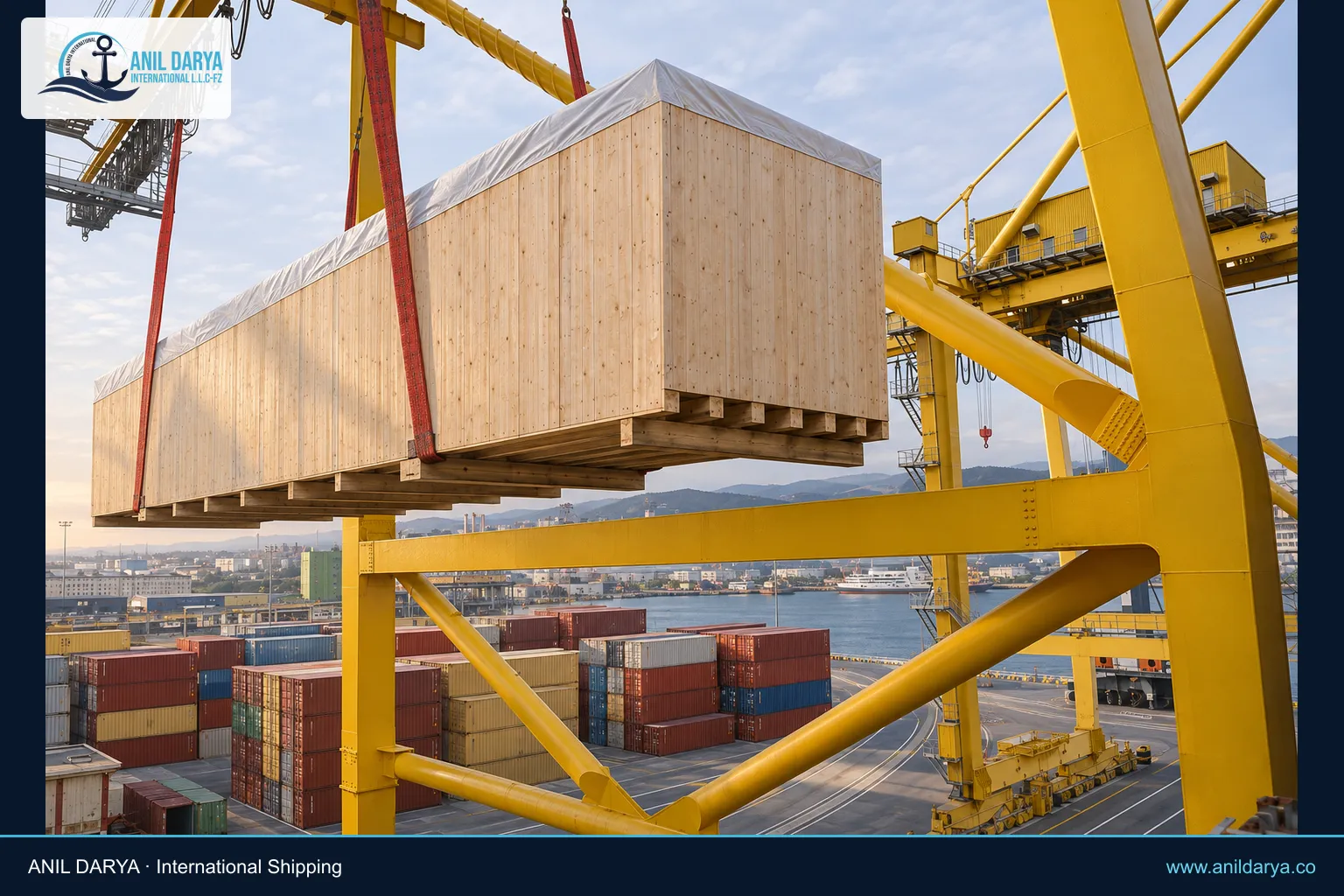
Mexico's main ports all handle heavy cargo. Manzanillo has project cargo areas at its La Junta zone, and the Contecon terminal there accepts flat racks, open tops and out-of-gauge boxes. SSA's terminal at Lazaro Cardenas handles high and heavy machinery. Altamira's ATP terminal lists lifts of up to 200 tonnes. At the Dubai end, Jebel Ali has dedicated handling for out-of-gauge project cargo.
For pieces that fit a 40ft flat rack, a container service gives you more sailings, but every transfer port has to accept the out-of-gauge box, so confirm the whole routing. Larger pieces need breakbulk or heavy-lift tonnage, which sails less often on this lane. We plan the discharge, trailer and road permits in the UAE before the vessel arrives. See our break bulk and project cargo service.
Dangerous goods from Mexico to Dubai
Resins, chemicals, paints and batteries can travel on this lane, but they take more planning at both ends. In Mexico, the Customs Law gives hazardous goods left in customs deposit only three days before they count as abandoned, against three months for ordinary export cargo. The Lazaro Cardenas port rules ask for 24 hours' notice before DG export cargo arrives by land. Each carrier on the routing, including the feeder after the transfer, must accept the class.
In Dubai, Jebel Ali handles IMDG cargo, but port safety rules limit how long some classes may stay in the terminal. Your Dubai declaration and delivery must be ready when the ship berths. You need a Safety Data Sheet, a DG declaration, UN packaging and labels. Our guide to dangerous goods customs clearance in the UAE explains the Dubai side.
Air cargo from Mexico to Dubai
Published schedules show a Mexico City to Dubai International route of 19 hours 27 minutes, and freighter services from Felipe Angeles to Al Maktoum International of 23 hours 40 minutes, run by Emirates, Qatar Airways and Cathay Pacific. For samples, spares, pharma and goods with a short shelf life, the time saved often justifies the cost.
The Dubai side does not change. You still need a declaration with a customs code, 5% duty and import VAT. Al Maktoum International sits close to Jafza, so free zone consignees get air and sea cargo in the same area.
What the Mexican exporter must do
Mexican export clearance is your supplier's job, but delays there land on your timeline. Under Mexico's Customs Law, anyone who takes goods out of the country under a customs regime must send customs an electronic pedimento. The definitive export regime covers goods leaving Mexico to stay abroad for an unlimited time.
Who files the export pedimento?
The Customs Law lets the exporter clear goods through an agente aduanal or agencia aduanal, or through its own accredited legal representative. In practice, ANAM, Mexico's customs agency, lists hiring a customs broker as one of the export requirements, and gives the broker associations CAAAREM and CLAA as places to find one.
ANAM lists these requirements for exporters:
- A valid RFC (Mexican tax ID).
- A customs broker.
- The correct tariff code (fraccion arancelaria) for the product.
- Registration in the Padron de Exportadores Sectorial, where the product requires it.
- Compliance with tariff and non-tariff export rules.
- Proof of value or an electronic invoice (CFDI).
What goes with the export pedimento?
For exports, the Customs Law requires two annexes to the pedimento: the value and sale data from the electronic invoice, and proof that any non-tariff export rules have been met. So the Mexican invoice must match the pedimento, and it is the same invoice you file with Dubai Customs.
The sector exporter register
SAT runs the Padron de Exportadores Sectorial for exporters of certain goods covered by Mexico's special tax on production and services (IEPS). Registration is a separate application to SAT. If your supplier is new to exporting a product in these groups, ask early whether it is registered, as the broker cannot file the pedimento without it.
Mexican VAT and returns
Mexican companies apply a 0% VAT rate to definitive exports under the IVA law, so the invoice to a Dubai buyer should not carry 16% Mexican VAT. If goods have to come back, the Customs Law lets them return to Mexico without import duty within one year of export, as long as they were not altered abroad. That helps with samples and trial equipment.
Dubai customs clearance for cargo from Mexico
Dubai Customs handles cargo arriving at Jebel Ali and the other Dubai entry points. Declarations are filed online, and each falls under one regime: import, export, transit, transfer or temporary admission.
Do you need a customs code to import from Mexico into Dubai?
Yes. Dubai Customs says any business that uses its services must register and get a customs business code, which you apply for on Dubai Trade. A clearing agent with a Dubai Economic Department clearing and forwarding licence can also clear cargo for the consignee. If you do not have a code yet, we arrange clearance through a licensed agent.
Which documents does Dubai Customs need?
Dubai Customs lists an invoice, a packing list, a certificate of origin and, for restricted goods, a permit from the relevant authority. For sea cargo you also need the bill of lading and the shipping line's delivery order.
| Document | Who provides it | Why Dubai needs it |
|---|---|---|
| Commercial invoice (CFDI) | Mexican exporter | Customs value and HS code |
| Packing list | Mexican exporter | Inspection and LCL release |
| Certificate of origin | Exporter, through an issuing body in Mexico | Proof of origin; no preferential rate applies |
| Bill of lading or air waybill | Carrier | Title to the goods |
| Delivery order | Shipping line in Dubai | Releasing the container |
| Permit | UAE authority for the product | Restricted goods only |
| SDS and DG declaration | Mexican exporter | Dangerous goods only |

Which Dubai declaration should you use?
| What happens to the goods | Declaration | Duty and VAT |
|---|---|---|
| Sold or used in the UAE mainland | Import for local use | Duty and VAT at import |
| Delivered into Jafza | Transfer into the free zone | Due only if the goods later enter the mainland |
| Brought in for a time, then sent out | Temporary admission | Deposit equal to the duty; none under an ATA carnet |
| Passing through to another country | Transit | Not imported into the UAE |
How much is customs duty and VAT on goods from Mexico to Dubai?
Dubai Customs charges 5% of the CIF value for most goods. CIF means the goods' value plus insurance and freight to the place of import. On a long route like Mexico to Dubai, freight is a bigger share of CIF than on short lanes, so the duty on the freight portion is larger too. Alcohol pays 50% and cigarettes 100%. Check your HS code for exceptions.
Import VAT is 5%. The Federal Tax Authority's guide says it is charged on the customs value, including insurance, freight and any customs fees and excise tax paid on import. The person named as importer on the customs declaration accounts for it. How you pay depends on your VAT status:
- VAT-registered importer whose customs number is linked with the Federal Tax Authority: the VAT goes in your VAT return and can be recovered as input tax if you are eligible.
- Importer not registered for VAT: VAT is paid before customs releases the goods.
| Charge | Rate | Base |
|---|---|---|
| Customs duty (most goods) | 5% | CIF value |
| Customs duty, alcohol (tequila, mezcal, beer) | 50% | CIF value |
| Customs duty, cigarettes | 100% | CIF value |
| Import VAT | 5% | Customs value plus customs fees and excise tax |
Is there a trade agreement that lowers duty on Mexican goods?
No. Mexico's Ministry of Economy lists 14 free trade agreements covering 52 countries, and the UAE is not among them. The UAE appears only on Mexico's list of investment promotion and protection agreements, published in the official gazette on 24 January 2018. That agreement covers investment, not customs duty. Mexican goods therefore pay the standard UAE rate, and a Mexican certificate of origin proves origin but does not cut the duty.
Re-exporting Mexican goods from Dubai
Some cargo from Mexico does not stay in the UAE. A Dubai trader buys it, stores it and sells it on to other Gulf, African or Asian markets. Jafza, operating since 1985 next to Jebel Ali Port and close to Al Maktoum International Airport, hosts over 11,000 businesses, and many use it for this kind of trade.
- Declaration. Deliver into Jafza under a free zone transfer, or use transit if the goods only pass through. Duty applies only if the goods later enter the UAE mainland.
- Origin. The goods stay Mexican-origin. Check what the next buyer's country needs as proof.
Our guide to Jafza re-export explains how this works for bulk and breakbulk cargo.
Restricted and prohibited goods for the UAE
Restricted goods need a permit from the competent UAE authority before Dubai Customs clears them. Groups that come up on this lane:
- Food, fruit, avocados and beverages: food safety approvals and origin health certificates.
- Alcoholic drinks: 50% duty plus the licences needed to import and sell them.
- Medicines and medical devices: approval from the health authority.
- Seeds, plants and fertilisers: agricultural approvals.
- Chemicals and dangerous goods: permits for some products and port approvals for some classes.
- Telecom and wireless equipment: type approval.
- Cosmetics and personal care products: product registration.
Apply for permits before the vessel leaves Mexico. A permit that arrives after the ship does means storage and demurrage in Dubai.
Shipping from Mexico to Dubai step by step
- Tell us about the cargo. Commodity, HS code, weight, volume, the Mexican pickup point and the delivery address in the UAE.
- Agree the Incoterm with the supplier. Under FOB we book the ocean freight from the Mexican port. Under CFR or CIF the supplier books it and we take over in the UAE.
- Get your Dubai side ready. Customs business code, VAT number linked to it, and permits for restricted goods.
- Choose the Mexican port. Match it to the factory location and compare the services, transfers and final UAE port.
- Book space. We book with the carrier, confirm the transfer port and Jebel Ali as the discharge port, and get approval first for DG, reefer and out-of-gauge cargo.
- Origin pickup and Mexican export clearance. The supplier or its origin agent trucks the cargo to the port, and its customs broker files the export pedimento.
- Check the documents before arrival. Invoice, packing list, bill of lading and certificate of origin must match on names, weights and HS codes.
- File the Dubai declaration. We file it through a licensed agent before the vessel berths.
- Pay the duty, VAT if due and the line's local charges. We arrange payment of the duty and VAT and collect the delivery order.
- Deliver and return the empty. We book the truck slot, deliver to your site or Jafza warehouse, and return the container within free time.
[AMIR-FACT: one real Mexico to Dubai shipment we handled, with cargo type, Mexican load port, transfer hub, mode and how clearance went at Jebel Ali, cleared for publication]
What decides the cost of shipping from Mexico to Dubai?
Rates on this lane move with the carriers' transfer connections, so we quote each shipment. These are the cost drivers:
| Cost factor | Effect |
|---|---|
| Mexican load port | Pacific and Gulf ports use different routings and transfer hubs |
| Inland leg in Mexico | Long truck or rail runs from inland factories add to the origin cost |
| Number of transfers | More legs mean more handling and a higher chance of delay |
| Final UAE port | A service ending at Khor Fakkan or Fujairah needs a feeder or truck to Dubai |
| Incoterm | Decides who pays which leg and which local charges |
| Dubai destination charges | Terminal handling, delivery order, clearance, trucking, CFS for LCL |
| Duty and VAT | 5% duty on CIF and 5% VAT; no trade agreement discount |
| Free time | Demurrage and detention once free days run out |
Who pays the Dubai duty: DAP or DDP?
Under DAP you, the buyer, clear the goods and pay duty and VAT in Dubai. Under DDP the seller pays them, but someone with a Dubai customs code still has to act as importer, which a Mexican seller with no UAE company usually cannot do. Agree in the contract whose code is used and who recovers the VAT.
Checklist before cargo leaves Mexico
- Your Dubai customs business code is active and your VAT registration is linked to it.
- HS code agreed with the supplier and checked for UAE duty and restrictions.
- Supplier has an RFC, a customs broker and, if the product needs it, a sector exporter registration.
- Permits for restricted goods applied for in the UAE.
- Booking shows the transfer port and Jebel Ali (or your chosen UAE port) as final discharge.
- Invoice, packing list, certificate of origin and bill of lading match.
- Declaration type chosen: local import, free zone, temporary admission or transit.
- DG: SDS, DG declaration, approval from every carrier on the routing, and a delivery plan that meets Dubai port storage limits.
Common mistakes on the Mexico to Dubai lane
| Mistake | What happens | How to avoid it |
|---|---|---|
| Booking on the quickest sailing without checking where it ends | The box lands at Khor Fakkan or Fujairah and needs another leg | Book through to Jebel Ali or plan the onward truck |
| Expecting a trade agreement discount | Budget is short by the full 5% duty | Price the standard rate; no UAE-Mexico trade agreement is in force |
| Invoice and pedimento values that do not match | Mexican release is held, then Dubai queries the value | Use the same CFDI data for both |
| Supplier not in the sector exporter register | The broker cannot file the export | Ask the supplier before the cargo is ready |
| Late Dubai permits | Storage and demurrage at the terminal | Apply while the ship is still at sea |
The biggest avoidable cost is a container waiting at the Dubai terminal after free time ends. Our article on demurrage and detention explains how it adds up.
Frequently asked questions
How long does shipping from Mexico to Dubai take?
Published schedules show about 47 to 62 days port to port by sea, with one or two transfers, depending on the Mexican port. Air takes about a day: 19 hours 27 minutes from Mexico City to Dubai on the quickest published route.
Which Mexican port is best for sea freight from Mexico to Dubai?
Use the port closest to the factory. Manzanillo handles 46% of Mexico's containers and suits central Mexico; Veracruz and Altamira suit the Gulf side and the north-east.
What is the import duty on goods from Mexico to Dubai?
Dubai Customs charges 5% of the CIF value for most goods, 50% on alcohol and 100% on cigarettes. There is no trade agreement between Mexico and the UAE, so Mexican goods pay the standard rate.
Do I pay VAT when I import from Mexico into Dubai?
Yes, 5% import VAT applies on the customs value plus duty and excise. A VAT-registered importer with its customs number linked to the Federal Tax Authority accounts for it in the VAT return.
Who handles customs on the Mexican side?
The Mexican exporter, through a licensed customs broker or its own accredited legal representative. They file the export pedimento with the invoice data and proof that any export rules are met.
Can I ship tequila or other alcohol from Mexico to Dubai?
Yes, if the importer holds the licences needed in the UAE. Dubai Customs charges 50% duty on alcohol, and the Mexican exporter may need to be in the sector exporter register.
Can cargo from Mexico go into a Dubai free zone without duty?
Yes. Goods delivered into Jafza under a free zone declaration pay duty only if they later enter the UAE mainland.
Get a quote for shipping from Mexico to Dubai
Send us the cargo details, the Mexican pickup point and your delivery address in the UAE. We will come back with a routing, the transfer port, the final UAE port and a price that includes clearance at the Dubai end. Use our freight rate inquiry form or contact our team. You can also read more about our Dubai freight forwarding team.
Sources
- Fluent Cargo: Manzanillo to Dubai (sea and air schedule data)
- Fluent Cargo: Veracruz to Dubai (sea and air schedule data)
- Fluent Cargo: Mexico to United Arab Emirates (Altamira routes, air routes)
- Fluent Cargo: Mexico City to Dubai (air carriers)
- ANAM: Frequently asked questions (export and import requirements)
- SAT: Padron de Exportadores Sectorial
- Ley Aduanera (arts. 29, 36, 36-A, 40, 102, 103)
- Ley del Impuesto al Valor Agregado (art. 29, 0% rate on exports)
- Secretaria de Economia: countries with trade and investment agreements with Mexico
- Port of Manzanillo: location and zone of influence
- Port of Manzanillo: distances
- Port of Manzanillo: specialised terminals (La Junta project cargo)
- Port of Manzanillo: statistics December 2025
- Contecon Manzanillo: business lines (flat rack, open top, OOG, IMO)
- ASIPONA Lazaro Cardenas: port infrastructure (access channel)
- Port of Lazaro Cardenas: Rules of Operation (DG notice)
- Hutchison Ports LCT: FAQ (free storage)
- SSA Mexico: Lazaro Cardenas terminal
- Mexico Industry: Lazaro Cardenas 2025 results
- Latin American Cargo: Port of Lazaro Cardenas (CPKC rail)
- Hutchison Ports ICAVE: infrastructure
- Hutchison Ports ICAVE: FAQ (free days)
- ASIPONA Altamira: presentation January 2026
- ATP Altamira: terminal (200 t lift)
- Baja Impacto: Port of Ensenada
- ASIPONA Ensenada: FAQ (draft)
- iContainers: Port of Manzanillo (export cargo and documents)
- DP World: Jebel Ali Port (terminals, services, cargo types)
- Gulftainer: Khorfakkan Commercial Terminal, Sharjah
- Dubai Customs: Submit customs declaration (regimes and documents)
- Dubai Customs: Frequently asked questions (duty, business code, clearing agents, deposits)
- UAE Government portal: Customs duty and tariff
- Federal Tax Authority: VAT guide (import VAT)
- Jafza: About Jebel Ali Free Zone
Reviewed: 10 November 2026