
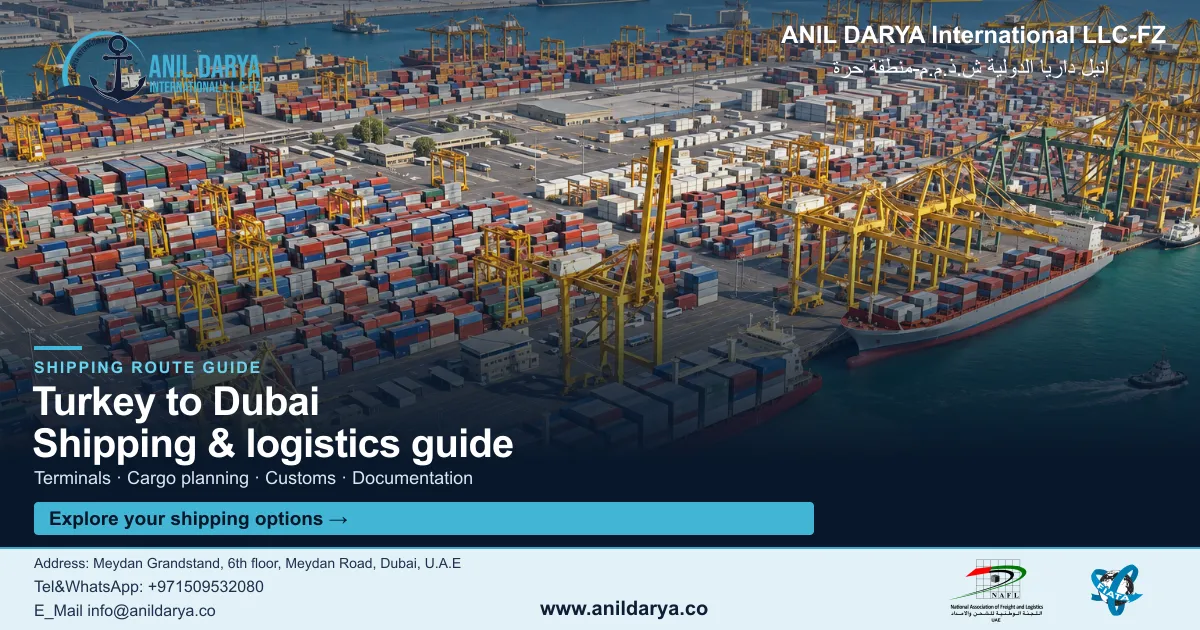
Shipping from Turkey to Dubai usually starts at one of the big Marmara terminals around Istanbul, at Mersin on the south coast or at Aliaga near Izmir, and ends at Jebel Ali. Air cargo from Istanbul covers urgent goods. If you import from Turkey to Dubai regularly, the origin paperwork matters as much as the freight. Turkish-origin goods shipped directly can enter duty-free or at a reduced rate under the UAE-Türkiye CEPA, in force since 1 September 2023. Without a preferential claim, the normal product-specific UAE tariff applies, commonly 5% of CIF value. Standard-rated imports attract 5% VAT; CEPA relief does not itself remove VAT.
Turkey to Dubai shipping at a glance
| Item | Detail |
|---|---|
| Turkish container gateways | Ambarli (Istanbul), Kocaeli, Tekirdag, Mersin, Aliaga |
| Turkish container traffic, 2025 | 13,996,579 TEU at all Turkish ports (Ministry of Transport and Infrastructure) |
| Main UAE discharge port | Jebel Ali, four container terminals, over 80 weekly services |
| Air gateway | Istanbul Airport (IST); confirm the Dubai arrival airport and current cargo schedule |
| Modes | FCL, LCL, flat rack and breakbulk, dangerous goods, air cargo |
| Who can export from Turkey | Holders of a Turkish tax ID who are members of the relevant exporters' association |
| Turkish customs system | BILGE, used by the exporter or its licensed customs broker |
| Trade agreement | UAE-Türkiye CEPA, signed 3 March 2023, in force 1 September 2023 |
| CEPA claim in the UAE declaration | Valid preferential proof of origin and the applicable Dubai Customs preference claim; confirm the current filing field with the declarant |
| UAE duty without CEPA | Normally 5% of CIF; check exemptions and product-specific rates, including alcohol 50% and cigarettes 100% |
| Import VAT | 5%, deferred for VAT-registered importers with a linked customs number |
Sea freight from Turkey to Dubai: how the lane runs
Turkey's container trade is spread across several port areas rather than one hub. In 2025 the five busiest areas handled 83.9% of the country's 13,996,579 TEU. That gives you a real choice of load port, and the right one is usually the port nearest the factory.
Services to Jebel Ali leave from the Marmara terminals, the Aegean and the Mediterranean coast. Some sail with few calls, others relay through a hub, and route-finder sites show very different day counts for the same pair of ports. We do not publish one transit figure for that reason. Ask for the vessel's rotation and the relay port, if any, before you commit to a delivery date.
Request a dated itinerary with the loading port, carrier, any relay hub and estimated port-to-port transit. Agree a separate delivery estimate including customs and inland transport.
What stretches the transit time?
| Cause | What happens | How to limit it |
|---|---|---|
| Relay at a hub | The box waits for a connecting vessel | Prefer services with a short rotation when dates matter |
| Late export filing | The box misses the cut-off and rolls to the next sailing | Have the BILGE declaration done before gate-in |
| Strategic goods permit | Dual-use or military items wait for ministry permission | Check the product's status when you order |
| Bayram holidays and Gulf holidays | Factories, trucks and offices slow down at both ends | Book space earlier around them |
| Missing UAE permit | Cargo sits at Jebel Ali after discharge | Get the permit before the ship sails from Turkey |
Which Turkish port should your cargo leave from?
| Port area | 2025 container volume and facts | Close to |
|---|---|---|
| Ambarli (Istanbul, European side) | 3.43 million TEU; several terminals, including Kumport (project cargo, cranes up to 104 t) and Marport | Istanbul, Thrace, the western Marmara belt |
| Kocaeli (Gulf of Izmit) | 2.50 million TEU | Gebze, Kocaeli, the eastern Marmara industry |
| Tekirdag | 2.14 million TEU | Tekirdag, Corlu, western Istanbul |
| Mersin | 1.97 million TEU; Mersin International Port handles container and multipurpose cargo, with rail and road links to Ankara, Gaziantep, Kayseri, Kahramanmaras and Konya | Southern and central Anatolia |
| Aliaga (Izmir) | 1.70 million TEU | Izmir, Manisa, the Aegean region |
A supplier in Gaziantep or Konya often saves more by railing or trucking to Mersin than by sending the box north to Istanbul. A supplier in Bursa, Gebze or Istanbul is usually best served by the Marmara terminals. Gemlik, near Bursa, and Iskenderun, in the south-east, also handle containers, so ask whether a service from either fits your dates.
Which UAE port should Turkish cargo arrive at?
Jebel Ali is the default for Dubai, Jafza and most of the UAE. DP World lists four container terminals there with over 80 weekly services, plus specialised areas for project cargo, Ro-Ro, reefers and IMDG dangerous goods. Our Jebel Ali port guide explains the terminals.
- Delivery to Abu Dhabi or its industrial zones: compare Khalifa Port in Abu Dhabi.
- Delivery to Sharjah, Ajman or the northern emirates: compare Sharjah port shipping.
- Stock for resale to other markets: deliver into Jafza next to Jebel Ali.
Container, breakbulk and DG cargo from Turkey
| Cargo | Usual equipment | Point to settle before booking |
|---|---|---|
| Furniture, textiles, building materials | 40ft high cube, FCL or LCL | Volume versus weight, and whether a 40ft beats two 20ft |
| Steel, marble, ceramics | 20ft, often weight-limited | Payload per box with the carrier |
| Fresh fruit, dried fruit, food | Reefer or dry box | Product registration and applicable food import/release requirements |
| Machinery and production lines | Flat rack, open top or breakbulk | Dimensions, lifting points, Dubai trailer and permit |
| Chemicals, paints, batteries | Approved equipment and packaging for the specific IMDG classification | Load port acceptance of the class and carrier approval |
| Samples, spares, urgent goods | Air cargo | Chargeable weight and the UAE declaration |
Choosing between FCL and LCL
For a mixed order of furniture, textiles or food, LCL can save money on a few cubic metres, but Dubai release depends on unpacking, consolidation documents and clearance of your consignment. A container-level hold may delay availability; clearance of every other consignee is not a universal requirement. Once the order gets close to a full 20ft, ask us to price a whole box as well. Our FCL vs LCL comparison sets out the trade-off, and our sea freight service page covers how we book containers.
Project cargo and out-of-gauge pieces
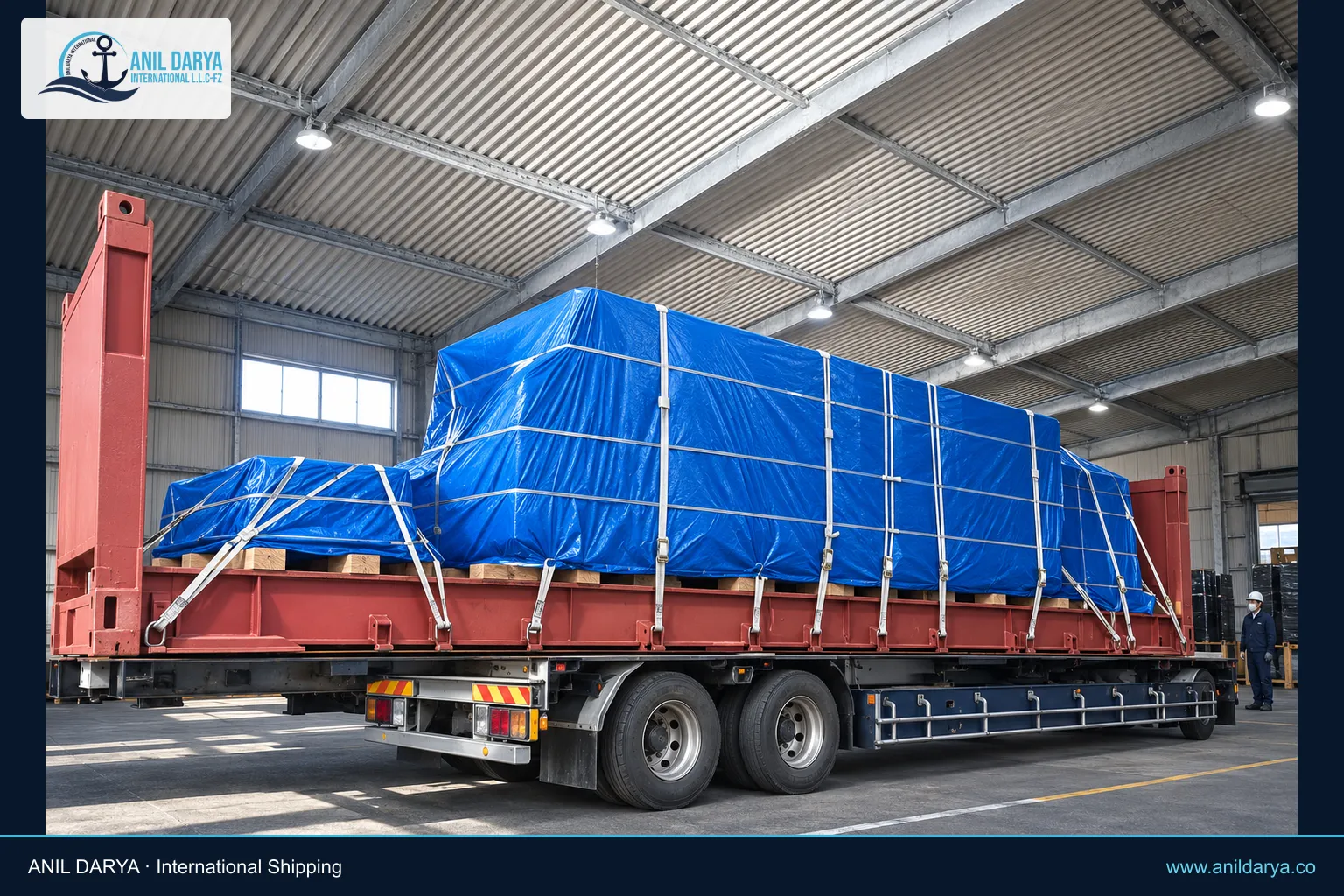
Kumport at Ambarli offers project cargo services with cranes up to 104 tonnes. Pieces accepted on a flat rack or open top may use container services, subject to dimensions, weight and carrier approval. Heavier or wider units need breakbulk tonnage. We plan the discharge at Jebel Ali, the trailer and any road permit before the ship arrives. Read how flat rack, open top and breakbulk compare for oversized cargo.
Dangerous goods from Turkish ports
Not every Turkish terminal accepts every class. Marport’s June 2025 handling guide excludes Class 1, 6.2 and 7 cargo from its port area; confirm the current acceptance rules before booking. Confirm that the load terminal and the carrier accept your class before the factory packs the goods. Jebel Ali handles IMDG cargo but limits port stay for some classes, so the Dubai declaration and the truck must be ready on arrival. Our guide to dangerous goods classes explains the class system.
Air cargo from Istanbul
For air cargo, confirm the available origin airport, Dubai arrival airport, carrier acceptance and dated flight itinerary before booking. Air suits fashion samples, spare parts, medical goods and short-life food. In Dubai the goods follow the applicable air-cargo customs procedure, with an air waybill and any required permits. See our air cargo service.
Export clearance on the Turkish side
Your supplier, or the customs broker it appoints, runs the Turkish export. We book the space with the carrier and handle the UAE end. Four rules from Turkey's Ministry of Trade matter most:
- Who can export. The ministry's export regime FAQ says an exporter needs a Turkish tax ID and membership of the relevant exporters' association.
- How it is declared. Goods are declared to customs on a customs declaration, and the carrier lodges an exit summary declaration at the exit office. Filing is done in BILGE, the ministry's customs system, with a username and password issued by the regional customs directorate.
- Strategic goods. Military items, dual-use goods and nuclear items need permission from the competent authority before export, and the FAQ describes a catch-all rule for unlisted goods in doubt.
- False declarations. Declaring goods falsely to gain export incentives is treated as smuggling, so the invoice and declaration must tell the same story.
For a CEPA claim, the supplier also needs a certificate of origin, or authorisation as an approved exporter so it can write the origin declaration on its invoice.
How the UAE-Türkiye CEPA cuts duty on cargo from Turkey to Dubai
The UAE Ministry of Economy says the CEPA was signed on 3 March 2023 and entered into force on 1 September 2023, with some products at zero duty from day one and others reduced over time. Abu Dhabi Customs says Turkish-origin goods imported directly from Türkiye are exempt from customs duty according to the exemption and reduction schedules in the UAE's market access offer. Check the schedule for your HS code: a phased line may still carry some duty.
| Rule | What Abu Dhabi Customs says | What you do |
|---|---|---|
| Proof of origin | A certificate of origin, or an origin declaration by an approved exporter on an invoice, packing list, bill of lading or delivery note | Agree with the supplier which one it will provide |
| Direct transport | Goods travel from Türkiye to the UAE; a third country is allowed only under customs control, with handling such as unloading, reloading, storage or labelling | Keep the relay port's papers if the box is transhipped |
| Submission | Certificate and documents submitted electronically; originals kept and shown on request | Keep originals and supporting origin records for at least five years, or longer if domestic rules require |
| Declaration code | Special code 59 in the customs declaration, then "Apply" | This is Abu Dhabi Customs guidance; confirm the corresponding procedure for a Dubai declaration |
Goods that only pass through Turkey, such as Asian goods resold by an Istanbul trader, are not Turkish origin. They pay the normal UAE rate.
Customs clearance in Dubai for Turkish goods
Dubai Customs clears cargo at Jebel Ali under one of five regimes: import, export, transit, transfer or temporary admission. Its declaration service asks for an invoice, a packing list, a certificate of origin and, for restricted goods, a permit from the controlling body. A sea shipment also needs the bill of lading and the line's delivery order.
Customs business code
Dubai Customs requires every business using its services to register for a customs business code online through Dubai Trade. Clearing agents holding a Dubai Economic Department clearing and forwarding licence may clear cargo with their own code once the goods owner authorises them. If you have no code yet, we clear through a licensed agent.
Documents for Turkish cargo
| Document | Issued by | Role at Jebel Ali |
|---|---|---|
| Commercial invoice (with origin declaration if the exporter is approved) | Turkish supplier | Value, HS code, CEPA proof |
| Packing list | Turkish supplier | Inspection and LCL release |
| Certificate of origin | Turkish issuing body | Origin and CEPA rate |
| Bill of lading or air waybill | Carrier | Transport document |
| Delivery order | Shipping line in Dubai | Container release |
| Permit | UAE controlling authority | Restricted goods only |
| Applicable DG transport documents and SDS where relevant | Turkish supplier | Dangerous goods only |

Local use, free zone, temporary or transit?
| Purpose | Declaration | Duty and VAT |
|---|---|---|
| Sale or use in the UAE mainland | Import for local use | At import (CEPA rate if it applies) |
| Stock in Jafza for regional sales | Transfer into the free zone | Customs duty suspension depends on the approved free-zone procedure; VAT treatment depends on designated-zone rules and the transaction |
| Exhibition, trial or repair | Temporary admission | Customs approval and security normally required; refund subject to compliant re-export and claim. An accepted ATA carnet may replace the separate deposit for eligible goods |
| Onward to another country | Transit | Under customs transit control, subject to security and completion requirements |
Jafza, open since 1985 beside Jebel Ali Port, has over 11,000 businesses. Our guide to re-exporting from Jafza covers how the free zone route works.
Duty and VAT on goods from Turkey
| Charge | Rate | Base |
|---|---|---|
| Duty, CEPA-qualifying Turkish goods | Zero or reduced, per the UAE schedule | CIF value |
| Duty, other goods | Normally 5%; check product-specific rates and exemptions | CIF value |
| Duty, alcohol | 50% | CIF value |
| Duty, cigarettes | 100% | CIF value |
| Import VAT | 5% | Customs value including freight and insurance, plus customs duty and applicable excise tax; do not count freight or insurance twice |
The CEPA removes or reduces duty, not VAT. The Federal Tax Authority's guide says a VAT-registered importer that has given the FTA its customs registration number pays no VAT at the border; the amount appears in its VAT return. An importer outside the VAT system pays before release. Make sure the company named as importer on the Dubai declaration is the one holding both registrations.
UAE restricted goods that often come from Turkey
- Food, dried fruit, nuts, olive oil and confectionery: confirm product registration, labelling and shipment-release requirements with the destination food authority before shipping.
- Cosmetics and personal care products: product registration.
- Medicines and medical devices: health authority approval.
- Plants, seeds and fertilisers: agricultural approval.
- Electrical goods with radio modules: telecom type approval.
- Paints, chemicals and dangerous goods: permits for some products and port approval for some classes.
Prohibited goods cannot enter at all, so check the HS code against UAE rules before the supplier starts production.
How to ship from Turkey to Dubai: step by step
- Share the order details: product, HS code, weight, cubic metres, supplier city and UAE delivery address.
- Agree the Incoterm. FCA names the agreed delivery place, which may be inland or at a terminal. FOB is for delivery on board a sea or inland-waterway vessel. Under CFR or CIF the seller contracts the main carriage; confirm the named port and the separate transfer of risk. For container terminal handover, consider FCA.
- Agree the CEPA proof with the supplier: certificate of origin or approved exporter declaration.
- Prepare the UAE side: customs business code, VAT link and product permits.
- We book space and confirm the load port, rotation and Jebel Ali terminal. DG and out-of-gauge cargo get carrier approval first.
- The supplier's broker files the export in BILGE and the box gates in before the cut-off.
- We check the documents against each other before the vessel arrives.
- We confirm the applicable Dubai Customs preference procedure and submit the CEPA claim with valid proof where the goods qualify.
- We arrange payment of the duty, VAT if due and the line's charges, and collect the delivery order.
- We deliver to your warehouse or Jafza and return the empty box.
What decides the landed cost of Turkish goods?
| Factor | Why it moves the total |
|---|---|
| Load port | Inland trucking or rail in Turkey can cost as much as the sea leg |
| Service type | Short rotations and relays price differently |
| Equipment | Reefer, flat rack and open top cost more than dry boxes |
| Weight-limited cargo | Steel, marble and ceramics may need extra boxes |
| Incoterm | Sets who pays freight and local charges at each end |
| Duty | Zero or reduced for qualifying goods with valid CEPA proof; otherwise the applicable normal product-specific tariff |
| Dubai charges | Terminal handling, delivery order, clearance, delivery |
| Free time | Demurrage and detention once free days are used |
Most avoidable costs come from cargo waiting at the terminal for a permit or a document. Our article on demurrage and detention shows how the daily charges build.
Checklist before the box leaves Turkey
- UAE customs business code active and linked to the VAT registration.
- HS code agreed and checked in the UAE CEPA schedule.
- CEPA proof agreed: certificate or approved exporter declaration.
- Supplier holds a tax ID and exporters' association membership.
- Strategic goods status checked for machinery and electronics.
- UAE permits applied for.
- Routing keeps the goods under customs control if transhipped.
- Load terminal and carrier have accepted the specific DG classification and consignment.
- Invoice, packing list and bill of lading match.
- Cargo insurance arranged.
Common mistakes on the Turkey to Dubai lane
- No origin proof on arrival. The normal tariff may be charged unless the applicable preference-claim requirements are met.
- An origin declaration from a supplier that is not an approved exporter.
- Re-exported third-country goods invoiced as Turkish origin.
- Choosing Istanbul for a factory in the south, then paying for a long truck north.
- DG booked to a terminal that does not accept the class.
- Food or cosmetics shipped before UAE registration.
Frequently asked questions
Which Turkish port is best for shipping to Dubai?
The one nearest the factory with a good service to Jebel Ali. Marmara terminals such as Ambarli suit Istanbul and the north-west, Mersin suits southern and central Anatolia, and Aliaga suits the Aegean.
Do Turkish goods pay customs duty in Dubai?
Turkish-origin goods shipped directly with valid CEPA proof are exempt or pay a reduced rate according to the UAE schedule. Other goods pay the applicable normal tariff, commonly 5% of CIF, subject to product-specific rates and exemptions.
When did the UAE-Türkiye CEPA start?
It was signed on 3 March 2023 and entered into force on 1 September 2023.
What proof of origin does Dubai accept under the CEPA?
A certificate of origin, or an origin declaration written on a commercial document by an approved exporter authorised in Türkiye. Confirm the current preference claim procedure with Dubai Customs; code 59 is stated in Abu Dhabi Customs guidance.
Is VAT charged on imports from Turkey?
Standard-rated imports attract 5% VAT; check any product-specific exemption. The CEPA does not itself remove VAT. VAT-registered importers with a linked customs number account for it in their return.
Who handles export customs in Turkey?
The exporter or its customs broker files in BILGE. The exporter needs a tax ID and membership of the relevant exporters' association.
Can Turkish goods go into Jafza without duty?
Goods admitted under an approved free-zone procedure may remain under customs duty suspension for storage and re-export. Mainland release normally attracts import charges; confirm VAT treatment separately.
How long does sea freight from Turkey to Dubai take?
It depends on the load port and whether the service relays through a hub. Ask for the vessel's rotation when booking and add time for clearance in Dubai.
Get a quote for shipping from Turkey to Dubai
Send us the product, the supplier's city in Turkey and your UAE delivery address. We will suggest the load port, compare sea and air and price the Dubai clearance with the CEPA rate where it applies. Use our freight rate inquiry form or contact our team.
Sources
- UAE Ministry of Economy: UAE-Türkiye CEPA
- Abu Dhabi Customs: UAE-Türkiye CEPA (origin proof, direct transport, code 59)
- Republic of Türkiye Ministry of Trade: UAE free trade agreement
- Ministry of Trade: Export regime FAQ (tax ID, exporters' association, strategic goods)
- Ministry of Trade: Digital customs FAQ (BILGE)
- Ministry of Transport and Infrastructure: Maritime statistics bulletin 2025
- PSA: Mersin International Port factsheet
- PSA: Mersin International Port news release (rail and road links)
- Kumport: Project cargo services
- Marport: Dangerous cargo handling rules
- DP World: Jebel Ali Port
- Dubai Customs: FAQ (duty, business code, clearing agents, deposits)
- Dubai Customs: Submit customs declaration
- UAE Government portal: Customs duty
- Federal Tax Authority: VAT guide, section 3.5 (import VAT)
- Jafza: About Jebel Ali Free Zone
Reviewed: 16 November 2026