
Gas turbine relocation: how to prepare the unit for shipping, from locks to lift points
A technical checklist for preparing a used gas turbine for a sea voyage: shipping locks, rotor position, preservation, lift points, piece marking and the records the next site needs.
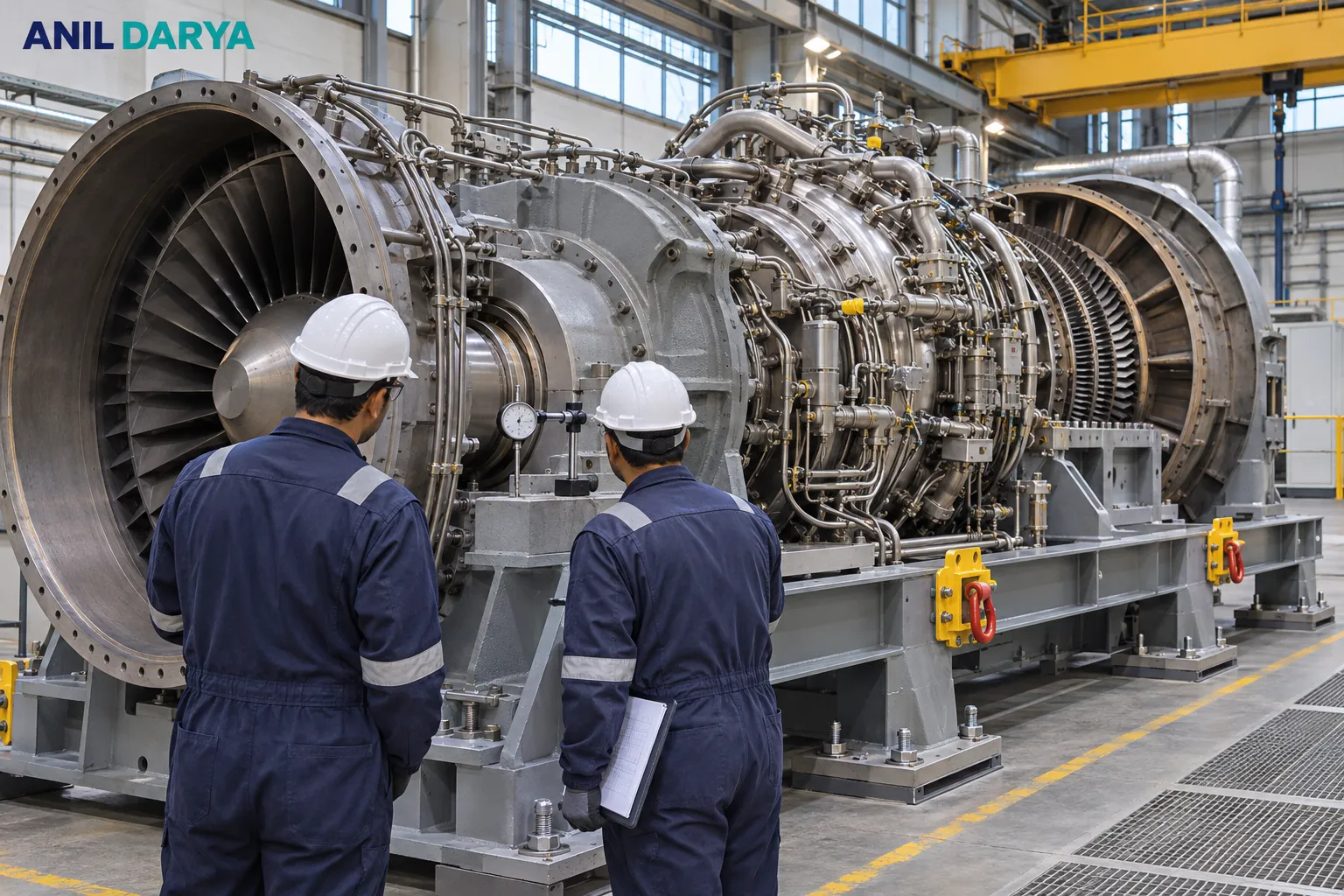
A gas turbine relocation goes wrong most often before the unit leaves the old site. A shell that rides on its support legs over a rough road, a rotor free to walk between its thrust pads, or a compressor inlet left open to sea air for six weeks can all cost more than the voyage itself. This guide walks through the preparation steps a shipping planner expects to see finished before the first lift: locks, rotor position, preservation, lift points, piece marking and records. The OEM's procedure for your frame always rules. Treat everything below as the questions to ask, not a replacement for the instruction book.
We are a Dubai freight forwarder that plans the sea and road legs, not a turbine service company. The machine work belongs to the OEM, its field service team or a specialist relocation contractor. If you are looking for the shipping service itself, our page covers vessels, stowage and port-to-site delivery.
Who does what in a gas turbine relocation
Three parties touch the unit before it sails, and the hand-overs between them are where things get missed.
| Task | Usually done by | What the shipping planner needs from it |
|---|---|---|
| Running inspection and condition report at the old site | OEM or relocation contractor | A dated condition report signed by buyer and seller |
| Disconnection of fuel, lube, controls and ducts | Dismantling contractor | Final piece list with weights and dimensions |
| Shipping locks, rotor position, shell support | OEM field engineer | Written confirmation that locks are fitted, with photos |
| Preservation of internals and openings | OEM or contractor, to the OEM specification | Preservation method, date applied, re-check interval |
| Lift plan, stowage, lashing | Freight forwarder's specialists, approved by a marine warranty surveyor where the insurer asks | Weights, centre of gravity, lift points from the OEM drawing |
| Road route survey and permits | Heavy-haul contractor arranged by the forwarder | Transport dimensions on the trailer |
VBR Turbine Partners describes starting with an inspection while the turbine still runs at its original site, and reviewing engine parameters to confirm it is in good condition. That running baseline is your best evidence if a damage claim comes up later. Our article on break bulk and project cargo insurance explains how cover and surveys tie together.
Shipping locks and shell support in a gas turbine relocation
One of the clearest published examples comes from the Combined Cycle Journal, in a Turbine Tip by Dave Lucier of PAL Turbine Services. It covers GE package power plants, Model Series 5001P, 6001B and 7001 B-EA. The point of the procedure is simple: during transport the turbine shell must not hang on its support legs, because a lift by crane or a bump on a truck or train can "hump" the shell.
The sequence the article describes:
- Remove the side panels next to the turbine shell to reach the two shell supports. Each support foot has four vertical bolts and one dowel.
- Loosen the exhaust seal bolts before jacking. They may be rusted and can snap, so be ready to replace them.
- Loosen the support leg bolts and set mechanical jacks at the two vertical-joint locations.
- Jack the shell about 15 mils, so a shipping pin can go into the lower centreline gib key. Tap loose the shims under the support feet.
- Leave the dowel in place. The legs now carry no turbine weight; the shipping pin carries the shell.
- Hang a red tag on the dowel. It reminds the crew at the new site to remove the dowel after jacking, then bolt the legs down.
- Leave the horizontal gib key bolts in place if a 25-mil feeler gauge slips in on each side. That confirms the shell is not pinched. Then remove the jacks.
The front flex plate and the front compressor flex support need no disturbance in that procedure. Other frames and other makers use different hardware, different clearances and different sequences. Ask the OEM for the shipping instruction for your exact model and serial number, and keep a copy with the cargo documents.
Rotor position and thrust bearing
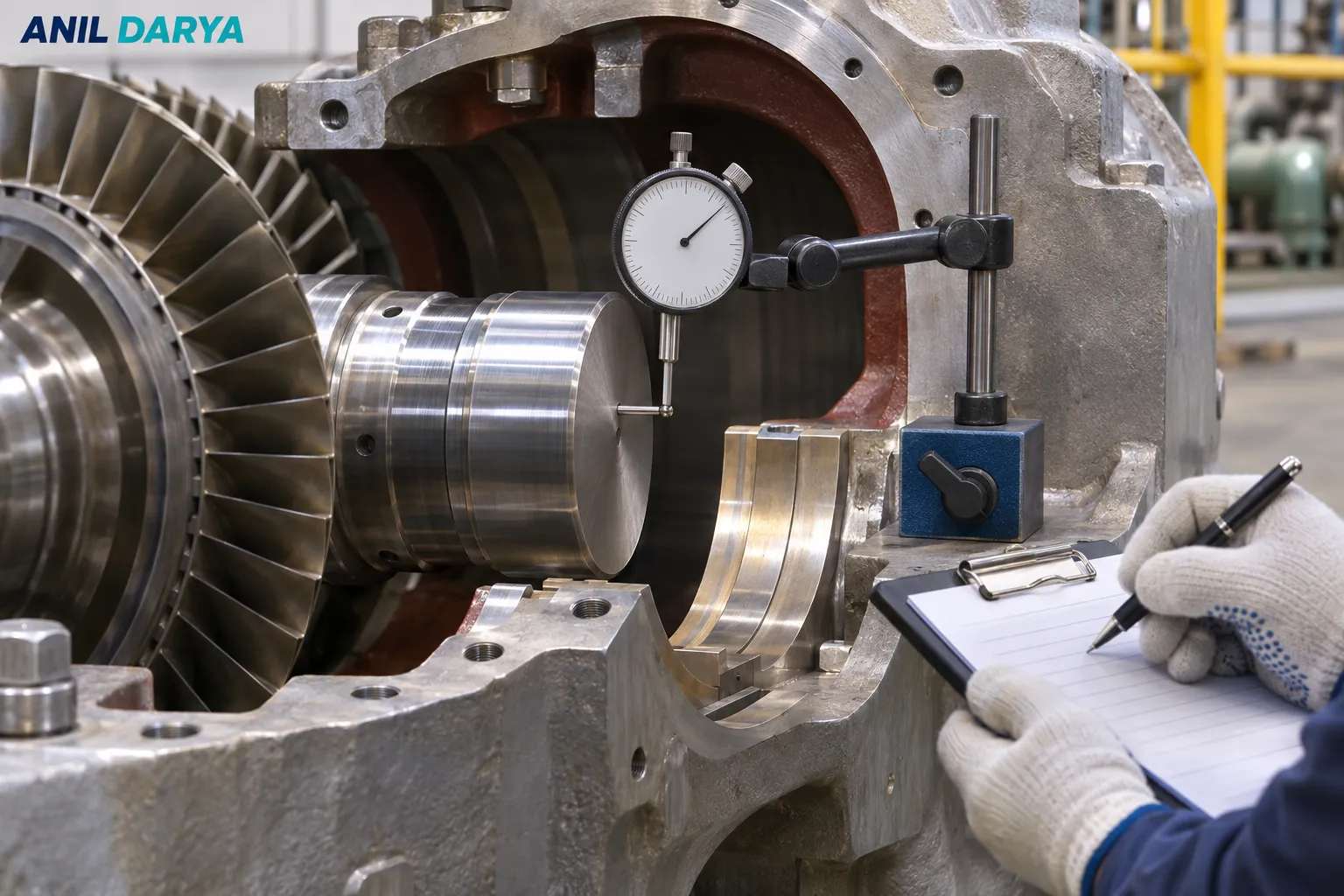
The rotor has axial float between its thrust pads. Left free, it can move back and forth with every road bump and every roll of the ship. The same CCJ tip says the rotor is pushed axially against the active thrust bearing, at the No. 1 bearing, to keep it secure during shipment. The article gives the internal axial clearance between the thrust bearings as about 16 to 19 mils and recommends a dial indicator to check the movement.
What the shipping planner needs here is confirmation, not detail. A photo of the dial indicator reading and a signed line in the preparation checklist is enough for the surveyor and the insurer. The generator rotor gets its own lock under the generator maker's instruction.
Preservation for the voyage
A turbine leaving a plant has years of deposits on it and a lube system full of service oil. The voyage adds salt air and temperature swings. The OEM preservation specification sets the method, but the same areas come up on every job:
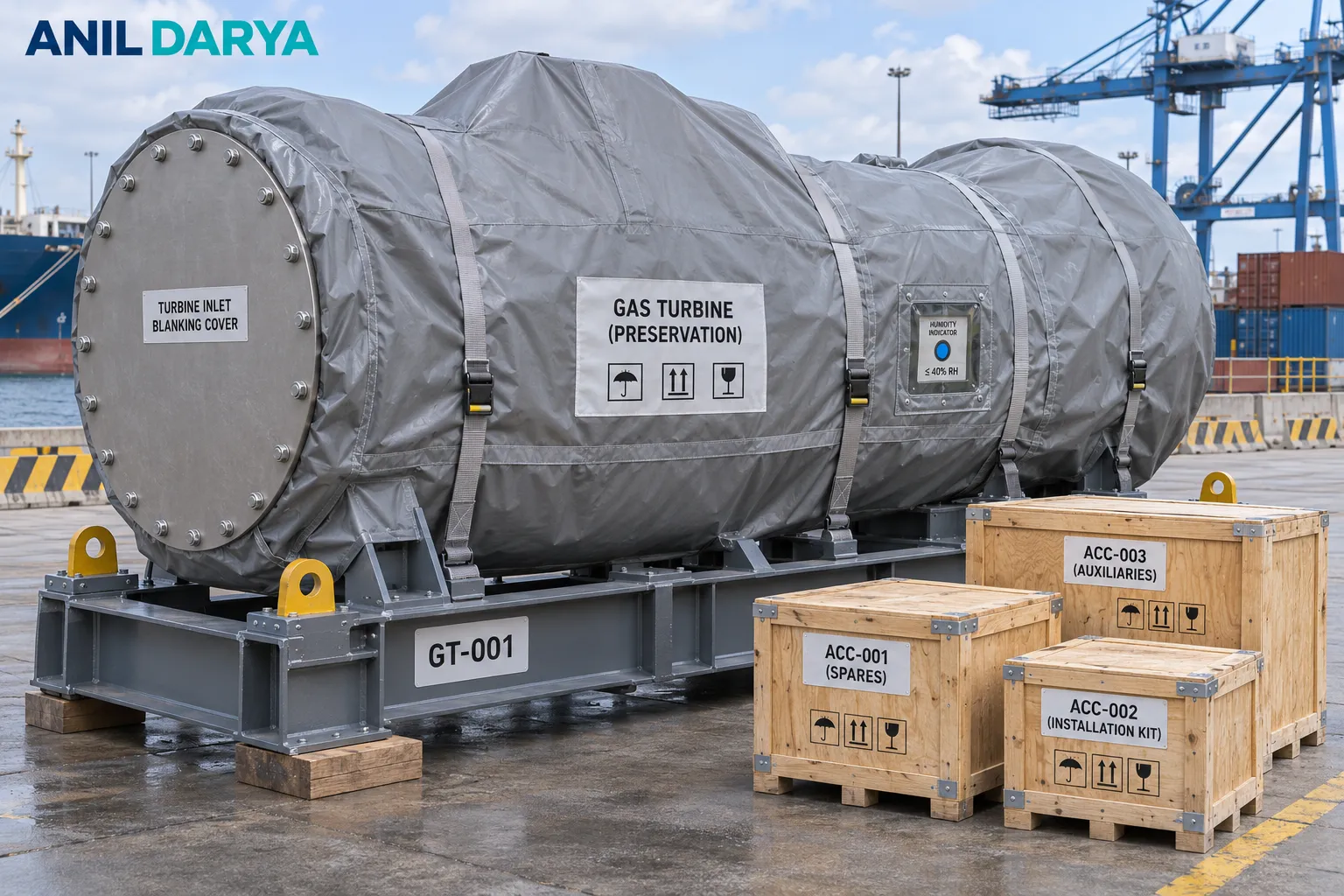
- Compressor inlet and turbine exhaust blanked with covers. One industry storage guide lists inlet and exhaust covers with desiccant packs and sealed borescope ports for the compressor section.
- Fuel nozzles plugged and open flanges blinded. The same guide mentions blind flanges on the cross-fire tubes.
- Exposed shaft surfaces coated, bearing pedestals wrapped in VCI material, and lube oil breathers replaced with sealed plugs.
- Some long-term storage packages hold nitrogen at positive pressure in the wheelspace. That same guide states that all storage and testing procedures must follow the OEM technical manuals.
EthosEnergy's John Clifford, writing in Turbomachinery Magazine about a relocation from Florida to Houston, lists sealing, bundling and wrapping high-speed rotating equipment, bearings, inlets, outlets, pipes, pumps, ducts and wiring as the preservation step. Compressor packages that travel with the turbine have their own routine: Saipem engineers describe using the compressor casing as a sealed container under a slight nitrogen pressure.
Nitrogen brings a safety point. The UK HSE notes that asphyxiation is a major risk with inerting, particularly in confined spaces. Any enclosure, casing or container under nitrogen needs a warning label and an entry procedure at the receiving site. Our covers VCI, desiccant and sealed wraps in more depth.
Lift points, centre of gravity and the transport frame
Do not lift the turbine through anything the OEM has not marked for lifting. On most heavy-duty units the lift goes through the base or a transport frame. The OEM shipping drawing should show:
- Shipping weight of each piece as it will be lifted, including frame and covers.
- Centre of gravity in three directions.
- Approved lift points and the sling angle limits.
- Support points for the voyage, where the piece may sit on timber or steel.
Our specialists turn that drawing into the lift plan, rigging and spreader beam selection, and the stowage and lashing calculation. Where the insurer or charterer requires it, an independent marine warranty surveyor approves them. DNV-ST-N001 is the DNV standard for marine operations and marine warranty, and it covers load-out and sea voyages. The IMO CSS Code sets the general principle that cargo is stowed and secured so the ship and people on board are not put at risk. For lift planning in general, see our heavy lift shipping guide.
Marking, inventory and records
A relocated turbine arrives as hundreds of pieces. Without a disciplined inventory, the re-erection crew spends weeks searching for bolts and shims. EthosEnergy describes cataloguing all parts and major components with a barcode device during disassembly. Whatever system you use, the same number should appear on the piece, the packing list, the stowage plan and the bill of lading description.
Records that should travel with the unit, in paper and digital form:
- The running condition report and any borescope findings from the old site.
- The OEM shipping and preservation instruction, with signed completion checklists.
- Photos of locks, pins, the red-tagged dowel and the dial indicator reading.
- Preservation dates and the date the next check is due.
- Shims, kept bagged and labelled by support foot, because the alignment at the new site starts from them.
The pre-loading survey at the port then records the condition of each piece before the ship takes it. Our article on pre-loading surveys and the bill of lading explains why that report matters if a claim comes later, and break bulk damage prevention covers handling at the port.
At the new site
The arrival steps mirror the departure steps. The crew checks preservation first, then removes covers, jacks the shell, removes the red-tagged dowel and shipping pin as the procedure says, and bolts the legs down. Turbomachinery Magazine's relocation case lists site pre-planning items: load-bearing soil in laydown areas, cribbing, and weather protection for equipment on arrival. Plan those before the ship sails, not when the trailer reaches the gate. For UAE deliveries, heavy pieces can discharge at Jebel Ali, and our break bulk service page explains how we book that cargo.
[AMIR-FACT: Vessel type and port used on a turbine or generator move we coordinated, or confirmation that we have not shipped a turbine yet and this section stays general]
Free gas turbine relocation consultation
Before the dismantling contract is signed, send us the turbine model and frame, the OEM shipping drawing if you have it, approximate weights and centre of gravity of the main pieces, the old site and the new one, and the dates you are working to. A list of the auxiliary skids, ducts and crates helps us size the whole shipment.
Our specialists reply straight away by email, and we set up a meeting when the job calls for one. We send back the ship options for the heaviest lifts, the lift planning and surveys the move needs, a documents list for export and import, the checks we would make at the discharge port and on the road to site, and a route proposal in either direction or as cross-trade, where the cargo travels on the shipping line's bill of lading released through us as the line's agent. The machine preparation stays with the OEM, and we flag which of its steps the surveyor will want to see. You can also reach us through the contact page.
Frequently asked questions
What is a shipping pin on a gas turbine?
A temporary pin fitted in the lower centreline gib key so the shell rides on the pin during transport instead of on its support legs. In the CCJ example the shell is jacked about 15 mils to fit it.
Why is the rotor pushed against the thrust bearing for shipping?
To stop it moving through its axial float every time the load is jolted. The CCJ tip gives that float as about 16 to 19 mils on the frames it covers.
Does the OEM procedure override general guides?
Always. Clearances, locks and preservation differ by model. Published examples like the CCJ tip help you ask the right questions; the OEM instruction book for your serial number decides.
How long does preservation last on a sea voyage?
It depends on the method and the OEM specification. Set a re-check date before loading, and if the cargo will wait in port or storage, plan an inspection of covers, desiccant and any nitrogen pressure.
Is relocating a used gas turbine worth it?
That is a commercial and technical decision for the owner. EthosEnergy's case shows one relocated plant gaining more than 20 years of productive life. The shipping side is planned once the decision is made.
Who signs off the lift and lashing?
Our specialists prepare and issue the lift plan and lashing calculations. An independent marine warranty surveyor approves them where the insurer or charterer requires it.
What should go with the turbine to the new site?
The condition report, OEM shipping and preservation records, photos of locks and dial readings, labelled shims and the full piece list.
Sources
- Combined Cycle Journal: What to do before relocating a gas turbine (Dave Lucier, PAL Turbine Services)
- DNV: DNV-ST-N001 Marine operations and marine warranty
- IMO: Code of Safe Practice for Cargo Stowage and Securing (CSS Code)
- UK HSE: Inerting, technical measures
- Turbomachinery Magazine: Relocation of gas turbine generators (John Clifford, EthosEnergy)
- Turbomachinery Magazine: Compressor preservation (Saipem)
- VBR Turbine Partners: Gas turbine relocation
- Industrial Monitor Direct: Gas turbine long-term storage procedures and pre-shipment testing
Reviewed: 16 November 2026