
Heavy lift vessel types: MPP, semi-submersible and deck carriers
The main heavy lift vessel types compared: MPP ships with cranes, semi-submersibles, deck carriers, RoRo, barges and open-hatch ships, and which cargo each one suits.
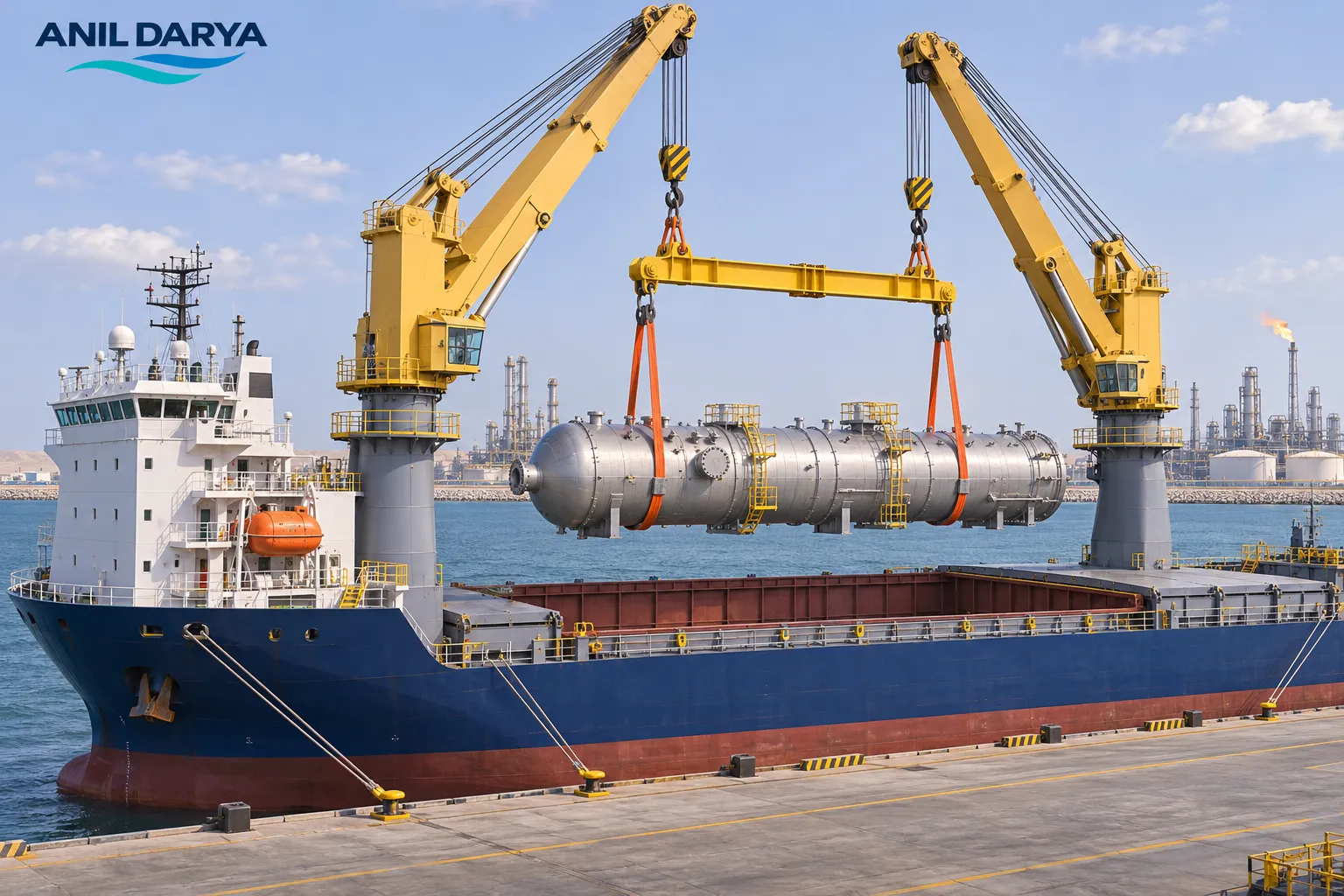
Heavy lift vessel types differ mainly in how cargo gets on board. Some ships lift it with their own cranes, some sink their deck and let it float on, some take it rolled on by trailers, and some are simply strong flat decks towed by a tug. The industry uses the names loosely: Marine Insight groups heavy lift vessels into semi-submersibles, dock ships, open deck ships and project cargo carriers, while Wikipedia splits them into semi-submersibles and project cargo ships. This article sorts them by what matters to a shipper: loading method, cargo they suit, and the port they need.
We do not cover lift plans or port crane requirements here. Those are in our heavy lift shipping guide.
Heavy lift vessel types at a glance
| Vessel type | How cargo is loaded | Typical cargo | Main limit |
|---|---|---|---|
| Multipurpose (MPP) heavy lift ship | Lifted by the ship's own cranes, often two in tandem | Reactors, columns, turbines, transformers, rig parts, mixed project packages | Combined crane capacity and outreach |
| Semi-submersible heavy transport ship | Float-on, float-off by ballasting the deck under water | Jack-up rigs, floating units, barges loaded with modules | Needs deep, sheltered water to ballast down |
| Deck carrier or module carrier | Rolled on by trailers or SPMTs, or skidded; some lifted by shore cranes | Process modules, pre-assembled units, very wide structures | Depends on quay strength and ramp or linkspan at both ends |
| RoRo ship | Driven or rolled on over a ramp | Wheeled and tracked machinery, cargo on roll trailers | Ramp capacity and deck height |
| Ocean barge with tug | Rolled, skidded or lifted on at a quay | Modules, tanks, large steel structures | Slow tow speed and weather sensitivity |
| Open-hatch ship with gantry cranes | Lifted by gantry cranes into box-shaped holds | Steel, pipe, packaged project cargo, moderate-weight pieces | Gantry crane capacity |
Multipurpose heavy lift ships with their own cranes
The multipurpose (MPP) heavy lift ship is the workhorse for oil, gas and refinery cargo. It has holds with hatch covers, a strong weather deck, and heavy cranes along one side. Wikipedia describes project cargo ships as non-submersible ships that load with at least one onboard crane and carry enough ballast for stability, typically between 13,000 and 19,000 deadweight tonnes.
Marine Insight explains the design logic. Long or heavy pieces often need lifting from both ends, so these ships usually have two large cranes, which can work in tandem. The side hull is reinforced to support the cranes, and ballast is used during the lift to keep the ship upright as the load swings out. The cranes let the ship load and discharge at a quay without heavy shore cranes, which is often the reason for choosing it.
For a shipper, the useful numbers are the combined tandem capacity at the outreach your piece needs, the hold dimensions, and the deck strength. A ship's maximum crane rating applies only at short radius, so the plan must be checked against the actual reach.
Semi-submersible heavy transport ships
A semi-submersible heavy transport ship floods its ballast tanks until its long flat deck sits below the surface. Floating cargo is moved over the deck, usually by tugs, and the ship pumps out ballast to lift it clear. Wikipedia notes that, to balance the cargo, the tanks can be pumped out unevenly. The ship typically has a forward wheelhouse, an aft machinery space and a long, low cargo deck between them.
Marine Insight lists the cargo these ships commonly carry: drilling rigs, oil processing plants, dredging equipment, offshore structures, floating docks and other vessels. Only cargo that floats can be loaded by float-on. Heavy items that do not float are loaded by rolling or skidding on at the quay, or by first loading them on a barge that is then floated on.
Breakbulk magazine quoted the module logistics director of a large EPC firm on two strengths. Semi-submersibles have much larger ballast capacity than other ships, which matters at sites with a big tidal range. They can also carry barges already loaded with modules, a "piggyback" approach that lets a barge do the last mile up a shallow river.
For rigs, the speed is the point. PetroWiki says a heavy lift ship carrying a mobile offshore drilling unit usually travels above 10 knots, two to three times faster than a wet tow. The full rig-move picture is in .
Dock ships
Marine Insight treats the dock ship as a cousin of the semi-submersible. It has walls along the sides and an opening at the stern, so it fills with water when it ballasts down and the cargo floats in through the stern. Dock ships mainly carry other vessels and are rarely used for plant equipment.
Deck carriers and module carriers
A deck carrier is a ship with a large, strong, open deck and little else in the way. Marine Insight says open deck ships can have decks of 100 to 300 metres, with no side walls, so cargo wider than the ship can be loaded. Cargo is placed either by cranes or driven on like RoRo cargo.
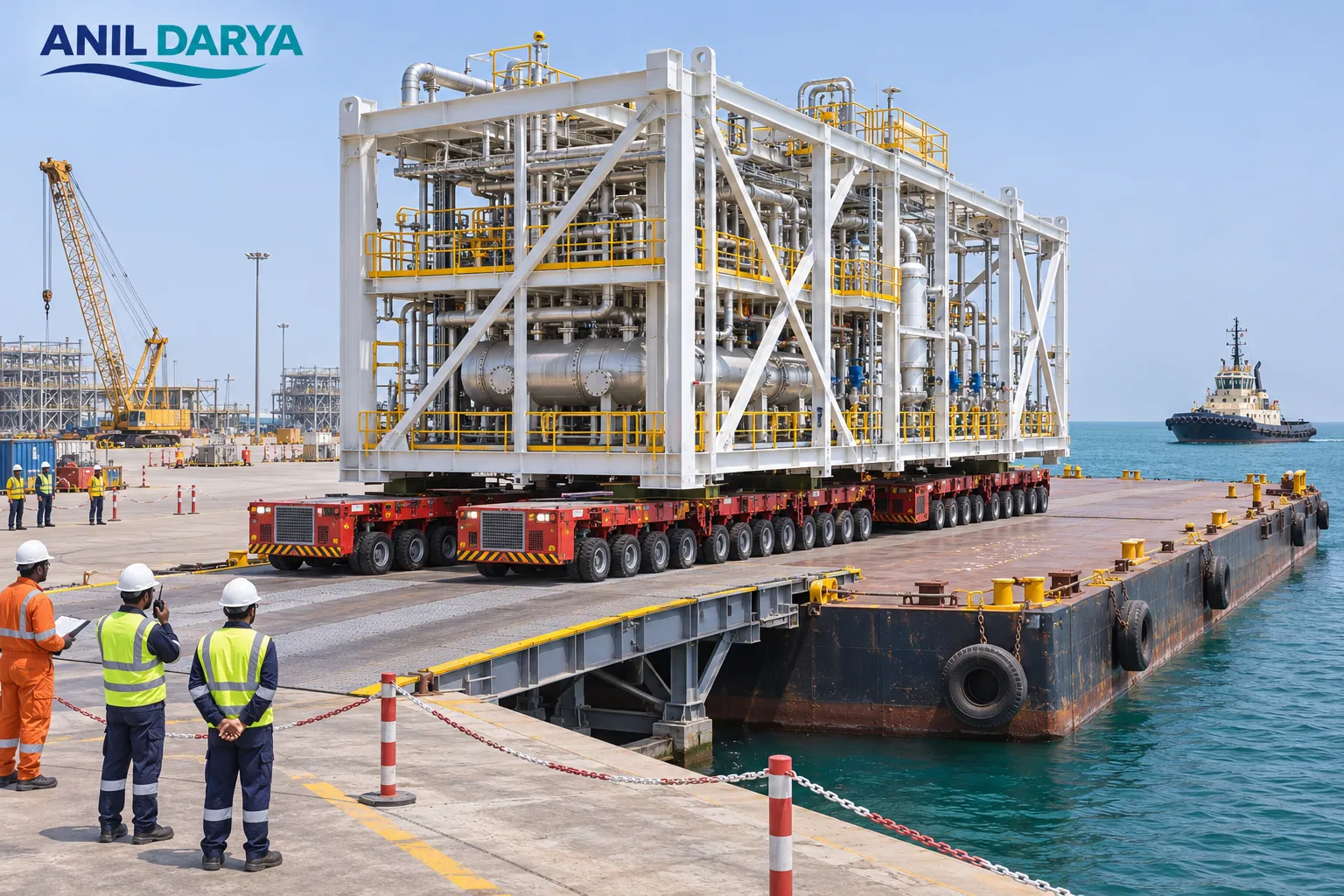
Module carriers are the version built for oil, gas and refinery work. They carry pre-assembled process modules and pipe racks that are too big for any hold, and they load them by SPMT or trailer over a ramp. Breakbulk reported that some newer ballastable module carriers have ballast systems strong enough to offer performance close to a semi-submersible, which helps with tide and quay height differences.
The limits sit ashore: quay load capacity for the SPMTs, a level or adjustable link between quay and deck, and enough tidal and draught margin. If you are shipping modules, our service covers the planning in more detail.
RoRo ships for heavy wheeled and tracked cargo
Roll-on/roll-off ships are designed for wheeled cargo that moves on and off on its own wheels or on a platform vehicle such as an SPMT, according to Wikipedia. Larger car and truck carriers have heavier decks for "high and heavy" cargo, and liftable decks for vertical clearance. ConRo ships combine containers with heavy equipment and oversized cargo.
For project cargo, RoRo works when the piece is mobile, such as cranes, drilling rig carriers and construction machinery, or when it can sit on a roll trailer. The limits are ramp capacity, deck height and the turning space inside. Very heavy single pieces outgrow RoRo quickly.
Barges and tugs
An ocean-going deck barge is a flat steel pontoon with no engine, towed by a tug. It is the simplest heavy lift solution and often the most flexible on short sea routes. Cargo is rolled on with SPMTs or trailers, skidded on, or lifted on by a shore or floating crane. Mammoet, describing load-out methods, notes that skid tracks have a small footprint and suit barges with limited space, and that SPMTs can stay on the barge with the load or be removed once the cargo is seafastened.
The trade-off is speed and weather. A barge moves at tug speed, and PetroWiki's comparison of wet tows with heavy lift ships shows how much slower towing is. So barges suit regional moves and coastal or river legs better than ocean crossings. Submersible barges also exist: PetroWiki notes that non-propelled submersible barges load the same way as heavy lift ships.
Open-hatch ships with gantry cranes
Open-hatch general cargo ships were built for forest products and steel, but they carry project cargo too. Wikipedia describes them as typically fitted with two gantry cranes with a safe working load of 30 to 80 tons, box-shaped holds sized to fit containers, and hatch covers handled by the same gantry. Project cargo can also travel on the hatch covers.
They suit pipe, steel structures and packaged plant equipment within the gantry limit. Anything above that is a job for an MPP heavy lift ship. Smaller out-of-gauge items that fit on a flat rack may not need a heavy lift ship at all; see our guide to flat rack and out-of-gauge cargo.
Matching cargo to heavy lift vessel types
Start from the cargo, then the ports, then the ship. A few rules of thumb we use:
- A single heavy piece that does not float, with a port at each end that has no heavy shore crane, points to an MPP ship with tandem cranes.
- A floating unit, such as a jack-up or barge, points to a semi-submersible.
- A wide, tall module that cannot be lifted easily points to a deck carrier or a barge with SPMT roll-on.
- Self-propelled or wheeled machinery points to RoRo.
- Steel, pipe and moderate pieces in volume point to open-hatch or MPP holds.
Then the ports have their say: water depth for a semi-submersible to ballast down, quay strength for SPMTs, and whether the berth can take the ship's draught. For the UAE side, our port pages for Jebel Ali and Khalifa Port cover what each handles.
Whether you book a liner sailing or a charter changes the choice too. That decision is covered in break bulk liner vs charter.
[AMIR-FACT: the vessel types used on our refinery project shipments to Iraq and the refinery parts shipment to Saudi Arabia, and a photo of the loading if one can be published]
Securing cargo on each heavy lift vessel type
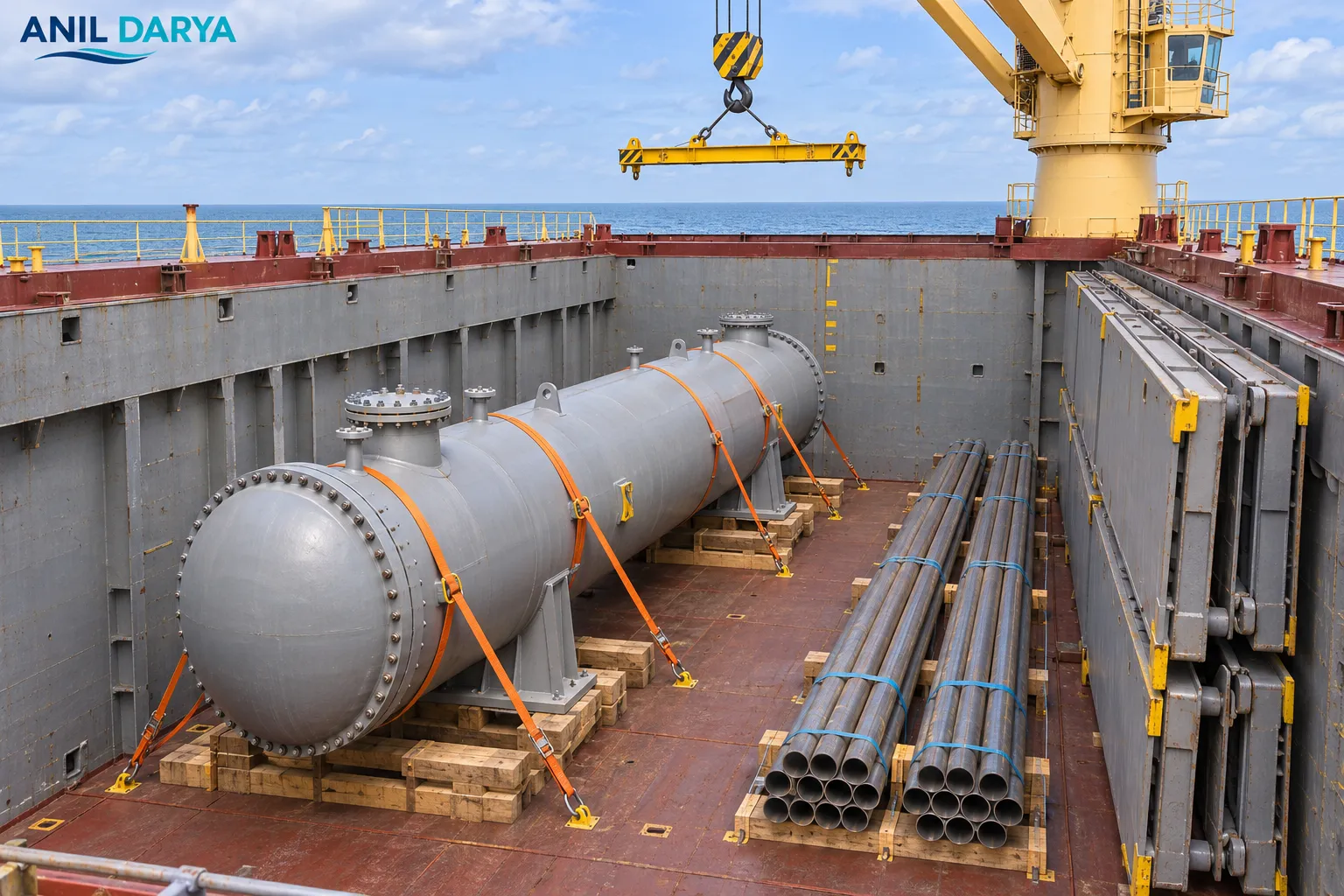
Whatever the ship, the cargo has to stay put. The IMO's Code of Safe Practice for Cargo Stowage and Securing says stowage and securing decisions should be based on the most severe weather expected for the voyage. DNV notes that every break bulk or project cargo item needs individual seafastening, using chains, cables, support frames, grillage and load spreaders. On a semi-submersible or deck carrier, that usually means welded stoppers and braces; in an MPP hold, a mix of welding, chains and dunnage.
For heavy pieces on deck, a marine warranty surveyor often reviews the design under DNV-ST-N001, which DNV says covers load-out and voyages. Our article on explains that review.
Free consultation on the right vessel for your cargo
Choosing between these ships is easier with the cargo data in front of you. Send us drawings, weights and centre of gravity for the main pieces, the packing list, the origin and destination, and the date the cargo must arrive. We look at it free of charge.
We come back with the vessel types that fit, the lift, lashing and stowage work our specialists would prepare, whether a marine warranty survey is likely, the documents list, checks at the destination port, and a suggested route into the UAE, out of Dubai or cross-trade between two other countries. Our specialists answer by email straight away, and we arrange a meeting in person when it helps.
You can also use our contact page.
Frequently asked questions
What are the main heavy lift vessel types?
Multipurpose heavy lift ships with their own cranes, semi-submersible heavy transport ships, deck and module carriers, RoRo ships, ocean barges towed by tugs, and open-hatch ships with gantry cranes. Dock ships are a niche type used mainly for other vessels.
What is a semi-submersible heavy lift ship?
A ship that ballasts its cargo deck below the water so floating cargo can be moved over it, then pumps out ballast to lift the cargo clear. It carries rigs, floating units and barges.
What is a heavy lift multipurpose vessel?
A general cargo ship with holds, a strong deck and heavy cranes, often able to lift a single piece with two cranes in tandem. It can load and discharge without shore cranes.
What is the difference between a deck carrier and a semi-submersible?
A deck carrier has a strong open deck and loads by crane, ramp or skidding. A semi-submersible can also sink its deck under water and take floating cargo by float-on.
Can a RoRo ship carry heavy lift cargo?
Yes, if the cargo is wheeled, tracked or can sit on a roll trailer or SPMT within the ramp and deck limits. Very heavy single pieces usually need an MPP ship or deck carrier.
When is a barge used instead of a ship?
For short sea and coastal moves, river legs and sites a ship cannot reach, or as the last leg after a semi-submersible drops it off in deeper water.
Sources
- PetroWiki (SPE): MODU mobilization
- IMO: Code of Safe Practice for Cargo Stowage and Securing (CSS Code)
- DNV: DNV-ST-N001 Marine operations and marine warranty
- DNV: Route-specific cargo calculator and seafastening
- Wikipedia: Heavy-lift ship
- Wikipedia: Open hatch general cargo
- Wikipedia: Roll-on/roll-off
- Marine Insight: Heavy lift vessels, design, operation and types
- Breakbulk: Semi-subs, the mega vessels made for modules
- Mammoet: Load-out methods explained
Reviewed: 16 November 2026