
How do you move an oil rig? Land rigs, jack-ups and ship options
How land rigs, jack-ups and floating rigs are moved: rig-down and trucking, wet tow, dry tow and dry transport on a semi-submersible heavy transport ship.
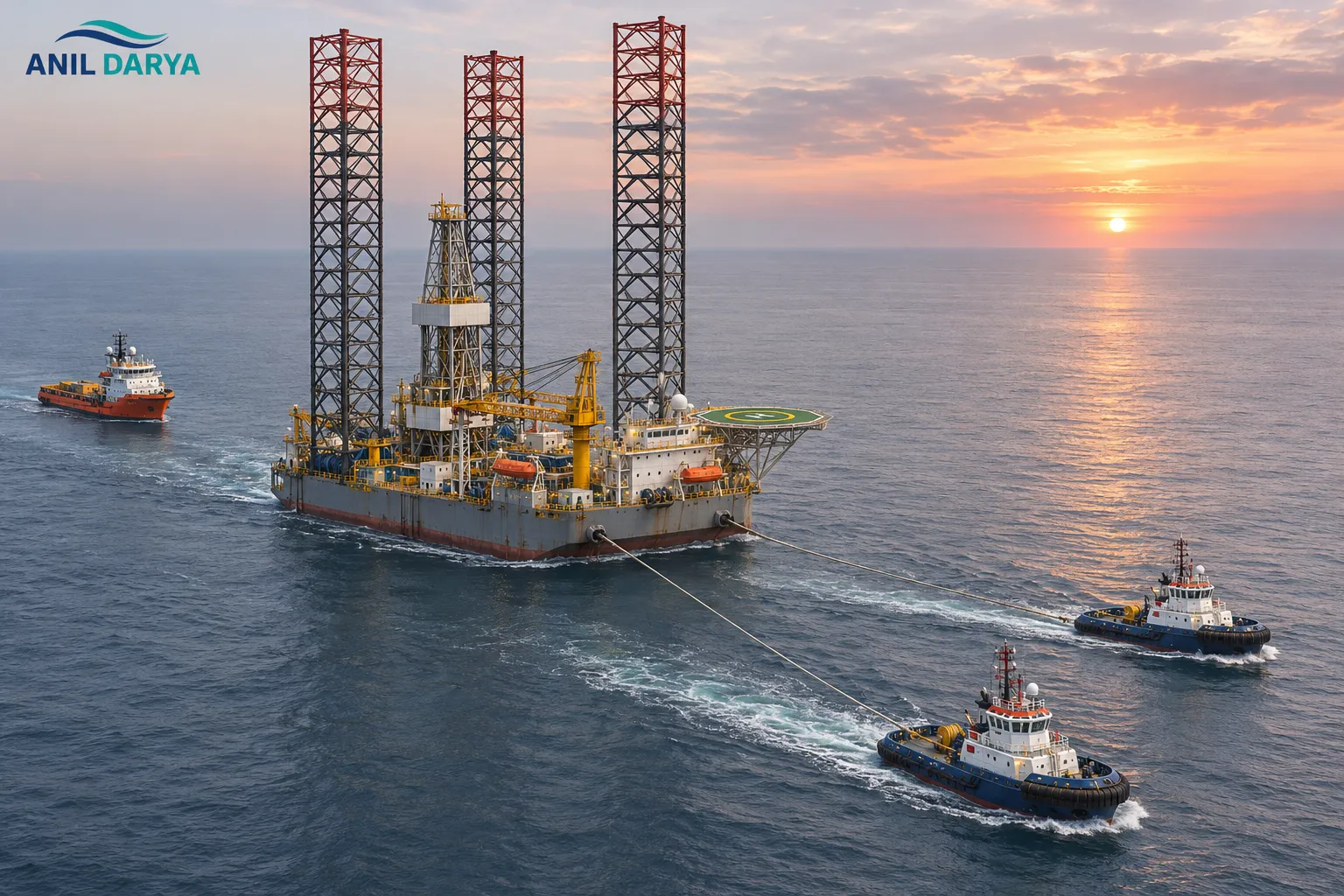
How do you move an oil rig? It depends on the rig. A land rig is taken apart and carried in loads, by truck between nearby wells and by ship when it changes country. An offshore jack-up floats on its own hull once the legs are up, so it can be towed by tugs or lifted onto a heavy transport ship and carried dry. Floating rigs, the semi-submersibles and drillships, either sail or are towed. This article explains each method in plain terms, the order of work, and why long moves have shifted from towing to ships.
The short version: distance and rig type pick the method, and weather and the seabed decide the date.
What kind of oil rig are you moving?
"Oil rig" covers very different machines. PetroWiki, the Society of Petroleum Engineers' reference, lists the main offshore unit types in use as fixed-platform rigs, tender-assisted drilling units, ship- and barge-shaped rigs, jack-ups, submersibles, semi-submersibles and ultra-deepwater units. Onshore, a land rig is a set of steel assemblies on a pad: substructure, rig floor, mast or derrick, power units and the mud system.
| Rig | Short move | Long or international move |
|---|---|---|
| Land rig | Rigged down, trucked in loads, or moved on rolling gear for very short distances | Rigged down and shipped as break bulk, with small parts in containers |
| Jack-up | Wet tow by tugs, legs raised | Dry transport on a semi-submersible heavy transport ship or submersible barge, or a long ocean tow |
| Semi-submersible | Anchors recovered, towed or self-propelled, anchors re-laid | Self-propelled transit, wet tow, or dry transport |
| Drillship | Sails under its own power | Sails under its own power |
How do you move an oil rig on land?
Rigging down is the reverse of rigging up. OSHA's drilling eTool sets out the rig-up order: substructure first, then rig floor and mast or derrick, the power system, the circulating system with mud tanks and pumps, and auxiliary equipment. To move, the crews work backwards: lay the mast down, disconnect lines and cables, separate the floor from the substructure, and break everything into transportable pieces.
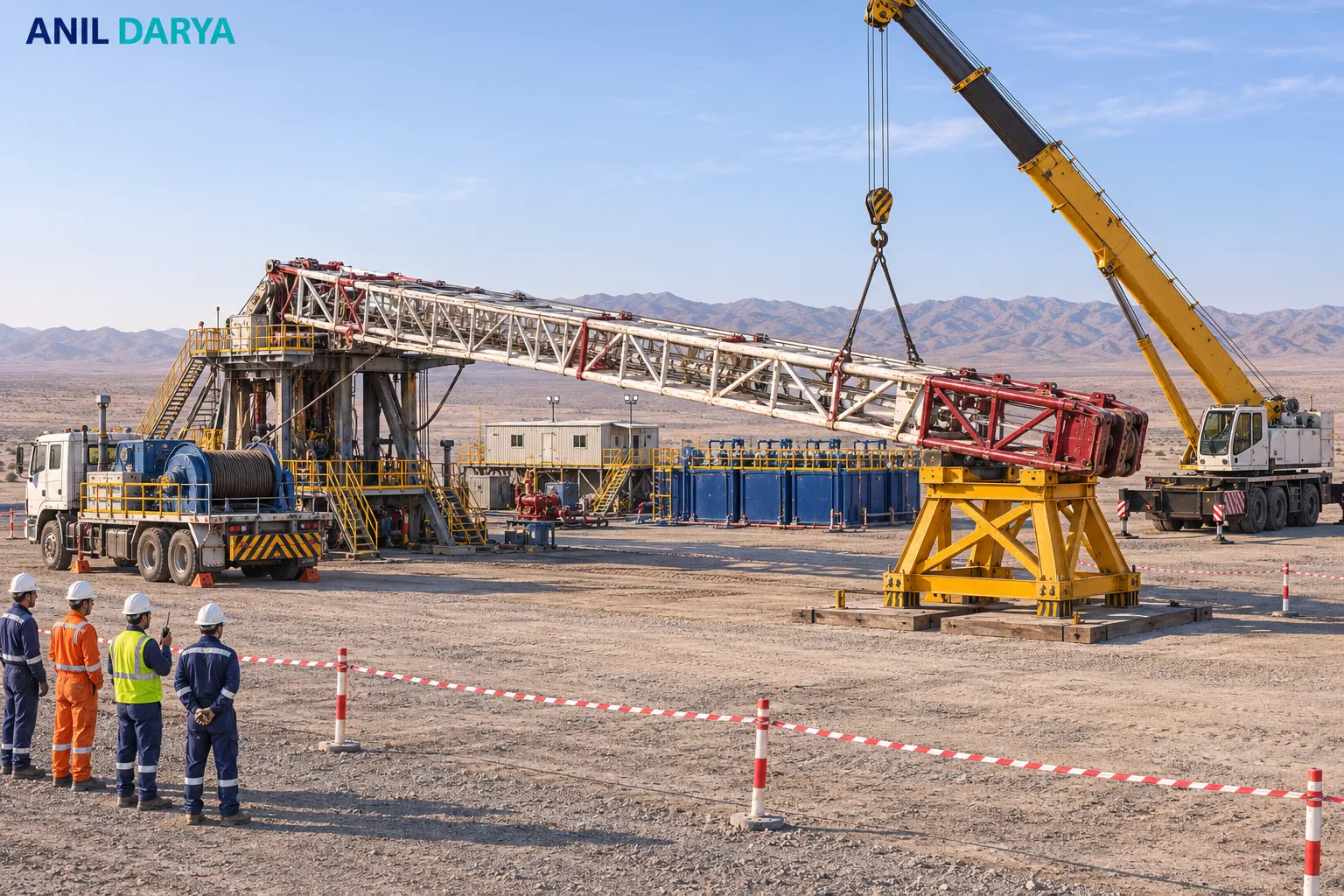
There are two common ways to do it. A Drilling Manual guide to rig moves describes a move with rolling gear, where the substructure is jacked up and moved on its own wheels behind trucks, and a move with the mast dismantled into sections, where cranes take the floor, mast and substructure apart piece by piece. Rolling gear is quicker but only works on a short, firm, level route. A dismantled move works over any distance.
The truck fleet is specialised. A Houston rig hauler interviewed by FreightWaves listed picker trucks, boom cranes, winch trucks, bed trucks, tandem trucks and rolling tailboards. The same guide warns that most bending of mast and substructure parts happens through rough handling in transport. That is why experienced crews spend so long on blocking and lashing.
When a land rig changes country, the truck leg ends at a port. Derrick sections, mud pits and substructure boxes are usually too wide or tall for containers, so they travel as break bulk, each piece lifted on board and secured on its own. Our guide to the project cargo logistics process walks through that chain from packing list to delivery.
How do you move an oil rig offshore? The jack-up case
A jack-up is a floating hull with legs that can be lowered to the seabed. PetroWiki describes how both main types, independent-leg and mat-supported, float onto location, jack the legs to the bottom and then jack the hull out of the water. Moving it means doing that in reverse, then towing.
The usual sequence before a field move, from the Drilling Manual checklist:
- Skid the cantilever and drill floor back into the towing position.
- Close all openings and bring the variable deck load within the tow limits.
- Check a 72-hour weather forecast and inspect the towing gear.
- Jack the hull down into the water and pull the legs clear of the seabed.
- Tow to the new location, with the legs raised clear of the bottom on approach.
- Lower the legs, preload, and jack the hull back up to its working air gap.
Preloading is where the danger sits. PetroWiki explains that an independent-leg jack-up pumps seawater into its preload tanks to drive the legs into the seabed, often in stages. If one leg breaks through a hard crust into weak soil below, the other legs can be overstressed. This is called punch-through, and it is why soil borings are usually required before a jack-up goes to a new site. PetroWiki also notes that jack-ups are most at risk of major damage or loss while floating.
In the Offshore Technology interview, the head of a marine consultancy put a typical jack-up field move at around 24 hours from jacking down to jacking back up.
Semi-submersibles and drillships
Floating rigs are easier to move because they never sit on the bottom. A drillship sails. A semi-submersible recovers its anchors, transits under its own power or behind tugs, and lays its anchors again at the new site. The same interview put an in-field move for a standard floater at two to three days, most of it anchor handling. PetroWiki adds that ships and semis have fewer weather restrictions on moves than jack-ups and submersibles because of their more favourable marine design.
How do you move an oil rig across an ocean?
For long moves PetroWiki gives two basic options: a wet tow with tugs, or a dry tow on a heavy lift ship or barge. PetroWiki sorts moves into three categories, field moves (usually under 500 miles in the same area), area moves and long or international moves, and the long ones need the most preparation.
Wet tow
The rig floats on its own hull behind one or more ocean tugs. It is slow. The Offshore Technology interview gave roughly 3 to 4 knots for a jack-up and 5 knots for a floater. PetroWiki notes that ocean-going tugs above 20,000 hp are not uncommon for this work.
Dry tow on a heavy transport ship
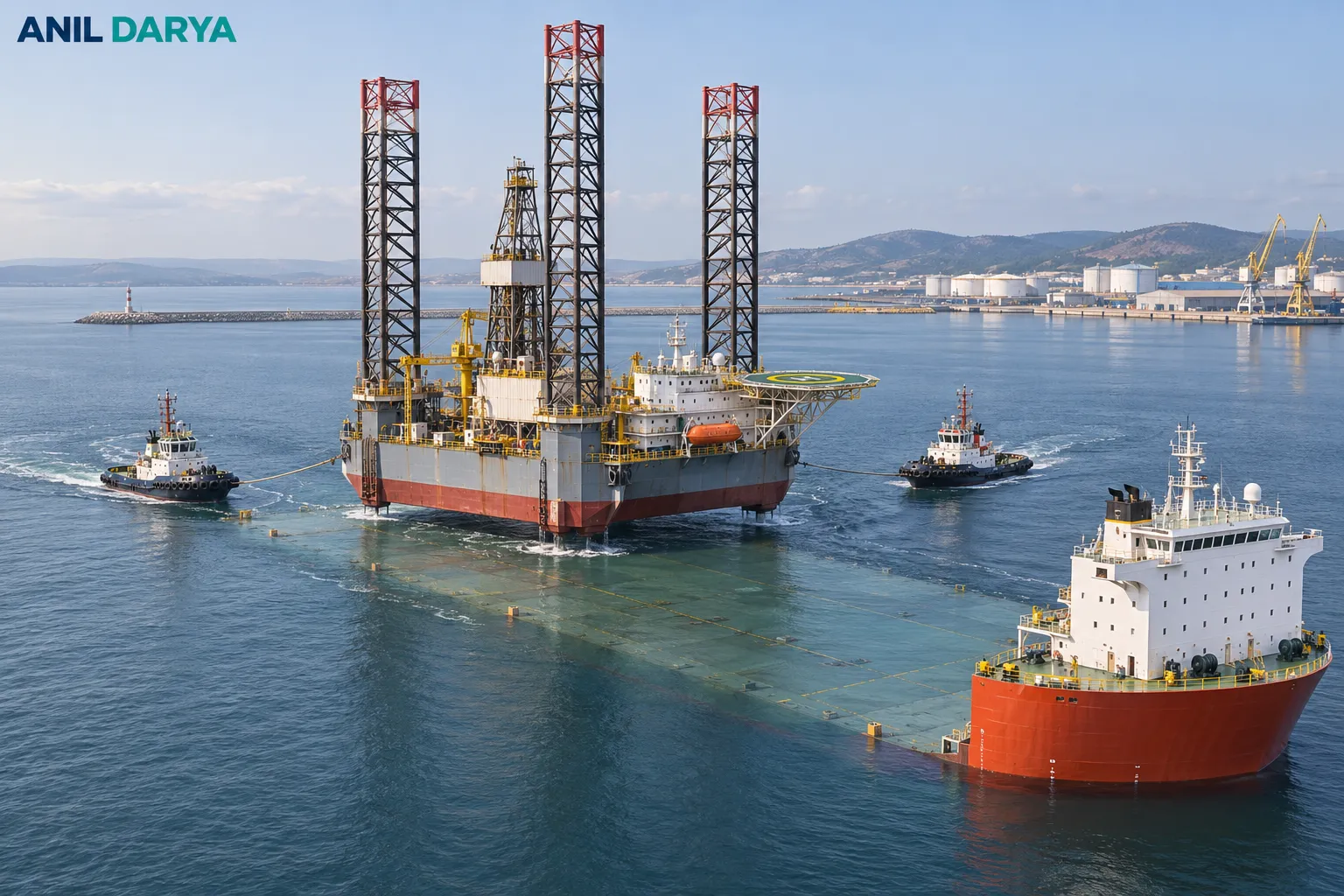
A semi-submersible heavy transport ship floods its ballast tanks until the cargo deck sits a few metres under water. Tugs float the rig over the deck, the ship pumps out ballast, and the deck rises under the rig. The rig then travels as deck cargo, welded and braced to the deck. PetroWiki says this is the most expensive transport but usually runs above 10 knots, two to three times faster than a wet tow. It also gives the insurance rate as a third to a quarter of a wet tow's. How insurers price and condition heavy cargo is covered in our article on break bulk and project cargo insurance. Non-propelled submersible barges load the same way, then travel under tow.
Why long rig moves go dry
Speed pays for the ship. PetroWiki says that if collecting the contract day rate matters to the drilling contractor, the heavy lift ship is cheaper overall because the rig reaches location much faster. The Offshore Technology interview put the crossover at about 1,000 miles, and also pointed to less stress on the rig. Wikipedia's summary of heavy-lift ships says float-on, float-off vessels can carry rigs at roughly three to four times the speed of a self-deploying rig.
The ships themselves are compared in our article on , and the general rules for heavy cargo on ships are in our heavy lift shipping guide.
Who signs off an oil rig move?
A rig move involves more parties than most cargo. PetroWiki notes that, depending on the drilling contractor's arrangement with its underwriters, a third-party surveyor may need to be present, and that both the surveyor and the underwriter are "keenly interested in the seaworthiness" of the unit. For a long tow it lists conditions such as tug hookup and emergency lines, watertightness of openings, crew training, weather forecasting, class compliance, tow routing and a post-tow inspection.
The surveyor in question is usually a marine warranty surveyor. The insurer Skuld lists transport of heavy objects on deck, including mobile offshore units, among the operations where it asks for one. The surveyor reviews the plans and calculations and issues a certificate of approval before the operation starts. Our article on the covers that process in detail.
Others on the team: the rig owner's marine staff and a rig mover or tow master, the tug or heavy transport operator, the soil and seabed survey contractor and, for land rigs going by sea, a freight forwarder who books the ship and handles the port and customs side.
[AMIR-FACT: photos from a real heavy lift or rig-component loading we coordinated, cleared for publication, and the vessel type used]
Free consultation before you move an oil rig by sea
If your rig has to cross a sea, send us what you have before you pick a method or a ship. We will tell you how we would plan it, at no charge. Useful inputs are the rig type and model, the latest rig-down packing list, the heaviest and largest pieces with weights and centre of gravity, the current location and the target well site or port, and the spud date you are working to.
You get back a recommended way to ship it, the surveys and approvals likely to apply, the export and import documents list, checks on the destination port, and a route, whether the rig is coming into the UAE through a port such as Jebel Ali, leaving Dubai or going cross-trade between two other countries. Our specialists answer by email straight away and set up a meeting in person when the move calls for it. Lift plans, lashing and stowage calculations are prepared and issued by our own specialists, with an independent marine warranty surveyor approving them where the insurer or charterer requires it. For the commercial side of a rig move, see our service.
You can also reach us through the contact page or send cargo details through the freight rate inquiry form.
Frequently asked questions
Can oil rigs be moved?
Yes. Land rigs are built to be rigged down and moved between wells, and offshore jack-ups and semi-submersibles are mobile units designed to work at one site and then move to the next.
How long does it take to move an oil rig?
A jack-up field move can take around a day from jacking down to jacking up, and a floater in-field move two to three days. Ocean moves take weeks, depending on distance and whether the rig is towed or carried dry.
How fast is an oil rig towed?
Slowly. Figures quoted in industry interviews are around 3 to 4 knots for a jack-up and about 5 knots for a floater. Dry transport on a heavy transport ship usually runs above 10 knots.
What ship carries oil rigs?
A semi-submersible heavy transport ship. It sinks its deck below the water, the rig is floated over it, and the ship rises to lift the rig clear. Land rig pieces travel on multipurpose and heavy lift ships with their own cranes.
What is a jack-up rig move?
It is the sequence of jacking the hull down into the water, pulling the legs from the seabed, towing to the new site, then lowering and preloading the legs and jacking the hull back up.
Why are some rigs carried on ships instead of towed?
Speed and risk. Dry transport is two to three times faster than a wet tow, the rig starts earning sooner, and PetroWiki puts the insurance rate at a third to a quarter of a wet tow's.
How is a land rig moved to another country?
It is rigged down, tagged and trucked to a port, then shipped as break bulk on a multipurpose or heavy lift ship, with small parts in containers. At the other end it is cleared, trucked to site and rigged up in order.
Sources
- PetroWiki (SPE): MODU mobilization
- PetroWiki (SPE): Jackups
- PetroWiki (SPE): MODU types
- OSHA: Oil and gas well drilling eTool, rigging up
- Drilling Manual: Rig move operations guide and checklist
- Offshore Technology: How to move the world's largest rigs
- FreightWaves: Transporting oil and gas drilling rigs
- Wikipedia: Heavy-lift ship
- Skuld: The marine warranty surveyor
Reviewed: 16 November 2026