
Marine warranty survey and seafastening explained
What a marine warranty survey covers, who appoints the surveyor, the certificate of approval under DNV rules, and how seafastening on heavy cargo is designed.
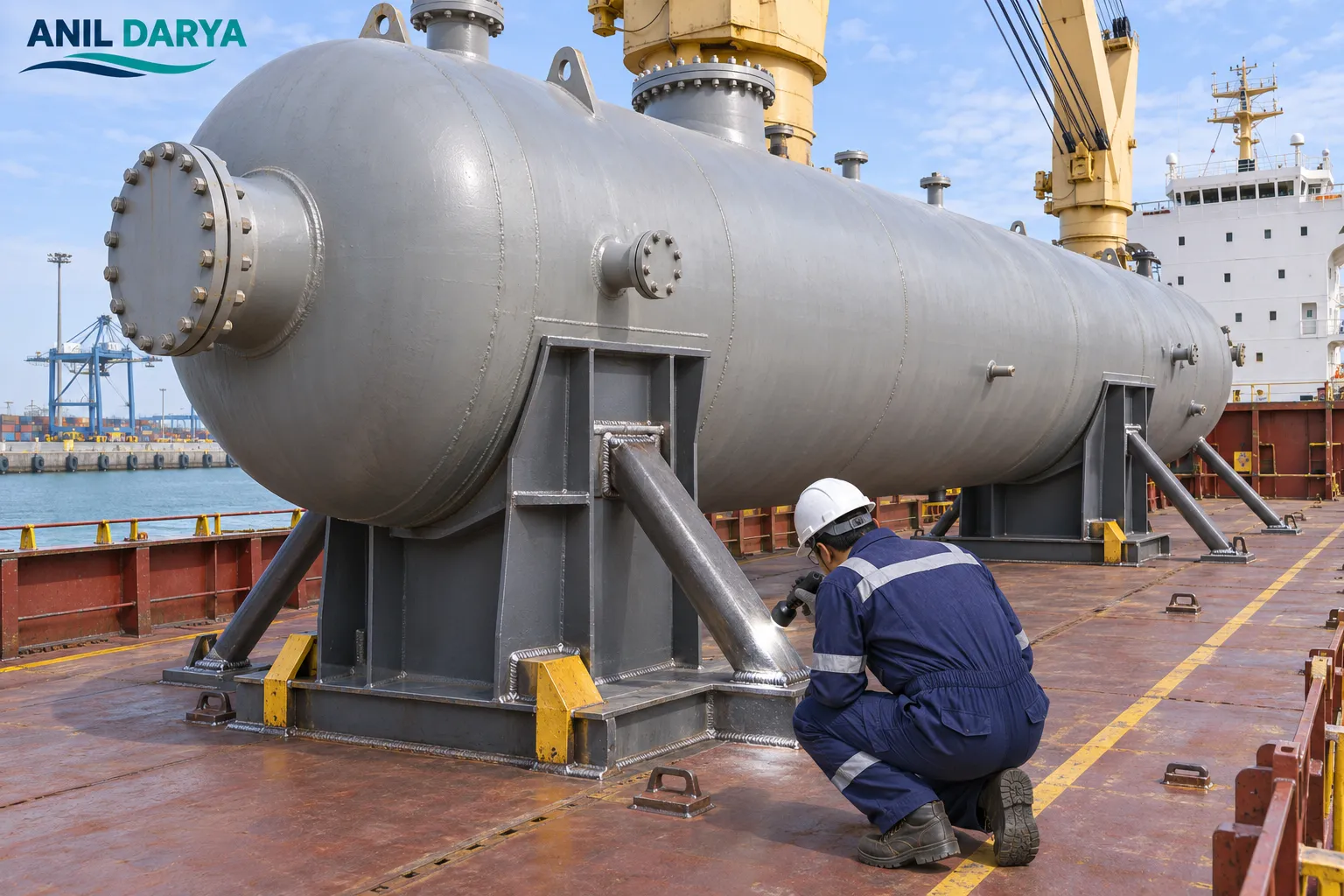
A marine warranty survey is an independent technical review of a high-value or high-risk marine operation, carried out because the insurance policy says so. The surveyor checks the plans, the calculations and the equipment, attends the operation, and signs a certificate of approval before it starts. Without that certificate, the cover for the operation may not apply. For heavy cargo on a ship, the item the surveyor looks at hardest is the seafastening: the steel that holds the cargo to the deck for the whole voyage.
This article is for shippers, EPC logistics teams and project engineers who have just been told "the MWS needs to approve it" and want to know what that means for their schedule.
What a marine warranty survey is, and what it is not
The insurer Skuld describes the marine warranty surveyor (MWS) as a qualified, independent third party appointed to act for both the assured and the insurer on a specific, non-routine marine project. The aim is to reduce the risk of a casualty to an acceptable level and to make sure the work follows recognised standards and codes.
It is not a class survey. Skuld draws the line clearly: class covers a vessel's normal operations, while the MWS is engaged only for designed, non-routine operations of limited duration. It is also not a cargo condition survey of the kind done at loading for a bill of lading. That pre-shipment check is covered in our article on the pre-loading survey and the bill of lading.
The word "warranty" comes from insurance law. A warranty in a marine policy is a condition the assured must meet. When the policy requires MWS approval of named operations, that approval is part of the deal.
When a marine warranty survey is required
Skuld lists the triggers. An MWS comes in when the assured has high-value equipment or high-risk marine operations, when a contract has put the risk on the assured, when the insurer wants comfort that the risk meets accepted standards, and when the policy carries a warranty or condition requiring MWS approval.
The same insurer gives examples of operations where it will ask for one:
- transport of heavy objects on deck, such as project cargo, vessels and mobile offshore units;
- towing of vessels, barges, rigs and other floating structures;
- heavy lifting of modules and structures;
- subsea installation, pipe and cable laying;
- decommissioning, and salvage under a salvage plan.
For a break bulk shipper, the first item is the one that matters. A refinery reactor on a heavy lift ship, a jack-up on a semi-submersible, or a process module on a deck carrier will usually need one. A pallet of valves in the hold will not.
Who appoints the marine warranty surveyor?
The assured normally proposes and engages the MWS, but the choice is not free. Skuld says the MWS, both the company and the individual surveyor, should be selected in conjunction with the insurer, and that the experience required is agreed between the underwriter and the assured for each project. Like many insurers, Skuld keeps a pre-approved list of MWS companies it has audited against the Joint Rig Committee's pre-qualification and good practice guideline.
Who is "the assured" on a cargo project depends on the contract. On an EPC job it may be the owner, the EPC contractor or the fabricator, depending on who carries the transit risk under the contract and who holds the policy. Check the policy wording before you assume.
Bureau Veritas, in an interview with a Lloyd's energy underwriter, describes the process from the insurer's side: the client submits the project, the underwriter reviews it and then reaches out to an experienced surveyor. The underwriter called it a three-way dialogue between insurers, clients and surveyors.
Our article on break bulk and project cargo insurance explains how cargo cover is placed and where warranty conditions appear.
DNV-ST-N001 and DNV-SE-0080: the Noble Denton rules
Much MWS work worldwide is done against DNV's rules, which carry forward the Noble Denton guidelines. Marine warranty surveying was largely started by two firms, according to a note published by the Lloyd's Market Association: Noble Denton, now part of DNV, and Matthews Daniel, now part of Bureau Veritas.
Two DNV documents matter:
- DNV-ST-N001, Marine operations and marine warranty. DNV says it covers marine operations during development or decommissioning of an offshore asset, and when objects are moved by water from one place to another. It addresses MWS requirements for load-out, construction afloat, voyages and installation or removal. The current edition is December 2023. Location approval of mobile offshore units is covered separately in DNV-ST-N002.
- DNV-SE-0080, Noble Denton marine services, marine warranty survey. This service specification describes the process DNV uses to decide whether a marine operation can be accepted for insurance-related MWS. It names the main deliverable: a certificate of approval for marine operations, or location approval for mobile offshore units. The listed edition is June 2020, amended September 2021.
DNV-ST-N001 was first issued in June 2016 and merged DNV's older OS-H series of marine operations standards into one document, as a summary by an offshore engineering firm sets out. If your contract names "Noble Denton" or "DNV" for marine operations, this is the standard the surveyor will work to.
How the marine warranty survey process runs
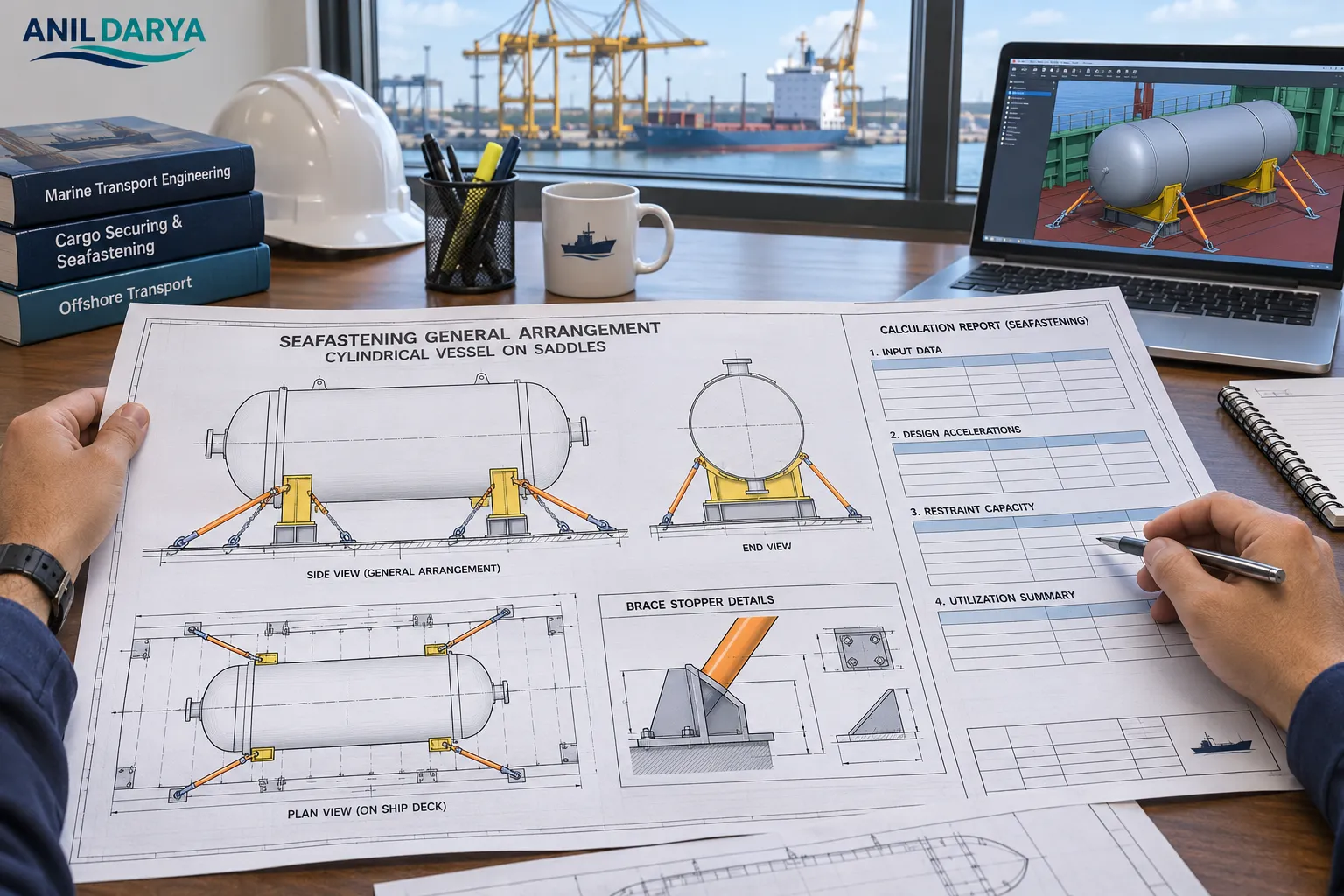
The steps below follow Skuld's description and the Lloyd's Market Association note on how MWS companies work.
- Scope and contract. The MWS is engaged for named operations, and a kick-off meeting sets the standards and first attendances.
- Document review. The surveyor reviews the design basis, calculations, procedures and voyage plans. Comments come back as technical review notes, and the documents go round again until they are accepted. Skuld adds that a warranty review letter is issued once the documents are satisfactory.
- Suitability surveys. The MWS inspects the vessels to be used, which the LMA note says includes tugs, barges, heavy lift ships and other ships carrying project cargo, and checks equipment certification and manning.
- Attendance. For load-outs, lifts and sailaways, the surveyor is on site to see the operation follow the approved procedure.
- Certificate of approval. When every comment is closed and the arrangement is complete, the CoA is signed. Skuld says it identifies the operation, the vessels and equipment, and states any conditions.
The LMA note makes one point that catches people out. All comments and recommendations must be closed before the CoA is issued, and one CoA is issued for each operation, not for intermediate stages. A load-out and the sea voyage that follows are usually separate certificates.
The same note lists freight forwarders among the parties a client may ask the MWS to meet, along with port authorities, shipyards and fabrication yards. In practice that is where we sit: between the cargo owner, the ship and the surveyor.
Seafastening design under a marine warranty survey
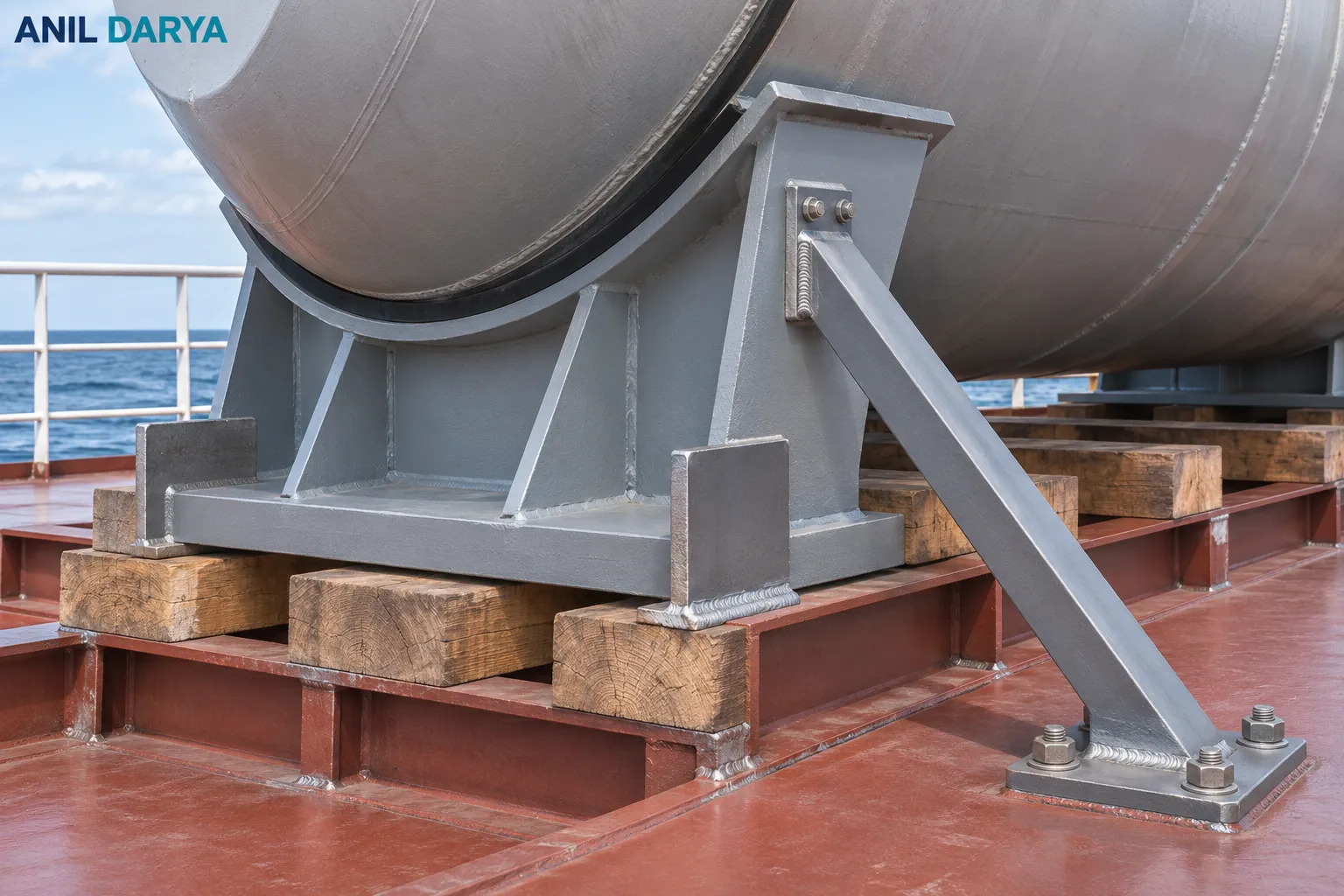
Seafastening is the steelwork that stops cargo moving at sea. DNV, describing its route-specific cargo calculator, says every break bulk or project cargo item on board needs individual seafastening using chains, cables, load-distribution and support frames, grillage and load spreaders. For heavy pieces on deck, it usually means welded stoppers against sliding, braces or tie-downs against tipping, and grillage that spreads the load into the ship's structure.
The design follows four steps, as Marine Insight sets out in its explanation of deck cargo forces:
- Define the sea conditions for the route and season.
- Find the ship's motions and accelerations in those conditions.
- Turn the accelerations into forces on the cargo.
- Design the seafastening to resist those forces.
Where do the accelerations come from? Marine Insight lists model tests, the design criteria in DNV-ST-N001, class rules, and, for smaller cargo, the IMO CSS Code. A ship moves in six ways (surge, sway, heave, roll, pitch and yaw), and roll and pitch add dynamic forces on top of the cargo's weight.
CSS Code values and weather-restricted transport
The IMO's Code of Safe Practice for Cargo Stowage and Securing says stowage and securing decisions should be based on the most severe weather expected for the intended voyage. Skuld explains that its Annex 13 tabulates design accelerations that represent a winter crossing of the North Atlantic. Using them everywhere is safe but heavy, and DNV says the resulting values are unreasonably high for many routes, especially in milder seasons.
Two ways out exist. Annex 13 allows accelerations for the actual route and season. Or, for fragile cargo, the transport can be weather-restricted: engineers find the wave height at which the cargo's tolerable acceleration would be reached, reduce it by an alpha factor under DNV-ST-N001, and the voyage then sails only within that limit. Skuld's example is two fully erected harbour cranes with a tolerable acceleration of 3.5 m/s², which gave an operational wave height limit of 4 metres. The tabulated values were almost twice as high and would have forced the cranes to ship dismantled.
What the shipper has to provide
The seafastening is only as good as the cargo data behind it. The surveyor and the calculation need:
- weight and centre of gravity in three directions, from weighing or the vendor's certified data;
- the cargo's own strength: where it can take load, where saddles and stoppers may bear, and its tolerable acceleration if it is sensitive;
- lifting and lashing points, with their safe working loads;
- drawings of saddles or transport frames;
- any vendor limits, such as a maximum tilt for a transformer or a rotor lock requirement on a turbine. Our article on covers those locks.
A wrong centre of gravity is the commonest reason for a calculation to be sent back. Lift planning itself is covered in our heavy lift shipping guide, and the stowage mistakes that cause damage are in break bulk damage prevention.
At Anil Darya, the lift plan, lashing and stowage calculations for the shipments we handle are prepared and issued by our own experienced specialists. Where the insurer or charterer requires it, an independent marine warranty surveyor reviews and approves them before the cargo moves.
[AMIR-FACT: a photo of seafastening on one of our shipments (for example the refinery parts for Saudi Arabia), and the vessel type it travelled on]
Timing a marine warranty survey into your schedule
MWS review takes time, and it runs in rounds. The LMA note gives examples of design documents going through several submissions over months on large offshore projects. A cargo shipment is far simpler, but the same logic holds: the surveyor cannot approve a calculation that is not finished, and the ship will not wait.
Three habits help. Bring the surveyor in when the vessel is chosen, not the week before loading. Send cargo data that is final, not "approximate". And agree early whether the load-out, the voyage and the discharge each need attendance, because travel for the surveyor is part of the plan. How the vessel choice affects all this is covered in and in our comparison of break bulk liner and charter shipping.
Free consultation on survey and seafastening needs
Not sure whether your cargo needs an MWS, or what the surveyor will ask for? Send us the drawings, weights and centre of gravity, the packing list, the origin and destination, and the date you need the cargo on site. We look at it free of charge.
We reply with the vessel types that suit the piece, whether a marine warranty survey is likely and what it will cover, the lift, lashing and stowage work our specialists would prepare, the documents list, checks on the discharge port, and a suggested route into the UAE, out of Dubai, or cross-trade between two other countries. Our specialists answer by email straight away, and we arrange a meeting in person when the project needs one. For rigs specifically, see our service.
You can also write to us through our contact page, or read how we handle break bulk shipping.
Frequently asked questions
What is a marine warranty survey?
An independent third-party review and approval of a high-value or high-risk marine operation, required by the insurance policy. The surveyor reviews plans and calculations, inspects vessels and equipment, attends the operation and issues a certificate of approval.
Who appoints the marine warranty surveyor?
The assured usually engages the MWS, but the company and surveyor are selected together with the insurer, and many insurers keep a list of approved MWS companies.
What is a certificate of approval?
The document the MWS signs when an operation is ready to go. It names the operation, the vessels and equipment, and any conditions. DNV-SE-0080 calls it the main deliverable of the MWS process.
Is a marine warranty surveyor the same as a class surveyor?
No. Class covers the vessel's normal operations. The MWS covers specific non-routine operations, such as a heavy cargo voyage or a rig tow, for the insurer and the assured.
What is seafastening?
The stoppers, braces, chains, grillage and frames that hold cargo to the ship so it cannot slide or tip under the ship's motions at sea.
What standard does a marine warranty surveyor use?
Whatever the project agrees. Much of the industry works to DNV-ST-N001, the successor of the Noble Denton guidelines, with the IMO CSS Code for cargo securing on ships.
Does every break bulk shipment need a marine warranty survey?
No. It is driven by the insurance policy. Very heavy or high-value pieces on deck, tows and rig moves usually need one; ordinary break bulk in the hold usually does not.
Sources
- DNV: DNV-ST-N001 Marine operations and marine warranty
- DNV: DNV-SE-0080 Noble Denton marine services, marine warranty survey
- DNV: Route-specific cargo calculator and seafastening
- IMO: Code of Safe Practice for Cargo Stowage and Securing (CSS Code)
- Skuld: The marine warranty surveyor
- Skuld: Weather-restricted sea transports for heavy lift ships
- Lloyd's Market Association: Marine warranty surveying companies
- Bureau Veritas: Marine warranty surveyors and underwriters
- Marine Insight: Calculating forces on a ship's deck cargo
- NoDynamics: DNV-ST-N001 marine operations explained
Reviewed: 16 November 2026