
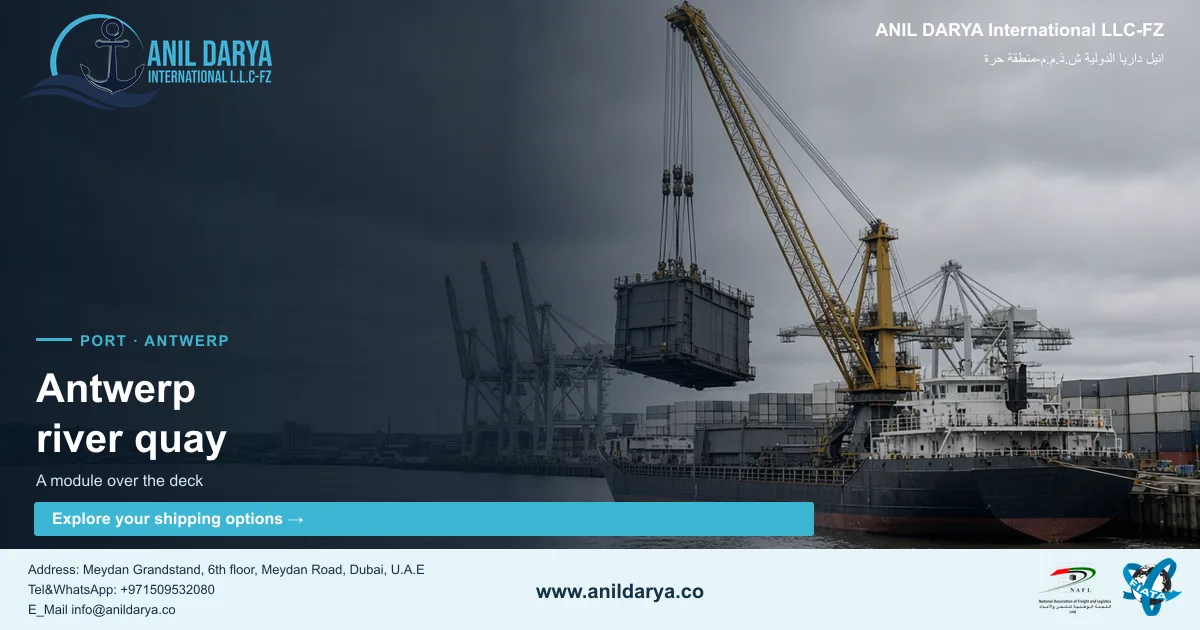
Port of Antwerp shipping covers Belgium's main gateway for containers, steel, project cargo, chemicals and vehicles. Since 2022 Antwerp and Zeebrugge have been run as one port, the Port of Antwerp-Bruges, which handled 266.5 million tonnes and 13.6 million TEU in 2025. This guide covers the terminals, the breakbulk and project cargo strengths, dangerous goods rules, EU customs at the port and how to ship there from Dubai. We ship both ways: from Dubai to Antwerp and from Antwerp to Dubai.
Port of Antwerp guide: key facts at a glance
| Item | Detail |
|---|---|
| Port authority | Port of Antwerp-Bruges, a public limited company owned by the cities of Antwerp and Bruges |
| Platforms | Antwerp (river port with docks) and Zeebrugge (on the coast) |
| UN/LOCODE | BEANR (Antwerp), BEZEE (Zeebrugge) |
| Total cargo 2025 | 266.5 million tonnes |
| Containers 2025 | 13.6 million TEU |
| First half of 2026 | 133.9 million tonnes, down 2.4% |
| Deepsea container terminals | Six: five in Antwerp, one in Zeebrugge |
| Largest container ships | Up to 23,000 TEU |
| Seagoing vessel calls 2025 | 20,236 |
| Breakbulk position | Europe's leading breakbulk port for steel, more than 200 breakbulk calls a month in Antwerp |
| Metal products 2023 | 7,838,441 tonnes, 73% of breakbulk tonnage (excluding Ro-Ro) |
| New cars 2025 | 3,186,000 |
| Industry | Europe's largest integrated chemical cluster, over 1,400 companies in the port |
| Customs | EU Union Customs Code, run by Belgian customs (FPS Finance); declarations in IDMS |
| Import VAT | 21% standard rate in Belgium |
| Dangerous goods notice | At least 24 hours before arrival, to the Harbour Master's Office |
| Shipping from Antwerp to Dubai | Also handled: arrival at Jebel Ali, Khalifa Port or Sharjah, cleared by UAE customs with 5% duty on most goods and 5% VAT |
What is Port of Antwerp-Bruges and how is it organised?
The port authority manages two platforms. Antwerp is a river port on the Scheldt with docks behind locks, home to most container terminals, the breakbulk terminals and the chemical industry. Zeebrugge, on the coast, is the platform for Ro-Ro, cars, forest products and LNG, and has one deepsea container terminal. The authority is a public company and the cities of Antwerp and Bruges are its shareholders.
The port says it accounts for around 164,000 direct and indirect jobs and over 1,400 companies. For a shipper, the practical point is choice: many terminal operators, forwarders, customs brokers, surveyors and steel service centres work in one port area.
Recent volumes help you read the market. In 2025 the general cargo segment (containers, conventional general cargo and Ro-Ro) grew 0.7%, while bulk fell 12.8%. In the first half of 2026 Ro-Ro grew 5.9%, while conventional general cargo fell 11.7% on weak European industrial demand and US steel tariffs.
Which terminals does the Port of Antwerp have?
Deepsea container terminals
| Terminal | Platform |
|---|---|
| DP World Antwerp Gateway | Antwerp |
| MSC PSA European Terminal (MPET) | Antwerp |
| PSA Antwerp Europa Terminal | Antwerp |
| PSA Antwerp Noordzee Terminal | Antwerp |
| ATO Antwerp | Antwerp |
| CSP Zeebrugge Terminal | Zeebrugge (Bruges) |
All container terminals in Antwerp are open 24/7 for ships. Truck gates run 24/5, including night openings that spread road traffic. Each terminal has road, rail and barge access. Your carrier's service decides the terminal, so check it on the arrival notice before you book a truck or barge.
Empty containers go back to depots named by the carrier. The port lists several multimodal depots that take dry and reefer containers and repair damage. Container release at the terminal uses Certified Pick up, a digital platform that creates an authorised pick-up only once the final trucker is known.
Breakbulk, Ro-Ro and specialised terminals
Beyond containers, the port has specialised terminals for steel, project cargo, forest products, Ro-Ro and liquid bulk. Antwerp has a covered breakbulk terminal where ships load and unload under a roof, which matters for steel that must stay dry. At the All Weather Terminal of Wijngaard Natie, barges and short sea ships of up to 10,000 dwt can be worked in dry conditions.
Breakbulk and project cargo at the Port of Antwerp
This is where Antwerp stands out. The port describes itself as Europe's leading breakbulk port for steel and its most important breakbulk port for project cargo. Antwerp sees more than 200 breakbulk calls a month, so the wait for a multipurpose or heavy-lift sailing is usually short. Conventional general cargo grew 1.6% in 2025, helped by strong steel imports in the fourth quarter.
Steel
Antwerp handles coils, sheets, plates, bars, tubes and pipes. In 2023 firms in the port handled 7,838,441 tonnes of metal products, 73% of all breakbulk tonnage excluding Ro-Ro and not counting steel in containers. Steel imports from China reached 700,000 tonnes in 2025, ahead of India at 680,000 tonnes.
Steel service centres in the port add value before delivery:
- Weighing, labelling, packing and unpacking of containers.
- Cutting coils to size and slitting into tape at the terminal.
- Coating and shot-blasting.
- Storage approved by the London Metal Exchange (LME) for zinc, aluminium, lead, billets and ingots traded on LME contracts.
Steel imports into the EU also face import quotas and the Carbon Border Adjustment Mechanism (CBAM), a levy on high-carbon imports. Check both before you price a steel shipment.
Project cargo and heavy lift
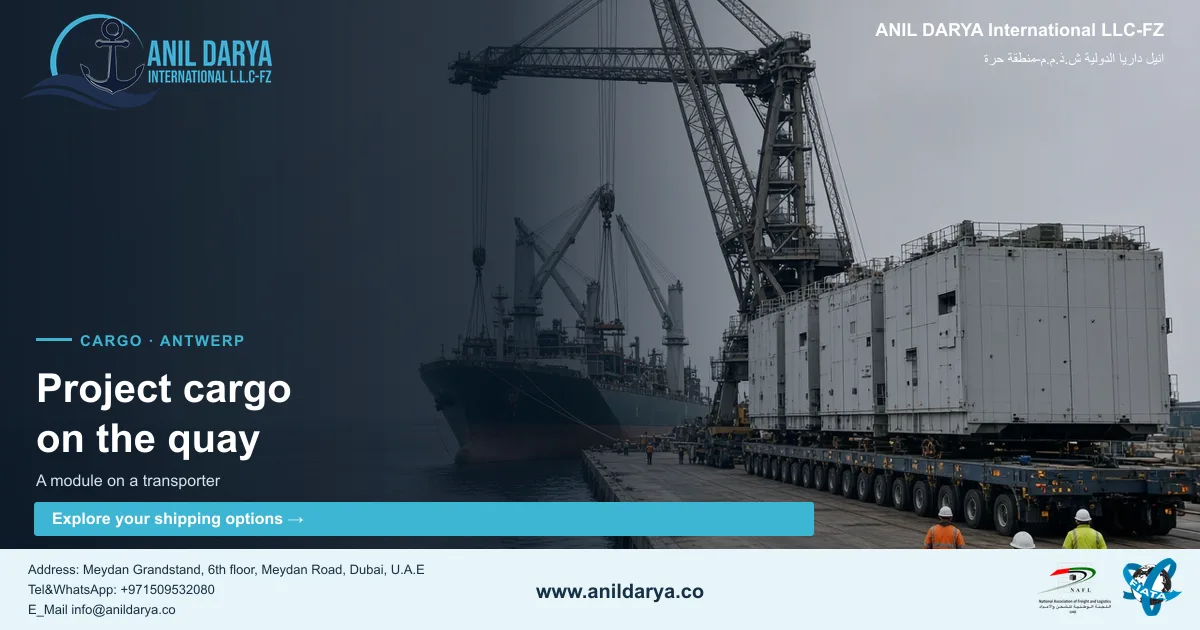
The port ships wind turbines, machinery, generators, furnaces, power plant units and even helicopters. Specialised breakbulk operators handle loading, unloading, storage and marshalling of project cargo, and offer consolidation, packing, storage in customs warehouses and customs clearance. Many terminals have their own lifting gear, and mobile cranes can be hired when a piece is too heavy for the terminal's cranes.
The PSA Breakbulk Project Cargo Ecosystem at Churchill Dock, launched in April 2023 by PSA, Haeger & Schmidt Logistics and Felbermayr, is one example. Trade press reports a permanent heavy-lift crane of up to 750 tonnes, the highest quayside lifting capacity in the port, a 13 m draught, a 140,000 m² yard and self-propelled modular transporters of up to 40 axle lines.
The port's largest recent project shows how it works at scale. For INEOS's Project ONE ethane cracker in Antwerp, modules built overseas were shipped in whole, PSA Breakbulk handled the transshipment and storage, and heavy transport firms Felbermayr and Sarens moved the pieces with special equipment.
| Cargo | How it usually moves to Antwerp | What to plan |
|---|---|---|
| Steel coils, plates, pipes | Breakbulk in the hold or on deck, or in containers | Dunnage, dry storage, quotas, CBAM |
| Machinery slightly over size | Open top or flat rack on a container ship | Lashing, carrier acceptance, terminal handling |
| Heavy modules, transformers, generators | Heavy-lift or multipurpose vessel to a breakbulk terminal | Lift plan, crane capacity at the berth, SPMT or road permit |
| Wind turbine parts | Breakbulk or project vessel | Laydown area, marshalling, onward transport |
| Forest products | Breakbulk terminals in Antwerp and Zeebrugge | Covered storage, rail or barge onward |
| Vehicles and high and heavy | Ro-Ro, mainly via Zeebrugge | Vehicle documents, storage time |
How we plan breakbulk from the UAE to Antwerp
- Collect drawings, dimensions, weights, centre of gravity and lifting points for every piece.
- Choose the equipment: container with open top or flat rack, or breakbulk or heavy-lift tonnage. Antwerp's Breakbulk/RORO Sailing List shows which operators sail to the port by cargo type.
- Get carrier acceptance and agree lashing, securing and dunnage.
- Agree the discharge terminal and its crane capacity with the consignee's agent in Antwerp.
- Plan the onward move: road with permits, barge or rail.
- Send customs documents to the Belgian broker before the vessel arrives.
A simple rule: if a piece fits a 40ft flat rack by size and weight, a container service gives you more sailings. If not, the breakbulk sailing date drives the whole plan. Our guides to the project cargo logistics process and heavy-lift shipping go deeper, and our break bulk and project cargo service covers the UAE end.
[AMIR-FACT: one real breakbulk or project shipment we sent from the UAE to Antwerp (cargo, weight or size, vessel type, terminal, total days, problem solved)]
Ro-Ro and vehicles at Antwerp-Bruges
The port handled 3,186,000 new cars in 2025. Zeebrugge is described by the port as the largest Ro-Ro hub in Europe, and the port has specialised Ro-Ro terminals on both platforms. High and heavy equipment, such as construction machines on wheels or tracks, grew 6.3% in 2025. If a machine can be driven or towed onto a ship, Ro-Ro is often simpler than a heavy lift.
Dangerous goods and chemicals at the Port of Antwerp
Antwerp is the largest chemical cluster in Europe and, according to the port, the second largest in the world after Houston. Refineries, three steam crackers and many tank terminals sit inside the port. Antwerp is also Europe's main polymer hub, with more than 1,300 silos and 680,000 m³ of storage for plastic pellets. The port owns 720 km of pipelines, 90% of them serving the chemical industry.
Port rules for dangerous goods
- Anyone who delivers, unloads or stores dangerous or polluting goods must report their position to the Harbour Master's Office at least 24 hours in advance.
- Freight forwarders and shipping agents send the notification as an electronic IFTDGN message. Terminals then report actual arrival, loading and departure times.
- Some activities need prior approval. The port publishes lists of approved terminals, approved warehouses for DG storage and approved fumigation areas.
For a DG container from the UAE you need the UN number, proper shipping name, class and packing group, a Safety Data Sheet, a signed DG declaration, a container packing certificate and correct labels and placards. Check our article on dangerous goods classes, and let our dangerous goods shipping team get carrier acceptance before you commit to a sailing.
FCL and LCL container shipping to Antwerp
- FCL (full container load). A whole 20ft, 40ft or 40ft high cube box, stuffed at origin and delivered sealed to the terminal.
- LCL (less than container load). Your cargo shares a box and is unpacked at a warehouse in Antwerp, so release depends on the consolidator's paperwork too.
From Antwerp, containers continue by truck, barge or rail. The port points to easy access to markets such as Germany and France, and every terminal has multimodal links. Our sea freight service covers both options and the container types.
Inland connections from Antwerp
Most cargo landed in Antwerp travels on. Each container terminal has road, rail and inland waterway access, and the steel terminals are trimodal too. The chemical industry also uses the port's pipelines: the port owns 720 km of them and more than 1,000 km run through the port area in total.
| Onward mode | Suits | What to plan |
|---|---|---|
| Truck | Belgium and nearby regions, urgent deliveries | Terminal gate hours (24/5), Certified Pick up release, permits for oversized loads |
| Barge | Heavy, bulky or non-urgent cargo to inland terminals | Barge slot at the terminal, transfer time |
| Rail | Regular volumes to inland hubs | Train schedule, rail operator booking |
| Short sea | Other European ports | Feeder or short sea connection, transshipment time |
Forest products show how the mix works: the port handles up to 6 million tonnes a year, split evenly between Antwerp and Zeebrugge, and much of it leaves the terminals directly by train, truck or barge.
Free time, demurrage and detention in Antwerp
Carriers give a set number of free days for their containers. After that, demurrage runs while the full box stays at the terminal, and detention while you keep it outside. Free days and daily rates differ by carrier and container type, so read them on the quote and the arrival notice. File customs before arrival and book the truck, barge or train early to stay inside free time. Our article on demurrage and detention shows how the charges add up.
Customs clearance at the Port of Antwerp
Belgium applies EU customs law. Belgian customs, part of FPS Finance, handles declarations, which are now filed in the IDMS application. IDMS replaced PLDA as the main import system from 30 September 2025, with PLDA kept as a fallback.
How clearance works at the port
- Before arrival, the carrier or a representative files an Entry Summary Declaration in ICS2. From 1 June 2026 every consignment entering the EU needs a valid ENS.
- On arrival, the goods are presented to customs and held in temporary storage, for no longer than 90 days.
- The importer or its customs broker files the import declaration, with the CN code, origin and value.
- Customs may check the documents or inspect the goods.
- Duty and VAT are paid or secured, the goods are released for free circulation, and the terminal releases the container.
You can also move goods unpaid to another EU country under customs transit, or store them in a customs warehouse in the port and pay duty only when you release them.
Who can import and which documents do you need?
To import into the EU you must be established as a business in the EU and hold an EORI number. A non-EU business applies for its EORI in the EU country of its first customs operation. Most shippers from Dubai sell to a Belgian or EU buyer who acts as importer.
| Cargo | Core documents | Usually also needed |
|---|---|---|
| General cargo (FCL or LCL) | Commercial invoice, packing list, bill of lading | Proof of origin if a lower duty rate is claimed |
| Steel | Core set | Quota and CBAM information, mill certificates |
| Project and breakbulk cargo | Core set with a piece-by-piece packing list | Drawings and weights for the terminal, road permits |
| Dangerous goods | Core set | DG declaration, SDS, any EU or Belgian permit |
| Food and agricultural goods | Core set | Health or sanitary certificates |
| Restricted goods (chemicals, medicines, weapons, dual-use) | Core set | Import licence before arrival |
Duty, VAT and TARIC
Find the product's CN code and check it in TARIC, the EU's integrated tariff. TARIC shows the third-country duty, preferences, suspensions, quotas, anti-dumping duties and import restrictions for that code. It does not show VAT, which is national.
Belgium's standard VAT rate is 21%, with reduced rates of 6% and 12%. Import VAT is paid at clearance unless the importer holds an ET 14.000 authorisation, which lets a Belgian VAT-registered business declare import VAT on its periodic VAT return. The EORI number must be linked to the Belgian VAT number for this to work.
Shipping from Dubai to Antwerp: step by step
Most cargo from the UAE to Antwerp loads at Jebel Ali. Maersk's published transit table from February 2025 gives 29 days from Jebel Ali to Antwerp and 27 days from Abu Dhabi. Route aggregator Fluent Cargo also shows services with one transfer. Ask on every quote whether the service is direct or transships, and which Antwerp terminal it uses.
[AMIR-FACT: the carriers we actually book from Jebel Ali to Antwerp and our real port-to-port days in 2026]
- Agree the Incoterm and confirm who is the EU importer with an EORI number.
- Send us the cargo details: commodity, HS code, weights, dimensions, pickup address and ready date.
- Check the CN code in TARIC for duty, quotas, CBAM and permits.
- We compare services from Jebel Ali or Abu Dhabi to Antwerp, or breakbulk sailings for out-of-gauge cargo, and confirm the discharge terminal.
- Book space. For DG, reefer and out-of-gauge cargo we get carrier acceptance first.
- We arrange UAE trucking, stuffing or lashing, and the UAE export or re-export declaration.
- Gate-in before the cut-off. For DG, the forwarder or agent files the port notification at least 24 hours before arrival in Antwerp.
- We check the draft bill of lading and send the final documents to the consignee's broker in Belgium.
- The broker files the declaration, duty and VAT are paid or deferred, and the cargo leaves by truck, barge or rail.
We work with your consignee's customs broker or a destination clearing agent in Belgium. Our Dubai freight forwarding team handles the UAE side, and our Jebel Ali port guide explains the export steps there.
How to ship from the Port of Antwerp to Dubai
We also handle the other direction: shipping from Antwerp to Dubai, with arrival at Jebel Ali, Khalifa Port or Sharjah port. We book the space with the carrier and run the UAE side. The Belgian export papers stay with the shipper or its Belgian agent.
The Belgian export side
- EORI. The exporter or declarant needs an EORI number to be identified in EU customs procedures.
- Export declaration. The exporter or its customs representative lodges the declaration electronically in the Automated Export System, at the customs office for the place where the exporter is established.
- Exit. The goods stay under customs supervision until they leave the EU. The customs office of exit checks them and tells the office of export that they have left.
The UAE import side
For cargo cleared in Dubai, the import declaration goes to Dubai Customs with the commercial invoice, packing list, certificate of origin and any permit from the authority that controls restricted goods. The bill of lading is what releases the cargo from the shipping line. Customs duty in Dubai is 5% of the CIF value for most goods, with 50% on alcohol and 100% on cigarettes. Import VAT is 5%, charged on the customs value including freight and insurance. A VAT-registered importer that has registered its customs number with the Federal Tax Authority pays no VAT at the border and accounts for it on its next VAT return.
- Send us the shipper's details in Antwerp, the cargo, the HS code and the UAE delivery address.
- We book space with the carrier from Antwerp to Jebel Ali, Khalifa Port or Sharjah and send the booking and cut-offs to the shipper.
- The shipper or its trucker picks up the cargo and delivers the container to the Antwerp terminal named in the booking before the cut-off.
- The shipper or its Belgian agent lodges the EU export declaration in the Automated Export System.
- We check the draft bill of lading against the invoice and packing list before the line issues it.
- We file the UAE import declaration before the vessel arrives.
- We arrange payment of the duty and VAT and collect the delivery order from the shipping line.
- We truck the container to your site in the UAE.
- We return the empty container to the line's depot within free time.
[AMIR-FACT: the carriers we actually use from Antwerp to Jebel Ali, Khalifa Port or Sharjah and our real port-to-port transit days in this direction]
Antwerp or Zeebrugge: which platform fits your cargo?
| Your situation | Usual platform | Why |
|---|---|---|
| Containers on a service that calls Antwerp | Antwerp | Five deepsea terminals and wide inland links |
| Steel, machinery, project cargo | Antwerp | Steel service centres, heavy-lift terminals, frequent breakbulk calls |
| Chemicals and DG for the chemical cluster | Antwerp | Production, tank storage and approved DG terminals in the port |
| Cars, trucks and Ro-Ro cargo | Zeebrugge | Europe's largest Ro-Ro hub |
| Containers on a service that calls Zeebrugge | Zeebrugge | CSP Zeebrugge Terminal, on the coast |
Checklist before you ship to Antwerp
- EU importer named, with a valid EORI number.
- CN code checked in TARIC for duty, quotas, anti-dumping and restrictions.
- Discharge terminal confirmed with the carrier.
- For steel: quota status and CBAM data ready.
- For project cargo: drawings, lifting points, terminal crane capacity and onward transport plan.
- For DG: SDS, DG declaration, packaging and labels, port notification planned.
- Invoice, packing list and bill of lading match on weights, pieces and consignee.
- Belgian customs broker appointed and documents sent before arrival.
- VAT plan agreed: paid at clearance or deferred under ET 14.000.
- Free time agreed and cargo insurance arranged.
Common mistakes when shipping to Antwerp
- No EU importer. A seller on DDP terms without an importer of record cannot clear the goods.
- Wrong terminal. A truck or barge sent to the wrong terminal loses its slot.
- Late DG notification. The port needs notice at least 24 hours before arrival, and a late message delays handling.
- Ignoring steel quotas or CBAM. They change the landed cost after the cargo has sailed.
- No lift plan. Heavy pieces arrive at a berth whose cranes cannot lift them, and a mobile crane must be hired at short notice.
- Late permits. Goods wait in temporary storage, which has a 90-day limit and daily costs.
- Ignoring free time. Demurrage and detention start as soon as free days end.
Frequently asked questions
Is the Port of Antwerp the same as the Port of Antwerp-Bruges?
Yes. Since 2022 the ports of Antwerp and Zeebrugge have been run by one authority, the Port of Antwerp-Bruges. Antwerp is the river port and Zeebrugge is the coastal platform.
How big is the Port of Antwerp?
Port of Antwerp-Bruges handled 266.5 million tonnes of cargo and 13.6 million TEU in 2025, with 20,236 seagoing vessel calls. It can take container ships of up to 23,000 TEU.
What is the port code for Antwerp?
The UN/LOCODE for Antwerp is BEANR. Zeebrugge is BEZEE. You will see these codes on bookings and bills of lading.
How many container terminals does Antwerp have?
Port of Antwerp-Bruges has six deepsea container terminals: five in Antwerp and CSP Zeebrugge Terminal in Zeebrugge. The Antwerp terminals are open 24/7 for ships and 24/5 for trucks.
Is Antwerp good for breakbulk and project cargo?
Yes. The port calls itself Europe's leading breakbulk port for steel and its most important breakbulk port for project cargo, with more than 200 breakbulk calls a month and a 750-tonne quayside crane at one terminal.
Can I ship dangerous goods to Antwerp?
Yes. The position of dangerous goods must be reported to the Harbour Master's Office at least 24 hours before arrival, and only approved terminals and warehouses may handle or store them.
What is the import VAT rate at Antwerp?
Belgium's standard VAT rate is 21%, with reduced rates of 6% and 12%. Importers with an ET 14.000 authorisation can declare import VAT on their periodic VAT return instead of paying it at clearance.
How long does shipping from Dubai to Antwerp take?
Maersk's published table from February 2025 gives 29 days from Jebel Ali to Antwerp. Services with a transfer can take longer, so confirm the transit time on each quote.
How do I ship from Antwerp to Dubai?
The Belgian shipper or its customs representative lodges the EU export declaration, with an EORI number. We book the space to Jebel Ali, Khalifa Port or Sharjah, file the UAE import declaration and arrange payment of the 5% duty (on the CIF value of most goods) and the 5% import VAT.
Get a quote for Port of Antwerp shipping
Send us your cargo details, dimensions and the delivery address in Belgium, and we will come back with a routing and a price to Antwerp. Use our freight rate inquiry form, or contact our team to talk through a breakbulk, project or DG shipment first.
Sources
- Port of Antwerp-Bruges: Factsheet throughput figures 2025
- Port of Antwerp-Bruges: First half 2026 results and port profile (July 2026)
- Port of Antwerp-Bruges: Deepsea container terminals and empty depots
- Port of Antwerp-Bruges: Containers (23,000 TEU ships, Certified Pick up)
- Port of Antwerp-Bruges: Breakbulk, steel, project cargo and forest products
- Port of Antwerp-Bruges: Steel handling, LME storage and CBAM
- Port of Antwerp-Bruges: Project cargo for Project ONE
- AJOT: PSA Breakbulk Project Cargo Ecosystem (crane, draught, yard, SPMT)
- PSA: Project Cargo Ecosystem launch at Churchill Dock (April 2023)
- Port of Antwerp-Bruges: Dangerous goods and chemical cluster
- Port of Antwerp-Bruges: Chemicals (polymer hub, silos, pipelines)
- Port of Antwerp-Bruges: Notification of dangerous and polluting goods
- Port of Antwerp-Bruges: Terminal notification of dangerous goods
- Port of Antwerp-Bruges: Approved locations for dangerous goods
- Your Europe: Customs duties and procedures on imports
- European Commission: EORI number
- European Commission: EU customs tariff (TARIC)
- European Commission: ICS2
- Your Europe: VAT rates by EU country
- Eurofiscalis: ET 14.000 VAT deferment in Belgium
- EY: Belgium customs update, IDMS replaces PLDA (2025)
- Maersk: Middle East-India to Europe transit times from February 2025
- Fluent Cargo: Dubai to Antwerp routings
- Parcels: Port of Antwerp-Bruges (BEANR) port code
- MarineLink: Antwerp port profile (river port on the Scheldt)
- Wikipedia: Port of Antwerp-Bruges (2022 merger, ownership)
- European Commission: What is exportation? (export declaration in AES, office of export and exit)
- Dubai Customs: Submit customs declaration (invoice, packing list, certificate of origin, permits)
- UAE Government portal: Clearing customs and paying customs duty (5% of CIF, alcohol 50%, cigarettes 100%)
- Federal Tax Authority: VAT (5% rate)
- Federal Tax Authority: VAT guide, section 3.5 on VAT on imports (5%, deferral for VAT-registered importers)
Reviewed: 10 November 2026