
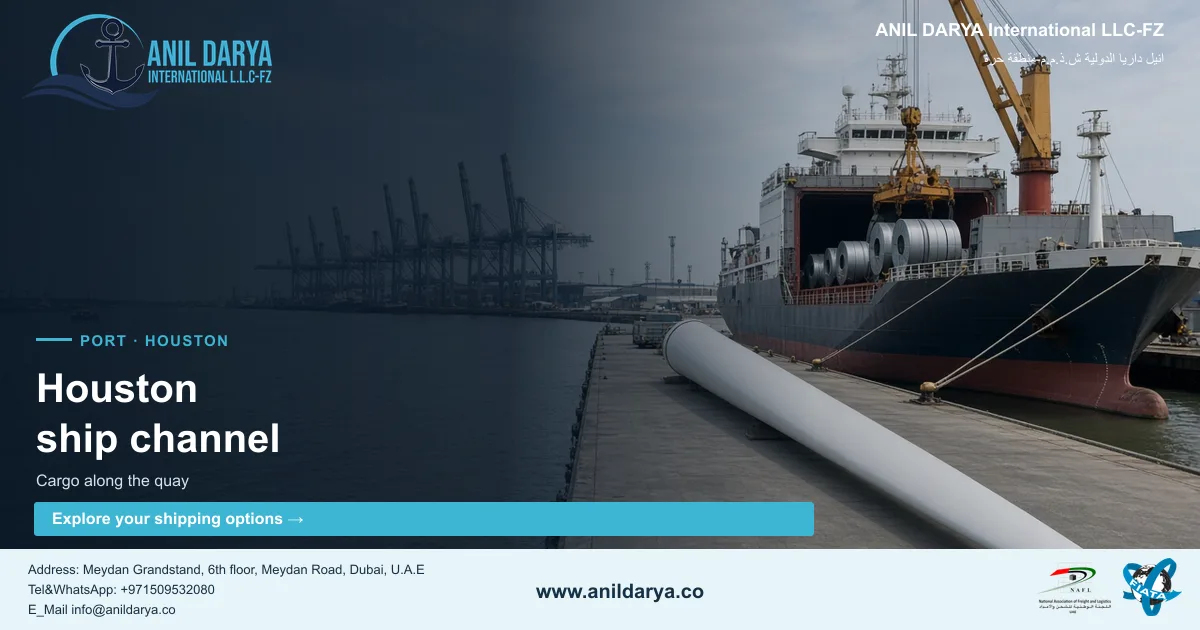
Port of Houston shipping covers containers through Bayport and Barbours Cut and, above all, breakbulk, steel and project cargo through the multi-purpose terminals along the Houston Ship Channel. Port Houston owns and operates the eight public facilities on the 52-mile channel and ranks first among US ports for foreign waterborne tonnage. This guide covers the terminals, the breakbulk and project cargo rules, free time, dangerous goods, US customs and how we ship your cargo there from Dubai. We ship both ways: from Dubai to Houston, and from Houston to Dubai with clearance on arrival in the UAE.
Port of Houston at a glance
| Item | Detail |
|---|---|
| Port authority | Port Houston (Port of Houston Authority), led by a seven-member Board of Port Commissioners |
| UN/LOCODE | USHOU |
| Waterway | Houston Ship Channel, 52 miles, more than 200 public and private facilities |
| Public facilities | Eight, owned and operated by Port Houston |
| Container terminals | Barbours Cut (6 berths) and Bayport (5 operational berths) |
| Main breakbulk facility | Turning Basin Terminal |
| Foreign waterborne tonnage | 1st among US ports, 220.1 million short tons (2024) |
| Container ranking | 5th US container port by total TEU |
| Containers, January to September 2026 | 3,349,547 TEU, up 2% on the same period of 2025 |
| Steel, January to September 2026 | 3,450,634 short tons, import and export |
| Container market share | 97% of Texas, 75% of US Gulf Coast container traffic |
| Customs authority | U.S. Customs and Border Protection (CBP) |
| Ocean security filing | ISF 10+2, before the cargo is loaded at the foreign port |
| Houston to Dubai (import) | EEI in AES by the US shipper or its agent; Dubai Customs declaration, 5% duty on CIF for most goods, 5% import VAT |
Where is the Port of Houston and how does the ship channel work?
The Port of Houston is not one quay. It is a chain of public and private terminals along the 52-mile Houston Ship Channel, which runs from Galveston Bay up to the Turning Basin. The channel opened in 1914, and Port Houston has run it for over a century.
Where your cargo discharges matters. The two container terminals sit lower down the channel, closer to the bay. The general cargo and breakbulk terminals stretch from the Turning Basin a few miles downstream, closer to the city and the industrial belt along the channel.
Project 11: the channel widening
Port Houston and its partners are widening and deepening the channel under Project 11. The main points from the project's own pages:
- The Galveston Bay reach widens by 170 feet, from 530 to 700 feet.
- Some upstream segments deepen to 46.5 feet, for example Boggy Bayou to Hunting Bayou, from 41 feet.
- The Bayport and Barbours Cut side channels widen to about 455 feet.
- Dredging began in 2022. Port Houston completed its own portion of the dredging in October 2025, and the partners aim to complete the work in 2029.
Your carrier handles draught and scheduling, but ask about channel restrictions when you book a heavy-lift vessel.
Which terminals does Port Houston run?
Container terminals
| Terminal | Opened | Berths | Container yard | Other facts |
|---|---|---|---|---|
| Barbours Cut Container Terminal (Morgan's Point) | 1977 | 6 | 300 acres | 29 entry truck gates, more than 8,000 feet of working rail track, $650M capital programme 2023 to 2027 |
| Bayport Container Terminal (Pasadena) | 2007 | 5 operational | 314 acres | $750M capital programme 2023 to 2027, including more wharves and ship-to-shore cranes |
Your carrier's service decides the terminal. Check the arrival notice before you book a truck. Each terminal has its own tariff: No. 14 for Barbours Cut and No. 15 for Bayport.
Multi-purpose, breakbulk and project cargo terminals
Port Houston lists these public facilities for general cargo, breakbulk and bulk:
| Facility | Typical use |
|---|---|
| Turning Basin Terminal | The area's largest breakbulk facility |
| Care Terminal | General cargo |
| Jacintoport Terminal | General cargo |
| Manchester Terminal | Multi-purpose |
| Sims Bayou Terminal and Southside Wharves | Multi-purpose |
| Bulk Materials Handling Plant | Dry bulk |
| Public Grain Elevator No. 2 | Grain |
Port Houston describes the cargo range as running from grain to steel to heavy-lift project cargo to wind turbines and blades, with large laydown areas next to the general cargo and heavy-lift docks. The table's "typical use" column is a planning guide. Your terminal is set by the carrier and stevedore.
How much cargo does the Port of Houston handle?
| Measure | Figure | Period |
|---|---|---|
| Foreign waterborne tonnage (rank 1st in US) | 220.1 million short tons | 2024 |
| Total Houston Ship Channel tonnage | 309.5 million tons, up about 5% | 2023 |
| Port Houston public terminals, total tonnage | 54,491,066 short tons | 2025 |
| Of which containerized | 40,176,436 short tons | 2025 |
| Containers | 3,349,547 TEU (3,270,595 a year earlier) | January to September 2026 |
| Steel imports | 3,248,614 short tons | January to September 2026 |
| General cargo, import and export | 1,044,794 short tons, up 46% | January to September 2026 |
The Middle East matters on this lane. Port Houston's trade-lane report estimates 227,960 import TEU from the India and Middle East region in 2025 (11.8% of its import containers) and 263,424 export TEU to that region (16.4%).
Shipping from Dubai to Houston: published transit indications
There is no single standard transit on this lane. The sea services schedule aggregator Fluent Cargo lists all use transshipment:
| Route listed | Indicated transit | Routing | Frequency |
|---|---|---|---|
| Khor Fakkan to Houston (ONE and MSC services) | About 51 days 16 hours | 1 transfer | Every 1 to 2 weeks |
| Jebel Ali to Houston (ONE service) | About 67 days 22 hours | 2 transfers | Every 2 to 4 weeks |
| Al Maktoum (DWC) to Houston IAH, Emirates freighter | About 1 day 6 hours | 1 stop | 2 to 4 times a week |
Treat these as planning ranges, and check the current sailing before you promise a delivery date. The UAE loading port can matter as much as the carrier.
[AMIR-FACT: our typical port-to-port transit from Jebel Ali to Houston and the carriers or services we actually book to Bayport or Barbours Cut]
Breakbulk and project cargo at the Port of Houston
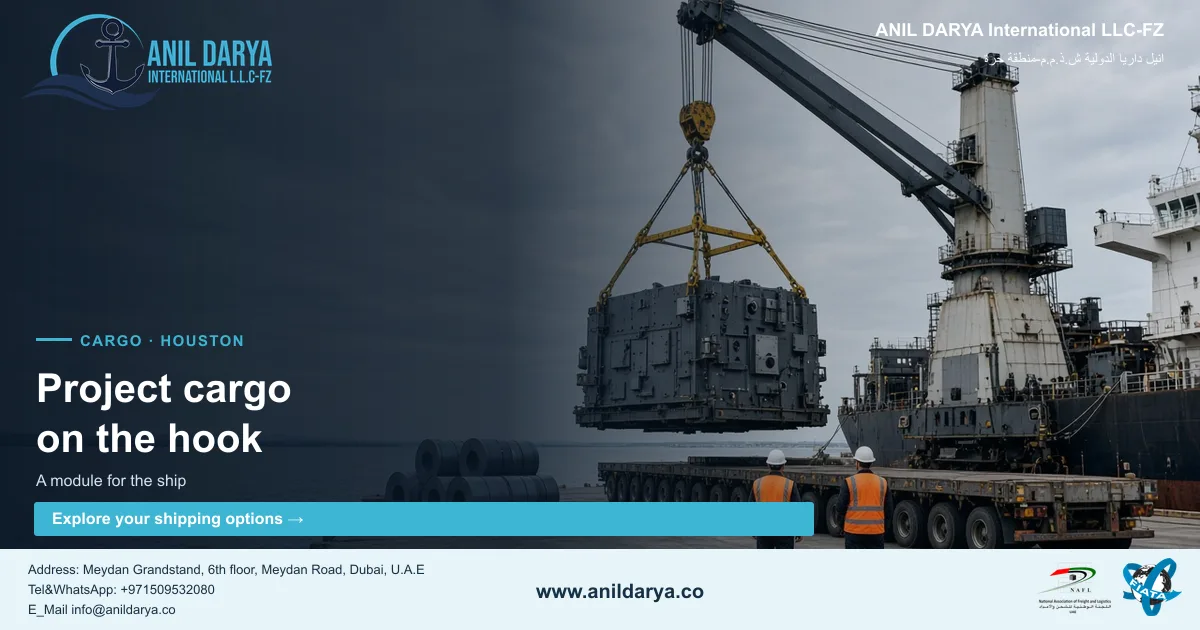
This is where Houston stands out. Port Houston calls itself the national leader for breakbulk cargo and describes its multi-purpose terminals as the largest breakbulk, steel and project cargo complex in North America. The figures back the steel side: 3.45 million short tons of steel moved through its terminals in the first nine months of 2026.
Port Houston lists grain, steel, heavy-lift project cargo, and wind turbines and blades among the cargo its multi-purpose terminals handle, and says they take cargo that is heavy, bulky or difficult to move.
Free time for breakbulk cargo
Port Houston's Tariff No. 8, effective 23 February 2026, sets free time at its public wharves. Free time is the period cargo can sit on the terminal before wharf demurrage or storage starts.
| Cargo | Free time |
|---|---|
| Inbound steel for direct discharge (not palletized or skidded) | 15 days |
| Single consignment of one commodity, 2,000 tons or more on one bill of lading | 45 days inbound or outbound |
| Transshipped cargo | 30 days |
| Other inbound or outbound cargo not covered elsewhere | 30 days |
These are generous next to container free time, but late road permits can still eat them up.
Getting oversized cargo out of the Turning Basin
Gate widths at the Turning Basin limit what can leave by road without special arrangements. Port Houston publishes them:
| Gate | Width | Notes |
|---|---|---|
| Gate 8 (Clinton Drive) | 30 ft | Only for high and wide cargo; Port Police open it with stevedore approval |
| Cargo Bay Road | 29 ft 6 in | Main route for cargo trucks |
| Ramp Road 8 | 30 ft | 11 ft clearance on ramp road gates |
| Ramp Road 6 | 29 ft 2 in | 11 ft clearance |
| Ramp Road 2 | 27 ft | 11 ft clearance |
| Ramp Road 7 | 22 ft 9 in | 11 ft clearance |
Several Turning Basin gates, including Ramp Road 6 and Cargo Bay Road, run around the clock. Port Houston's terminal FAQs say breakbulk pickup needs a dock receipt or pick-up order showing the vessel name, commodity description and bill of lading number. Drop-off for export needs a dock receipt showing the booking number instead.
Use these numbers when you plan the trailer and the escort. The Texas road permit and the route to site are the consignee's or its trucker's job, but the cargo dimensions we send at booking must match what actually arrives.
How we plan project cargo from Dubai to Houston
- Collect drawings, dimensions, weights and centre of gravity for each piece.
- Choose the vessel: flat rack on a container service to Bayport or Barbours Cut, or breakbulk and heavy-lift tonnage to a multi-purpose terminal.
- Agree lifting, lashing and securing with the carrier, and check the discharge berth.
- Share the out-of-gauge dimensions with the consignee's trucker so the gate and road permits are ready.
- Make sure the ISF is filed in time. Breakbulk needs one too.
- Plan clearance before arrival so the cargo leaves inside free time.
Our break bulk and project cargo team handles the UAE side of these moves. For the detail behind each step, read our project cargo logistics process and our heavy-lift shipping guide.
[AMIR-FACT: one real breakbulk or project cargo shipment we moved from the UAE to Houston (cargo, vessel type, terminal, transit days) or confirmation that we have not yet handled one]
Container shipping through Houston: FCL and LCL
Containers discharge at Bayport or Barbours Cut. FCL suits full loads and gives the cleanest release. LCL boxes are unpacked at a container freight station before your share is released, so your release also depends on the consolidator's paperwork. Our sea freight service covers both.
A simple rule: below about half a container, price LCL first; above that, price both and add the Houston destination charges before you compare. Our guide to FCL vs LCL costs shows the maths.
Free time and dwell fees at the container terminals
Container free time at Houston is short. Bayport's Tariff No. 15 and Barbours Cut's Tariff No. 14, both effective 1 September 2026, set the same import rules:
| Item | Rule |
|---|---|
| Free time, loaded import containers | 7 days, starting the first 6:00 a.m. after receipt |
| Free time if CBP examination or USDA inspection is needed | 10 days in total |
| Demurrage after free time, 20ft container | $35.79 per day |
| Demurrage after free time, 40ft or longer | $71.55 per day |
| Scheduled terminal closures | Count towards demurrage |
| Sustained import dwell fee | Charged to the cargo owner from the eighth day after free time expires (Bayport and Barbours Cut) |
Port charges change, so check the current tariff before you plan a long dwell. These terminal charges are separate from the shipping line's own demurrage and detention. Our article on demurrage and detention explains the difference.
Gate hours, Express Pass and Lynx
| Item | Bayport and Barbours Cut |
|---|---|
| Gate hours | Monday to Friday, 6:00 a.m. to 7:00 p.m.; ingate closes at 6:00 p.m. |
| Weekends | Closed; after-hours access by Extended Gate Request Form |
| Truck appointments | Express Pass, mandatory for truckers |
| Online system | Lynx portal: container status, vessel schedules, bookings, receiving dates, gate transactions |
| Escorts | Tariff No. 8 sets fees for escorting people without a TWIC (Transportation Worker Identification Credential) |
Because weekends are closed and closures still count towards demurrage, a container that lands on a Thursday has fewer working days of free time than it seems. Ask the consignee's trucker to check availability in Lynx and book the Express Pass slot as soon as the container is released.
Dangerous goods at the Port of Houston
Port Houston's tariffs set clear limits on hazardous cargo, on top of the IMDG Code at sea. Hazardous materials at its terminals must meet 49 CFR Parts 171 to 180 and the IMDG Code, and cargo arriving without the required documents is not received or offloaded.
| Cargo | Port Houston rule |
|---|---|
| Explosives Class 1.1, 1.2, 1.3 and all fireworks | Not handled at the Port of Houston, whether loading, discharging or in transit |
| Explosives Class 1.4 and 1.5 (not fireworks) | Tell terminal operations before arrival; arrange timely loading to vessel or truck |
| Vessel with more than 10 tons of Class 1.4 or 1.5 | Cleared through the Port Authority's Fire Department and the Captain of the Port at least 24 hours before arrival |
| Flammable liquids (red label), organic peroxides, spontaneously combustible goods | Not placed in a transit shed; delivered to open wharves only once the ship is in port, in limited quantity |
| Flammable solids (Class 4), oxidizers (Class 5), corrosives (Class 8) | May be stored in a transit shed |
| Poisons (Class 6) | May go in a transit shed, with extreme caution near food cargo |
Before you book DG to Houston, you need the UN number, proper shipping name, class and packing group, an SDS, a signed DG declaration, UN-approved packaging and carrier acceptance. Our dangerous goods shipping team checks all of this against the carrier's and the terminal's rules.
Customs clearance at the Port of Houston
US customs works the same in Houston as at any US port. CBP clears the goods, and the US importer of record files, alone or through a licensed customs broker. We prepare the UAE side so the US filing is quick.
- ISF 10+2. For ocean cargo, most of the importer's 10 data elements must reach CBP no later than 24 hours before the cargo is loaded in Dubai. The container stuffing location and consolidator are due no later than 24 hours before arrival in a US port. Breakbulk files an ISF too.
- Customs bond. Goods are not released at entry without a bond on file. A continuous bond or a stand-alone ISF bond must also cover the ISF.
- Entry. Entry documents must be filed within 15 calendar days of arrival, and the entry summary (CBP Form 7501) with estimated duties within 10 working days.
- Duty. The rate comes from the HTS code. Rates and extra duties change often, so check the current Harmonized Tariff Schedule for your code.
- Fees. Merchandise processing fee of 0.3464% of value (minimum $34.58, maximum $670.86 from 1 October 2026) and harbor maintenance fee of 0.125% of value on sea cargo.

Which documents does a Houston shipment need?
| Cargo | Core documents | Usually also needed |
|---|---|---|
| General cargo (FCL or LCL) | Commercial invoice, packing list, bill of lading, ISF data | Customs bond, entry and entry summary |
| Breakbulk and project cargo | Core set with a piece-by-piece packing list | Drawings, weights and centre of gravity; road permits for oversized pieces |
| Dangerous goods | Core set | DG declaration, SDS, carrier and terminal acceptance |
| Food | Core set | FDA prior notice at least 8 hours before arrival by water |
| Goods on wooden pallets or crates | Core set | ISPM 15 treated and marked wood |
Every item of foreign origin must also be marked with its country of origin in English, unless an exception applies. Check this in Dubai, before loading.
How to ship from Dubai to Houston: step by step
This is how we handle a typical shipment from the UAE to Houston. We book space, prepare documents, arrange origin trucking and UAE export clearance, and work with the US importer's customs broker.
- Tell us about the cargo: commodity, HTS code, weights and dimensions, and the US importer and broker.
- We compare services from Jebel Ali Port to Houston, container or breakbulk, and confirm the Houston terminal.
- Book space. For DG, reefer or out-of-gauge cargo we get carrier acceptance first.
- Send ISF data to the US filer early, including the stuffing location and consolidator.
- We arrange the empty or the cargo delivery, stuffing or lashing, the Dubai Customs export declaration and gate-in before cut-off.
- We check the draft bill of lading against the invoice and ISF, then release it after sailing.
- The broker files entry before arrival so the cargo is released inside free time.
- The consignee's trucker collects from Bayport, Barbours Cut or the breakbulk terminal and delivers to site.
How to ship from the Port of Houston to Dubai
We also handle the other direction: shipping from Houston to Dubai, with arrival at Jebel Ali, Khalifa Port or Sharjah port. We book the space with the carrier and run the UAE side. The US export papers stay with the shipper or its US agent.
The US export side
- Electronic Export Information (EEI). The US Principal Party in Interest (USPPI) or its authorized agent files it in the AES. For vessel cargo, the filing citation must reach the carrier 24 hours before the cargo is loaded at the US port.
- Exemptions. EEI is generally not needed when the goods under one Schedule B or HTS number are worth $2,500 or less, under the conditions in the rule. The shipper's agent confirms this for each shipment.
- Container gate-in. Bayport does not accept loaded export containers more than 7 days before the vessel's expected arrival, so the shipper times its delivery to the sailing.
- Breakbulk drop-off. At the multi-purpose terminals, export cargo needs a dock receipt showing the booking number.
The UAE import side
On arrival, the declaration goes to Dubai Customs with the commercial invoice, packing list, bill of lading, certificate of origin and any permit for restricted goods. The importer needs a Dubai Customs business code, or a licensed clearing agent with the owner's authorisation files for it. Customs duty in Dubai is 5% of the CIF value for most goods, with 50% on alcohol and 100% on cigarettes. Import VAT is 5%, charged on the customs value including freight and insurance. A VAT-registered importer that has linked its customs registration number with the Federal Tax Authority accounts for it on its VAT return instead of paying at the border.
- Send us the shipper's details in Texas, the cargo, the HS code and the UAE delivery address.
- We book space from Bayport, Barbours Cut or the breakbulk terminal and send the booking and cut-off to the shipper.
- The shipper or its trucker delivers the box or the breakbulk to the terminal inside the receiving window.
- The shipper or its US agent files the EEI at least 24 hours before loading.
- We check the draft bill of lading against the invoice and the certificate of origin.
- We file the UAE declaration before the vessel arrives.
- We arrange payment of the duty and VAT and collect the delivery order.
- We truck the cargo to your site in the UAE.
- We return the empty container inside the carrier's free time.
[AMIR-FACT: the carriers we actually use from Houston to Jebel Ali/Khalifa/Sharjah and our real transit days in this direction]
Houston or another US port?
| Your situation | Port to choose | Why |
|---|---|---|
| Consignee in Texas, Oklahoma or Louisiana | Houston | 97% of Texas container traffic already moves through it |
| Project cargo for sites near the ship channel | Houston multi-purpose terminals | Breakbulk and heavy-lift berths, laydown, short road leg |
| Consignee in the Northeast | New York and New Jersey | Shorter US inland leg |
| Consignee in the Southeast | Savannah, Charleston or Norfolk | Closer to the buyer |
| Consignee on the West Coast | Los Angeles and Long Beach | Compare against Houston plus rail |
| Class 1.1 to 1.3 explosives or fireworks | Not Houston | Port Houston does not handle them |
Checklist before you ship to Houston
- US importer, importer number and customs broker confirmed.
- Customs bond active and covering the ISF.
- HTS code agreed and the current duty checked.
- ISF data with the US filer before the 24-hour deadline.
- Terminal confirmed: Bayport, Barbours Cut or a multi-purpose terminal.
- For breakbulk: drawings, weights, lifting points and gate-width check for oversized pieces.
- For DG: class allowed at Houston, papers ready, carrier acceptance.
- Wood packaging ISPM 15 marked, goods marked with country of origin.
- Delivery booked inside container or breakbulk free time.
Common mistakes when shipping to Houston
- Late ISF. The deadline is before loading in Dubai.
- Assuming long container free time. Bayport gives 7 days on loaded imports, and closures still count.
- Booking an oversized piece without checking the Turning Basin gates and road permits.
- Planning Class 1.1 to 1.3 explosives or fireworks through Houston. The port does not handle them.
- Showing Dubai as origin for goods made elsewhere. Origin is where the goods were made.
- No bond in place when the ship sails.
Frequently asked questions
Who runs the Port of Houston and its terminals?
Port Houston, the Port of Houston Authority, owns and operates the eight public facilities along the 52-mile Houston Ship Channel. It is led by a seven-member Board of Port Commissioners.
What are the container terminals at the Port of Houston?
Barbours Cut Container Terminal, opened in 1977 with 6 berths, and Bayport Container Terminal, opened in 2007 with 5 operational berths. Your carrier's service decides which one your container uses.
Is the Port of Houston good for breakbulk and project cargo?
Yes. Port Houston describes its multi-purpose terminals as the largest breakbulk, steel and project cargo complex in North America, with the Turning Basin Terminal as the area's largest breakbulk facility.
What is the port code for Houston?
The UN/LOCODE for Houston is USHOU. You will see it on bookings, bills of lading and tracking systems.
How much free time do containers get at Houston?
At Bayport, loaded import containers get 7 days free under Tariff No. 15, effective 1 September 2026, or 10 days if CBP examination or USDA inspection is needed.
Can I ship dangerous goods through the Port of Houston?
Yes, for most classes, under 49 CFR and the IMDG Code. Class 1.1, 1.2 and 1.3 explosives and all fireworks are not handled at the Port of Houston.
Do I need an ISF for cargo shipped from Dubai to Houston?
Yes, for ocean cargo, including breakbulk. Most ISF data must reach CBP no later than 24 hours before the cargo is loaded in Dubai.
Can you handle shipping from Houston to Dubai?
Yes. We book the space with the carrier, the shipper or its US agent files the EEI, and we clear the cargo through Dubai Customs and deliver it in the UAE. Most goods pay 5% duty on the CIF value plus 5% import VAT.
How long does shipping from Dubai to Houston take?
Fluent Cargo lists about 51 days from Khor Fakkan and about 68 days from Jebel Ali by sea, both with transshipment, and about 1 day 6 hours by Emirates freighter from Al Maktoum. Check the current sailing for your date.
Get a quote for shipping to the Port of Houston
Send us your cargo details and we will come back with a routing and a price to Houston. Use our freight rate inquiry form, or contact our team to talk through a breakbulk, project or DG move first. You can also read more about our Dubai freight forwarding team.
Sources
- Port Houston: home page (52-mile channel, eight public terminals, more than 200 facilities)
- Port Houston: Our port (Board of Port Commissioners, eight public facilities)
- Port Houston: Port statistics (rankings, tonnage, market share)
- Port Houston: Monthly comparative statistics, September 2026
- Port Houston: Public terminal cargo tonnage 2021 to 2025 (report generated 2 February 2026)
- Port Houston: Container volume by trade lane, 2025
- Port Houston: Barbours Cut Container Terminal
- Port Houston: Bayport Container Terminal
- Port Houston: Multi-purpose, breakbulk and project cargo
- Port Houston: Multi-purpose terminal gate information (Turning Basin gate widths)
- Port Houston: Tariffs (Nos. 8, 14 and 15; import dwell fee)
- Port Houston Tariff No. 8 (effective 23 February 2026): breakbulk free time, hazardous cargo
- Port Houston Tariff No. 14, Barbours Cut (effective 1 September 2026): import free time
- Port Houston Tariff No. 15, Bayport (effective 1 September 2026): free time, demurrage, hazardous cargo
- Port Houston: Hours of operation (container and Turning Basin gates)
- Port Houston: Container terminal gate information (Express Pass, Lynx)
- Port Houston: Terminal toolbox FAQs (dock receipt and pick-up order)
- Fluent Cargo: Dubai to Houston route (published transit indications)
- Project 11: Houston Ship Channel expansion overview
- Wikipedia: Port of Houston (UN/LOCODE, 1914 opening, terminal locations)
- 19 CFR 149.2: ISF time of transmission
- CBP: ISF frequently asked questions (breakbulk, bonds)
- 19 CFR 142.4: Bond required at time of entry
- CBP: What is entry summary
- Federal Register, CBP Dec. 26-14: Customs user fees for fiscal year 2027
- 15 CFR 30.4: EEI filing timeframes
- 15 CFR 30.37: EEI exemptions ($2,500 per Schedule B number)
- Dubai Customs: Submit customs declaration (documents)
- Dubai Customs: FAQ (5% of CIF, business code, clearing agents)
- UAE Government portal: Customs duty (5% of CIF, alcohol 50%, cigarettes 100%)
- Federal Tax Authority: VAT guide (import VAT at 5%, deferral for registered importers)
- 19 CFR 24.24: Harbor maintenance fee
- 21 CFR 1.279: FDA prior notice timing
- USDA APHIS: Wood packaging material
- CBP: Marking of country of origin on US imports
Reviewed: 10 November 2026