
Anil Darya International L.L.C-FZ is a Dubai-based freight forwarder offering sea freight, air cargo, dangerous goods, bulk cargo and break bulk / project cargo services, and a member of FIATA and NAFL.
[CHATGPT-IMAGE: COVER | 1536x1024 | large refinery process module on the deck of a heavy lift ship | a multi-level steel process module with piping and walkways, seafastened on a heavy lift ship deck with twin mast cranes, open sea | template: ANIL DARYA (navy & turquoise, logo top-left) | Pre-assembled refinery process module seafastened on the deck of a heavy lift ship]
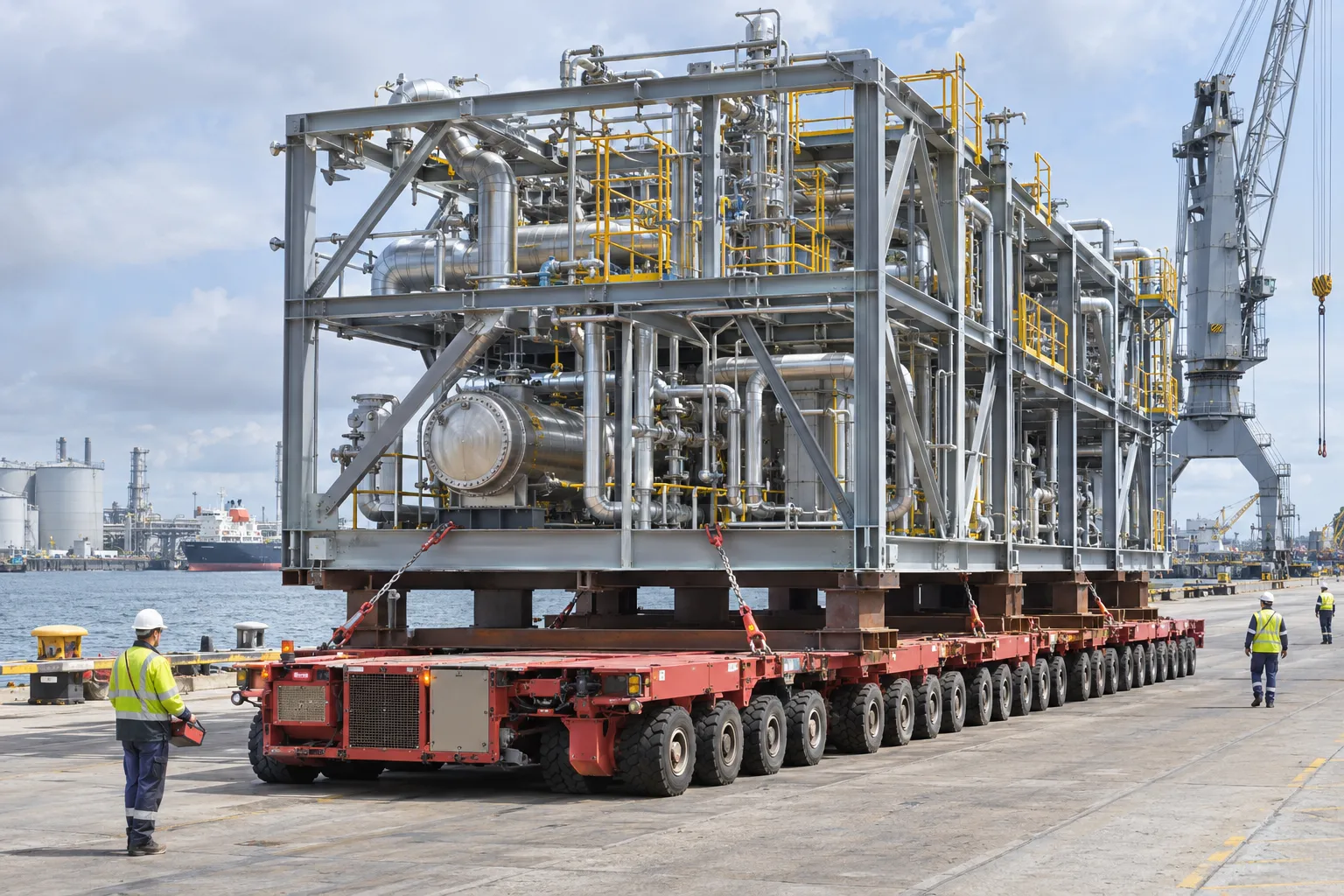
Refinery module transport starts long before the module leaves the fabrication yard. The size of the largest module decides the ship, the load port, the discharge method and often the road from the quay to the plot. Anil Darya plans and books sea transport for process modules, skids, pipe racks and pre-assembled units with heavy lift, multipurpose and module-carrier lines. We coordinate the surveys and the local contractors at each end, into the UAE, out of yards in the UAE, and as cross-trade between two other countries.
This page is for EPC logistics leads, fabrication yards and owners' teams who need to fix module envelopes, pick a vessel type and plan the discharge before the shipping budget is locked.
Modules, skids and pre-assembled units
The words get used loosely, so here is how we use them on a booking:
| Unit | What it is | Typical shipping mode |
|---|---|---|
| Skid | Process equipment, piping and instruments on a steel base frame, built and tested in a workshop | Container, flat rack, or break bulk on a multipurpose ship |
| Pre-assembled unit (PAU) | Larger frame, often several levels, with equipment, piping and cable trays installed | Break bulk or heavy lift ship |
| Pipe rack module | Long steel structure carrying pipes and cables between process areas | Heavy lift ship, deck stow |
| Process module | A whole process section, sometimes thousands of tonnes | Heavy lift, semi-submersible or module carrier, often chartered |
A modular process skid is a process system held in a frame so it can be moved. Wikipedia's summary of the concept lists controls, piping, pumps, valves, heat exchangers and instrumentation as typical contents, and notes that skids are not always suitable when individual parts are too large for the frame. PRIOS makes a related point about modular process plants: module size and weight have to fit practical transport limits such as axle loads, bridge clearances, turning radii and port access, and the chosen transport method decides the practical module size.
That is why the logistics team should be in the room when the module split is decided, not after. For the concept behind modular plants, see .
Refinery module transport by vessel type
The module envelope (length, width, height, weight and centre of gravity) narrows the vessel choice quickly. The published projects below show the range.
| Module size (published example) | Vessel type used | Loading and discharge |
|---|---|---|
| 59 refinery modules up to 472 t, Batangas to Burns Harbour (BigLift, 2011) | Heavy lift ships with own cranes | All modules discharged onto barges at Burns Harbour |
| Nine FPSO modules of 320 to 520 t, almost 30,000 cbm (BigLift, 2013) | Two heavy lift ships, open-top configuration | Delivered by barge alongside at Jurong; tandem lifts with both ships |
| 24 modules for a US ethane cracker, built in Hamriyah, UAE (Roll Group, 2019) | RollDock vessels, plus BigRoll module carriers for the largest | Most cargo loaded and discharged directly from the quay |
| Five modules and five pipe racks, heaviest about 1,800 t, Qingdao to Rotterdam (Shell Pernis) | RollDock multi-deck ships | Rolled onto a barge by SPMT, barge towed to site, rolled off on a ro-ro ramp |
| 35 modules totalling 179,000 t for LNG Canada, Qingdao yard (COOEC) | Semi-submersible heavy transport, including Xiang An Kou for the last two | Float-off or roll-off at the LNG site |
Heavy lift ships with their own cranes
These carry most modules from a few hundred tonnes up to the combined lift of the ship's cranes. BigLift's Happy S-type ships were built with two 900-tonne mast cranes that can be combined for 1,800 tonnes, on a 156 metre hull with a single large hold. They lift cargo off the quay or a barge without shore cranes, which matters at a remote site. For the main ship types, see .
Ro-ro module carriers
Above crane capacity, or where the quay is good, modules are rolled on and off with self-propelled modular transporters (SPMTs). Roll Group used shallow-draft RollDock vessels to load and discharge most of the ethane cracker modules straight from the quay, and switched to BigRoll module carriers on two voyages because of module size.
Semi-submersible heavy transport
The largest LNG and process modules go on semi-submersible ships. The ship ballasts down, the cargo is floated or rolled on, and the ship deballasts to sail. LNG Canada's 35 Qingdao-built modules included all 19 core process modules, and COOEC delivered the last two on the semi-submersible Xiang An Kou.
[CHATGPT-IMAGE: INLINE | 1200x800 | self-propelled modular transporters rolling a pipe rack module onto a barge | SPMT lines under a long steel pipe rack module crossing a link ramp from a quay onto a flat deck barge | template: ANIL DARYA (navy & turquoise, logo top-left) | SPMTs rolling a pipe rack module from the quay onto a deck barge]
Discharge to barge or straight to the jetty
Many refinery and LNG sites sit up a river, behind a shallow approach or on a plot with no heavy quay. The ship cannot reach the plot, so the module goes onto a barge first. BigLift reports that at Burns Harbour all 59 refinery modules were discharged onto barges. At Milne Inlet, where there were no heavy cargo facilities, BigLift moored MC BigLift Barentsz stern-on to a barge held by spud poles and drove modules of up to 1,757 tonnes off the ship with SPMTs, over a bridging construction, across the barge and onto land.
When the site has its own jetty, the module can go straight from ship to jetty and onto SPMTs. For the Woodfibre LNG project, the first seven pipe rack modules arrived from Qingdao on BigLift Baffin and were offloaded to a new dock built for heavy-load delivery during construction. The project expects 19 modules in total, ranging from a 126-tonne pipe rack to an 11,000-tonne liquefaction unit, according to the SPE's Journal of Petroleum Technology.
| Discharge option | When it fits | What has to be checked |
|---|---|---|
| Ship's cranes to quay, then SPMT | Port with heavy quay and road access to site | Quay bearing capacity, road route, overhead lines |
| Ship's cranes to barge, tow to site | Site on water but no heavy quay, or shallow approach | Barge deck strength, ballasting, landing point at site |
| Roll-off by SPMT onto barge or quay | Module above crane capacity, or ro-ro ship | Linkspan or ramp, tide range, ballast sequence |
| Float-off from semi-submersible | Very large modules, deep water at the discharge point | Water depth, weather window, tug support |
The barge leg brings its own SPMT work at the far end. Irving moved two refinery modules in Saint John, Canada, about 2.5 km overland and about 20 km by barge, using 36 axle lines of SPMTs for each module. We arrange barges, tugs and SPMT contractors through local partners; we do not own them.
Engineering and approvals for refinery module transport
Module moves are engineered operations. The usual package includes:
- A weight and centre of gravity report from the yard, updated as equipment is added. At Pernis the modules ended up considerably heavier than expected, according to Breakbulk Magazine.
- A transport frame and seafastening design: grillage, stoppers and sea fastening welded or bolted to the deck.
- A lift or load-out plan with rigging, crane configuration or SPMT layout, and the ballast sequence.
- Motion and acceleration figures for the voyage, based on the ship and the route.
- A marine warranty survey where the project needs one. DNV-ST-N001 sets marine warranty survey requirements for load-out, voyages and installation.
Stowage and securing on board follow the IMO Code of Safe Practice for Cargo Stowage and Securing (CSS Code). Our specialists prepare and issue the lift plan, lashing and stowage calculations. When an insurer or charterer requires it, an independent marine warranty surveyor still approves them. Survey practice is covered in .
Our refinery work includes a refinery project in Iraq and the shipment of parts for a refinery project in Saudi Arabia.
[AMIR-FACT: photos of a real lift or loading from the Iraq or Saudi Arabia refinery projects, plus the vessel type used, cleared for publishing without client names]
Refinery module transport into and out of the UAE
Modules move in both directions here. UAE fabrication yards build modules for export: the Roll Group ethane cracker modules were built in Hamriyah and shipped to Port Arthur in the United States over seven voyages. Projects in the UAE and the wider Gulf also import modules from Asian yards.
- Out of the UAE, we book the vessel and coordinate port staging and loading at Hamriyah Port, Jebel Ali or Khalifa Port.
- Into the UAE, we arrange discharge, clearance and haulage to site. Dubai Customs charges duty at 5% of the CIF value, and we arrange payment of the duty and VAT as part of clearance.
- As cross-trade, modules go from a yard in one country to a site in another and never touch the UAE. The shipping line's own B/L is issued and released to you through us as agent for the line. Destination clearance is agreed with the consignee's broker before shipping.
[AMIR-FACT: site visit policy for module jobs: do our specialists visit the fabrication yard, load port or discharge jetty before booking, in the UAE and abroad]
[CHATGPT-IMAGE: INLINE | 1200x800 | skid-mounted process units on flat racks at a container terminal | several compact process skids with pumps and piping lashed on flat rack containers in a terminal stack area | template: ANIL DARYA (navy & turquoise, logo top-left) | Skid-mounted process units lashed on flat rack containers before loading]
Skids and small modules: containers and break bulk
Not every module needs a heavy lift ship. Skids that fit inside the gauge of a flat rack can move on the container network, and slightly larger ones go break bulk on a multipurpose liner. The decision rests on three numbers: width over the flat rack, height over the stack, and weight against the flat rack's payload. Our guide to flat rack and open top containers for OOG cargo covers the limits, and break bulk shipping covers the next step up.
Skids still need the same care as large modules: lifting points marked, instruments boxed or removed, open nozzles blanked, and preservation for the voyage. For preservation methods, see .
What drives time and cost in module shipping
We do not publish rates. These factors decide the scope:
- The largest module envelope decides between a crane ship, a ro-ro carrier and a semi-submersible.
- The number of modules sets the voyage count. One heavy lift ship can take several modules if the deck plan works. BigLift cut one project phase from four voyages to three this way.
- Late weight growth can break the stowage plan and the seafastening design.
- A barge transfer adds equipment, tugs and a weather window.
- Road route, bridges and overhead lines limit the SPMT move to the plot.
- Marine warranty and insurer approvals take time and need complete data; see break bulk and project cargo insurance.
Free module transport consultation before the envelope is frozen
The cheapest time to fix a module problem is before the yard cuts steel. Send us the module list with envelope dimensions and weights, the yard's weight and centre of gravity reports, general arrangement drawings, the fabrication yard location, the plant site and the required on-site dates. For skids, a packing list with crate sizes is enough to start.
Our specialists answer by email straight away. If the job needs it, we arrange a meeting in person. You get a shipping concept for the modules: which ones can go on the container network or as break bulk, which need a heavy lift ship, ro-ro carrier or semi-submersible, the lift planning and surveys the large units will need, the documents list, the checks to make at the discharge port or jetty, and whether a barge transfer is likely. We also suggest a route, whether the modules come into the UAE, leave a UAE yard or go cross-trade between two other countries. The first review is free.
You can start through the freight inquiry form or contact the team. If the modules belong to a wider plant scope, see also .
Frequently asked questions
How are LNG modules transported?
Mostly by sea on heavy lift ships, ro-ro module carriers or semi-submersible ships, depending on size. LNG Canada's largest modules came from Qingdao on semi-submersibles. Woodfibre LNG's pipe rack modules came on a heavy lift ship to a dedicated dock.
What is the difference between a skid and a module?
A skid is a single process system on a base frame, usually small enough for a flat rack or a truck. A module is a larger structure, often several levels, that can carry several systems and needs a heavy lift ship or module carrier.
How heavy can a module be for shipping?
There is no single limit. Published examples range from pipe racks of about 126 tonnes to an 11,000-tonne liquefaction unit at Woodfibre LNG. The vessel type changes as the weight rises.
Can modules be discharged straight onto barges?
Yes. It is common practice when the site has no heavy quay. BigLift reports discharging all 59 refinery modules onto barges at Burns Harbour, and used a barge bridge with SPMTs at Milne Inlet.
Do you own the heavy lift ships or SPMTs?
No. We book heavy lift and multipurpose lines and arrange SPMT, barge and lashing contractors, surveyors and haulers through local partners.
Can you ship modules from a UAE fabrication yard?
Yes, we coordinate export bookings from UAE ports. Modules built in Hamriyah have been shipped to the United States by module carrier, which shows the route is used.
What is skid shipping?
In project cargo, it means shipping process skids as containerised, flat rack or break bulk cargo. The skid's frame carries the lifting points and the lashing points.
Who approves the seafastening on a module voyage?
Our specialists prepare and issue the lashing and stowage calculations. Where the insurer or charterer requires it, an independent marine warranty surveyor approves them. DNV-ST-N001 is one of the standards used for these approvals.
Sources
- BigLift Shipping: 59 preassembled refinery modules
- BigLift Shipping: FPSO modules
- BigLift Shipping: constructions for Milne Inlet
- SPE Journal of Petroleum Technology: first modules arrive at Woodfibre LNG site
- Breakbulk Magazine: complex transportation for Pernis refinery
- Digital Refining: Total selects Roll Group to transport 24 modules
- LNG Prime: COOEC wraps up LNG Canada module job
- gCaptain: BigLift orders third 1,800-ton capacity heavy lift vessel
- Hydrocarbon Engineering: refinery modules given lift
- PRIOS: the advantages of modular process plants
- Wikipedia: modular process skid
- DNV: DNV-ST-N001 Marine operations and marine warranty
- IMO: Cargoes (CSS Code and cargo securing)
- Dubai Customs: FAQ (customs duty)
Reviewed: 16 November 2026