
Anil Darya International L.L.C-FZ is a Dubai-based freight forwarder offering sea freight, air cargo, dangerous goods, bulk cargo and break bulk / project cargo services, and a member of FIATA and NAFL.
[CHATGPT-IMAGE: COVER | 1536x1024 | Industrial gas turbine on a transport frame lifted by two ship cranes in tandem | Quayside at a multipurpose heavy-lift ship, a large turbine in grey weather covers hanging level under a spreader beam, tag lines held by crew seen from behind, a generator on a trailer waiting on the quay, no company names on the hull | template: ANIL DARYA (navy & turquoise, logo top-left) | Gas turbine lifted onto a heavy-lift ship with a spreader beam in tandem crane operation]
Gas turbine shipping is rarely about one heavy box. A power train is a turbine on its base, a generator that can weigh about as much, a compressor package or two, a step-up transformer, and dozens of crates of ducts, enclosures and controls. Anil Darya International L.L.C-FZ is a Dubai freight forwarder that plans and books this cargo with heavy-lift and multipurpose shipping lines, surveyors and local contractors, and coordinates it from the old foundation or the factory to the new site. We handle it into the UAE, out of Dubai, and cross-trade between two other countries.
This page is for owners, EPC logistics teams, buyers of used power plants and equipment traders. It covers what we plan, what the turbine maker and the site team must do, and how the cargo moves from the factory or the old plant to the new foundation. The step-by-step preparation of the machine itself is in our article.
What a gas turbine shipping job usually contains
Each piece in a power train has its own weak point. The planning starts by listing them, because the weak point decides the packing, the stowage and how the piece is lifted.
| Piece | Typical way it travels by sea | What we plan around |
|---|---|---|
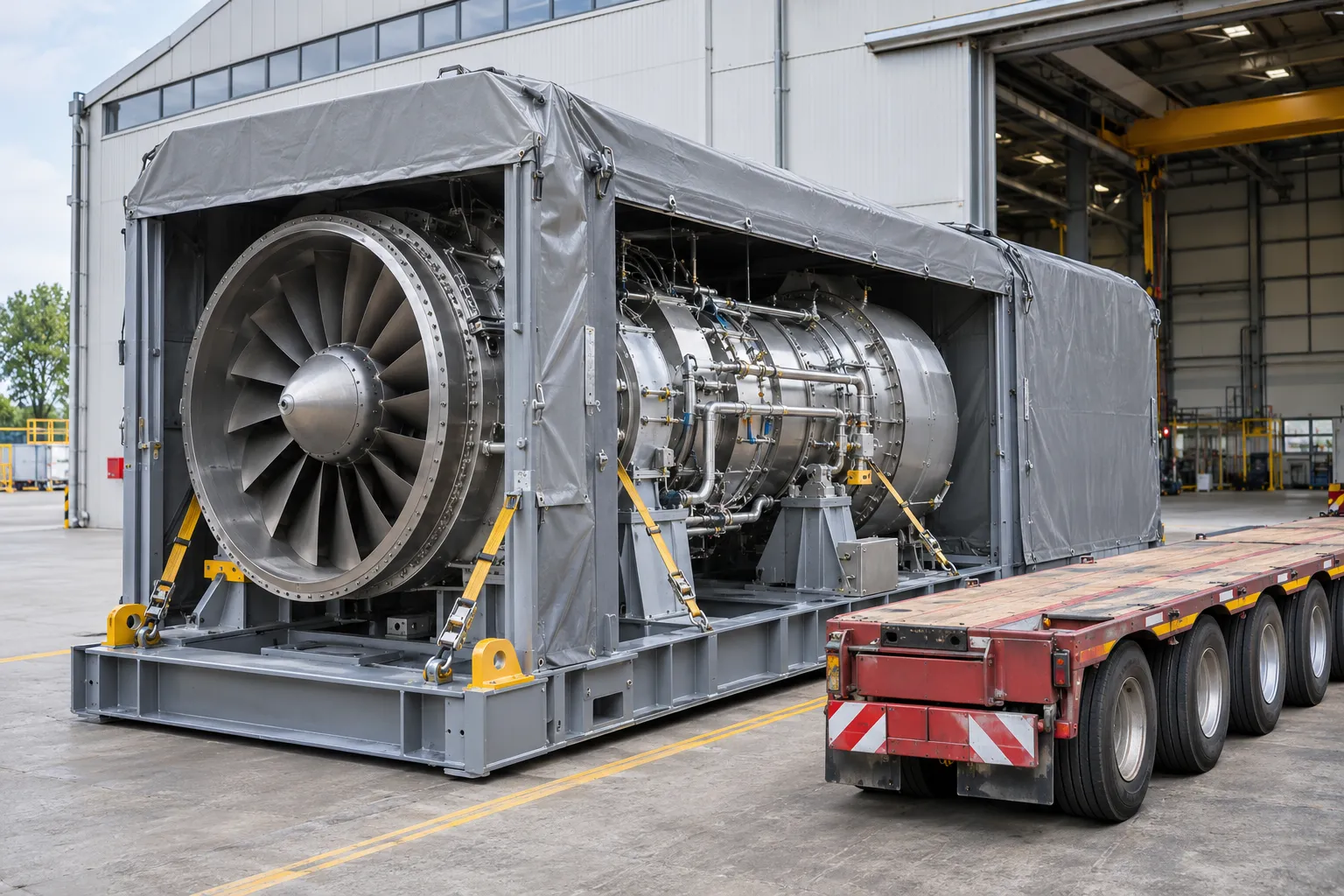
| Gas turbine (core engine on its base or transport frame) | Heavy-lift or multipurpose ship, often under deck; some relocation specialists put smaller turbines in a purpose-built shipping container | Shipping locks fitted by the OEM or field engineer, lift points and centre of gravity from the shipping drawing, no point loads on the casing |
| Generator | Heavy-lift ship, usually as a separate lift from the turbine | Rotor locked, moisture protection for the windings, the heaviest single lift on many jobs |
| Compressor package or skid | Multipurpose ship, flat rack or open top for smaller skids | Casing sealed and kept under a slight nitrogen pressure where the maker asks for it, instruments protected |
| Step-up or unit transformer | Heavy-lift ship or ro-ro main deck | Gas fill and pressure checks, impact recorders, oil shipped separately, bushings in their own crates |
| Inlet house, filters, exhaust duct, stack sections | Break bulk on deck or under deck, sometimes containers | Volume rather than weight, light steel that dents easily, lashing points |
| Control cabins, MCCs, spares | Containers or under deck | Humidity, shock, and keeping crates in the same piece numbering as the packing list |
Published jobs show the range. A Siemens gas turbine of 485 metric tons and a 465-ton generator were loaded at Bremerhaven onto a 30,000 dwt multipurpose heavy-lift vessel in 2016, with the turbine loaded from a barge, according to Marine Link. A 310-tonne Siemens turbine measuring 11.00 x 4.80 x 4.90 m was lifted onto a ship in Hamburg by two 300-tonne mobile harbour cranes, as KHL reported. At the other end of the scale, Expeditors described a 98-ton turbine rotor shipped as break bulk on a container vessel rather than a chartered ship.
[AMIR-FACT: Photos of a real gas turbine, generator or compressor lift we coordinated (no client names), with the vessel type used, for this section]
Before it leaves site: locks, rotor position and preservation
We do not prepare the machine. The OEM, its field service team or the dismantling contractor does that, and their procedure always rules. What we do is make sure the preparation is finished, documented and visible to the surveyor before the lift.
For a turbine this means shipping locks or pins fitted and the rotor secured. The Combined Cycle Journal describes one published case for older GE frames: the shell is jacked about 15 mils so a shipping pin can be fitted in the lower centreline gib key, and the rotor is pushed against the active thrust bearing for the voyage. Other frames and other makers use their own hardware. We ask for the OEM shipping instruction and attach it to the cargo file.
Preservation is the other half. Inlets, exhausts and open flanges are blanked, and the maker's preservation is applied for the expected time in transit and storage. Compressors are often shipped with the casing sealed and kept slightly above atmospheric pressure with nitrogen. In a Turbomachinery Magazine article, Saipem engineers describe holding about 15 to 20 mbar inside the casing and changing the nitrogen cylinder if it falls below about 20 to 30 mbar. The detail for long voyages is in our .
Lift points, centre of gravity and spreader beams
A turbine casing is not a lifting structure unless the maker says so. The lift has to go through the base frame, the transport frame or the marked lugs, and the centre of gravity is rarely in the middle. The OEM shipping drawing gives the weight, the lifting points and the centre of gravity. Without it nobody can plan a safe lift.
Our specialists use that drawing to prepare the lift plan, the rigging arrangement and the spreader beam or lifting beam selection, and the stowage and lashing calculation for the voyage. These are issued by our team. Where the insurer or a charterer asks for it, an independent marine warranty surveyor reviews and approves them before loading. DNV-ST-N001, the DNV standard for marine operations and marine warranty, sets out the load cases that the design and planning of load-out and sea voyages should address. More on the general method is in our heavy lift shipping guide.
[CHATGPT-IMAGE: INLINE | 1536x1024 | Gas turbine on a steel transport frame with marked lifting lugs | Close view in a fabrication yard, yellow painted lifting lugs on the frame, centre of gravity symbol stencilled on the side, spreader beam and shackles laid out on timber beside it, engineer's hands holding a printed lift drawing | template: ANIL DARYA (navy & turquoise, logo top-left) | Transport frame with marked lift points and centre of gravity before gas turbine shipping]
Transformers in the same power train
A generator step-up transformer often ships with the turbine and it behaves very differently. Large units often leave the factory drained of oil, with the tank filled with dry air or nitrogen under a small positive pressure, as EC&M describes. Bushings, radiators and arresters are removed and shipped separately, and the openings are sealed with gasketed plates, as described in Virginia Transformer's installation manual. The oil follows in its own drums or tanks.
[CHATGPT-IMAGE: INLINE | 1536x1024 | Power transformer tank without bushings on a heavy-haul trailer at a port | Grey transformer tank with blanked bushing turrets, a small steel box with an impact recorder bolted on top, a gas cylinder and pressure gauge strapped to the side, bushing crates stacked nearby on the quay | template: ANIL DARYA (navy & turquoise, logo top-left) | Step-up transformer with gas cylinder and impact recorder ready for sea transport]
Impact recorders go on the tank. POWER magazine reports that Siemens fits two recorders to each transformer and uses 1g, 2g or 3g alert thresholds, depending on the unit. The acceptance limit comes from the transformer maker, not from us. IEEE C57.150 is the IEEE guide for transporting transformers and reactors rated 10 000 kVA or higher. The full receiving routine is in our .
On deck or under deck: stowage and seafastening
Most turbines, generators and transformers go under deck when the hatch and the hold allow it. That keeps salt spray off the covers and puts the heaviest lifts low in the ship. Inlet ducts, stack sections and other bulky, light pieces often go on deck or on the hatch covers.
The choice depends on the ship. A multipurpose ship with its own heavy cranes can load at a quay without shore cranes. A ro-ro ship can take units rolled on by a self-propelled modular transporter: Atlantic Container Line moved three 161-ton transformers onto its main deck that way, with 7.45 m internal height. A heavy-lift ship is the answer when single pieces exceed what liner ships can lift. The IMO Code of Safe Practice for Cargo Stowage and Securing (CSS Code) is the reference for stowing and securing this kind of non-standard cargo.
Seafastening is welded or lashed, depending on the frame and what the owner allows on the equipment. Any welding goes to the transport frame or to stoppers, never to the machine, and the OEM has to agree to it. The lashing calculation is checked against the ship's accelerations for the route and season. For the trade-off between a liner sailing and a full charter, see breakbulk liner vs charter.
Gas turbine shipping from port to site
The sea leg is often the shortest part of the risk. The road from the discharge port to the plant has bridges, roundabouts, overhead lines and soft ground. GE described moving a 215-ton 9EMax turbine on a 529-ton transport with 42 axles, so no axle carried more than 12 tons, and said it took about six months to get all local and regional authorities to sign off. A surveyor checked each roadway, intersection and bridge before the convoy passed.
We arrange the route survey, the heavy-haul contractor and the permits with local contractors at each end. In the UAE the discharge port can be Jebel Ali or Khalifa Port, with hydraulic trailers or SPMTs taking the pieces on to site. On the receiving site, the laydown area needs ground that can carry the load, cribbing ready and weather protection for the covers. An EthosEnergy case study in Turbomachinery Magazine lists these as part of site pre-planning for a relocated turbine.
Relocating a used gas turbine
A relocation adds steps that a new unit from the factory does not have: inspection while the unit still runs, a full inventory, dismantling by the OEM or a specialist contractor, and piece marking that survives a long voyage. EthosEnergy describes cataloguing every part with a barcode device during disassembly. That list becomes our packing list and our stowage plan.
For a full plant move the turbine is one part of a much larger shipment. Our page covers that wider job. If the unit is bought from a seller abroad, agree early who pays for dismantling and preservation, and who signs the condition report at the old site.
Into the UAE, out of Dubai, or cross-trade
Imports go to power, desalination and oil and gas sites, with customs clearance arranged in Dubai, and we arrange payment of the duty and VAT as part of that clearance. Exports and re-exports leave from Dubai, including units held in a free zone; our note on JAFZA re-export of break bulk explains that route.
Cross-trade is the third case. A turbine moves from country A to country B and never touches the UAE. It travels under the shipping line's own bill of lading, issued and released to you through us as agent for the line, and clearance at destination is agreed with the consignee's broker before the cargo sails.
Our project record includes cargo for a refinery project in Iraq and parts for a refinery project in Saudi Arabia. The planning method on those jobs is the same one we apply to a power train.
What drives lead time and cost
We do not publish rates for this cargo. Every quote depends on the pieces. The main drivers are the heaviest single lift and its dimensions, whether a liner sailing exists on the route or a charter is needed, how far the site is from the port and what the road allows, the number of permits, how long the preparation and preservation take at the old site, and the survey and insurance conditions. Our quote checklist lists the data that speeds this up, and you can send an enquiry through the freight rate inquiry form.
Free gas turbine shipping consultation before you book
Send us what you have at this stage: the OEM shipping drawings or general arrangement, weights and centre of gravity for the turbine, generator and any transformer, the packing list for the crates, the origin site or factory, the destination site, and the dates you are working to. A photo of the unit on its foundation helps for used equipment.
Our specialists reply straight away by email, and we arrange an in-person meeting when the job needs one. You get back the ship types that suit the heaviest lifts, the lift planning and surveys the move will need, the documents list for export and import, the points we would check at the discharge port and on the road to site, and a suggested route into the UAE, out of Dubai or cross-trade. Any OEM preparation steps stay with the maker and are flagged in our reply.
[AMIR-FACT: Our site visit policy for turbine and generator jobs: do we visit the old plant or factory before quoting, in Dubai and abroad?]
Frequently asked questions
How are gas turbines transported?
By road to the nearest suitable port on hydraulic trailers or SPMTs, by sea on a heavy-lift, multipurpose or ro-ro ship, then by road again to the new site. Some inland legs use barges. GE's 9EMax travelled by road, then by barge through 48 locks on the Rhine and Main, then by road to Munich.
Can a gas turbine be shipped in a container?
Some can. VBR Turbine Partners describes lifting the turbine out of its package and placing it in a specially designed shipping container for relocation. Heavy-duty frame units with their bases are far too large for that and ship as break bulk.
How heavy is an industrial gas turbine?
It varies widely. Published shipments include a 98-ton rotor, a 215-ton GE 9EMax and a 485-ton Siemens turbine. The OEM shipping drawing gives the real figure for your unit.
How do you ship a generator?
Usually as its own heavy lift, with the rotor locked as the maker specifies, the windings protected from moisture, and lifting through the marked points only. On many power plant jobs the generator is the heaviest piece.
Do compressor packages need shipping brackets?
Yes, where the maker supplies them. Brackets and locks hold the rotor and mounts during transit and are removed only at the final site. Many compressors also ship with the casing sealed under a slight nitrogen pressure.
Who does the lift plan and lashing calculation?
Our specialists prepare and issue the lift plan, stowage and lashing calculations. An independent marine warranty surveyor approves them when the insurer or charterer requires it. The OEM keeps responsibility for preparing the machine.
Can you ship a turbine between two countries without passing through Dubai?
Yes. In a cross-trade move the cargo sails on the shipping line's bill of lading, released through us as the line's agent, and destination clearance is agreed with the consignee's broker before loading.
What should we prepare before asking for a quote?
Weights, dimensions and centre of gravity per piece, the shipping drawings, the packing list, the pickup and delivery addresses, and the target dates. See the consultation section above.
Sources
- DNV: DNV-ST-N001 Marine operations and marine warranty
- IMO: Code of Safe Practice for Cargo Stowage and Securing (CSS Code)
- IEEE: C57.150-2023 Guide for the Transportation of Transformers and Reactors Rated 10 000 kVA or Higher
- Combined Cycle Journal: What to do before relocating a gas turbine
- GE News: Handled with care, a 529-ton odyssey
- Marine Link: Massive gas turbine shipped to Turkey
- KHL: Bohnet transports 310 tonne gas turbine
- Expeditors: Middle East to Europe gas turbine rotor
- Atlantic Container Line: Transformer transport
- Turbomachinery Magazine: Compressor preservation
- Turbomachinery Magazine: Relocation of gas turbine generators
- POWER: Innovative tool monitors for damaging impacts and vibration
- VBR Turbine Partners: Gas turbine relocation
- EC&M: Getting the most from your transformer installation
- Virginia Transformer: Liquid filled installation and operation manual
Reviewed: 16 November 2026