
Anil Darya International L.L.C-FZ is a Dubai-based freight forwarder offering sea freight, air cargo, dangerous goods, bulk cargo and break bulk / project cargo services, and a member of FIATA and NAFL.
[CHATGPT-IMAGE: COVER | 1536x1024 | refinery distillation column being lifted onto a multipurpose heavy lift vessel | quayside at dusk, two ship cranes in tandem, column on saddles, lashing crew on deck, calm water | template: ANIL DARYA (navy & turquoise, logo top-left) | Refinery column lifted in tandem onto a heavy lift vessel at a Gulf quay]
Oil and gas project cargo is the heavy, oversized and high-value equipment that builds or rebuilds a well site, a gas plant or a refinery: drilling rigs, line pipe, turbines, compressors, reactors, columns and process modules. Anil Darya International L.L.C-FZ is a Dubai freight forwarder that plans and books these pieces as break bulk and project cargo with heavy-lift and multipurpose shipping lines, surveyors and local contractors. We coordinate each shipment from loading to delivery, including inland haulage to site, whether the cargo is coming into the UAE, leaving Dubai, or moving between two other countries.
This page is the starting point for our oil, gas and refinery services. Each section below gives a short answer and points you to the page that goes deeper. If you already have drawings and weights, skip to the free consultation section near the end.
What we ship as oil and gas project cargo
Most oil and gas equipment is too big, too heavy or too oddly shaped for a standard container. A general rule from EPC logistics practice: containers suit small and medium items, while turbines and heavy machinery generally go break bulk. Many projects mix the two, with spares and small fittings in boxes and the main units loose on deck or in the hold.
The table shows the cargo we are asked about most and the shipping method that usually fits. The final choice always depends on the real dimensions, weight and the ports at both ends.
| Equipment | Typical form | Usual shipping method | Main planning point |
|---|---|---|---|
| Land drilling rigs | Mast, substructure, mud pumps, generators, tanks, in many pieces | Multipurpose (MPP) vessel, flat racks for smaller items | Piece tagging and a complete packing list |
| Jack-up and offshore units | One floating or self-elevating structure | Semi-submersible heavy lift ship or tow | Marine warranty approval and ballast plan |
| Line pipe, casing, tubing (OCTG) | Bundles or loose joints, coated or bare | Break bulk in the hold, sometimes containers for short lengths | Coating and pipe-end protection, stowage pattern |
| Gas turbines and compressors | Skid-mounted packages with lift points | Heavy lift vessel, under deck where possible | Shipping locks, centre of gravity, preservation |
| Pressure vessels, reactors, columns | Long cylinders on saddles | Heavy lift or MPP vessel, often on deck | Saddle design, lifting lugs, quay capacity at discharge |
| Heat exchangers, drums, tanks | Heavy shells, sometimes with bundles inside | MPP vessel or flat rack | Internal securing, nozzle protection |
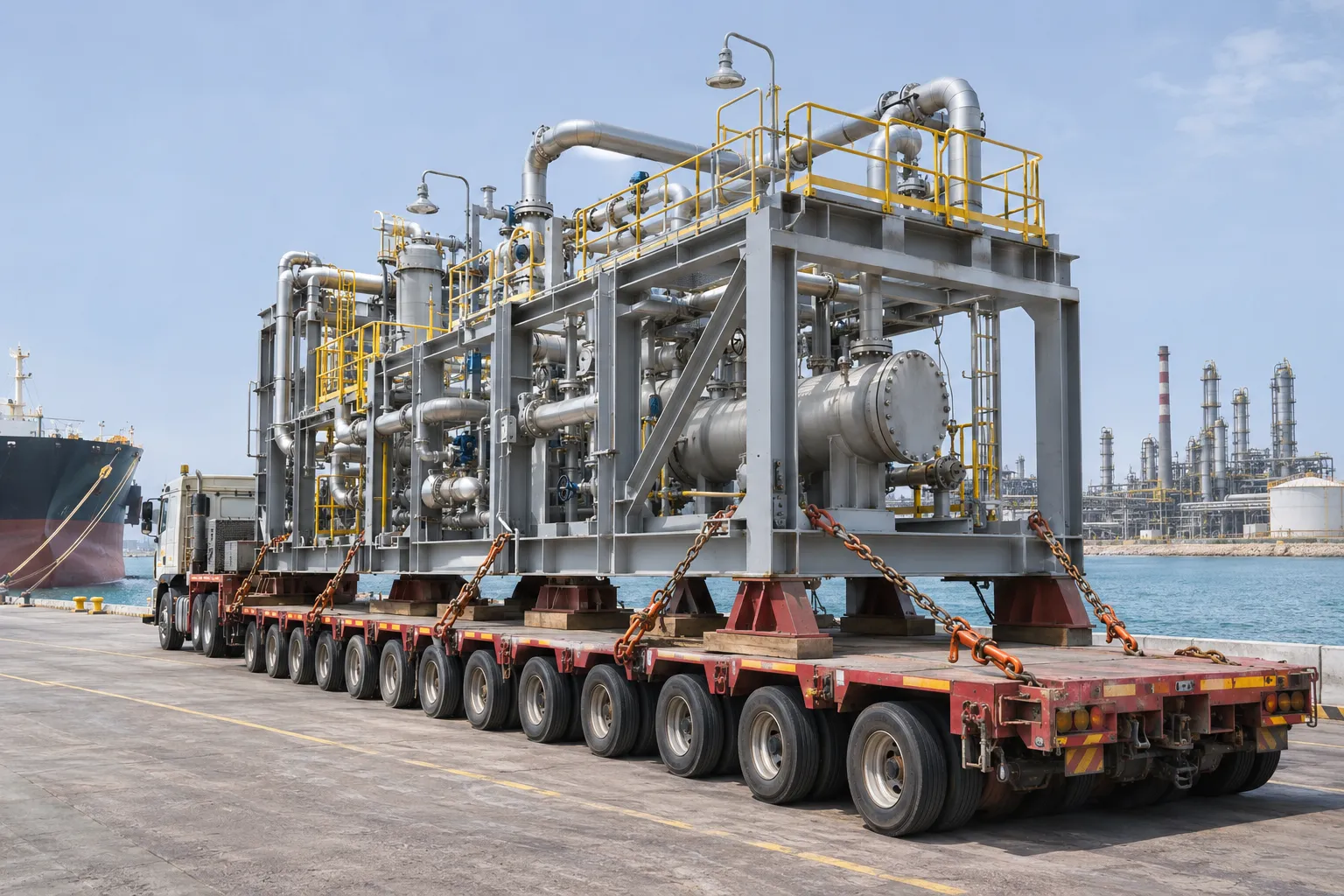
| Process modules and skids | Pre-assembled steel frames with piping | Heavy lift or deck carrier, barge for the last leg | Module footprint, jetty and road route |
| Transformers | Heavy tank, often shipped dry with the oil sent separately | Heavy lift vessel | Dry air or nitrogen fill, axle loads on the road |
| Wellheads, valves, small spares | Crated | Containers or break bulk with the main cargo | Consolidating with the main shipment |
Each family has its own page. For rigs, see . For whole plants that are being taken down and rebuilt, see . Rotating equipment is covered under , and long cylindrical units under . Modules and skids have their own page on , and pipe has .
Some of this equipment also arrives with fuel, batteries, gas cylinders or chemicals on board. Those items are declared and packed under the dangerous goods rules, which we handle through our dangerous goods shipping service.
Recent work in this sector includes cargo for a refinery project in Iraq and parts for a refinery project in Saudi Arabia.
[AMIR-FACT: the vessel type used on the Iraq and Saudi Arabia refinery shipments (MPP, heavy lift or containers plus flat racks), and one or two cleared photos of a real lift from these jobs]
Choosing the vessel for each piece
The vessel follows from the cargo, not the other way round. Weight, footprint, height and the lifting gear available at both ports decide which ships can carry a piece at all. After that, sailing dates and port rotation narrow the list.
- Multipurpose (MPP) and project cargo ships are non-submersible and carry their own cranes. Many sit in the range of about 13,000 to 19,000 deadweight tonnes. A mixed rig or plant shipment with pieces of every size usually starts here.
- Heavy lift vessels have high-capacity cranes, often paired for tandem lifts. Reactors, transformers and turbine packages go this way when one piece is beyond normal ship cranes.
- Semi-submersible heavy lift ships flood their ballast tanks to sink the deck, float the cargo on, then pump out. Jack-up rigs and other floating structures travel like this.
- Flat racks and open tops take out-of-gauge items that are still light enough for container handling, such as small skids and crated spools. Our guide to flat rack and open top OOG cargo explains the limits.
- RoRo ships suit wheeled or tracked equipment, and cargo that can be rolled on with trailers.
- Barges cover the last leg to a jetty near site, or replace a port that cannot handle the piece.
Liner sailings and full or part charters each have their place. A single turbine can often ride a scheduled MPP liner. A whole refinery may need its own charter. Our article on breakbulk liner vs charter sets out how that decision is made, and the vessel families are compared in .
[CHATGPT-IMAGE: INLINE | 1536x1024 | semi-submersible heavy lift ship carrying a jack-up drilling rig | open sea, rig legs raised, deck partly awash, clear sky, no names on hull | template: ANIL DARYA (navy & turquoise, logo top-left) | Semi-submersible ship carrying a jack-up rig on its open deck]
Engineering and surveys before loading
Heavy pieces do not move on a booking note alone. Before a reactor or a turbine is lifted, someone has to decide how it is lifted, stowed and held in place at sea. On our shipments, the lift plan, lashing and stowage calculations are done and issued by our own experienced specialists. Where an insurer or charterer requires it, an independent marine warranty surveyor still approves them.
Lift plan and centre of gravity
Every heavy lift starts with an accurate weight and centre of gravity, ideally from the manufacturer's drawings or a weighing report. Our specialists use them to select slings, shackles and spreader beams and to write the lift plan. UK HSE guidance says complex lifts need a written plan from a person with significant and specific competence, and that the plan should set out the risks, the resources and each person's role.
Lashing and seafastening
At sea the cargo is held with chains, wire, turnbuckles, welded stoppers and supports. The forces and the lashing needed are calculated for the voyage. IMO's Code of Safe Practice for Cargo Stowage and Securing (CSS Code), adopted in 1991, is the international reference, and the people planning stowage are expected to know the ship's Cargo Securing Manual.
Marine warranty survey
On larger moves, an independent marine warranty surveyor is brought in. DNV describes the marine warranty process as assessing whether a marine operation can be accepted for insurance purposes, with a certificate of approval as the main deliverable. DNV-ST-N001 covers load-out, voyages and installation work. The deeper explainer is .
[AMIR-FACT: whether our specialists attend loading and discharge in person, and our site visit policy in the UAE and abroad]
For a step-by-step view of a heavy lift from survey to discharge, read our heavy lift shipping guide.
Documents for oil and gas break bulk shipments
A missing certificate can hold a heavy piece at the quay for days. A typical document set:
- Commercial invoice and detailed packing list, with piece numbers, dimensions and weights for every item.
- General arrangement drawings showing lift points and centre of gravity.
- The shipping line's bill of lading, issued and released to you through us as agent for the line.
- Certificate of origin where the destination asks for it.
- Survey reports: pre-loading condition survey, lashing survey and, where required, the marine warranty certificate of approval.
- Dangerous goods declaration and safety data sheets for any fuel, batteries or chemicals.
- Import permits or technical approvals required by the destination country for used or specialised equipment.
For cargo arriving in the UAE, our guide to breakbulk documents and the port process in the UAE walks through each step at the terminal. Cargo insurance is a separate decision and is covered in breakbulk and project cargo insurance.
Into the UAE, out of Dubai, and cross-trade
We plan oil and gas shipments in three directions.
Into the UAE, equipment arrives at Jebel Ali, Khalifa Port or another UAE port. We arrange customs clearance, we arrange payment of the duty and VAT, and we book the port handling, permits and the heavy haulage contractor for the road move to site.
Out of Dubai, rigs, spares and refurbished equipment leave the UAE for projects in Africa, Asia, Europe and the Americas. We collect from the yard or workshop, check the packing and marking, arrange export clearance and book the vessel.
Cross-trade cargo never touches the UAE. A compressor can go from a European factory straight to a gas plant in Asia, or a used rig from one African country to another. We book the space with the shipping line, and the line's own bill of lading is issued and released through us as agent for the line. Clearance at destination is agreed with the consignee's customs broker before the cargo sails.
What drives lead time and cost on oil and gas project cargo
We do not publish rates for heavy cargo, because two shipments of similar weight can be priced very differently. These are the factors that move the numbers:
- The size and weight of the largest piece decide which vessels and cranes can handle it.
- More pieces mean more lifts, more lashing and more stowage space.
- Heavy lift and semi-submersible ships are few, so their sailing dates can set the whole schedule.
- Lift plans, lashing calculations and any marine warranty survey are part of the cost.
- If a port lacks crane capacity or quay strength, you need a floating crane or a different port.
- Bridges, overhead lines and road permits on the inland route can add weeks for very large pieces.
- Long voyages and long storage need more preservation and packing.
- Late certificates or permits hold cargo at the port.
The data you send at enquiry stage has a direct effect on how accurate the first quote is. Our breakbulk quote checklist lists what to include.
[CHATGPT-IMAGE: INLINE | 1536x1024 | heavy haulage convoy moving a gas turbine package from port to site | desert road at sunrise, multi-axle trailer, escort vehicles, power lines raised ahead | template: ANIL DARYA (navy & turquoise, logo top-left) | Multi-axle trailer moving a gas turbine package along a desert road]
Our role and what we arrange
We are the forwarder and coordinator. We book vessel space with heavy-lift and multipurpose shipping lines, appoint surveyors, and engage local contractors for cranes, trailers and lashing gangs. We do not own ships, cranes or trucks, and we do not dismantle plants. Our specialists do the lift, lashing and stowage calculations. The dismantling contractor and, where required, the marine warranty surveyor keep their own responsibility, and everyone works from the same data and schedule.
For general sea freight that runs alongside a project, such as containers of spares and consumables, see sea freight from Dubai. For break bulk outside oil and gas, see our main break bulk shipping service.
Free oil and gas project cargo consultation before you book
Before you commit to a vessel or a delivery date, send us what you know about the equipment. A rig list with rough weights is enough to start. Better still: general arrangement drawings, weights and centre of gravity for the heavy pieces, the packing list, the pickup location, the final site and the date the equipment must be on site.
We reply with the vessel types that can realistically carry your largest pieces, the surveys and lift planning the cargo will need, a list of documents for export and import, and the checks to run at the discharge port: crane capacity, quay strength, draft and storage space. We also suggest a route. That might be into the UAE, out of Dubai, or a cross-trade move that never touches the UAE. There is no charge and no obligation to book.
The full process, from first email to written summary, is set out on our page. You can also send your details straight through the freight rate inquiry form.
Our specialists answer consultation requests straight away, by email. If the project needs it, we arrange an in-person meeting.
Frequently asked questions
What counts as oil and gas project cargo?
Any equipment for exploring, producing, processing or transporting oil and gas that needs special planning to move: drilling rigs, pipe and OCTG, turbines, compressors, pressure vessels, reactors, columns, heat exchangers, process modules, transformers, wellheads and tanks. The line between ordinary break bulk and project cargo is explained in .
How early should oil and gas equipment be booked?
As early as the drawings and weights are known. Heavy lift and semi-submersible ships are limited, and surveys and permits take time. For a single turbine on a liner sailing, a few weeks may be enough. For a full rig or plant, planning should start months before the ready date.
Do you deliver to site?
Yes. We arrange inland haulage from the discharge port to site with local heavy transport contractors, including route surveys and road permits where the size of the cargo requires them.
Can you ship between two countries without passing through Dubai?
Yes. In a cross-trade shipment the cargo goes directly from the origin port to the destination port. The shipping line's bill of lading is released through us as agent for the line, and destination clearance is agreed with the consignee's broker before sailing.
What is a marine warranty survey and who needs one?
It is an independent review of a marine operation, such as loading or a voyage, so that the insurer can accept the risk. Under DNV's service description the main output is a certificate of approval. It is usually required for the heaviest and highest-value moves, such as rigs and large modules.
Can oilfield equipment go in containers?
Smaller items can: valves, spares, crated fittings and short pipe lengths. Large pieces such as turbines, columns and rig masts generally need break bulk or heavy lift ships. Many projects use both.
Who issues the bill of lading?
The shipping line issues its own bill of lading. We release it to you as the line's agent, so the document you receive is the carrier's B/L.
Do you handle oil and gas equipment with dangerous goods on board?
Yes. Fuel in tanks, batteries, gas cylinders and chemicals must be declared under the dangerous goods rules. We prepare the declarations with you and book the cargo with lines that accept it.
Sources
- DNV-ST-N001 Marine operations and marine warranty (DNV)
- DNV-SE-0080 Noble Denton marine services: marine warranty survey (DNV)
- Code of Safe Practice for Cargo Stowage and Securing (IMO)
- Planning and organising lifting operations (UK HSE)
- API Specification 5CT, Casing and Tubing (API)
- Optimizing EPC logistics: containerized vs break-bulk cargo (EY)
- Heavy-lift ship (Wikipedia)
- Getting the most from your transformer installation (EC&M)
- Heavy lift and project cargo advisory (BMT)
Reviewed: 16 November 2026