
Anil Darya International L.L.C-FZ is a Dubai-based freight forwarder offering sea freight, air cargo, dangerous goods, bulk cargo and break bulk / project cargo services, and a member of FIATA and NAFL.
[CHATGPT-IMAGE: COVER | 1536x1024 | Tall refinery column being loaded onto a heavy lift ship | A long white distillation column resting on steel saddles, lifted in tandem by the two cranes of a heavy lift vessel at a quay at sunrise, spreader beam and slings visible, port workers in hard hats at a distance with faces not visible, no logos on the hull | template: ANIL DARYA (navy & turquoise, logo top-left) | Distillation column on transport saddles lifted aboard a heavy lift vessel by two ship cranes]
Refinery equipment shipping is mostly about moving long, heavy steel cylinders without bending them, denting them or letting water in. Columns, reactors, pressure vessels, heat exchangers, drums and tank sections reach the quay with their own drawings, saddles and lifting lugs. Each one needs a vessel, a stowage plan and a discharge plan that fit it. Anil Darya plans this cargo from Dubai with heavy-lift and multipurpose shipping lines, surveyors and local contractors. We ship into the UAE, out of Dubai, and between two other countries as cross-trade, and we coordinate from loading to delivery, including inland haulage to site.
This page is for the engineer or project buyer who has the fabricator's general arrangement drawing on the desk and wants to know what the shipping side will ask for. It covers saddles and lifting points, stowage, the destination port checks, and the documents and inspections. The last section explains the free consultation we offer before you book.
Refinery equipment we ship and how it usually travels
The name of the item matters less than its length, diameter, weight and the way its supports are built. Most refinery pieces fall into one of these groups.
| Item | Typical shape | Usual shipping method | Points to settle early |
|---|---|---|---|
| Distillation, fractionator and stripper columns | Very long and slender, horizontal for transport | Heavy lift or multipurpose vessel, sometimes a barge for the last leg | Saddle positions, bending under self-weight, tailing lug for upending |
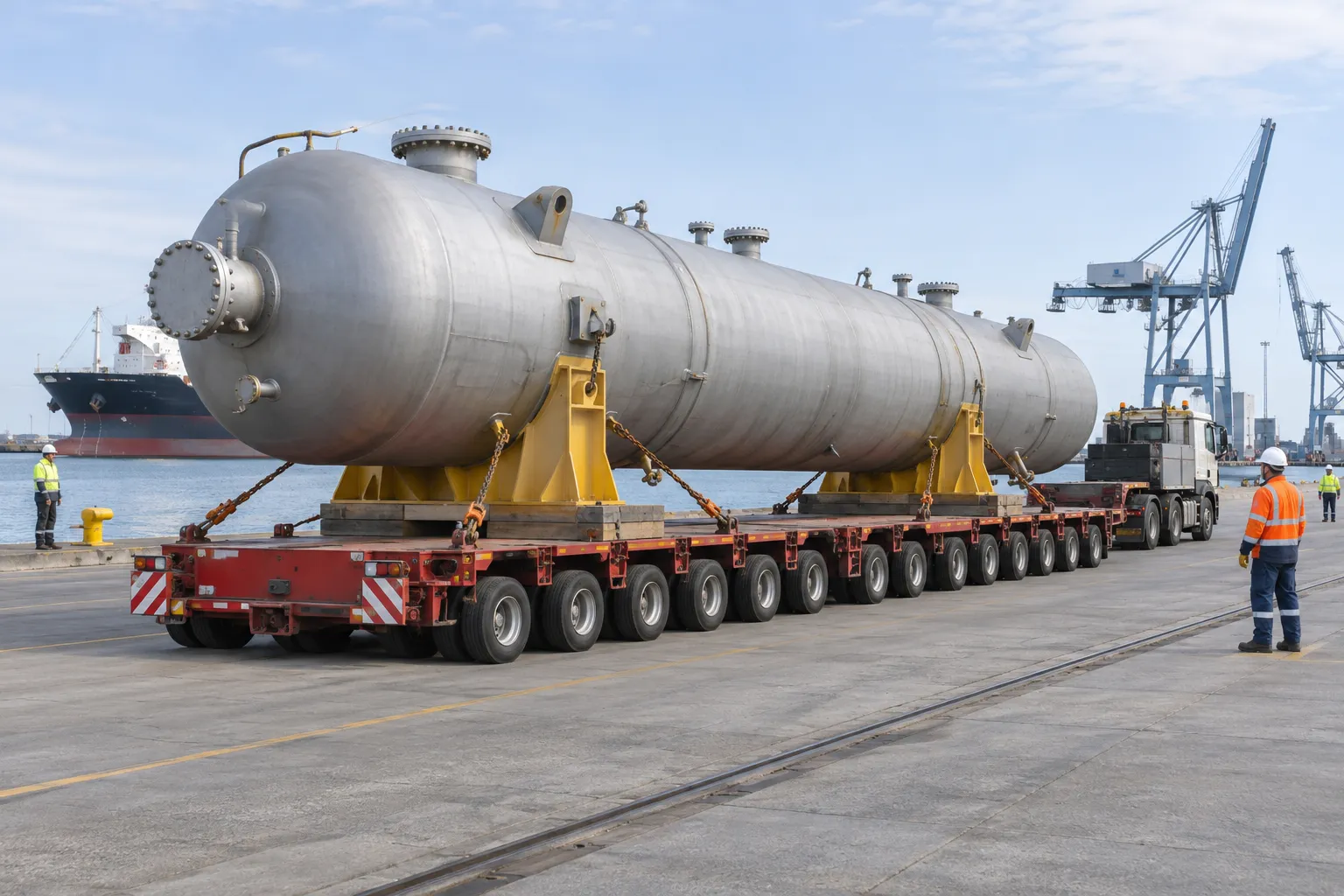
| Hydrocracking and hydrotreating reactors | Short, thick-walled, very heavy for their size | Heavy lift vessel with ship cranes in tandem, or a semi-submersible | Quay bearing capacity, SPMT axle count, crane capacity at outreach |
| Pressure vessels and drums | Medium length, nozzles and manways on the shell | Multipurpose vessel, under deck where height allows | Nozzle protection, blind flanges, internal preservation |
| Shell-and-tube heat exchangers | Shell plus a removable tube bundle | Multipurpose vessel, or flat rack for small units | Bundle restraint inside the shell, nitrogen or dry air fill |
| Air coolers and skids | Wide, light frames with fragile fins | Under deck or on flat racks | Fin protection, stacking limits |
| Storage tank shell rings and roof sections | Large curved or flat plates | Break bulk, often on deck | Bracing so curved plates keep their shape |
Valves, instruments, column internals and spares usually go in containers on the same booking. Splitting one project between containers and break bulk is normal. Our guide to flat rack, open top and out-of-gauge cargo shows where that line usually falls.
Columns and reactors: saddles, lifting lugs and stowage
A column is designed to stand upright on a foundation. On a ship it lies on its side, and the shell has to carry its own weight as a beam between two or three supports. So the fabricator's transport saddles matter as much as the vessel.
Transport saddles
Saddles are curved steel cradles, usually timber-lined, either welded or bolted to the shell or loose under it. Their spacing decides how much the column sags and where the load goes into the deck or tank top. Our specialists check the saddle positions against the deck strength of the vessel and against the lashing points. If the saddles do not suit the ship, changing them at the fabrication shop is far easier than changing them at the quay.
Saddles have to suit the land leg too. In one published case, the heavy haul contractor Deep South received a 790,025 lb debutanizer column at the Port of New Orleans, 174 ft 3 in long and 21 ft 3 in across. The team worked with the vessel manufacturer to modify the shipping saddles so the column could ride on split SPMT trailers. The lower load then passed under the plant's pipe racks with less than an inch of clearance. That only works if the shipping and site teams see the saddle drawing before the column is finished.
Lifting lugs and the centre of gravity
Columns and reactors carry lifting lugs or trunnions near the top and a tailing lug at the base for upending on site. At sea, the ship's cranes usually lift the item horizontally with a spreader beam, on lugs or slings at marked points. The lift plan needs the weight, the centre of gravity in all three directions and the certified lug capacity. Guidance from the UK Health and Safety Executive says a complex lift, such as a tandem lift with more than one crane, needs a written plan from someone with specific competence. Heavy refinery pieces nearly always fall into that group.
Tandem lifts with the ship's own cranes are common for the biggest pieces. In 2018, two hydrocracking reactors built by ATB Riva Calzoni for the Dangote refinery in Nigeria, each about 1,535 tonnes and 60 metres long, came to the quay in Venice on a 72-axle SPMT. They were loaded on BigLift's Happy Star, which has two 1,100-tonne cranes, and the port said it had never loaded anything that heavy. In 2023, DSV shipped a 950-tonne crude fractionator from Kuantan in Malaysia to the Balikpapan refinery in Indonesia on a ship whose two 900-tonne cranes lifted it in tandem.
Stowage and seafastening
Long pieces go fore and aft where possible, on their saddles, held by welded stoppers or seafastening brackets and chain or wire lashings. The IMO Code of Safe Practice for Cargo Stowage and Securing (CSS Code) says stowage should be planned for the worst weather that can reasonably be expected on the voyage. It also notes that most securing problems come from the ship's motion, mainly the transverse roll. For a reactor, that means the lashing calculation is done for the route and the season, not just the weight. Under deck stowage keeps spray off nozzles and paint, but large-diameter columns and reactors often have to go on deck.
[CHATGPT-IMAGE: INLINE | 1536x1024 | Pressure vessel seafastened on the deck of a multipurpose ship | A horizontal grey pressure vessel on two steel saddles welded to the deck of a multipurpose vessel, chain lashings and welded stoppers at each saddle, blind flanges on all nozzles, open sea in the background, no logos | template: ANIL DARYA (navy & turquoise, logo top-left) | Pressure vessel on deck saddles with chain lashings and blind flanges on its nozzles]
Heat exchangers, drums and tanks
These pieces are lighter than reactors but easier to damage, because the weak points sit inside them or on their surface.
In a shell-and-tube heat exchanger, the tube bundle has to be locked inside the shell so it cannot slide during the voyage. The unit is sealed and usually kept under a small nitrogen pressure. One published construction preservation guide sets this at 0.5 bar(g). Where nitrogen is impractical, it allows dry air with moisture absorbents, provided their position is recorded so they come out before start-up.
Drums and pressure vessels get a blind flange or solid cover on every nozzle. Bolts and flange faces are greased, and openings for instruments not yet fitted are plugged. The same guide treats temporary covers that keep water out as mandatory, and calls a nitrogen blanket on austenitic stainless steel imperative. Stainless items also need timber or rubber between the shell and any carbon steel lashing.
Tank shell rings and roof sections need internal bracing, often called spiders, so the curved plate keeps its shape when it is lifted and lashed. Flat plates travel in bundles with timber between the layers.
Preservation follows the fabricator's or owner's specification, and the shipping plan has to respect it. Tell us what gas or desiccant is inside, at what pressure, and who checks it on arrival.
Choosing the vessel for refinery equipment shipping
Three facts decide the vessel: the heaviest single lift, the longest piece, and whether the ports at each end have shore cranes that can take it. If they do not, the ship's own gear does the work, and the choice narrows to heavy lift and multipurpose vessels with enough crane capacity at the required outreach.
A multipurpose vessel suits a mixed refinery package of a few heavy vessels plus steelwork, pipe spools and boxes. Single pieces of several hundred tonnes usually need a heavy lift ship with paired cranes. Units too heavy to lift at all are rolled or floated onto a semi-submersible or deck carrier. When the refinery has its own jetty or sits up a river, a barge or coaster often does the last leg.
Whether you use a liner sailing or charter a ship depends on the size of the package and your dates. That trade-off is in break bulk liner vs charter, and lift planning is covered in our heavy lift shipping guide.
Destination port checks: quay capacity, cranes and draft
Most delays on refinery jobs happen at the receiving end, not at sea. Before we confirm a vessel, we check the discharge port and the route to site against the heaviest and the longest pieces.
| Check | What we ask the port or terminal | Why it matters |
|---|---|---|
| Quay bearing capacity | Allowable load per square metre at the berth and in the laydown area | A reactor on an SPMT puts a high load on a small patch of quay |
| Draft and tide | Berth depth, tidal range, any night or tide limits | A deep-laden heavy lift ship may only berth on certain tides |
| Cranes | Shore crane capacity at outreach, mobile crane hire, floating crane availability | Decides whether ship's gear is needed for discharge |
| Berth length and access | Free berth length, fenders, space beside the ship for SPMTs | A tandem discharge needs room on the quay for the transporter |
| Storage | Laydown area, ground preparation, free storage days | Pieces often wait for the site to be ready |
| Route to site | Bridges, overhead lines, roundabouts, escorts and road permits | The land leg often takes longer to approve than the sea leg |
Ports that handle heavy cargo usually publish these figures. The Port of Aberdeen, for example, states heavy lift areas rated up to 140 tonnes per square metre and deepwater berths of 10.5 metres below chart datum. Many refinery jetties publish nothing. Then the terminal operator or a local surveyor has to confirm the numbers in writing.
Road permits can be the slowest item of all. When Mammoet moved a 400-tonne cracking column, made in India, from the port of Huelva to CEPSA's La Rabida refinery in Spain, the drive took about two hours on a 24-axle SPMT. The public road permits took two months of work with three Spanish authorities and the police.
Industry example: columns by barge, coaster and floating crane
If the refinery is on the water, the last leg can avoid the road. In 2017 GEODIS moved a 310-ton column for Kinetics Technology, part of the Maire Tecnimont Group, by barge along the Ems in Germany to Rotterdam. There it went onto a coastal vessel bound for the Lotos refinery jetty in Gdansk, Poland, where a floating crane lifted it off. Three more large columns from Northern Italy and Spain went by break bulk vessel to the Port of Gdansk and then by barge to the refinery. The transport was matched to the receiving jetty, not to the nearest big port.
Into the UAE, out of Dubai, and cross-trade
Into the UAE
For refinery and petrochemical equipment arriving for a UAE project, we book the vessel and plan discharge at Khalifa Port, Jebel Ali or another suitable berth. Customs clearance and inland haulage to site are arranged with local contractors, and we arrange payment of the duty and VAT as part of clearance.
Out of Dubai
Equipment fabricated or stored in the UAE, free zone re-exports included, can load at a UAE port for any destination we serve. The shipping line's own bill of lading is issued and released to you through us as agent for the line.
Cross-trade
A column built in Asia for a refinery in Africa never has to touch the UAE. We book the heavy lift line from Dubai, coordinate the surveyors and the load port work, and release the line's B/L to you through us. Destination clearance is agreed with the consignee's customs broker before shipping, so the documents match what the receiving country expects.
Our own refinery work includes a refinery project in Iraq and parts for a refinery project in Saudi Arabia.
[AMIR-FACT: Vessel type used on the Iraq and Saudi Arabia refinery shipments, and photos of a real lift or loading from those jobs that can be published]
Documents and inspection for refinery equipment shipping
Heavy refinery pieces need more paperwork than a normal break bulk shipment, and most of it has to exist before the vessel is fixed.
- A general arrangement drawing for each piece, with dimensions, weight, centre of gravity, saddle and lug positions, and the lug load certificate.
- A packing list with a piece number painted on each item that matches the bill of lading.
- The lift plan, stowage plan and lashing calculations. Our experienced specialists prepare and issue these. Where an insurer or charterer requires it, an independent marine warranty surveyor still reviews and approves them. DNV's standard DNV-ST-N001 covers that kind of approval for load-out and for objects moved by water.
- Pre-loading and discharge surveys with photos and notes on paint, nozzles and preservation pressure, so any damage can be placed in the right leg.
- Commercial invoice, certificate of origin, and any import permits the destination needs for pressure equipment.
- Cargo insurance that suits project cargo, as explained in break bulk and project cargo insurance.
The document flow at UAE ports is set out in break bulk documents and the port process in the UAE.
[CHATGPT-IMAGE: INLINE | 1536x1024 | Surveyor checking a heat exchanger before loading | A cargo surveyor seen from behind, holding a tablet and checking the nitrogen pressure gauge on a large shell-and-tube heat exchanger resting on timber-lined saddles on a quay, blind flanges on nozzles, ship hull in the background with no name | template: ANIL DARYA (navy & turquoise, logo top-left) | Surveyor checking preservation gauge on a heat exchanger before it is loaded]
What drives lead time on refinery equipment
We publish no prices, but the drivers are predictable. The heaviest single piece sets the crane capacity and so the pool of ships that can take it. Ports without heavy shore cranes push you toward ships with their own heavy gear. Heavy lift ships are far fewer than container ships, so a ready date that slips can cost weeks. Road approvals for very large pieces can take longer than the voyage.
Short notice hurts most. In the Balikpapan case, DSV had three weeks to find a ship, get permits and prepare the shipping manual and method statement, and public holidays closed government offices for almost a week of that.
For an indication on your own package, the freight rate inquiry form lists the data we need. Our break bulk quote checklist explains why each item matters.
[AMIR-FACT: Site and factory visit policy for refinery equipment: do we inspect at the fabricator or the refinery before shipping, and where]
Free refinery equipment consultation before you book
Before a column or reactor is booked, a short review saves weeks later. Send us the general arrangement drawings, the weight and centre of gravity of each piece, the saddle and lug details, the packing list, the factory or load port, the refinery or discharge port, and the date the equipment will be ready.
Our specialists answer straight away, by email. If the job needs it, we arrange an in-person meeting. You get back the vessel types that suit your heaviest and longest items, the surveys and lift planning required, a documents list for both ends, the points we will check at the discharge port or jetty, and a suggested route. That route can run into the UAE, out of Dubai, or as cross-trade between the fabricator's country and the refinery's, with the line's B/L released through us.
Send drawings through the contact page, or read our break bulk service overview first.
Frequently asked questions
How are pressure vessels transported by sea?
Horizontally, on transport saddles, with every nozzle blanked and the inside preserved, usually with nitrogen or dry air. The ship's cranes or shore cranes lift them on certified lugs, and they are then welded or chained down according to a lashing calculation for the route.
How do you ship a distillation column?
Lying down on two or more saddles placed so the shell is not overstressed, on a heavy lift or multipurpose vessel. Long columns often finish by barge or coaster if the refinery has a jetty. The tailing lug used for upending on site should be protected during the voyage.
What is the heaviest refinery equipment shipped in one piece?
Hydrocracking reactors are among the heaviest. The two Dangote reactors loaded at Venice in 2018 weighed about 1,535 tonnes each and were 60 metres long, a record for that port.
Can heat exchangers go in containers?
Small units can go on flat racks or in open top containers if they fit the size and weight limits. Large shell-and-tube exchangers normally go break bulk, with the bundle locked in the shell and the unit kept under nitrogen or dry air.
What information do you need to quote refinery equipment shipping?
Dimensions, weight and centre of gravity per piece, drawings showing saddles and lugs, origin and destination addresses, the ready date and the Incoterm. Without the centre of gravity nobody can plan the lift.
Who does the lift plan and lashing calculations?
Our experienced specialists prepare and issue the lift plan, lashing and stowage calculations. If an insurer or charterer requires it, an independent marine warranty surveyor approves them as well.
Do you deliver refinery equipment to site?
Yes. We coordinate from loading to delivery, including inland haulage to site with local heavy transport contractors and their SPMTs or trailers.
Can you ship refinery equipment between two countries without passing through Dubai?
Yes. As cross-trade the cargo goes straight from the load port to the destination. We book and coordinate from Dubai, the shipping line's B/L is released to you through us, and destination clearance is agreed with the consignee's broker before shipping.
Sources
- GEODIS: out-of-gauge refinery columns for Kinetics Technology, Gdansk (July 2017)
- IMO: Code of Safe Practice for Cargo Stowage and Securing (CSS Code)
- DNV: DNV-ST-N001 Marine operations and marine warranty
- HSE: Planning and organising lifting operations
- Port of Aberdeen: Breakbulk facilities
- Maritime Logistics Professional: Record cargo project loaded in Port of Venice (October 2018)
- Breakbulk: DSV delivers fractionator to Indonesia (January 2023)
- Deep South: customised saddles for a refinery debutanizer
- Hydrocarbon Engineering: Mammoet installs cracking column in Spanish refinery (April 2019)
- Red Bag: Care and preservation of equipment during construction
Reviewed: 16 November 2026