
Anil Darya International L.L.C-FZ is a Dubai-based freight forwarder offering sea freight, air cargo, dangerous goods, bulk cargo and break bulk / project cargo services, and a member of FIATA and NAFL.
[CHATGPT-IMAGE: COVER | 1536x1024 | Coated line pipe being lowered into the hold of a general cargo ship | Long black-coated line pipes in a spreader lift with padded hooks descending into an open cargo hold, timber dunnage rows visible on the tank top below, stevedores at a distance with faces not visible, overcast port sky, no logos on the hull | template: ANIL DARYA (navy & turquoise, logo top-left) | Coated line pipe lowered into a ship hold with padded hooks and timber dunnage]
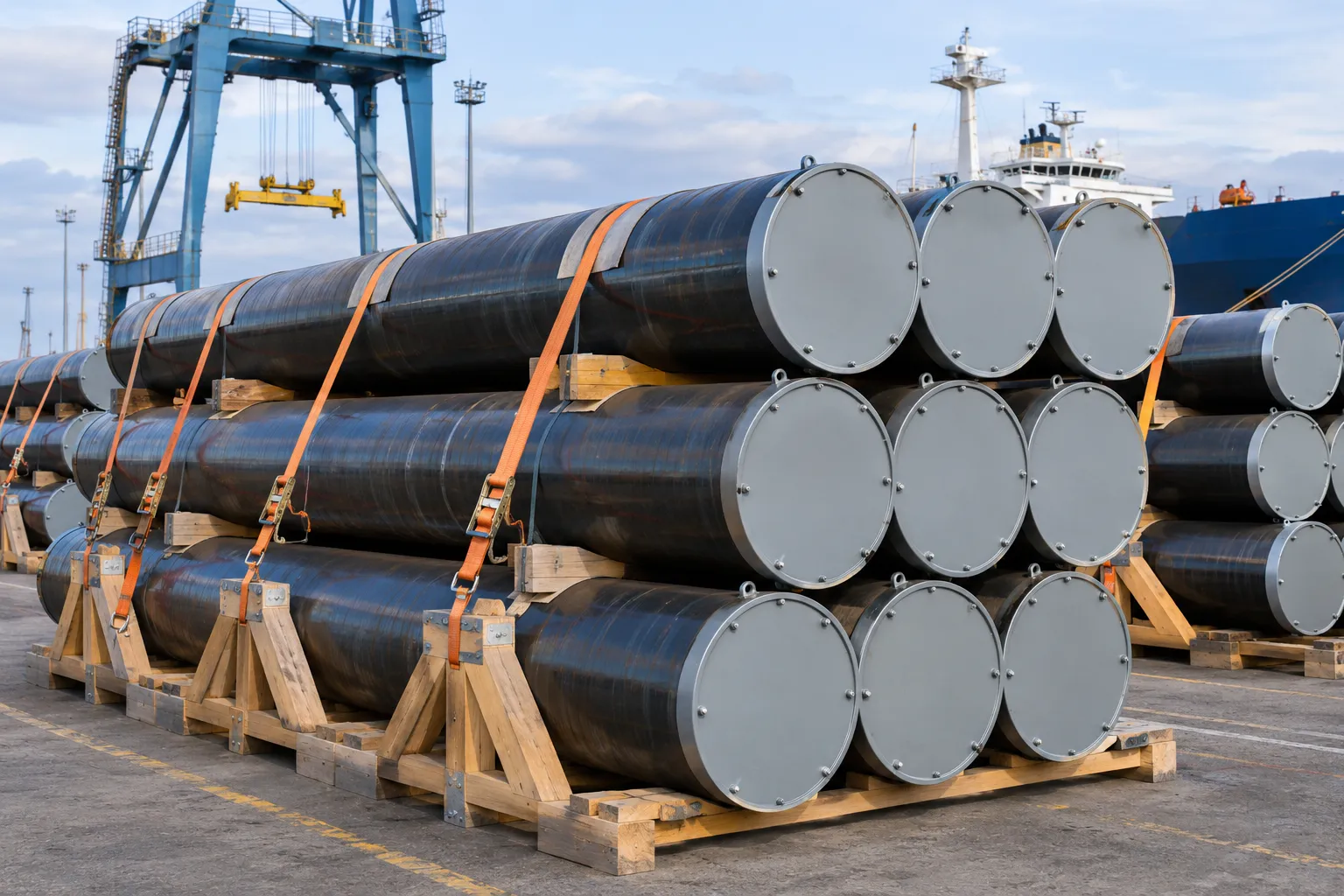
Steel pipe shipping looks simple on paper: round steel, known weight, no awkward centre of gravity. In practice most pipe claims come from a few things done badly. Coatings get scraped, bevels get notched, bundles shift, and pipes get wet and rust. Anil Darya books line pipe, casing, tubing and structural pipe as break bulk with multipurpose and general cargo shipping lines, and coordinates surveyors, stevedores and inland haulage from loading to delivery. We ship into the UAE, out of Dubai, and between two other countries as cross-trade.
This page covers stowage in the hold, coating and bevel-end protection, bundles and lengths, lashing, and the choice between break bulk and containers. If you want to know what casing, tubing and drill pipe are before you ship them, start with our explainer on OCTG.
Steel pipe we ship as break bulk
| Pipe type | Common standard | How it usually travels | Main risk in transit |
|---|---|---|---|
| Line pipe, bare or with mill varnish | API 5L | Loose, nested in the hold | Dented ends, bevel damage, rust |
| Line pipe with 3LPE, FBE or similar coating | API 5L plus the coating specification | Loose, with padding and separators | Coating scuffs from hooks, dunnage and other pipe |
| Concrete weight-coated pipe | Project specification | Loose, low tiers, heavy dunnage | Chipped concrete, cracked coating |
| Casing and tubing (OCTG) | API 5CT | Bundles or loose with thread protectors | Thread damage, protectors lost, corrosion |
| Small-bore and structural pipe | Various | Strapped bundles | Chafing inside the bundle, bent pipe |
API's licensing form for Spec 5L lists the pipe types the standard covers, such as SMLS pipe made without a weld, high-frequency welded (HFW) and longitudinal submerged-arc welded (SAWL), with grades from B up to X90. It also lists annexes for sour service and offshore pipe. Those details matter to the shipper because the purchaser's specification often adds handling rules on top.
How steel pipe is bundled, measured and marked
The German insurers' Transport Information Service (TIS) notes that large-diameter pipe normally ships as single pieces, while small-diameter pipe goes in bundles held by steel straps or wire. The strapping has to be tight enough that the pipes inside cannot rub against each other. On long or rough voyages, bundles may also get plastic or jute wrapping and sheet-metal protectors at the ends and at the sling points.
For booking, the line needs the outside diameter, wall thickness, length, weight per piece, number of pieces and total weight, plus any bundle size. Pipe is dense cargo, so the hold usually fills by weight before it fills by space. TIS quotes a stowage factor of about 1.04 cubic metres per tonne for steel pipe as one example, and says the real figure varies widely with diameter and packing. Large-diameter pipe takes far more space per tonne, which is why nesting smaller pipe inside larger pipe is sometimes allowed by the purchaser and sometimes banned.
Each pipe or bundle should carry marking that matches the packing list and the mill certificate: heat number, size, grade and pipe number. On a project with thousands of joints, a marking mismatch at discharge can hold the whole lot at the port.
Stowing steel pipe in the hold
TIS says pipe is generally stowed in the lower hold because of its weight, and that the deck loading capacity has to be part of the stowage plan. Pipes go fore and aft, not athwartships, wherever possible. Unusable spaces at the ends of the hold are filled with shores or similar material so the stow cannot move.
Wallenius Wilhelmsen's published instructions for break bulk steel pipe give a practical picture of the same rules:
- Timber goes on the tank top or deck before loading starts, with no more than 3.0 m between timbers.
- Strong timber goes between each layer of pipe, and stacks stay under 3.0 m high unless the vessel says otherwise.
- Wedges are placed on the timber where needed so the stack cannot collapse while loading.
- Pipes load fore and aft unless the operator's representative or the master decides otherwise.
TIS adds a rule for the wedges themselves. The effective securing height should be at least one eighth of the pipe diameter, and the wedge width at least two thirds of its height. For coated pipe, TIS warns that oil-based paint and wooden dunnage may damage the coating. That is why coated line pipe often travels on rubber-padded or foam-wrapped battens instead of bare timber.
The IMO CSS Code is the general framework behind all of this. It says the safe stowage and securing of cargo depends on proper planning, execution and supervision, and that the people planning it should know the ship's Cargo Securing Manual.
[CHATGPT-IMAGE: INLINE | 1536x1024 | Steel pipe stowed fore and aft in a cargo hold | View down into a cargo hold with several tiers of grey line pipe stowed fore and aft, timber separators between tiers, wooden wedges at the wings, chain lashings rising to the hatch coaming, no people and no logos | template: ANIL DARYA (navy & turquoise, logo top-left) | Tiers of line pipe stowed fore and aft with timber separators and wedges in a ship hold]
Protecting coatings and bevel ends
A line pipe that arrives with a damaged bevel has to be cut back and re-bevelled before welding. A pipe with a holiday in its coating has to be repaired and tested. Both cost time on the spread, so the shipping plan is built around the ends and the coating.
The bevel is the machined end the welder needs. It is protected by end caps or bevel protectors fitted at the mill, and by keeping bare steel hooks off it. TIS lists notched or bruised pipe ends and bent pipe among the common handling damage. Spreader bars with padded hooks or nylon slings keep the pipe from being lifted on a single wire.
TIS notes that PE and similar coatings need padding to protect them, and that pipes with sensitive inner walls, threads or chamfers get plastic or metal end caps. Coated pipe should not touch other pipe, bare timber with nails, or any lashing chain without a pad between them.
Casing and tubing are protected by thread protectors at both ends. API's announcement of the 11th edition of Spec 5CT mentions improved thread protector provisions among its changes. If a protector is missing at the pre-loading check, it should be noted and replaced before the pipe is lifted.
Corrosion is the slow version of the same problem. TIS states that steel starts to corrode at a relative humidity of 40 percent and that corrosion accelerates quickly above 60 percent. Ventilating a hold with warm outside air over cold steel can cause cargo sweat. So holds are cleaned and dried before loading, and pipe is handled in dry weather or under cover. Pipe that sat uncovered at the port before loading needs to be noted on the documents, not discovered at the other end.
Lashing and dunnage for steel pipe
Steel pipe is round, heavy and slides easily, so lashing works by keeping the stow tight and blocked rather than by tying single pieces. The Wallenius Wilhelmsen instructions set lashing for every 2.4 m width of stow. Pipes up to 6.1 m long get three vertical lashings per 2.4 m of width, and longer pipes up to 12.2 m get at least five. Chains are run as close to vertical as possible to an overhead deck or bulkhead and tightened hard.
TIS adds that gaps, especially lengthwise gaps, should be avoided. Where a gap cannot be avoided, the stow needs direct securing such as a tight fit or loop lashing, friction securing such as tie-down lashing, or both. Friction mats under the cargo and between layers help. The Swedish Club, a P&I insurer, published a claim where concrete-coated pipe had no protection at the bulkhead and too little dunnage between layers. The pipes were damaged on the voyage and again when stevedores let them hit the ground at discharge.
On our jobs the stowage plan and lashing calculation are done and issued by our experienced specialists, using the vessel's Cargo Securing Manual. Where an insurer or charterer requires it, an independent surveyor still approves them.
Break bulk or containers for steel pipe shipping
EY's 2025 paper on project logistics lists the factors that decide between containers and break bulk: cargo size, weight and fragility, freight and handling cost, transit time, and the port's infrastructure and vessel availability. For pipe, the answer usually comes down to length, tonnage and coating.
| Situation | Usually better | Why |
|---|---|---|
| Hundreds or thousands of tonnes of line pipe for one project | Break bulk, full or part hold | Fewer handlings, one stow plan, direct to the project port |
| Long joints that do not fit a 40 ft box | Break bulk or flat rack | Container internal length is the limit |
| Small lots of casing, tubing or fittings | Containers | Weekly sailings, sealed against weather |
| Coated pipe going to a port with weak shore handling | Break bulk on a geared ship | The ship's cranes and padded gear control the lift |
| Mixed spread: pipe plus valves, bends and consumables | Both | Pipe break bulk, small items in boxes on the same booking |
Pipe in containers has its own risk. TIS warns that badly secured pipe can slide lengthwise and go through the front wall of the box. Weight usually limits a container before space does. Our article on flat rack, open top and out-of-gauge cargo covers the container options, and break bulk liner vs charter covers when a full ship makes sense.
Into the UAE, out of Dubai, and cross-trade
Into the UAE
For pipe arriving for a UAE pipeline or plant, we book the vessel to Jebel Ali, Khalifa Port or another berth near the project, plan discharge with padded gear, and arrange customs clearance and trucking to the pipe yard. We arrange payment of the duty and VAT as part of clearance.
Out of Dubai
Pipe stocked in the UAE, including free zone stock for re-export, can load at a UAE port for the destination project. The shipping line's own bill of lading is issued and released to you through us as agent for the line. Re-export from free zones is explained in JAFZA re-export for bulk and break bulk.
Cross-trade
Mill to project port is often the shortest route, with no reason to touch the UAE. We book the line from Dubai, coordinate the surveyor at the mill port, and release the line's B/L through us. The consignee's customs broker agrees the clearance plan with us before shipping, including the certificates the destination asks for.
[AMIR-FACT: Steel pipe or OCTG shipments we have handled that can be described without client names: pipe type, trade lane and vessel type]
[CHATGPT-IMAGE: INLINE | 1536x1024 | Casing pipe bundles with thread protectors on a quay | Strapped bundles of casing pipe with coloured plastic thread protectors on both ends, stacked on timber bearers on a dry quay under a covered shed, a mobile crane with a padded spreader beam in the background, no people and no logos | template: ANIL DARYA (navy & turquoise, logo top-left) | Strapped casing bundles with thread protectors waiting under cover for loading]
Documents and the pre-loading survey
A pipe shipment normally carries a commercial invoice, packing list by pipe or bundle number, mill test certificates, coating certificates where relevant, and a certificate of origin. The B/L describes the pipe and its condition at loading.
That condition is where most pipe disputes start. The Swedish Club recommends a pre-loading survey that records rain or sea spray exposure, rust, distortion and packaging damage with photos, and clausing the bill of lading for defects found at loading. We cover the survey and the clausing rules in detail in steel cargo pre-loading survey and the bill of lading, so we do not repeat them here.
[AMIR-FACT: Whether we attend pipe loading ourselves or appoint a surveyor, and at which load ports]
What drives lead time on steel pipe shipping
Tonnage and sailing frequency set most of it. A full or part hold of line pipe needs a ship positioned at the mill port, and mill ready dates often move. Coated pipe needs coating yard release and inspection before it can load. Discharge ports with limited shore cranes need a geared vessel. Rain at either end stops handling of pipe that has to stay dry. Our break bulk quote checklist lists the data that makes a quote fast.
Free steel pipe shipping consultation
Send us the pipe list: outside diameter, wall thickness, length, coating type, number of joints, weight per joint and total tonnage, plus the mill or load port, the project port and the date the pipe is released.
Our specialists reply straight away by email, and we set up a meeting in person when the project needs one. We send back the vessel options for that tonnage, the stowage and lashing approach for your coating, the survey points at loading and discharge, a documents list, the checks at the discharge port, and a suggested route into the UAE, out of Dubai, or as cross-trade from the mill to the project.
Contact us through the contact page.
Frequently asked questions
How are steel pipes shipped by sea?
Large pipe goes loose in the hold of a multipurpose or general cargo ship, stowed fore and aft on timber with separators between tiers and wedges at the sides. Small pipe goes in strapped bundles. Small lots can go in containers or on flat racks.
How do you protect pipe coating during shipping?
Lift with padded hooks or nylon slings and a spreader, never a single wire. Use padded battens or separators instead of bare timber, keep coated pipe off steel and chains, and keep the end caps on.
Can steel pipes go in a 40 ft container?
Yes, if the length fits the internal length of the box and the weight stays under its limit. Weight usually runs out first. The pipe must be blocked so it cannot slide into the front wall.
What is the stowage factor of steel pipe?
It depends on diameter and packing. TIS gives about 1.04 cubic metres per tonne as an example for steel pipe, and large-diameter pipe needs much more space per tonne.
Why is line pipe stowed in the lower hold?
Because of its weight. Low stowage keeps the ship's centre of gravity down, and the tank top usually has the strength for it, though deck loading limits still go into the plan.
Who prepares the stowage and lashing plan?
Our experienced specialists prepare and issue it from the ship's Cargo Securing Manual. Where an insurer or charterer requires it, an independent surveyor approves it as well.
Can you ship pipe from the mill to the project without going through Dubai?
Yes. That is a cross-trade booking. We book and coordinate from Dubai, the line's B/L is released to you through us, and the destination clearance is agreed with the consignee's broker before loading.
Sources
- TIS (German Insurance Association): Steel pipes
- Wallenius Wilhelmsen: Break bulk instructions, steel pipes
- Wallenius Wilhelmsen: Securing of steel pipes
- IMO: Code of Safe Practice for Cargo Stowage and Securing (CSS Code)
- API: New edition of Spec 5CT, Casing and Tubing
- API: Licensing information form for Spec 5L
- BSI Knowledge: API RP 5LW, transportation of line pipe on barges and marine vessels
- The Swedish Club: Concrete-coated steel pipes damaged during loading and discharge
- EY: Containerized vs break bulk cargo selection (April 2025)
Reviewed: 16 November 2026