
Anil Darya International L.L.C-FZ is a Dubai-based freight forwarder offering sea freight, air cargo, dangerous goods, bulk cargo and break bulk / project cargo services, and a member of FIATA and NAFL.
[CHATGPT-IMAGE: COVER | 1536x1024 | dismantled refinery column sections on saddles at a port quay | rows of numbered column sections, crated pipe spools and stacked containers on a quay beside a multipurpose heavy lift ship, late afternoon light | template: ANIL DARYA (navy & turquoise, logo top-left) | Dismantled refinery column sections and crated pipe spools waiting on a quay for loading]
A refinery relocation is a construction project run backwards, then forwards again somewhere else. A dismantling contractor takes the plant apart. Thousands of pieces are tagged and packed. Then the whole lot has to reach the new site in an order the erection crew can use. Anil Darya plans and books the sea leg of that job: containers, break bulk and, for the heaviest units, a chartered heavy lift ship. We work into the UAE, out of Dubai and as cross-trade between two other countries.
This page covers how a relocation is phased, how piece control works, which cargo goes in which mode, and where our role starts and stops. It is for plant buyers, EPC teams and dismantling contractors who want the shipping side settled before the budget is fixed.
When a refinery relocation makes sense
Buyers look at second-hand process units because a new build takes years. Phoenix Equipment reports that a 2,300 BPD recycled oil refinery it moved from Florida to Indonesia saved the buyer more than 30 months of new-construction lead time. The whole job took under nine months from due diligence to overseas delivery.
Small units, single trains and topping plants move most easily. The equipment count is manageable and the heaviest pieces fit on standard heavy lift ships. A move rarely pays when the plant is old, badly documented and corroded, or when the new site cannot take the largest pieces. The heaviest column or reactor sets the vessel type, the discharge port and the road route, so measure it before anyone signs.
If you are still deciding whether to buy, read . Plants built from skids in the first place are explained in .
The six phases of a refinery relocation
Published relocations follow the same six steps. Contractors name them differently. The order does not change.
| Phase | Who leads it | What the shipping side needs from it |
|---|---|---|
| 1. Scope study | Buyer, engineering consultant | Equipment list with weights and dimensions, heaviest lifts, target dates |
| 2. Dismantling | Dismantling contractor | Release sequence by area, so cargo reaches the port in sailing order |
| 3. Match-marking and tagging | Dismantling contractor, engineering consultant | Unique piece numbers that also appear on packing lists and shipping marks |
| 4. Preservation and packing | Packing contractor | Crate sizes, gross weights, centre of gravity marks, lifting points |
| 5. Shipping | Freight forwarder, shipping lines, surveyors | Booking, stowage and lashing calculations, bills of lading, insurance survey |
| 6. Import and re-erection | Buyer, customs broker, erection contractor | Clearance documents, port storage, inland haulage to site in erection order |
Phase 1: scope study
The scope study decides whether the move is worth doing. One published example is the European refinery that PRIOS assessed and sold to an overseas buyer. PRIOS ran a project identification and pre-feasibility study with a technical assessment and a relocation cost estimate. It gives the accuracy of that estimate as about plus or minus 30%. That is normal for an early study, and it is why the freight figures should be redone once real weights are known.
For shipping, the study should produce a first equipment list. Each line needs a tag number, description, length, width, height and weight, plus a note on whether the item will be cut, split or shipped whole. Without that list, a freight estimate is a guess.
Phase 2: dismantling
A specialist contractor does the dismantling with its own cranes, cutting crews and permits. Residual hydrocarbons are removed and the equipment is made safe before cutting starts. Phoenix lists this step on its Vicksburg job, where a 14,000 BPD crude unit was physically dismantled in under four months. Large plants take far longer. PRIOS reports about 20 months of dismantling for its European refinery.
Release order matters more to shipping than speed. Say the contractor clears the tank farm first but the buyer wants the crude unit erected first. The port then fills with the wrong cargo. Ask for a release schedule by area and book against it.
Phase 3: match-marking and tagging
Match-marking means marking both sides of every cut or flange joint so the erection crew can rejoin them exactly. Phoenix used match-marking and laser scanning on the Vicksburg unit because changes of ownership had left few drawings. On the Florida job it recorded connections, piping arrangements, skid layouts and equipment orientation before removal.
Each piece then gets a tag with a unique number. That number links the drawing, the packing list, the crate marking and the bill of lading. If one of the four uses a different number, pieces go missing.
Phase 4: preservation and packing
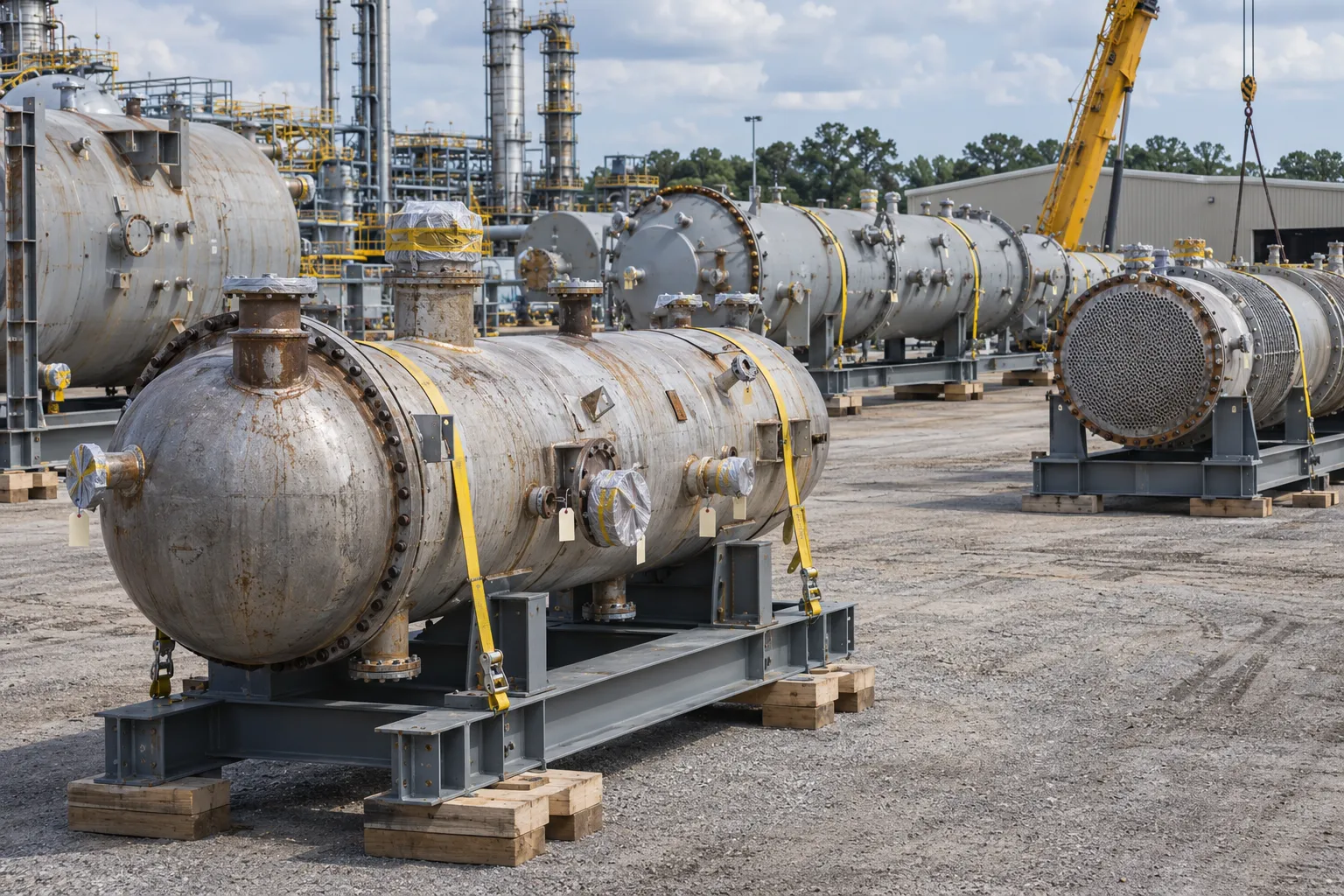
Open pipe ends are capped and machined faces coated. Instruments, motors and electrical panels go into boxes with moisture protection. Phoenix lists custom crating, VCI preservation, saddle fabrication, moisture protection and lashing plans in its export preparation. Long vessels and columns sit on fabricated saddles, which are used again for stowage and seafastening on the ship. Preservation methods are covered in .
Phase 5: shipping
This is our phase. We split the cargo by size and weight into containers, break bulk and, where needed, a part or full charter. The two sections below explain the split.
Phase 6: import and re-erection
At the destination, cargo is cleared, stored and trucked to site in the order the erection contractor needs. If the destination is the UAE, Dubai Customs charges duty at 5% of the CIF value. Its guidance on used machinery says value can be set by depreciation from the price of new machinery for the period of use. The buyer should have a valuation basis ready before the first vessel sails. We arrange payment of the duty and VAT as part of clearance.
Our refinery work includes a refinery project in Iraq and the shipment of parts for a refinery project in Saudi Arabia.
[AMIR-FACT: which vessel types and shipping modes (container, break bulk, heavy lift charter) were used on the Iraq refinery project and the Saudi Arabia refinery parts shipment, described without client names]
[CHATGPT-IMAGE: INLINE | 1200x800 | tagged and match-marked refinery piping at a dismantling site | pipe spools and a heat exchanger with painted match marks and metal tags, a crawler crane in the background | template: ANIL DARYA (navy & turquoise, logo top-left) | Match-marked piping and heat exchanger tagged for reassembly during a plant dismantling]
Piece control in a refinery relocation
Scale is the problem. PRIOS reports about 27,000 tonnes of plant steel and equipment and about 2,000 tonnes of cables on its European refinery move. It took around 1,200 containers and approximately 800 over-dimensional loads, shipped through the Port of Antwerp. Each container and load has its own packing list, and some hold hundreds of small items.
Piece control rests on four documents that must share one numbering system:
- The master equipment list has every tag, with weight, dimensions, area and erection priority.
- Packing lists, one per crate, container or unit, list the tags inside with gross and net weights.
- Shipping marks are stencilled on two sides of each piece: piece number, gross weight, centre of gravity and sling points.
- Bills of lading and manifests quote the piece numbers, so the consignee can match cargo to paperwork at discharge.
A booking register then links each piece number to its vessel, voyage and bill of lading. When the erection crew asks where tag 2-E-104 is, the answer should take minutes, not a site search.
Cables, bolts, gaskets and small valves cause the most trouble. They are light, numerous and easy to mix up. Pack them by area and system, never loose, and list them in detail.
Containers, break bulk and charter for a refinery relocation
No single mode suits a whole plant. The Phoenix Florida job shows the usual split. Skids, controls and auxiliary systems went in 20 forty-foot containers. Another 48 oversized pieces were prepared as break bulk. The shipment came to more than 4,300 cubic metres and about 955 tonnes.
| Cargo type | Typical mode | Why |
|---|---|---|
| Valves, instruments, cables, small spools, spare parts | Standard 20ft and 40ft containers | Lowest cost per tonne, sealed, easy to store at destination |
| Pumps, motors, small skids slightly out of gauge | Flat rack or open top containers | Stays on the container network with oversized items |
| Heat exchangers, drums, pipe racks, structural steel | Break bulk on a multipurpose liner service | Too big for containers, common enough for scheduled sailings |
| Columns, reactors, large modules | Heavy lift ship, often a part or full charter | Weight or length needs ship's cranes and engineered seafastening |
Out-of-gauge container limits are in flat racks and open tops for OOG cargo. The choice between a liner sailing and a charter is in break bulk liner vs charter.
Calculations and survey for the heavy pieces
Heavy units need a lift plan, a stowage plan and lashing calculations. Our specialists prepare and issue these. When an insurer or charterer requires it, an independent marine warranty surveyor still approves them. DNV-ST-N001 is the DNV standard for marine operations and marine warranty, and it covers load-out, voyages and installation. On board, stowage and securing follow the IMO Code of Safe Practice for Cargo Stowage and Securing (CSS Code), which is a mandatory instrument. Lift planning in general is covered in the heavy lift shipping guide.
Ports at each end
The load port needs quay strength, crane capacity and open storage for staging. The discharge port needs the same plus a road route to site. DP World lists breakbulk handling and project cargo OOG handling at Jebel Ali, with about 1 million square metres of open and covered yard. For plants coming into the UAE, see shipping through Jebel Ali Port.
Production lines and power plants: the same method
A production line or a power plant moves the same way, usually with fewer pieces. A bottling line or a steel processing line is mostly containers plus a few heavy frames. A gas turbine power plant has a handful of very heavy units (turbine, generator, transformers) and many small ones.
PRIOS describes a relocation concept for an 800 MW coal-fired power plant that dealt with large and heavy components, packing and corrosion protection. The approach is the same as for a refinery. Weigh and measure the heavy units first, decide which ones set the vessel type, and pack the rest by system. Turbines and generators need their own preparation; see and .
[CHATGPT-IMAGE: INLINE | 1200x800 | power plant generator stator on a heavy lift ship deck | a large stator on a steel cradle being lowered by twin ship cranes into the hold of a multipurpose vessel | template: ANIL DARYA (navy & turquoise, logo top-left) | Generator stator from a relocated power plant lowered into a heavy lift ship hold]
Our role and the dismantling contractor's role
We do not dismantle plants and we do not do process engineering. The dismantling contractor takes the plant apart and the engineering consultant documents it. We handle the logistics in between, including the shipping calculations.
| Task | Dismantling contractor | Anil Darya |
|---|---|---|
| Make-safe, cutting and dismantling | Yes | No |
| Match-marking and tagging | Yes, with the engineer | Checks that tags match packing lists |
| Packing and preservation | Yes, or a packing contractor | Advises on crate sizes and marks for shipping |
| Haulage to the load port | Often | Agrees delivery windows with the port and vessel |
| Vessel and container booking | No | Yes, with heavy lift and multipurpose lines |
| Lift plan, lashing and stowage calculations | No | Prepared and issued by our specialists; approved by a marine warranty surveyor where the insurer or charterer requires it |
| Bills of lading | No | The shipping line's B/L, issued and released to you through us as agent for the line |
| Destination clearance and haulage to site | No | In the UAE, yes; abroad, agreed with the consignee's broker before shipping |
[AMIR-FACT: site visit policy for plant relocations: do our specialists visit the dismantling site or load port before booking, in the UAE and abroad]
Into the UAE, out of Dubai and cross-trade
Into the UAE, we book the sea freight, receive the cargo at Jebel Ali or Khalifa Port, clear it and arrange haulage to site. Out of Dubai, we handle the export side for plants dismantled in the UAE and book the vessels to the buyer's country. As cross-trade, the plant goes from country A to country B and never touches the UAE. The shipping line's B/L is released through us as agent for the line, and destination clearance is agreed with the consignee's broker before the first cargo sails. Buyers who plan to re-export through a free zone can read JAFZA re-export for bulk and break bulk.
What drives time and cost in a refinery relocation
We publish no rates. Two plants of the same capacity can differ several times over in shipping scope. These are the drivers:
- The heaviest and longest pieces decide whether liner break bulk is enough or a charter is needed.
- Cutting a column into sections saves on shipping but adds weld and inspection work at the new site.
- Cargo that reaches the port out of sequence sits in storage and may be handled twice.
- Poor crates mean repacking at the port or damage claims later; see break bulk damage prevention.
- A shallow discharge port or a weak bridge on the road can force barging or a different port.
- Missing weights and drawings slow every booking and every survey.
Free relocation consultation before you plan the move
Before the scope study closes, send us what you have on the plant. Usually that is the equipment list with tags, weights and dimensions, general arrangement drawings of the largest units, centre of gravity data for the heavy lifts, a draft packing list or container estimate, the plant location, the new site and the target dates.
Our specialists reply by email straight away, and we set up a meeting in person when the project needs one. You get a shipping concept for the move. It shows which pieces go in containers, which go as break bulk and which need a heavy lift ship, with the vessel types worth looking at. It lists the lift planning and surveys the heavy units need, the export and import documents, and the checks to make at the destination port. It also gives a suggested routing, whether the plant comes into the UAE, leaves Dubai or goes cross-trade between two other countries. The first review is free.
You can send the list through our freight inquiry form or contact the team.
Frequently asked questions
What is industrial plant relocation?
It means dismantling a working or idle plant, shipping it and re-erecting it at a new site. Refineries, petrochemical units, production lines and power plants all move this way. A dismantling contractor, an engineering consultant, a freight forwarder and an erection contractor share the work.
How long does it take to relocate a refinery?
It depends on size. Phoenix Equipment moved a 2,300 BPD unit in under nine months. PRIOS reports about 20 months of dismantling alone for a large European refinery, before shipping and re-erection.
How many containers does a refinery relocation need?
A small unit may need a few dozen. The Phoenix Florida job used 20 forty-foot containers plus 48 break bulk pieces. The PRIOS European refinery needed around 1,200 containers and about 800 over-dimensional loads.
Do you dismantle the plant?
No. A specialist dismantling contractor does. We plan and book the shipping, prepare the lift, lashing and stowage calculations, and work with the contractor so cargo reaches the port in the right order.
Can a relocated plant be shipped without passing through Dubai?
Yes. As cross-trade, cargo goes from the origin country straight to the destination country. The shipping line's B/L is released through us as agent for the line, and clearance at the destination is agreed with the consignee's broker before shipping.
What is a manufacturing plant relocation project plan?
It is the schedule and responsibility matrix for the move: scope study, dismantling sequence, tagging method, packing standard, shipping plan and erection sequence. The shipping plan should follow the erection sequence, not the dismantling sequence.
How is customs duty valued on a used plant imported into Dubai?
Dubai Customs charges 5% of the CIF value. For used machinery, its guidance allows value to be set by depreciation from the price of new machinery for the period of use. Agree the valuation basis before shipping.
Is power plant relocation handled the same way?
Yes, with fewer pieces and heavier rotating equipment. Turbines, generators and transformers need their own preparation, such as shipping locks and impact recorders, before they leave site.
Sources
- PRIOS: Maximizing value amid energy transition, a successful oil refinery relocation
- PRIOS: From decommissioning to a binding offer, an 800 MW coal-fired power plant
- Phoenix Equipment: turnkey redeployment of a 2,300 BPD recycled oil refinery from Florida to Indonesia
- Phoenix Equipment: Vicksburg Petroleum 14,000 BPD crude unit sold to Africa
- DNV: DNV-ST-N001 Marine operations and marine warranty
- IMO: Cargoes (CSS Code and cargo securing)
- Dubai Customs: FAQ (duty and valuation of used machinery)
- DP World: Jebel Ali Port
- UAE Government portal: clearing the customs and paying customs duty
Reviewed: 16 November 2026