
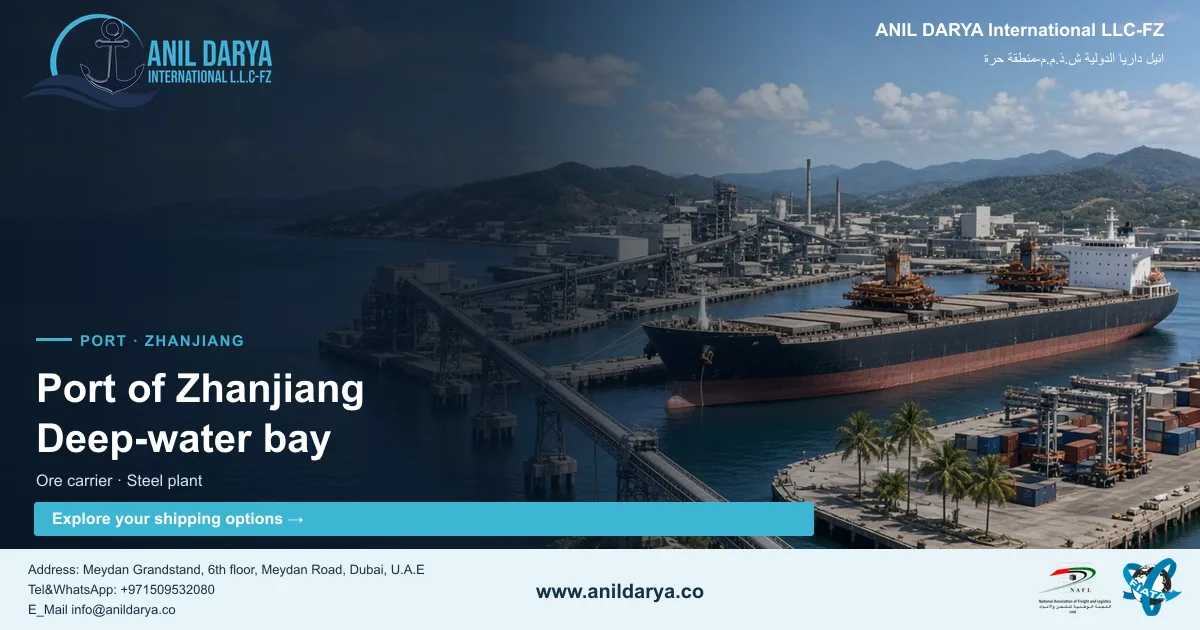
Port of Zhanjiang shipping covers the main deep-water port of western Guangdong, which handled about 265 million tonnes of cargo and 1.58 million TEU in 2025. Zhanjiang is a bulk and petrochemical port first: iron ore, crude oil and naphtha feed the steel, refining and chemical plants beside its berths. This guide explains the port areas, the Baoman container terminal and when a Pearl River Delta port is the better choice. It covers both directions: shipping from Zhanjiang to Dubai, the main flow, and shipping from Dubai to Zhanjiang.
Port of Zhanjiang: key facts at a glance
| Item | Detail |
|---|---|
| Location | Northeast side of the Leizhou Peninsula, western Guangdong, facing the South China Sea |
| UN/LOCODE | CNZHA |
| Operator | Zhanjiang Port Group, a joint venture whose shareholders include the city and Baosteel |
| Main port areas | Baoman, Xiashan, Tiaoshun Island, Donghai Island, Xuwen |
| Total cargo 2025 | About 265 million tonnes, of which 99.42 million tonnes foreign trade |
| Containers 2025 (whole port) | 1,576,500 TEU, down about 4.5% (2024: 1,650,400 TEU) |
| Containers 2025 (Port Group only) | 1,223,000 TEU |
| Main channel | 300,000-tonne class, 64.1 km long, 340 m wide; very large ships sail with the tide |
| Largest ships | Up to 400,000 DWT ore carriers |
| Big terminals | 400,000-tonne bulk, two 300,000-tonne oil, 250,000-tonne iron ore, 150,000-tonne coal |
| Container terminal | Baoman; Phase I has two 50,000-tonne container berths on a 678 m quay |
| Main container trade | Southeast Asia; long-haul cargo usually transships at South China hubs |
| Weather | Ice-free; typhoon season July to September |
| Usual UAE port | Jebel Ali, Dubai |
Where is the Port of Zhanjiang and what does it serve?
Zhanjiang sits on the northeast side of the Leizhou Peninsula, the southern tip of mainland Guangdong. Offshore islands shelter Zhanjiang Bay, which gives the port calm, broad water. Construction of the modern port started in 1956, and Wikipedia describes it as China's first modern port, planned and rebuilt from that year.
Its hinterland runs west and inland: Guangdong's western half, Guangxi, Guizhou, Yunnan, Sichuan and Chongqing. Much of that inland cargo reaches the port by sea-rail train. Haiphong in Vietnam is about 200 nautical miles away by sea, which explains why Southeast Asia is the port's main foreign container trade.
A simple rule for buyers in Dubai: if your supplier is in western Guangdong or is shipping bulk, steel, paper or chemicals from the plants around Zhanjiang Bay, look at Zhanjiang. If your supplier is in the Pearl River Delta, Nansha or Shenzhen is nearly always the better load port.
Should you load at Zhanjiang or a Pearl River Delta port?
| Your situation | Port to look at first | Why |
|---|---|---|
| Iron ore, crude, coal or other bulk on charter | Zhanjiang | Deep channel and very large bulk and oil terminals |
| Steel, chemicals or paper made around Zhanjiang Bay | Zhanjiang | Short haul from plant to berth |
| Containers from western Guangdong or the southwest by rail | Zhanjiang, compared with Nansha | Sea-rail into Zhanjiang against a longer truck run east |
| Containers from Guangzhou, Foshan, Dongguan or Shenzhen | Nansha or Shenzhen | Far more direct long-haul sailings |
| Small LCL lots | Nansha or Shenzhen | More consolidation services |
How is the Port of Zhanjiang laid out?
The port has 12 planned port areas. Five matter for shippers today. A 2018 Port Group profile listed 37 productive berths and an annual capacity of 116 million tonnes, including the bonded logistics park. Both figures have grown since.
| Area | Main role | What it means for you |
|---|---|---|
| Baoman | Container terminal | Where your container books unless the carrier says otherwise |
| Donghai Island | Iron ore and crude oil for the steel, refining and chemical plants | Industrial cargo, mostly on charter or direct to the plants |
| Xiashan | Bulk cargo and crude oil | Bulk and tanker berths; confirm the berth with the carrier |
| Tiaoshun Island | Bulk and breakbulk | Ask the carrier whether breakbulk loads here |
| Xuwen | Passenger and freight services across the Qiongzhou Strait to Hainan | Large tonnage, little relevance for UAE cargo |
The split between areas explains a common source of confusion. Ministry of Transport figures cover the whole port, including Xuwen, while Zhanjiang Port Group reports only its own terminals. That is why one source gives 1.58 million TEU for 2025 and another 1.22 million TEU.
The Baoman container terminal
Baoman is the core container area. Phase I has two 50,000-tonne-class container berths on a 678 m quay, with about 14 m of water dredged to 17 m. The structures are designed for 150,000-tonne container ships and can take ships of 12,500 TEU.
The Phase I expansion broke ground on 29 March 2024. It adds a designed 1.42 million TEU a year and takes Baoman's total capacity to about 3 million TEU, with about 1,324 m of quay. Capacity is not throughput: the whole port handled 1.58 million TEU in 2025.
Most container services from Baoman serve China's coast and Southeast Asia. The port lists coastal routes to Guangzhou, Shenzhen, Shanghai, Qinzhou and Yingkou. Abroad, Ho Chi Minh City, Singapore and Port Klang are the main calls. In 2023 the ICI7 route opened, linking Zhanjiang with Vietnam, Thailand, Singapore, Malaysia and India, and in 2026 the port reported new routes to Malaysia, Thailand, Vietnam and Indonesia.
We found no published direct container service from Zhanjiang to the UAE. Cargo for Jebel Ali usually goes by feeder to Nansha or Shenzhen, or via Singapore or Port Klang, and joins a mainline service there. Check this on every booking, because the hub decides the transit time.
[AMIR-FACT: our real routing and transit time from Zhanjiang to Jebel Ali (which hub it transships at) and the carriers or feeders we usually book for Zhanjiang cargo]
Shipping from Zhanjiang to Dubai: FCL and LCL
- FCL (full container load). You book a whole 20ft or 40ft box, stuffed at the supplier's plant. For Zhanjiang this is the usual option, and the box moves by feeder to a hub.
- LCL (less than container load). Zhanjiang has few LCL consolidation services for the Gulf. Small lots usually move by truck to a Pearl River Delta warehouse and consolidate there.
When the feeder leg and the mainline leg are on one bill of lading, the carrier owns the connection. When they are booked separately, a missed connection at the hub is your risk. Ask for a through bill of lading where you can. For container types and how we book space, see our sea freight service.
Sea-rail: how cargo from the southwest reaches Zhanjiang
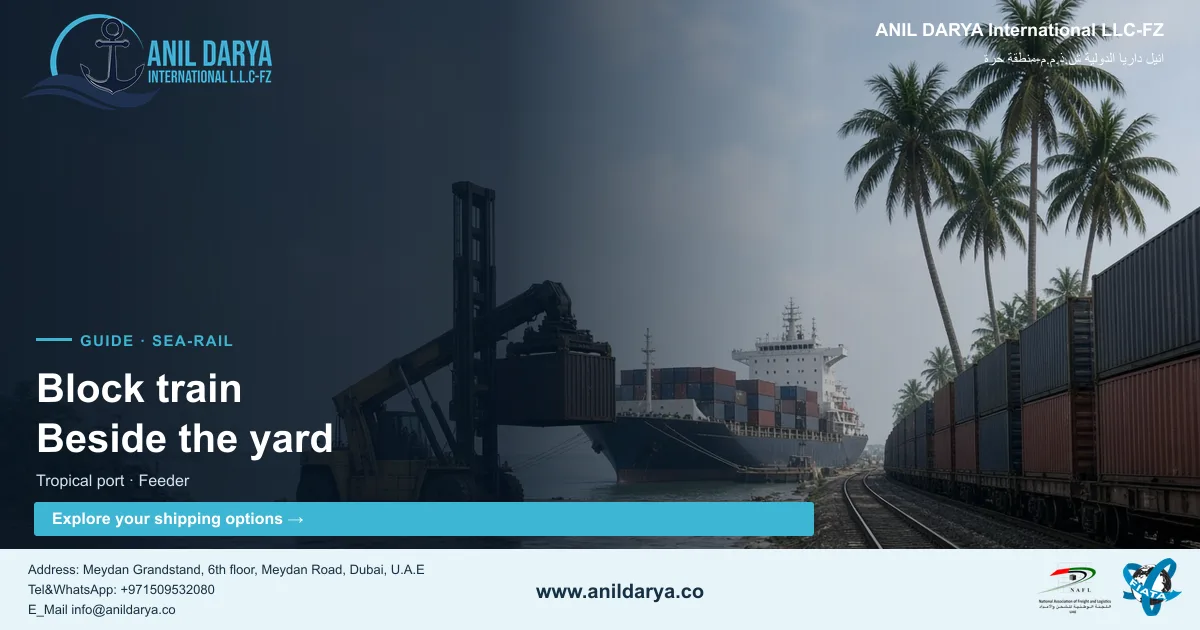
Zhanjiang is a southern exit for the New International Land-Sea Trade Corridor, the rail and sea route that links western China with overseas markets. Block trains from Yunnan, Guizhou, Sichuan and Chongqing load directly onto ships, and the port has run about 41 sea-rail services in total. In the first half of 2026, exports through Zhanjiang along the corridor rose 23.8% to 9.28 billion yuan.
The port also has about 74 km of dedicated railway and 33 km of pipelines, which carry crude oil and naphtha to the refineries and chemical plants.
A decision rule: if your supplier is in Guizhou, Yunnan, Sichuan or Chongqing, ask us to price sea-rail through Zhanjiang against trucking to Nansha. Fix the train against the vessel cut-off, because the rail plan and the shipping schedule are set by different operators.
Bulk, steel and petrochemicals: Zhanjiang's main business
Zhanjiang's strength is direct berthing for very large bulk ships, with cargo carried to the plants by conveyor belt or pipeline instead of lightering or transshipment. The main flows are imports of iron ore, crude oil and naphtha, and exports of steel, chemical and paper products.
| Facility or industry | Published detail | Why it matters |
|---|---|---|
| Deep-water channel | 64.1 km long, 340 m wide, 300,000-tonne class, trial operation from July 2021 | Very large ships wait for tidal windows |
| Bulk terminal | 400,000-tonne class | The largest ore carriers can berth |
| Oil terminals | Two 300,000-tonne terminals; the first opened in 2002 | Crude piped to refineries |
| Iron ore terminal | 250,000 tonnes, opened 2005 | Ore delivered to steelmakers |
| Coal terminal | 150,000 tonnes | Coal on large bulk carriers |
| BASF Verbund site | About 10 billion euros investment on Donghai Island | Chemical exports and DG volumes |
Port-related industry takes about 45 million tonnes of the port's cargo, over 20% of the total. For a UAE buyer, the export side is what counts: steel products, chemicals and paper made beside the port. Steel coils, plates and structures can move as breakbulk or on flat racks, and our break bulk and project cargo service handles the Dubai end. If you buy or charter bulk, see our dry and liquid bulk cargo service.
Dangerous goods and chemicals through Zhanjiang
Zhanjiang handles hazardous products, liquid chemicals and LPG, and the refinery and BASF site make chemicals a growing export. Petrochemicals must move through designated terminals, and dangerous goods need an advance declaration and terminal confirmation before the box arrives.
China Customs inspects the packaging used for exported dangerous goods. Since July 2024 a nationwide pilot lets qualified exporters ship several batches after one on-site check, with classes 6.2 and 7 excluded. Sea DG moves under the IMDG Code, 2024 edition (Amendment 42-24), mandatory since 1 January 2026.
- UN number, proper shipping name, class and packing group.
- Safety Data Sheet for each product.
- China Customs packaging inspection results.
- Signed DG declaration and container packing certificate.
- Acceptance from both the feeder and the mainline carrier, and from the hub terminal.
The last point is specific to Zhanjiang. A DG box that transships needs every carrier and hub on the route to accept the class. Our dangerous goods shipping team checks this before you commit to a sailing.
Export customs at the Port of Zhanjiang
Exports through Zhanjiang are cleared by China Customs under the same national rules as any Chinese port, which our Shanghai guide covers in more detail.
- The consignor, usually your supplier, files the export declaration itself or through a customs broker.
- The declaration is made once the goods reach the customs supervision area, and 24 hours before loading.
- The exporter must hold a Registration of Foreign Trade Operators and be recorded with customs.
What is specific to Zhanjiang is the feeder leg. Export clearance happens at Zhanjiang even when the box joins its mainline ship in Nansha or Singapore, so the bill of lading should show Zhanjiang as the place of receipt or port of loading. Ask your supplier to keep the export value in line with the invoice you give Dubai Customs.
Documents for a Zhanjiang to Dubai shipment
| Document | Prepared by | Used for |
|---|---|---|
| Commercial invoice | Supplier | China export declaration and Dubai Customs |
| Packing list | Supplier | Both customs authorities and weight checks |
| China export declaration | Supplier or its broker | Export clearance before loading |
| Rail waybill, if sea-rail | Rail operator | Rail leg to the port |
| Through bill of lading | Carrier or forwarder | Title to the goods across the feeder and mainline legs |
| Certificate of origin | Issuing body in China | Dubai Customs declaration |
| SDS and DG papers, if any | Supplier | Carrier acceptance and port rules |
| UAE permit, if restricted | Consignee | Release of restricted goods in Dubai |
How to ship from Zhanjiang to Dubai
Shipping from Zhanjiang to Dubai is the main flow on this lane: Chinese goods coming into the UAE. You buy from a supplier near Zhanjiang, we book the cargo with the carrier and handle everything once it lands in the UAE.
- Agree the Incoterm with your supplier. FOB Zhanjiang is usually simplest, because the supplier handles Chinese export clearance. Our Incoterms guide for sea freight explains who pays for each leg.
- Send us the cargo details: commodity, HS code, weight, volume or dimensions, supplier address, ready date and any DG.
- Get a quote and routing. We compare the feeder from Zhanjiang with trucking to Nansha, name the hub and ask for a through bill of lading where possible.
- Book space with the carrier and arrange origin pickup. The carrier or its trucking contractor collects the empty box or the cargo at the factory; if it comes by rail, the train is fixed against the vessel cut-off.
- Export documents at origin are handled by the shipper or its origin agent: the China export declaration, invoice, packing list and certificate of origin. For DG, heavy or out-of-gauge cargo we get carrier acceptance before this point.
- Check UAE permits for restricted goods and apply before the cargo sails.
- We check the draft bill of lading against the invoice and packing list.
- We file the UAE customs declaration before arrival, so clearance is ready when the vessel berths.
- Duty, VAT and local charges are paid, the delivery order is issued and we truck the cargo to your site in the UAE.
Customs clearance and delivery in the UAE
Dubai Customs charges 5% duty on the CIF value of most goods, with 50% on alcohol and 100% on cigarettes, and import VAT also applies. To file a declaration you need a Dubai Customs business code, or a licensed clearing agent can file with your authorisation. Most cargo from Zhanjiang lands at Jebel Ali; our Jebel Ali port guide covers terminals, trucking and declaration types there.
How to ship from Dubai to Zhanjiang
Shipping from Dubai to Zhanjiang is the export direction: you sell from the UAE to a buyer in western Guangdong or the southwest. We run the UAE end and the buyer, or a clearing agent it appoints, clears the goods in China.
- Agree the Incoterm with the buyer. Under CFR or CIF Zhanjiang we book the sea leg; under FOB the buyer's forwarder books it and we handle the UAE side.
- Check the HS code and any Chinese import licence with the buyer before you sell, not after the box sails.
- We book space with a carrier from Jebel Ali, Khalifa Port or Sharjah, whichever is closest to your goods and has a suitable service. For Zhanjiang the box usually transships at a South China hub and arrives at Baoman on a feeder, so we ask for a through bill of lading.
- We arrange the empty container, stuffing at your site or a warehouse, and trucking to the port before the cut-off.
- We prepare the UAE export or re-export declaration, the invoice and packing list checks, and the certificate of origin if the buyer needs one.
- For DG we check the SDS, packaging, labels and DG declaration, and confirm the Chinese terminal accepts the class before booking.
- After sailing we release the bill of lading and send the buyer the document set early.
- The buyer or its clearing agent files the Chinese import declaration within 14 days of the vessel's arrival declaration, as China Customs rules require, and arranges delivery in China.
Our Dubai freight forwarding team handles both directions from the UAE side and works with your supplier or buyer and their agent in China.
What affects the cost of shipping from Zhanjiang?
| Cost part | What moves it |
|---|---|
| Origin trucking or rail | Distance to Baoman, sea-rail from the southwest, or trucking to Nansha instead |
| Feeder leg | Zhanjiang to the hub, and whether it is on a through bill of lading |
| Ocean freight | Mainline service from the hub, container type, season, surcharges |
| DG and out-of-gauge | DG surcharges on each leg, packaging inspection, flat rack or breakbulk premiums |
| Dubai charges and duty | Terminal handling, delivery order, 5% duty on CIF value |
| Delays | Typhoon closures, missed connections at the hub, demurrage and detention |
Checklist before you ship through Zhanjiang
- Load port decided: Zhanjiang, or a truck to Nansha or Shenzhen.
- Hub named and through bill of lading agreed where possible.
- Rail plan fixed early for cargo from the southwest.
- Typhoon season (July to September) buffer built into the plan.
- HS code confirmed and UAE duty checked.
- Invoice, packing list and draft bill of lading match on weights, pieces and consignee.
- For DG: SDS, packaging inspection results, DG declaration and acceptance on every leg.
- Lunar New Year factory closures built into the plan.
Common mistakes when shipping through Zhanjiang
- Assuming a direct sailing to the Gulf. Plan for a feeder and a hub.
- Booking the feeder and the mainline separately, then missing the connection.
- Reading Port Group figures as whole-port figures, or the other way round.
- Ignoring typhoon season. Terminals can stop work for a storm.
- Sending chemicals without acceptance from every carrier and hub on the route.
- Sending a small LCL lot through Zhanjiang when a Pearl River Delta warehouse would consolidate it faster.
Frequently asked questions
What is the port code for Zhanjiang?
The UN/LOCODE for the Port of Zhanjiang is CNZHA. You will see it on bookings, bills of lading and tracking systems.
How big is the Port of Zhanjiang?
Ministry of Transport figures put the whole port at about 265 million tonnes of cargo and 1,576,500 TEU in 2025. Zhanjiang Port Group's own terminals handled 1,223,000 TEU, because the group figure leaves out areas such as Xuwen.
Which terminal handles containers at Zhanjiang?
Baoman is the core container area. Phase I has two 50,000-tonne-class berths on a 678 m quay and can take ships of 12,500 TEU, and an expansion started in March 2024.
Is there a direct container service from Zhanjiang to Dubai?
We found no published direct service. Zhanjiang's container routes focus on China's coast and Southeast Asia, so cargo for Jebel Ali usually transships at Nansha, Shenzhen, Singapore or Port Klang.
Should I ship from Zhanjiang or Nansha?
For bulk, steel, chemicals or paper made around Zhanjiang Bay, or rail cargo from the southwest, Zhanjiang is often the right choice. For containers from the Pearl River Delta or small LCL lots, Nansha or Shenzhen usually has more direct sailings.
Can I ship chemicals from Zhanjiang to Dubai?
Yes, if every carrier and hub on the route accepts the class. You need an SDS, China Customs packaging inspection results, a DG declaration and IMDG labels and placards, and petrochemicals must use designated terminals.
How does shipping from Zhanjiang to Dubai work?
Your supplier or its origin agent clears the goods for export in China, and we book the cargo with the carrier, usually on a feeder to a South China hub and a mainline ship to Jebel Ali. On arrival we clear it with Dubai Customs and deliver it to your site.
How does shipping from Dubai to Zhanjiang work?
We book space from Jebel Ali, Khalifa Port or Sharjah, truck and load the cargo, and file the UAE export or re-export declaration. The Chinese buyer or its clearing agent files the import declaration within 14 days of the vessel's arrival declaration.
When is typhoon season at Zhanjiang?
July to September. The port is ice-free all year, but terminals may stop work during a typhoon, so build in a buffer for sailings in those months.
Get a quote for Port of Zhanjiang shipping
Send us your cargo details and we will come back with a routing and a price for shipping between Zhanjiang and the UAE. Use our freight rate inquiry form, or contact our team if you want to talk through a bulk, steel or DG shipment first.
Sources
- Bofeng Logistics: Zhanjiang Port (2025 Ministry of Transport and Port Group figures, port areas, Baoman berths, channel, routes, sea-rail, typhoon season, DG notes)
- China Daily: Zhanjiang Port Group profile (37 berths, terminal classes, 116 million tonnes capacity, shareholders)
- China Daily: Zhanjiang channel project (64.1 km, 340 m)
- China Daily: Zhanjiang port-based industrial cluster (400,000 DWT ships, BASF Verbund)
- ECNS: South China port exports surge via new trade corridor (Baoman expansion, new routes, H1 2026)
- China Daily: ICI7 route links Zhanjiang with Southeast Asia and India (2023)
- Wikipedia: Port of Zhanjiang (location, history, oil and ore terminals)
- ShipNext: Zhanjiang port (UN/LOCODE, railway and pipeline length, cargo handled)
- Shanghai Municipal Government: China customs registration and declaration rules
- CIRS: China customs batch inspection pilot for DG packaging (July 2024)
- IMO: IMDG Code 2024 edition (Amendment 42-24)
- Dubai Customs: FAQ (duty, business code, clearing agents)
Reviewed: 10 November 2026