
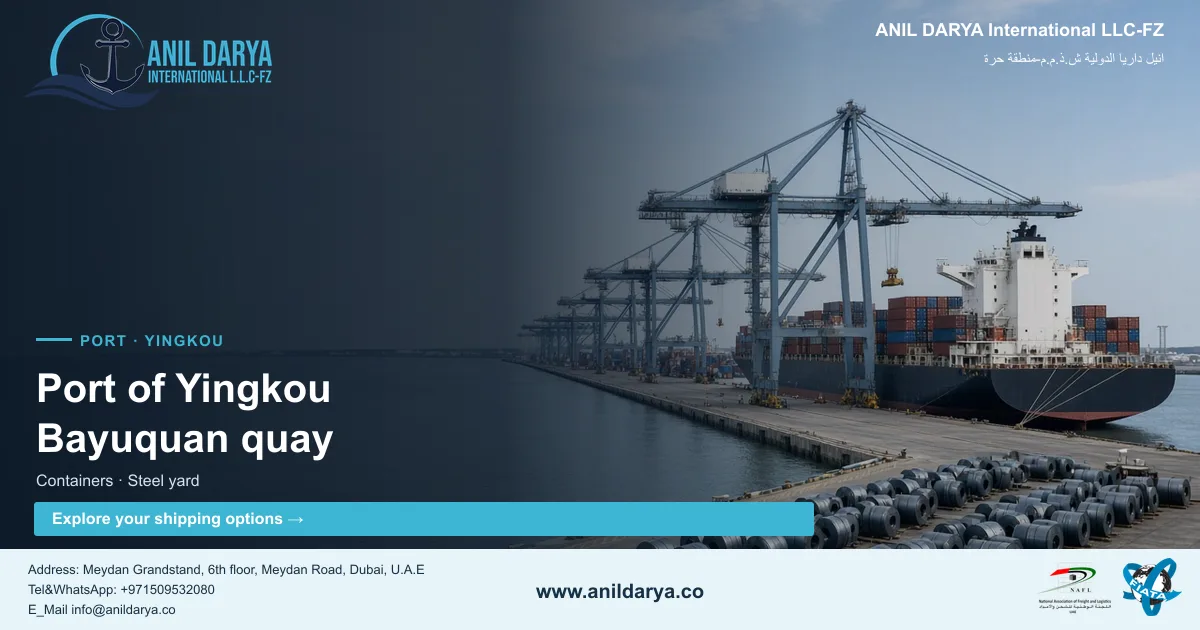
Port of Yingkou shipping is how most of northeast China's steel, grain and domestic container trade reaches the sea. Yingkou handled 5,846,000 TEU in 2025, more than Dalian by container count, but most of that is coastal trade inside China. This guide explains the port areas, the cargo, winter ice, the rules for dangerous goods and how to move cargo between Yingkou and Dubai. We ship both from Yingkou to Dubai and from Dubai to Yingkou.
Port of Yingkou shipping: key facts at a glance
| Item | Detail |
|---|---|
| Location | Yingkou, Liaoning Province, on Liaodong Bay in the Bohai Sea |
| Port group | Liaoning Port Group, which also runs Dalian |
| UN/LOCODE | CNYIK |
| Port areas | Bayuquan (main container and bulk area), Xianrendao (crude oil and liquid chemicals), Yingkou old port (river mouth, smaller ships) |
| Containers handled in 2025 | 5,846,000 TEU, up 5.1% on 5,560,000 TEU in 2024 |
| January to April 2025 | 68.333 million tonnes of cargo and 1.838 million TEU |
| Operational berths | 61, of which 56 take ships over 10,000 tonnes (2024) |
| Container network | Over 300 container sailings a month, coastal links to 30 Chinese ports, services to over 140 ports in more than 50 economies |
| Main exports | Steel, corn, chemicals, mechanical and electrical goods |
| Main imports | Iron ore, crude oil, grain |
| Winter | Sea ice in Liaodong Bay; icebreakers and ice-class tugs used in cold years |
| Free trade zone | Yingkou area of the China (Liaoning) Pilot Free Trade Zone, approved in 2017 |
| Dubai to Yingkou | Also handled: UAE export by us from Jebel Ali, Khalifa Port or Sharjah; China import declaration by the consignee or its broker |
| Nearest international airports | Shenyang Taoxian, about 170 km; Dalian, about 220 km |
Where is the Port of Yingkou and what does it serve?
Yingkou sits at the top of Liaodong Bay, where the Liao River meets the Bohai Sea, in the middle of Liaoning Province. The Bayuquan area is the closest deep-water port to central Liaoning, with a short road run to Anshan, Shenyang and the steel and chemical towns around them.
The hinterland covers central Liaoning, the three northeastern provinces and eastern Inner Mongolia. China Daily reports that Yingkou carries about 70% of northeast China's domestic container trade, and a Lloyd's List caption puts the share at over 60%. Either way, the port is first a domestic gateway, moving northern steel and grain south to Shanghai, Ningbo and Guangzhou.
So international services are thinner than the headline TEU suggests. A Chinese forwarder's port guide says Yingkou's foreign-trade route density is lower than Dalian's, and ocean trunk cargo is usually transshipped through Dalian or another Bohai port.
Yingkou or Dalian: which load port should your supplier use?
| Supplier location or cargo | Usually better | Why |
|---|---|---|
| Anshan, Yingkou, Panjin, Liaoyang | Yingkou | Shortest truck leg to Bayuquan |
| Steel coils, plate and sections in volume | Yingkou | Steel is the port's core export; breakbulk and container options |
| Dalian city and southern Liaoning | Dalian | Short haul and more deep-sea sailings |
| Urgent containers to the Gulf | Compare both | Yingkou boxes often feed through Dalian or another hub anyway |
| Shenyang, Changchun, Harbin | Compare both | Both have rail links; the sailing and cut-off decide |
A simple rule: if the supplier is closer to Yingkou and the cargo is steel or bulk-like, start with Yingkou. If the shipment is a time-sensitive container, ask for both routings and compare the total days, not only the port-to-port price.
Which port areas does Yingkou have?
Yingkou is three port areas under one name. Your booking may show Yingkou, Bayuquan or a terminal name.
Bayuquan: containers, steel and bulk
Bayuquan is the main port area and where almost all international cargo is worked. A Chinese port guide lists six harbour basins and more than 50 berths there, with the largest berth class at 300,000 DWT and five 100,000 DWT berths across container, general and bulk cargo. The container terminal work at Bayuquan dates back to 1996, when COSCO and the Yingkou port authorities set up a joint terminal.
The same guide lists ore terminals for one 300,000 DWT and one 200,000 DWT ship, with a combined capacity of about 50 million tonnes a year. That is why Yingkou matters for steel: ore comes in, finished steel goes out.
Xianrendao: crude oil and liquid chemicals
Xianrendao is the liquid bulk area, with a 300,000 DWT crude oil berth and chemical berths. If your cargo is liquid chemicals in bulk, the vessel will usually load here, not at Bayuquan.
Yingkou old port: smaller ships at the river mouth
The old port is at the mouth of the Daliao River, about 19 nautical miles north of Bayuquan. Port data gives a tidal depth of 11.2 m for breakbulk ships there. It handles near-sea and river traffic and is rarely the load port for UAE cargo.
What cargo moves between Yingkou and Dubai?
Northeast China sells heavy goods. That shapes what Dubai importers buy through Yingkou and how it ships.
| Cargo | How it usually ships | What to plan |
|---|---|---|
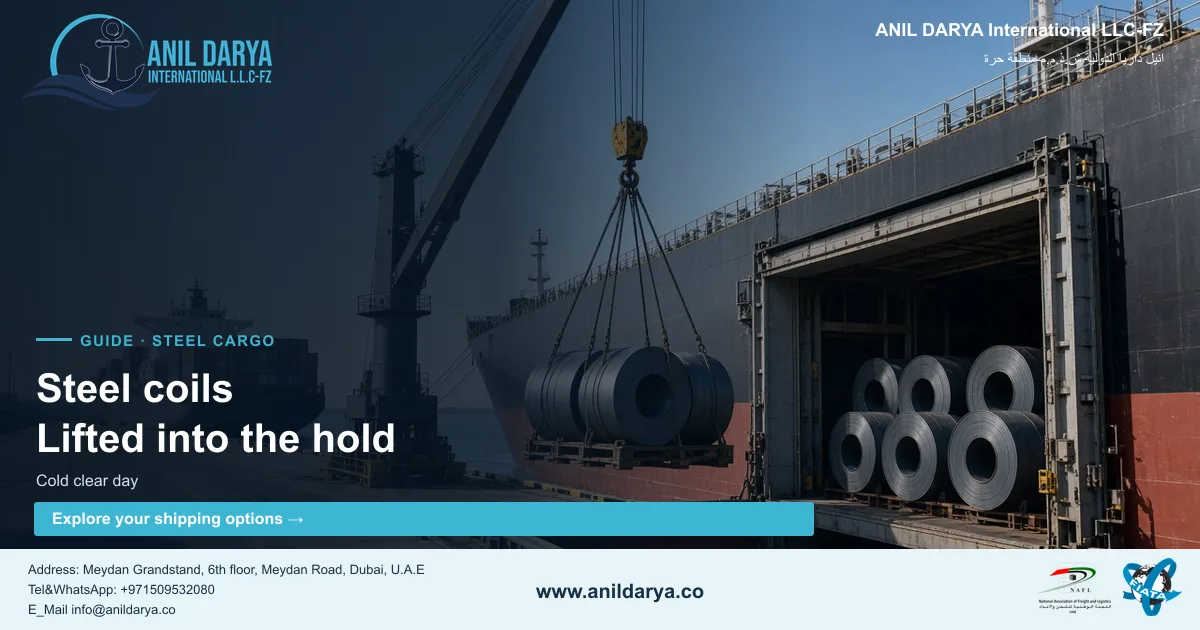
| Steel plate, coils and sections | 20ft FCL, flat racks or breakbulk | Weight per box, lashing, rust protection, mill test certificates |
| Machinery and electrical equipment | FCL, open tops or flat racks | Dimensions, lifting points, export packing |
| Chemicals and coatings | DG or non-DG containers | SDS, UN number, packaging, carrier acceptance |
| Corn and other grain products | Containers or bulk | Quarantine, clean and dry containers, UAE food rules |
| Vehicles and wheeled machinery | Containers, flat racks or Ro-Ro via another port | Vehicle documents, UAE conformity rules |
A 20ft container of steel often hits its weight limit long before it is full, so check the payload limit on the booking and the UAE truck weight before your supplier loads.
Does Yingkou port freeze in winter?
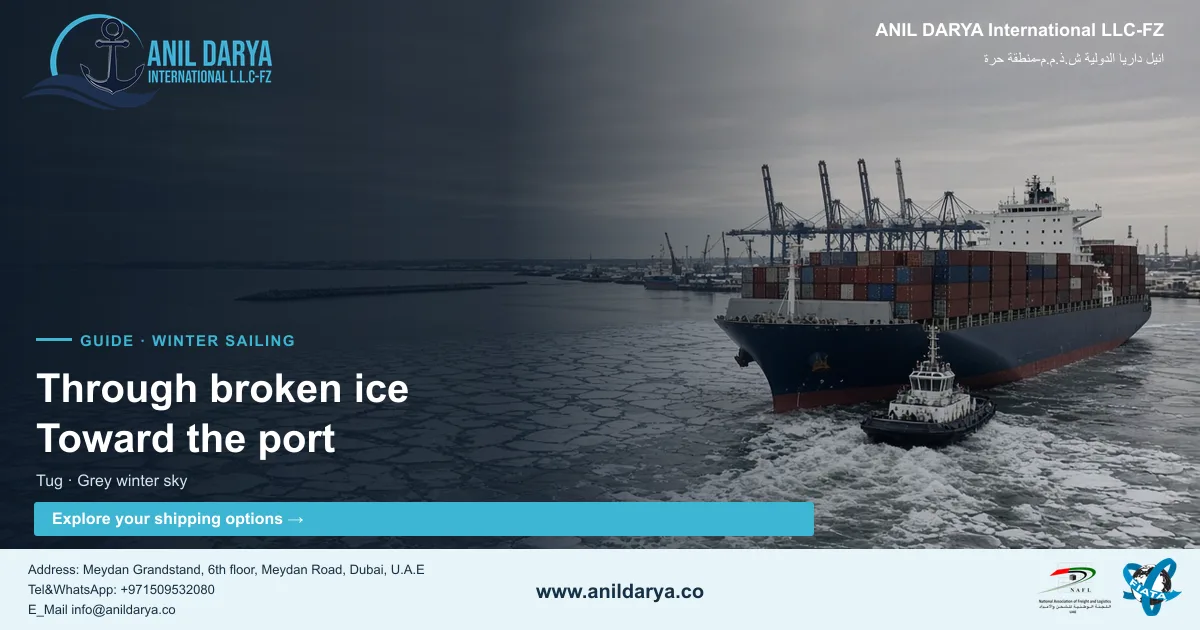
Yes, partly. Unlike Dalian, Yingkou sits deep in Liaodong Bay, where sea ice forms most winters. A Chinese port guide gives an average ice season at Bayuquan of about 112 days, with a severe ice period of about 68 days, and near-shore ice of 30 to 45 cm. Icebreakers and ice-class tugs keep the channel open, but hard winters can bring channel limits, reduced loads or delays.
| Month | What to expect | What to do |
|---|---|---|
| December to February | Ice in the bay, slower berthing in cold spells, fog and strong north winds | Add buffer days and confirm the ETA close to sailing |
| January to February | Chinese New Year factory closures on top of the ice | Ship before the holiday or plan for a later sailing |
| March to June | Ice clears; a port entry guide notes fog on 30 to 40 days a year, mainly in this period | Normal planning, with a small fog buffer |
| July to November | Usually the easiest months | Standard lead times |
For cargo due in Dubai in February or March, book earlier and ask your supplier for a packing date with slack.
Shipping from Yingkou to Dubai: FCL, LCL and routing
Most Yingkou cargo for Dubai travels in containers from Bayuquan and lands at Jebel Ali. Because Yingkou has few deep-sea services of its own, expect a transshipment. Common patterns are a feeder to Dalian or another Bohai port, or a coastal leg south to a large Chinese hub, then a mainline vessel to the Gulf. Route data on Cogoport lists Yingkou export lanes to Nhava Sheva and Mundra, and iContainers lists Jebel Ali among the ports Yingkou connects with.
We could not find a published direct Yingkou to Jebel Ali service or a reliable published transit time for this pair, so we do not quote one here. Ask for the full routing on each quote: the feeder, the hub, and the mainline vessel.
[AMIR-FACT: our real port-to-port transit time from Yingkou to Jebel Ali, the hub we usually tranship through (Dalian, Qingdao, Shanghai or other) and the carriers we book on this lane]
FCL or LCL from Yingkou?
FCL suits steel, machinery and full factory orders that you want sealed at origin. LCL suits samples and small lots, but iContainers notes that LCL from Yingkou may consolidate at Yingkou, Dalian, Tianjin, Qingdao, Shanghai or Busan. Each extra hub adds handling and days. Ask where your LCL is loaded into the shared box. Our guide to FCL vs LCL costs shows where the break-even sits, and our sea freight service books both.
How does cargo reach Yingkou by rail and road?
Yingkou has long been a sea-rail port. China Daily reports that the Yingkou-Manzhouli-Europe rail service started in 2008, and that in 2016 Yingkou handled more sea-rail containers than any other port in China. For UAE buyers the useful part is the inbound leg: a supplier in Shenyang, Changchun or Harbin can rail a box to Bayuquan instead of trucking it.
Road links are short for the central Liaoning cities. In May 2026, 100 TIR trucks left Bayuquan on Liaoning's first combined sea and TIR road service, with goods held in Yingkou Port's transit warehouse before moving overland to Central Asia and Europe.
If your supplier quotes FOB Yingkou but rails the box from far inland, the rail leg and its risk stay with the supplier. Our Incoterms guide compares FOB, FCA and EXW for this kind of move.
Dangerous goods through the Port of Yingkou
Chemicals are one of Yingkou's main exports, so DG questions come up often. Sea DG moves under the IMDG Code, and carriers check classification and packaging closely. A port entry guide for Yingkou lists these local points:
- Ships carrying dangerous goods give an extra 48-hour notice before arrival, with a DG manifest in IMO format.
- Class 1 explosives are not accepted, and Class 7 radioactive material needs a special permit.
- DG handling is not allowed on public holidays.
- Unauthorised DG operations can bring penalties of up to CNY 200,000.
That guide dates from 2021 and is not an official port notice, so confirm the rules with the carrier before your supplier stuffs the box. Because the cargo will usually tranship, every carrier on the route must accept it. You need the UN number, proper shipping name, class, packing group, an SDS and a signed DG declaration. Our dangerous goods shipping team checks acceptance before you commit.
Breakbulk and project cargo from Yingkou
Steel structures, plant and heavy machinery from the Liaoning steel belt often need more than a container. Bayuquan has general cargo berths and multipurpose capacity for breakbulk ships. Pieces that fit a 40ft flat rack can ride a container service, usually with a transshipment. Larger pieces need breakbulk or heavy-lift tonnage, and the sailing date then drives the whole plan.
Send drawings, weights and lifting points first, and ask which berth the ship will load at. Our break bulk and project cargo service plans the UAE discharge and road move, and we coordinate with your supplier's forwarder on the loading side.
Export customs at Yingkou in short
Yingkou uses the same China Customs export rules as every other Chinese port. Our Shanghai guide covers them in more depth, so here is the short version.
- Your supplier, as consignor, files the export declaration itself or through a customs broker.
- The declaration is made once the goods reach the customs supervision area, and no later than 24 hours before loading.
- The exporter needs foreign trade operator registration and customs recordation.
Two local points help. Yingkou is one of three areas in the China (Liaoning) Pilot Free Trade Zone, approved in 2017, so some suppliers store or process goods under bonded rules near the port. And steel buyers usually ask for mill test certificates and a correct HS code for every grade, so check these before the declaration is filed.
Documents for a Yingkou to Dubai shipment
| Document | Prepared by | Used for |
|---|---|---|
| Commercial invoice and packing list | Supplier | China export declaration and Dubai Customs |
| China export declaration | Supplier or its broker | Export clearance before loading |
| Bill of lading | Carrier or forwarder | Release of the cargo in Dubai |
| Certificate of origin | Issuing body in China | Dubai Customs declaration |
| Mill test certificate (steel) | Steel mill | Buyer's quality check and some UAE permits |
| DG papers, if any | Supplier | Carrier acceptance and port rules |
| UAE permit, if restricted | Consignee | Release of restricted goods |
What happens when Yingkou cargo arrives in Dubai?
At Jebel Ali, a company with a Dubai Customs business code files the import declaration, or a licensed clearing agent files it with the owner's authorisation. Duty is 5% of the CIF value for most goods, 50% on alcohol and 100% on cigarettes. Import VAT is 5% of the customs value, and a VAT-registered importer whose customs number is linked with the Federal Tax Authority accounts for it on its VAT return. Steel, food, vehicles and some chemicals may need a permit or conformity approval from the relevant UAE authority, so apply before the ship sails. Our Jebel Ali port guide covers terminals, trucking and declarations at the Dubai end.
How to ship from Yingkou to Dubai: step by step
- Send us the cargo details: product, HS code, weight, dimensions, supplier address and the Incoterm you agreed.
- Pick the load port. We check whether Yingkou or Dalian gives the better routing for your supplier's location and cargo.
- Book space. For DG, steel or out-of-gauge cargo we get carrier acceptance first.
- Check documents before loading. Invoice, packing list, certificate of origin and the draft bill of lading must match on weights, pieces and consignee.
- Supplier clears export. Your supplier or its broker files the China export declaration before the cut-off.
- Track the feeder and the hub. We follow the transshipment and update the ETA, which matters most in winter.
- File the Dubai declaration before arrival, so clearance is ready when the ship berths. We arrange payment of the duty and VAT and collect the delivery order.
- Deliver and return the empty within free time. Our article on demurrage and detention shows how the charges build up if you miss it.
How to ship from Dubai to Yingkou
Cargo also moves the other way, and we handle it with the same care. iContainers lists oil-related cargo, chemicals and plastics among Middle East shipments to Yingkou. We load at Jebel Ali, Khalifa Port or Sharjah port and run the UAE side. The China import side stays with your consignee or its customs broker.
The UAE export side
- We file the export or re-export declaration with Dubai Customs, which handles declarations for the movement of goods, with the commercial invoice and packing list.
- Goods that are restricted need the permit from the relevant UAE authority before the declaration is filed.
- For chemicals and other DG, we get carrier acceptance for every leg, including the transshipment port, before booking.
- We truck the box to the terminal and gate it in before the cut-off.
The China import side
- Who declares. The consignee files the import declaration with China Customs itself, or entrusts a customs broker to do it.
- Registration. The consignee needs foreign trade operator registration and customs recordation before the first shipment.
- Deadline. The import declaration is due within 14 days of the ship's arrival being declared, so send the documents to the broker before the box reaches Yingkou.
- Duty and tax. The consignee pays import duty under China's tariff and import VAT. Ask the broker for the rate on your HS code before you price the sale.
- Chemicals need an SDS on arrival, and some products may need registration in China before shipment. The consignee must confirm this first.
- Send us the cargo, the HS code, the pickup address in the UAE and the consignee's details in Liaoning.
- The consignee confirms its registration, any product registration and the broker that will clear the cargo.
- We book space from Jebel Ali with a transshipment at Dalian, another Bohai port or a large Chinese hub, and confirm the routing on the quote.
- We truck the cargo to the terminal and file the Dubai Customs export or re-export declaration.
- We send the draft bill of lading for checking. The consignee name must match its China Customs recordation.
- We send the bill of lading, invoice, packing list and certificate of origin to the consignee's broker before arrival.
- The broker lodges the import declaration within the 14-day limit and the consignee pays duty and VAT.
- After release, the consignee collects the box at Yingkou and returns the empty to the line's depot within free time.
[AMIR-FACT: the carriers and transshipment hub we actually use from Jebel Ali to Yingkou, and our real port-to-port transit days in this direction]
What affects the cost of shipping through Yingkou?
| Cost factor | Why it matters on this lane |
|---|---|
| Feeder or coastal leg | Most boxes need a first leg to a hub before the mainline |
| Container weight | Heavy steel may need overweight surcharges or more boxes |
| Equipment type | Flat racks and open tops cost more and need early booking |
| Season | Winter ice and Chinese New Year tighten space and drayage |
| Free time | Lines set it per box; a Chinese guide notes domestic free time is often shorter than foreign-trade free time |
| Dubai end | Duty, permits, delivery order fees and trucking to your site |
Checklist before you ship through Yingkou
- Load port agreed with the supplier: Yingkou or Dalian.
- Full routing on the quote, including the transshipment hub.
- HS code confirmed for every item and grade.
- Container payload checked against the cargo weight.
- Invoice, packing list and bill of lading show the same weights and pieces.
- Certificate of origin ordered early.
- Mill test certificates for steel.
- For DG: SDS, UN number, packaging, and acceptance from every carrier on the route.
- UAE permits applied for before sailing.
- Winter buffer added for December to March cargo.
Common mistakes when shipping through Yingkou port
- Assuming a direct sailing. Most Yingkou cargo to the Gulf transships, so a port-to-port price alone hides the real transit.
- Overloading 20ft boxes with steel. The box may be rejected at the gate or reweighed, with extra cost.
- Ignoring ice. A February shipment planned on summer timings will likely arrive late.
- Booking chemicals as general cargo. Undeclared DG can be refused, fined or rolled at the hub.
- Late certificate of origin. Dubai Customs needs it at import.
Frequently asked questions
Where is Yingkou port located?
The Port of Yingkou is in Yingkou, Liaoning Province, northeast China, on Liaodong Bay in the Bohai Sea. Its main area for international cargo is Bayuquan.
What is the port code for Yingkou?
The UN/LOCODE for Yingkou is CNYIK. You will see it on bookings, bills of lading and tracking systems.
How big is the Port of Yingkou?
Yingkou handled 5,846,000 TEU in 2025, up 5.1% on 2024. It had 61 operational berths in 2024, 56 of them for ships over 10,000 tonnes.
Is Yingkou port ice-free?
No. Liaodong Bay freezes in most winters, with an average ice season of about 112 days at Bayuquan according to a Chinese port guide. Icebreakers keep the port open, but cold spells can slow berthing.
Is there a direct ship from Yingkou to Dubai?
We found no published direct Yingkou to Jebel Ali service. Most cargo transships at Dalian, another Bohai port or a large Chinese hub, so ask for the full routing on every quote.
Can you ship from Dubai to Yingkou?
Yes. We book the space, file the Dubai Customs export or re-export declaration and send the documents to the consignee's broker. The consignee or its broker declares the goods to China Customs within 14 days of the ship's arrival and pays duty and import VAT.
Should I ship from Yingkou or Dalian?
Use Yingkou if the supplier is near Anshan, Yingkou or Panjin, or if the cargo is steel or bulk. Compare Dalian for urgent containers, since it has more deep-sea sailings.
Can I ship dangerous goods through Yingkou?
Yes, with carrier acceptance and IMDG paperwork. A port entry guide says Class 1 explosives are not accepted and Class 7 needs a special permit, so confirm with the carrier first.
What duty do I pay in Dubai on goods from Yingkou?
Dubai Customs charges 5% of the CIF value for most goods, 50% on alcohol and 100% on cigarettes. Some goods also need a UAE permit before release.
Get a quote for Port of Yingkou shipping
Send us the cargo, the supplier's address and the ready date, and we will compare routings through Yingkou and Dalian to Jebel Ali. Use our freight rate inquiry form, or contact our team to talk through steel, DG or project cargo first. You can also read about our Dubai freight forwarding team.
Sources
- Lloyd's List: 37 Yingkou, One Hundred Container Ports 2026 (2025 and 2024 TEU, domestic share)
- China Daily: Liaoning's Yingkou Port (berths, domestic share, sailings, network), June 2024
- Liaoning provincial press conference: Yingkou January to April 2025 throughput
- China Daily: Yingkou to aid northeast China growth (rail, sea-rail, pilot free trade zone)
- iLiaoning: First TIR and sea intermodal shipment from Bayuquan, May 2026
- Bofeng Logistics: Port of Yingkou guide (port areas, berths, ore and oil terminals, ice season, routes)
- iContainers: Port of Yingkou (UN/LOCODE, port group, LCL hubs, connected ports, Middle East cargo)
- Wikipedia: Port of Yingkou (location, history, COSCO terminal 1996)
- Findaport: Port of Yingkou (old port location, depth, airports)
- World Ports Organization: Port entry guide for Yingkou (DG notice rules, fog)
- Cogoport: Yingkou port info (export lanes)
- Shanghai Municipal Government: China customs declaration rules
- Dubai Customs: FAQ (duty rates, business code, clearing agents)
- Dubai Customs: Submit customs declaration (documents for import, export and re-export declarations)
- UAE Government portal: Customs duty (5% of CIF in Dubai, alcohol 50%, cigarettes 100%)
- Federal Tax Authority: VAT guide, section 3.5 (5% import VAT, customs value, deferral to the VAT return)
Reviewed: 10 November 2026