
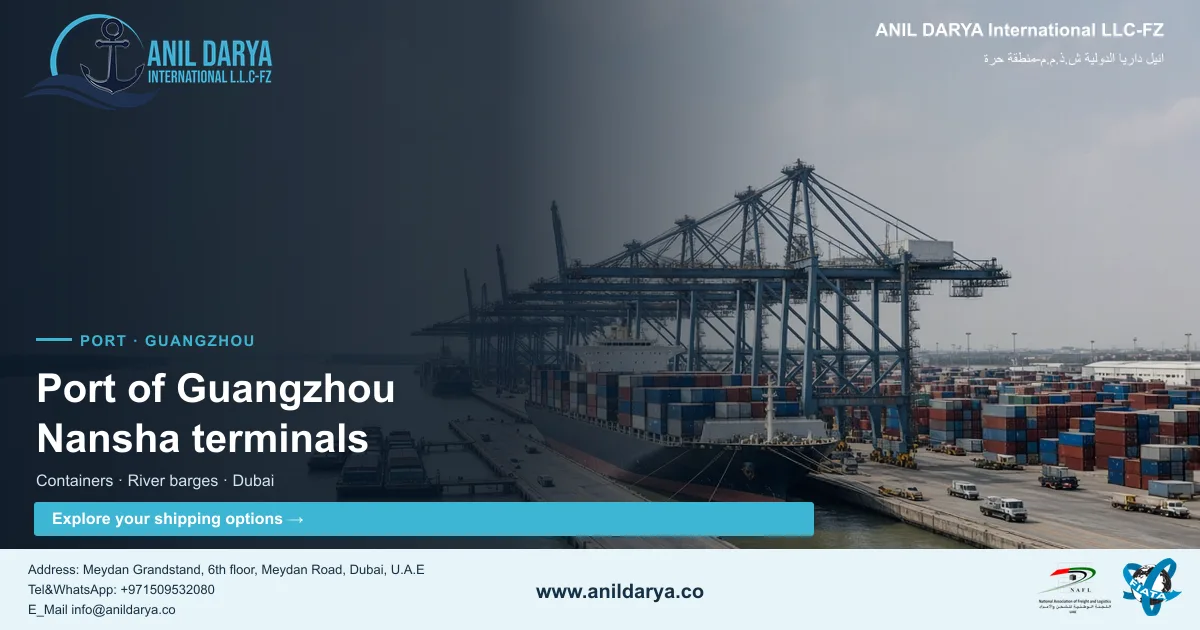
Port of Guangzhou shipping today means, in practice, Nansha: the deep-water container area at the mouth of the Pearl River that handles most of the port's containers. The whole port moved about 28 million TEU in 2025, and it is the natural load port for factories in Guangzhou, Foshan, Zhongshan and the west side of the Pearl River Delta. This guide covers the port areas, the Nansha terminals, barge and rail links, export rules and how to ship from Guangzhou to Dubai. We ship both ways: from Guangzhou to Dubai, and from Dubai to Guangzhou.
Port of Guangzhou guide: key facts at a glance
| Item | Detail |
|---|---|
| Operator | Guangzhou Port Group Co. Ltd (state-owned) |
| Location | Guangdong province, along the Pearl River from Guangzhou city down to the estuary |
| Port areas | Nansha, Xinsha, Huangpu and the Inner Harbour |
| Main container area | Nansha, on Longxue Island at the Pearl River estuary |
| Container throughput (2025) | 28.05 million TEU, up 7.6% on 2024 |
| Container throughput (2024) | 26.07 million TEU |
| Cargo throughput (2025) | More than 696 million tonnes |
| World ranking | 6th in Lloyd's List One Hundred Container Ports 2026 |
| Foreign trade liner routes (2025) | 182, with links to over 400 ports in more than 100 countries |
| Nansha channel depth | -17 m, approach channel about 35 nautical miles |
| Codes you may see | CNNSA (Nansha), CNCAN (Guangzhou), CNHUA (Huangpu) |
| Export customs | China Customs (GACC); declaration 24 hours before loading |
| Usual UAE discharge port | Jebel Ali, Dubai |
| Dubai to Guangzhou | UAE export declaration by us; China import declaration by the consignee or its registered broker within 14 days of the vessel's entry |
Where is the Port of Guangzhou and which cargo does it serve?
The Port of Guangzhou is not one quay. Its harbour area runs along the Pearl River coast and waters in Guangzhou, Dongguan, Zhongshan, Shenzhen and Zhuhai. The old river berths are close to Guangzhou city. The modern container terminals sit far downstream at Nansha, where the river opens into the estuary and big ships can reach the quay.
For a Dubai buyer the key fact is the side of the delta. Nansha is on the west bank, so it is the short truck run for suppliers in Foshan, Zhongshan, Jiangmen and the south of Guangzhou. Shenzhen's terminals sit on the east side and suit Dongguan and Shenzhen factories. Our Shenzhen guide covers that side of the delta in detail.
Which load port: Guangzhou, Shenzhen or Shanghai?
| Supplier location | Load port to ask for first | When to compare another |
|---|---|---|
| Foshan, Shunde, Zhongshan, Jiangmen | Nansha (Guangzhou) | If your carrier's best sailing is from Shekou |
| Guangzhou city districts | Nansha, or Huangpu for some feeder and bulk cargo | If the vessel schedule from Nansha does not fit |
| Dongguan | Shenzhen (Yantian or Shekou) | Compare Nansha when the factory is in west Dongguan |
| Shenzhen, Huizhou | Shenzhen | Guangzhou rarely saves money |
| Shanghai, Jiangsu, Zhejiang | Shanghai or Ningbo | Guangzhou rarely saves money |
A simple rule: price the truck from the factory to both Nansha and the nearest Shenzhen terminal, then add the ocean freight. The cheaper total wins, as long as the sailing date also works.
Which terminals and port areas does Guangzhou port have?
Guangzhou Port Group runs the port through four areas. Each has a different job, and the booking tells you which one your cargo goes to.
| Port area | Position on the river | Main cargo |
|---|---|---|
| Nansha | Estuary, Longxue Island | Deep-sea containers, reefer and general cargo |
| Xinsha | Mid-river, between Nansha and Huangpu | Mainly bulk cargo such as coal and grain |
| Huangpu | Upriver, east Guangzhou | Bulk, general cargo, liquid bulk, breakbulk and project cargo, plus some containers |
| Inner Harbour | Guangzhou city | Older river berths, smaller vessels |
Nansha phases I to IV
Nansha opened in stages. Phases I to III came into service in 2004, 2007 and 2017. Phase IV, a fully automated terminal with four 100,000-tonne berths and a design capacity of 4.9 million TEU a year, started operations in July 2022. It was built for river, sea and rail transfer, so containers can arrive by barge or train and leave on a deep-sea ship.
In 2026 the Nansha area had 20 deep-water container berths, with a general-purpose terminal adding four more deep-water berths. Nansha alone passed 20 million TEU in 2024 and accounts for about 75% of the group's container volume. In late 2024 it had 200 container liner routes, 165 of them international.
The GOCT terminal at Nansha
One Nansha terminal publishes a full profile. Guangzhou South China Oceangate Container Terminal (GOCT) was set up in June 2006. APM Terminals holds 20% together with Guangzhou Port Group and COSCO Shipping Ports.
| GOCT item | Figure |
|---|---|
| Deep-sea berths | 6, of 150,000-tonne class |
| Quay length | 2,100 m, plus an 800 m barge quay |
| Terminal area | 223 ha |
| Quay cranes | 22, plus 8 barge cranes |
| Reefer plugs | 1,108 |
| Gate lanes | 18 |
| Distance to Hong Kong | 38 nautical miles |
The other Nansha terminals do not publish the same level of detail in English. Your carrier's service decides the terminal, so read it on the booking confirmation before you order the truck.
Nansha phase V
Full construction of Phase V started on 15 May 2026. It is designed for 6.7 million TEU a year, with four berths for 200,000-tonne container ships and 15 berths for 5,000-tonne container barges. When it is complete, Nansha's annual capacity is planned to reach 35 million TEU. No opening date has been published, so it does not change your bookings yet.
How does cargo reach Nansha by barge, rail and road?
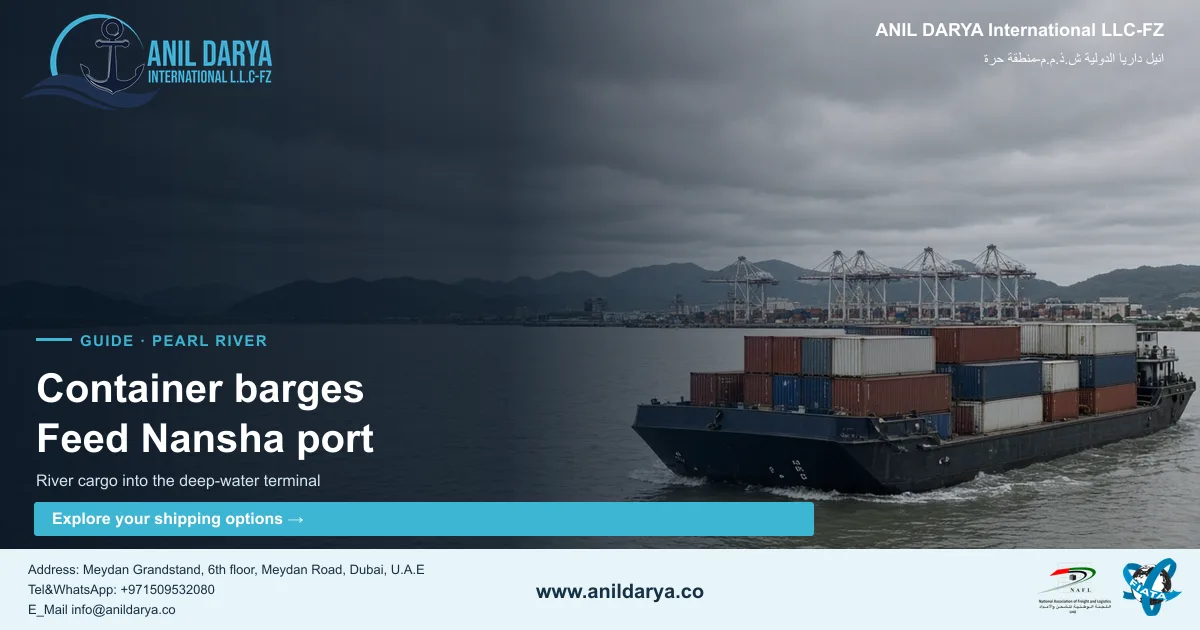
Nansha is unusual among Chinese ports because so much cargo reaches it by water. Many towns in the delta have river terminals, and barges shuttle containers to the Nansha barge quays. Phase V is planned with seagoing ships on one side and barges on the other for the same reason.
Rail arrived later. The Nansha Port Railway opened on 31 December 2021. It is an 88 km double-track electrified line, designed for 120 km/h, running through Jiangmen, Zhongshan, Foshan and Guangzhou into the port.
| Inland leg | Usually suits | What to check |
|---|---|---|
| Truck direct to Nansha | Factories within a short drive, urgent cargo | Terminal cut-off, gate appointment, truck availability |
| Barge from a river terminal | Suppliers near a delta river terminal, heavy boxes | Barge cut-off is earlier than the vessel cut-off |
| Rail to Nansha | Inland suppliers on the rail network | Rail schedule and the transfer at Nansha |
If your supplier quotes FOB Nansha but ships by barge from an upriver terminal, ask who carries the risk on the barge leg. Under FOB the supplier should deliver on board at Nansha, so the barge is their cost and their risk.
What cargo moves through Guangzhou port?
Guangzhou is China's biggest domestic trade container port, and its foreign trade share is growing fast. In 2025 foreign trade containers passed half of all container volume for the first time. For Dubai importers, the common cargo from the west delta looks like this.
| Cargo from the Guangzhou area | Where it is made | How it usually ships |
|---|---|---|
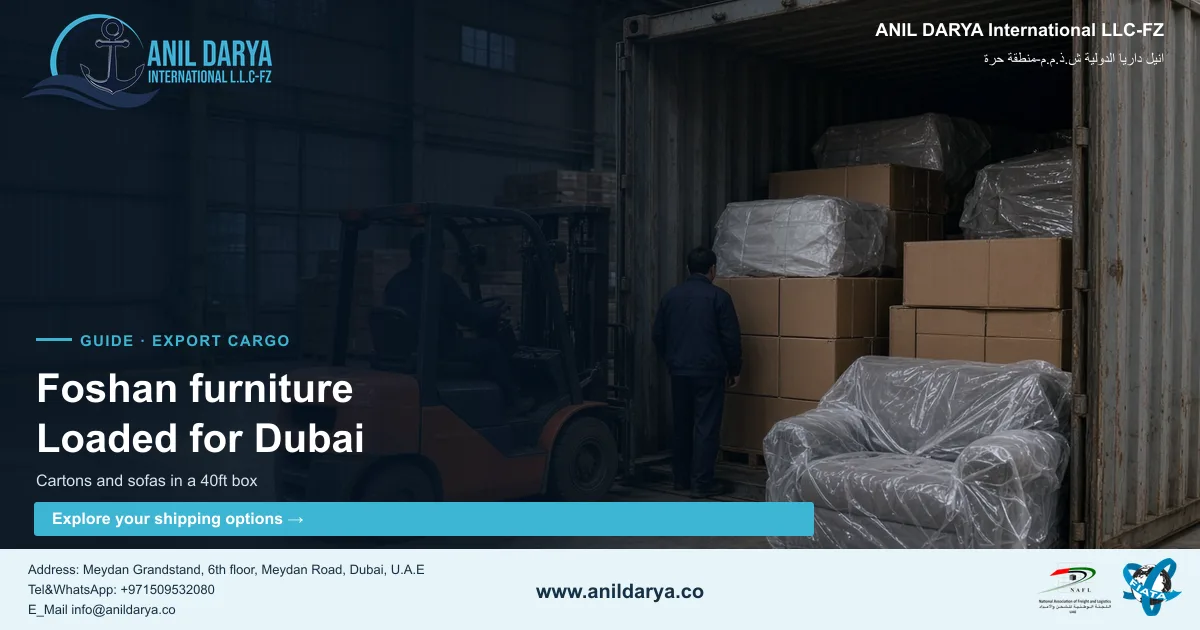
| Furniture, ceramics, sanitary ware | Foshan, Shunde | 40ft high cube FCL from Nansha |
| Home appliances, kitchen equipment | Foshan, Shunde, Zhongshan | FCL or LCL from Nansha |
| Lighting and small appliances | Zhongshan | LCL consolidation, FCL for larger orders |
| Hardware, auto parts, metal products | Jiangmen, Guangzhou | 20ft FCL for heavy cargo |
| Apparel, textiles, cosmetics | Guangzhou | LCL or FCL; check DG content for cosmetics |
| Machinery, steel structures | Across the delta | Flat rack, open top or breakbulk |
| Chilled and frozen food | Various | Reefer containers |
Heavy goods such as tiles and hardware hit the container weight limit before the volume limit. Ask the supplier for the gross weight per container and check it against the carrier's limit and the trucking rules before you book a 40ft.
Shipping from Guangzhou to Dubai: FCL and LCL
Most cargo from Guangzhou to Dubai moves in containers from Nansha into Jebel Ali. FCL means you book a whole 20ft, 40ft or 40ft high cube box, stuffed at the factory or a warehouse. LCL means your cartons go to a consolidation warehouse and share a box with other shippers. Our article on FCL vs LCL costs shows where the break-even point usually sits, and our sea freight service covers booking and container types.
Guangzhou is a good place to combine orders. Foshan furniture, Zhongshan lighting and Guangzhou textiles can go to one warehouse near Nansha and leave in one FCL. Make sure each supplier marks its cartons and that one combined packing list covers them all.
Not every service calls Nansha. Some carriers load Guangzhou cargo at Nansha and sail direct, others connect through another hub on the way. On each quote, ask for the load terminal, the vessel, the transit time and whether the service calls Jebel Ali directly.
[AMIR-FACT: our real transit time from Nansha to Jebel Ali and the carriers we usually book for Guangzhou cargo]
What a Guangzhou to Dubai shipment timeline includes
| Stage | Where | What can delay it |
|---|---|---|
| Cargo ready and packed | Supplier in the delta | Production delays, weak export packing |
| Truck, barge or rail to Nansha | Factory or river terminal to Nansha | Barge cut-off missed, wrong terminal |
| Export clearance | China Customs | Missing data, inspection, DG packaging results |
| Sailing | Nansha to Jebel Ali | Transshipment, rolled booking in peak season |
| Import clearance | Dubai Customs | Late declaration, missing permit |
| Delivery | Jebel Ali to your site | No truck slot, site not ready |
Dangerous goods through Guangzhou port
West delta factories make plenty of products that are dangerous goods at sea: aerosols and cosmetics, paints and coatings from furniture finishing, adhesives, cleaning chemicals, and appliances or tools with lithium batteries. Treat any product with a chemical or a battery as possible DG until the Safety Data Sheet says otherwise.
- Sea DG moves under the IMDG Code. The 2024 edition with Amendment 42-24 has been mandatory since 1 January 2026.
- China Customs inspects export DG packaging. Since July 2024 a nationwide batch inspection pilot lets qualified exporters ship several lots after one on-site check. Class 6.2 and Class 7 are excluded.
- The carrier must accept the cargo for the specific vessel, and some services do not take certain classes at all. Ask before you fix the sailing.
- If the cargo arrives by barge, the barge operator also has to accept it. Check this before the supplier books the river leg.
Our dangerous goods shipping team checks the papers and the carrier's acceptance before you commit, and our guide to dangerous goods classes explains what each class means.
Breakbulk and project cargo from Guangzhou
Guangzhou ships machinery, production lines, steel structures and generators. Pieces slightly over height go in open-top containers, wider pieces on flat racks, and both still sail on container ships from Nansha. Pieces too big for a flat rack need breakbulk tonnage, which often loads at a general cargo berth rather than a container terminal. Huangpu handles breakbulk and project cargo, so ask the carrier which berth the vessel will use.
Get drawings, dimensions, weights and lifting points before you ask for a price. Our guide to flat rack, open top and breakbulk cargo explains the options, and our break bulk and project cargo service handles discharge and delivery in the UAE.
Export customs at Guangzhou port in short
Exports through Nansha and Huangpu follow the same national China Customs rules as Shanghai and Shenzhen. The points that matter for you:
- Your supplier, as consignor, files the export declaration itself or through a customs broker.
- The declaration is made once the goods reach the customs supervision area and 24 hours before loading.
- The exporter must be registered as a foreign trade operator, which can be done online through the China International Trade Single Window.
At Nansha the terminal marketing office lists customs clearance seven days a week and an H986 X-ray machine for container inspection. Under EXW someone in China still has to act as exporter, which is why most Dubai buyers find FOB Nansha simpler. Our Incoterms guide compares the terms.
Documents for a Guangzhou to Dubai shipment
| Document | Prepared by | Used for |
|---|---|---|
| Commercial invoice and packing list | Supplier | China export declaration and Dubai Customs |
| China export declaration | Supplier or its broker | Export clearance before loading |
| Barge or rail document, if used | Barge or rail operator | Moving the box to Nansha |
| Bill of lading | Carrier or forwarder | Release of the cargo in Dubai |
| Certificate of origin | Issuing body in China | Dubai Customs declaration |
| DG papers, if any | Supplier | Carrier acceptance and port rules |
| UAE permit, if restricted | Consignee | Release of restricted goods |
What happens when Guangzhou cargo arrives in Dubai?
At Jebel Ali the declaration is filed with Dubai Customs by a holder of a customs business code, or by a licensed clearing agent with the owner's authorisation. Duty is 5% of the CIF value for most goods, with 50% on alcohol and 100% on cigarettes. Import VAT is 5% of the customs value including freight and insurance, and a VAT-registered importer can account for it through the reverse charge on its VAT return. The declaration carries the commercial invoice, packing list, bill of lading and certificate of origin. Restricted goods need a permit from the relevant UAE authority, so apply before the vessel sails. Cargo can also be routed to Khalifa Port or Sharjah if that suits the delivery address. Our Jebel Ali port guide covers terminals, trucking and declarations at the Dubai end.
How to ship from Guangzhou to Dubai: step by step
- Agree the Incoterm. FOB Nansha is usually simplest. Write the load port in the contract.
- Send us the cargo details: commodity, HS code, weight, volume or dimensions, supplier address, ready date and any batteries or chemicals.
- Get a quote and routing. We confirm the Nansha terminal, the sailing and the service into Jebel Ali.
- Decide the inland leg with the supplier: truck, barge or rail.
- Check UAE permits for restricted goods and apply before the cargo sails.
- Book space. For DG, reefer or out-of-gauge cargo we get carrier acceptance first.
- The supplier stuffs and seals the container, or delivers LCL cartons to the warehouse before its cut-off.
- The supplier or its broker files the export declaration, and the box reaches Nansha before the cut-off.
- We check the draft bill of lading against the invoice and packing list.
- We file the Dubai declaration before arrival, then arrange the delivery order and the truck from Jebel Ali.
Our Dubai freight forwarding team runs the UAE end and works with your supplier on the Guangzhou side.
How to ship from Dubai to Guangzhou
We also handle the other direction: shipping from Dubai to Guangzhou, usually from Jebel Ali into Nansha. We book the space, prepare the documents and clear the cargo out of the UAE. The China import side stays with the consignee or its Chinese customs broker. We do not have an office or agent in China.
The UAE export side
- Export declaration. Dubai Customs uses one declaration service for import, export, transit and re-export. We file the export or re-export declaration with the commercial invoice, packing list, certificate of origin and any permit for restricted goods.
- Trucking and cut-off. We truck the box to the terminal at Jebel Ali or Khalifa Port and deliver it inside the carrier's cut-off.
The China import side
- Who declares. Under the Customs Law of the People's Republic of China, the consignee declares imported goods and pays the duty, either itself or through a customs broker it appoints that is registered with customs.
- Deadline. China Customs rules require the consignee to declare imported goods within 14 days of the date the vessel's entry is declared. Boxes not declared in time can end up being disposed of by customs, so the broker should have the documents before the ship arrives.
- Duty and import VAT. China Customs assesses both on the HS code in the declaration. Ask the consignee's broker for the rate on your code, and whether the product needs any licence or certificate in China, before you sell. We do not quote Chinese duty.
- Send us the cargo details, HS code, weight, volume and the consignee's name in Guangdong.
- Confirm the consignee's Chinese broker and send it the draft invoice and packing list.
- We book space from Jebel Ali to Nansha and confirm any transshipment.
- We arrange pickup, stuffing and the UAE export or re-export declaration.
- We check the draft bill of lading and release it as agreed: original, telex release or sea waybill.
- The consignee's broker declares the import at Nansha within 14 days of the vessel's entry and pays duty and VAT.
- The consignee collects the box, delivers it and returns the empty inside free time.
[AMIR-FACT: the carriers we actually use from Jebel Ali/Khalifa to Nansha and our real transit days in this direction]
What affects the cost of shipping from Guangzhou?
| Cost part | What moves it |
|---|---|
| Inland leg to Nansha | Truck distance, or barge and rail charges from upriver |
| Origin port and export charges | Terminal handling, export declaration, LCL consolidation |
| Ocean freight | Container type, season, carrier, direct or transshipment service |
| Special cargo | DG surcharges, packaging inspection, flat rack or breakbulk premiums |
| Dubai destination charges | Terminal handling, delivery order, LCL unpacking |
| Duty | CIF value and HS code |
| Delays | Demurrage and detention once free time runs out |
Compare quotes on the same scope, from the same Incoterm to the same delivery point. Our guide to demurrage and detention explains the charges that build up after arrival.
Checklist before you ship from Guangzhou
- Load port written as Nansha (or Huangpu for breakbulk) in the contract.
- Terminal confirmed on the booking.
- Inland leg agreed: truck, barge or rail, and who pays for it.
- HS code and the UAE duty rate checked.
- Battery and chemical content checked against the SDS.
- Container gross weight checked for heavy cargo such as tiles.
- Invoice, packing list and draft bill of lading match.
- UAE permits applied for before sailing.
Common mistakes when shipping through Guangzhou port
- Writing "Guangzhou" as the load port without naming Nansha. Some suppliers then quote from an upriver berth or a different port.
- Missing the barge cut-off. It comes before the vessel cut-off.
- Overweight 40ft containers of tiles, stone or hardware.
- Furniture lacquers and aerosols booked as general cargo.
- Consolidating several suppliers without one combined packing list.
- Applying for UAE permits after arrival, which runs up container charges.
Frequently asked questions
Is Nansha the same as the Port of Guangzhou?
Nansha is one of four port areas of the Port of Guangzhou, alongside Xinsha, Huangpu and the Inner Harbour. It is the deep-water container area and handles about 75% of the port group's container volume.
How big is the Port of Guangzhou?
The port handled 28.05 million TEU of containers and more than 696 million tonnes of cargo in 2025. Lloyd's List ranked it the 6th busiest container port in the world in its 2026 list.
Which company operates the Port of Guangzhou?
Guangzhou Port Group Co. Ltd, a state-owned company, runs the port. Some Nansha terminals are joint ventures; GOCT, for example, is shared with COSCO Shipping Ports and APM Terminals.
How do I ship from Guangzhou to Dubai?
Agree FOB Nansha with your supplier, book FCL or LCL space to Jebel Ali, have the supplier file the China export declaration, then clear the cargo with Dubai Customs on arrival. Check DG content and UAE permits before you book.
Can you handle shipping from Dubai to Guangzhou?
Yes. We book the space from Jebel Ali to Nansha and handle the UAE export declaration. The consignee in China, or its registered customs broker, declares the import within 14 days of the vessel's entry and pays duty and import VAT.
Should I ship from Nansha or from Shenzhen?
Use Nansha for suppliers on the west side of the Pearl River Delta, such as Foshan, Zhongshan and Jiangmen. Use Shenzhen for Shenzhen and Dongguan factories. Compare the truck plus ocean cost to both when the supplier is in between.
How deep is the channel into Nansha?
The approach channel is about 35 nautical miles long, roughly three hours' steaming, with a depth of -17 m. It was widened to 385 m in a dredging project completed in August 2020.
Can Nansha take cargo by rail?
Yes. The 88 km Nansha Port Railway opened on 31 December 2021 and runs through Jiangmen, Zhongshan, Foshan and Guangzhou into the port. Phase IV was built for river, sea and rail transfer.
Can I ship dangerous goods from Guangzhou to Dubai?
Yes, if the carrier accepts the cargo and the papers are complete. You need the UN number, Safety Data Sheet, China Customs packaging inspection results and a DG declaration under the IMDG Code.
Which Dubai port does Guangzhou cargo arrive at?
Most container services from Nansha to Dubai discharge at Jebel Ali. Check the port of discharge on the booking, because some services route UAE cargo through other ports.
Get a quote for Port of Guangzhou shipping
Send us your cargo details and supplier location, and we will come back with a routing through Nansha and a price to Dubai. Use our freight rate inquiry form, or contact our team to talk through a DG, breakbulk or multi-supplier shipment first.
Sources
- Lloyd's List: Guangzhou, One Hundred Container Ports 2026 (2025 and 2024 TEU, growth)
- Lloyd's List: One Hundred Container Ports 2026 (ranking)
- Global Times, citing Xinhua: Guangzhou Port cargo and container throughput 2025 (January 2026)
- Life of Guangzhou: Guangzhou Port 2025 results, routes and foreign trade share (January 2026)
- Guangzhou International (China Daily): Nansha passes 20 million TEU, phases and routes (December 2024)
- Hellenic Shipping News: Automated Phase IV terminal opens in Nansha (July 2022)
- CRI: Full construction begins on Nansha Phase V (May 2026)
- APM Terminals: GOCT, Nansha (berths, quay, cranes, reefer plugs, shareholders)
- Port of Nansha: Port facts (channel, depth, customs, inspection)
- Port of Nansha: Home page (Nansha share of group volume)
- China Daily: Nansha Port Railway opens (January 2022)
- Wikipedia: Port of Guangzhou (operator, port areas, harbour extent)
- iContainers: Port of Huangpu (cargo types, code)
- Cogoport: Nansha (CNNSA) port code
- JCtrans: Guangzhou (CNCAN) port code
- Shanghai Municipal Government: China customs registration and declaration rules
- CIRS: China customs batch inspection pilot for DG packaging (July 2024)
- IMO: IMDG Code 2024 edition (Amendment 42-24)
- Dubai Customs: FAQ (duty rates, business code, clearing agents)
- Dubai Customs: Submit customs declaration (import, export, transit; invoice, packing list, certificate of origin, permits)
- UAE Federal Tax Authority: VAT guide, import VAT at 5% and reverse charge
- Customs Law of the People's Republic of China, amended 2013, English text (Article 9, who declares and pays duty)
- GACC Order No. 273 (2024), English text: imported goods to be declared within 14 days of the means of transport's entry
Reviewed: 10 November 2026