
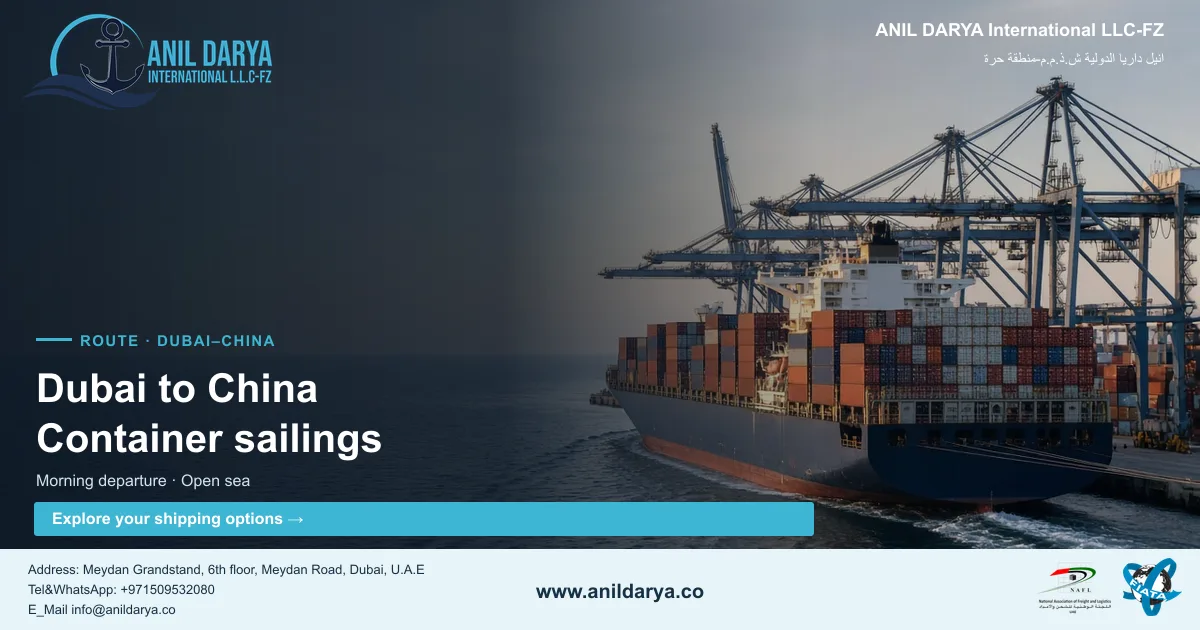
Shipping from Dubai to China usually means a container from Jebel Ali to Shanghai, Ningbo, Shenzhen or another main Chinese port, with air cargo to Shanghai Pudong or Guangzhou for urgent goods. In China, the consignee or its customs broker must declare the goods within 14 days of the ship's arrival declaration and pay duty and import taxes before release. This guide covers the ports, the modes, what China Customs asks for, the taxes and the order in which to do things.
Shipping from Dubai to China at a glance
| Item | Detail |
|---|---|
| Main UAE load port | Jebel Ali (Dubai); Khalifa Port and Sharjah on some services |
| Main Chinese container ports | Shanghai, Ningbo-Zhoushan, Shenzhen, Guangzhou (Nansha), Qingdao, Tianjin, Xiamen |
| Main air cargo gateways | Shanghai Pudong (PVG), Guangzhou Baiyun (CAN), Beijing Capital (PEK) |
| Modes on this lane | FCL, LCL, breakbulk and project cargo, dangerous goods, air cargo |
| Customs authority | General Administration of Customs of China (GACC) |
| Who declares | The consignee itself, or a customs declaration enterprise it authorises; both must be on record with Customs |
| Import declaration deadline | Within 14 days of the declaration of the ship's arrival; late fine from day 15 |
| Advance declaration | Possible within seven days after shipment, before the goods arrive |
| Taxes at import | Customs duty, plus import VAT and, for some goods, consumption tax, all collected by Customs |
| Payment deadline | Within 15 days of the declaration being completed |
| Customs value | Transaction value plus freight, related charges and insurance up to unloading in China |
| Food from overseas producers | Producer must be registered with GACC (rules in force from 1 June 2026) |
How the China lane works: who does what
Most of what goes from the UAE to China moves by sea in containers: re-exports through Jebel Ali, goods made in the UAE, returned stock and equipment going back to a Chinese factory for repair. Heavy pieces go breakbulk or on flat racks. Air is for samples, spare parts and urgent orders.
We handle the UAE side: booking space with the carrier, trucking to the port, the export or re-export declaration with Dubai Customs, and the shipping documents. In China, the consignee or its customs broker clears the goods. We do not have an office in China, so we work with the consignee's broker or a declaration enterprise it chooses.
Chinese ports and gateways
| Gateway | Region served | Notes |
|---|---|---|
| Jebel Ali Port (UAE) | Load port | The widest choice of services to Chinese ports |
| Shanghai (Yangshan, Waigaoqiao) | Shanghai and the Yangtze River Delta | 55.06 million TEU in 2025, the world's busiest container port |
| Ningbo-Zhoushan | Zhejiang, including the Yiwu area | 43 million TEU in 2025, third in the world |
| Shenzhen (Yantian, Shekou) | Pearl River Delta, Guangdong | Main southern import hub for manufacturing and retail |
| Guangzhou (Nansha) | Guangzhou and inland Guangdong | Alternative to Shenzhen for South China |
| Qingdao and Tianjin | Shandong; Beijing, Tianjin and North China | Main northern container ports |
| Xiamen | Fujian | Southeast China |
Which Chinese port should you pick?
| Consignee location | Port to price first | Why |
|---|---|---|
| Shanghai, Jiangsu, Anhui | Shanghai | Shortest truck or barge leg into the Yangtze River Delta |
| Zhejiang, Yiwu | Ningbo | Closest main port for Zhejiang suppliers and buyers |
| Shenzhen, Dongguan, Guangzhou | Shenzhen or Guangzhou Nansha | The two main gateways for the Pearl River Delta |
| Beijing, Tianjin, Hebei | Tianjin | Gateway for the capital region |
| Shandong | Qingdao | Main port for Shandong province |
| Fujian | Xiamen | Avoids a long truck leg from Shenzhen or Ningbo |
| Inland provinces | Ask us to compare | Sea-rail or river options from a coastal port may beat a long truck leg |
If you send goods back to a Chinese supplier, ask the supplier which port its own broker clears at. The import declaration is filed with the Customs office where the goods arrive, so the port choice should suit the broker as well as the address.
Sea freight from Dubai to China: FCL or LCL?
- FCL (full container load). You book a whole 20ft or 40ft box. It suits re-export stock, industrial materials, machinery and anything you want sealed from loading to delivery.
- LCL (less than container load). Your cargo shares a box and is unpacked at a container freight station in China. It suits samples and small consignments, but the release also depends on the consolidator's manifest data.
China Customs lists the cargo manifest among the documents for an import declaration, and the consignee's broker matches its declaration to it. On LCL, your cargo description, marks and weights must be the same on your invoice, your packing list and the consolidator's house bill. A mismatch holds your part of the box, not the whole container.
A simple rule: once your cargo fills a good part of a 20ft box, price FCL too. Our guide on when FCL beats LCL on cost shows the comparison, and our sea freight service from Dubai lists the equipment we book.
How long does sea freight from Dubai to China take?
It depends on the carrier, the Chinese port and whether the service calls directly or transships. We did not find a carrier schedule page for this direction that we could open, so we do not quote a figure. Ask for the routing and the transit time of the actual sailing when you book, then add time for Chinese clearance and any inspection.
[AMIR-FACT: our real port-to-port transit Jebel Ali to Shanghai, Ningbo and Shenzhen (FCL and LCL), direct or via which hub, and the carriers or services we actually book to China]
Sending goods back to China: returns, repairs and temporary imports
Not every UAE to China shipment is a sale. Some are faulty goods going back to the factory, moulds and tools returning after a project, exhibition stands, and samples for testing. Each needs a different customs treatment in China, so tell the consignee's broker the purpose before you ship.
| Purpose | What to tell the broker | Paperwork to send |
|---|---|---|
| Sale to a Chinese buyer | Normal import, duty and taxes payable | Contract, invoice, packing list, bill of lading |
| Faulty goods returned to the maker | Returned or repair goods, with the original export details | Proof of the original export, repair agreement, invoice showing value |
| Exhibition goods, samples for testing, equipment for a project | Temporary import, to be shipped out again | List of goods, purpose, planned re-export date |
| Re-export of third-country goods from Jebel Ali | Origin of the goods, not the UAE | Original supplier's certificate of origin where available |
GACC approves temporary imports for exhibitions, fairs and meetings, cultural and sports events, filming, scientific, teaching and medical work, samples and some other uses. Under China's Customs Law, temporarily imported goods must leave again within six months, unless Customs grants an extension. The consignee applies for the approval, so the request has to start on the Chinese side.
Breakbulk and project cargo to China
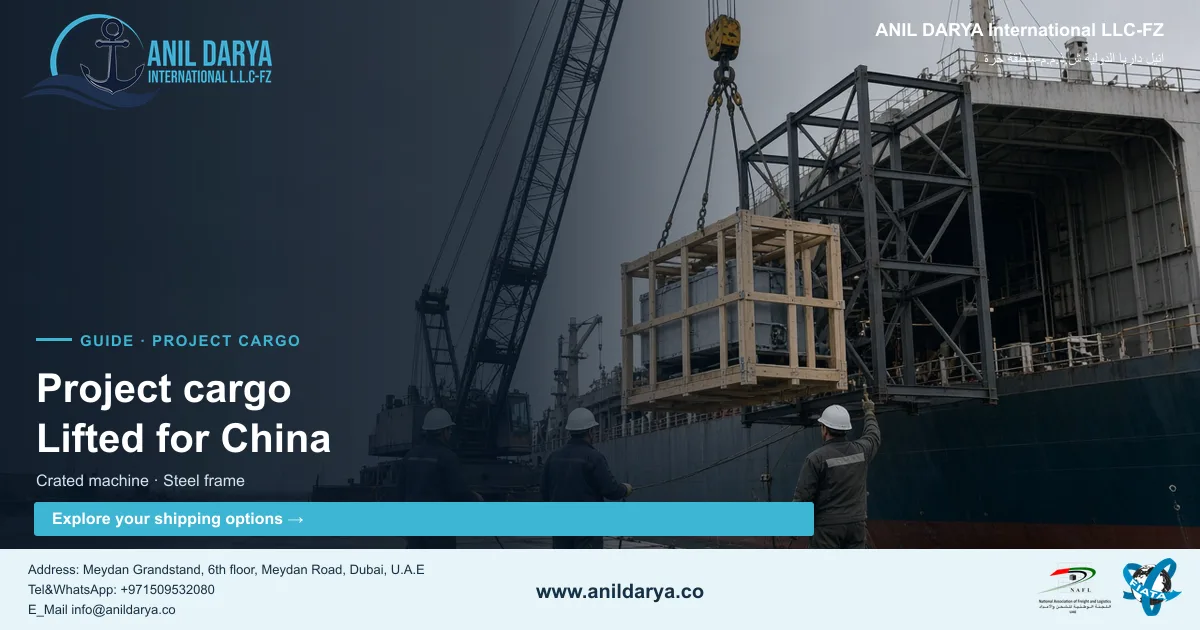
Machinery, plant sections and heavy equipment often do not fit a standard box.
| Cargo | How it usually moves | What to plan first |
|---|---|---|
| Machinery slightly over container size | Flat rack or open top on a container service | Exact dimensions, lifting points, carrier acceptance |
| Heavy-lift and project pieces | Breakbulk or heavy-lift vessel | Lift plan, sailing date, discharge berth in China |
| Steel structures and pipes | Breakbulk or flat racks | Weight per piece, lashing, inland transport |
| Vehicles and construction plant | Ro-Ro, flat rack or container | Chinese import rules for the machine type; ask the broker first |
A decision rule: if a piece fits a 40ft flat rack by size and weight, a container service gives you more sailings and more choice of ports. If it does not, the breakbulk sailing date drives the whole plan. Read our guide to flat racks, open tops and breakbulk, or see our break bulk and project cargo service.
Can you ship dangerous goods to China?
You can ship IMDG dangerous goods to China if the carrier accepts them and the consignee is allowed to import them. Two sets of rules apply.
For the ocean leg to the Chinese port you need:
- A correct UN number, proper shipping name, class and packing group for every product.
- A Safety Data Sheet and a signed Dangerous Goods Declaration.
- UN-approved packaging, labels on the packages and placards on the container.
- Carrier acceptance before you confirm the sailing. Not every service takes every class.
On the Chinese side, GACC lists import and export licences, and the documents for goods subject to inspection and quarantine, among the papers a declaration needs. Biological materials, such as microorganisms, human tissue, blood products and biological agents, fall under GACC's separate health quarantine rules for special goods, in force from 1 August 2026. Ask the consignee's broker whether the product needs a licence or inspection before you book. Our dangerous goods shipping team handles the classification and the carrier side.
Air cargo to China: when it makes sense
Air suits samples, spare parts, electronics and urgent orders. Fluent Cargo's route data lists direct freighter flights from Al Maktoum International (DWC) to Shanghai Pudong by Emirates and Air China, and from DWC to Guangzhou Baiyun by Emirates and China Southern. It also lists direct passenger flights from Dubai International to Beijing Capital. DP World describes Shanghai Pudong as China's main air freight gateway.
Air freight is charged on the higher of actual and volumetric weight. Lithium batteries, aerosols and many chemicals need a DG declaration and airline acceptance. The customs rules in China are the same as by sea. Ask us for air cargo from Dubai when time matters more than freight cost.
China Customs import procedure: who declares and when
China's rules on declaring imported goods are set out in GACC Decree No. 277, in force since 1 May 2025. These are the parts that affect a shipper in Dubai.
Who files the import declaration?
The consignee declares itself or authorises a customs declaration enterprise to declare for it. Both must complete recordation with Customs in advance. The Shanghai municipal government's guide adds that consignees must have market entity status and hold the Registration of Foreign Trade Operators. If your buyer has never imported before, this registration comes first.
The declaration is made electronically. The declarant is legally responsible for the accuracy of what it declares, and a broker must check the information its client gives it. That is why Chinese brokers often come back with detailed questions about model, use and origin.
Time limits that matter
| Rule | Detail |
|---|---|
| Normal deadline | Within 14 days from the declaration of the ship's (or aircraft's) arrival |
| Late declaration | A late declaration fine runs from the 15th day |
| Advance declaration | Within seven days after shipment and before arrival, once the manifest or bill of lading data is available |
| Two-step declaration | With Customs' approval, a summary declaration after shipment, then the full declaration within 14 days of arrival |
| Extra documents | If Customs asks for more documents, they are due within 10 days of the notice |
| Duty and tax payment | Within 15 days of the declaration being completed |
What this means for you: release the bill of lading data and send the documents to the broker as soon as the ship sails. An advance declaration lets the broker work while the cargo is still at sea.
Documents for an import into China
Decree No. 277 lists the documents that accompany a declaration. This is how they map to who provides them on this lane.
| Document | Who provides it | Notes |
|---|---|---|
| Contract | Seller and buyer | Shows the deal behind the invoice |
| Commercial invoice | Seller in the UAE | Description, model, quantity, unit price, Incoterm, currency |
| Packing list | Seller | Weights, carton count and marks must match the invoice |
| Cargo manifest | Carrier | The broker matches the declaration to it |
| Bill of lading or air waybill | Carrier, through us | Consignee should be the Chinese importer |
| Power of attorney | Consignee to its broker | Authorises the broker to declare |
| Import licences | Consignee | Only for goods that need them |
| Inspection and quarantine documents | Consignee, with the seller's help | For goods subject to inspection or quarantine |
| UAE export declaration and certificate of origin | Exporter; we file with Dubai Customs | Dubai Customs asks for invoice, packing list, certificate of origin and any permit |
GACC's duty rules also say that where a document is in a foreign language, Customs can ask for a Chinese translation, and the taxpayer is responsible for its accuracy. Write clear product descriptions in English so the broker can translate them without guessing.
Food, cosmetics, plants and other inspected goods
China checks several product groups under their own GACC rules. Several were replaced or updated in 2026, so do not rely on older guides.
| Goods | GACC rule | What it means for a UAE shipper |
|---|---|---|
| Food | Decree No. 280 on registration of overseas food producers, in force 1 June 2026, replacing Decree No. 248 | The overseas producer, processor or storage company must be registered with GACC. For food in GACC's catalogue, the home authority must also recommend the company. |
| Cosmetics | Decree No. 284 on imported and exported cosmetics, in force 1 December 2026 | The product must be registered (special cosmetics) or recorded (ordinary cosmetics). Customs inspects it, and goods that fail on safety, health or environmental items are destroyed or returned. |
| Plant propagating materials | Decree No. 279, in force 1 April 2026 | Seeds, seedlings and similar materials go through plant quarantine |
| Special goods (biological) | Decree No. 281, in force 1 August 2026 | Health quarantine for microorganisms, human tissue, blood products and biological agents |
If you ship dates, spices, perfumes or cosmetics, the Chinese buyer should confirm the producer's GACC registration or the cosmetic registration before the order ships. Without it, the goods can be refused at the port.
Import duty and import taxes in China
China Customs collects three kinds of charge at import: customs duty, import VAT and, for some goods, consumption tax. The consignee is the taxpayer for all three.
How the customs value is worked out
China's duty regulations, published by GACC, base the customs value on the transaction value plus the cost of transport, related charges and insurance up to unloading at the Chinese port. In practice, freight and insurance from Dubai are part of the value, even on an FOB sale. If Customs doubts the declared value, it can ask for a written explanation and, without one, set the value itself.
Which duty rate applies?
GACC's duty collection measures (Decree No. 272, in force since 1 December 2024) list the rate types: most-favoured-nation, conventional, concessionary and general rates, with tariff quota and temporary rates for some goods. Which one applies depends on the HS code and on where the goods originate, not on where they were shipped from. The rate used is the one in force on the day the declaration is completed.
That matters for re-exports. A product made in Europe and stored in Jebel Ali is assessed on its European origin. Give the broker the true origin and, where you have it, the original certificate of origin.
Import VAT and consumption tax
Customs collects import VAT and import consumption tax on behalf of the tax authorities, at the same time as duty. We could not open an official Chinese rate page during our research, so we leave the VAT and consumption tax rates for your goods to the consignee's broker. Ask for a landed-cost estimate covering all three charges before you agree the price.
| Charge | Basis | Who confirms the rate |
|---|---|---|
| Customs duty | Customs value times the duty rate, or a specific duty per unit | Broker, from the HS code and origin |
| Import VAT | Collected by Customs at import | Broker |
| Consumption tax | Only on goods subject to it | Broker |
Restricted and prohibited goods
For China, the check is less about a single banned list and more about licences and inspection. Before you ship, the consignee's broker should confirm:
- Whether the goods need an import licence.
- Whether they are subject to inspection or quarantine, and which certificates go with them.
- Whether the producer or product needs a GACC registration (food, cosmetics).
- Whether the goods carry a brand that is protected in China. GACC enforces intellectual property rights at the border under its own regulations.
Used goods, waste and scrap deserve extra care. Ask the broker before you load anything second-hand.
What decides the cost of shipping from Dubai to China
We quote each China shipment on its own, because freight and destination charges change by port and by week. These are the items that make up the cost once the goods are cleared in China.
| Cost factor | What drives it |
|---|---|
| Ocean or air freight | Container size, weight, carrier, season, direct or transshipped service |
| UAE origin charges | Trucking to Jebel Ali, terminal handling, export declaration, documents |
| Chinese destination charges | Terminal handling, delivery order, broker fees, CFS charges for LCL |
| Duty, import VAT and consumption tax | HS code, origin, customs value including freight and insurance |
| Inspection | Product type, quarantine checks, any sampling |
| Inland delivery in China | Distance from the port, truck, rail or barge |
| Delays | Late declaration fines, storage, demurrage and detention |
Agree the Incoterm with the Chinese consignee before booking: on most terms the consignee pays the duty, import VAT and broker, but the freight still counts in the customs value. Our guide to Incoterms 2020 for sea freight explains the split.
How to ship from Dubai to China: step by step
- Send us the cargo details. Commodity, HS code, origin, weight, volume or dimensions, the consignee's city and the Incoterm.
- Confirm the purpose. Sale, return, repair, temporary import or re-export changes the customs treatment in China.
- Check the Chinese side. The consignee confirms its customs recordation and foreign trade registration, names its broker, and starts any licence, registration or inspection request.
- Choose the port and mode. We price the port the broker uses nearest the consignee, and air if the timing needs it.
- Book space. For DG, reefer or out-of-gauge cargo we get carrier acceptance first.
- Prepare documents. Contract, invoice, packing list and certificate of origin. We check that descriptions, weights, marks and codes match.
- Export from the UAE. We truck the cargo to Jebel Ali, file the export or re-export declaration with Dubai Customs and load before the cut-off.
- Send documents early. The bill of lading data and the document set go to the broker as soon as the ship sails, so it can declare in advance.
- Clear in China. The broker declares within 14 days of arrival, the consignee pays duty and taxes within 15 days, and Customs releases the goods after any inspection.
- Deliver and return the empty within free time.
Checklist before you ship to China
- Consignee on record with Customs and holding the foreign trade operator registration.
- Broker named and power of attorney signed.
- HS code and true origin confirmed with the broker.
- Licence, inspection, GACC food registration or cosmetic registration in place where needed.
- Purpose of the shipment stated: sale, return, repair or temporary import.
- Contract, invoice, packing list and bill of lading show the same consignee, description and weights.
- For DG: SDS, DG declaration, packaging, labels and carrier acceptance.
- Free days agreed with the carrier and cargo insurance arranged.
Common mistakes on this lane
- Shipping to a buyer that has never imported. Without recordation and the foreign trade registration, nobody can declare the goods.
- Missing the 14-day deadline. The late declaration fine starts on day 15.
- Calling re-exports "UAE origin". Duty depends on the true origin.
- Sending returns as a normal sale. Tell the broker it is a return or repair so it can use the right treatment.
- Relying on old food or cosmetics rules. GACC replaced several of them in 2026.
- Vague descriptions such as "spare parts". Chinese brokers must check model, use and origin, and they will ask.
[AMIR-FACT: one real shipment we moved from Dubai to China (cargo type, Chinese port, mode, purpose such as sale or return, and what we handled), or confirm we have none yet]
Frequently asked questions
Which port in China should I ship to from Dubai?
Ship to the main port nearest your consignee and its broker: Shanghai or Ningbo for East China, Shenzhen or Guangzhou for South China, Tianjin or Qingdao for the north, and Xiamen for Fujian.
How long does shipping from Dubai to China take?
It depends on the carrier, the port and whether the service is direct or transshipped. Ask for the transit time of the actual sailing when you book, and add time for Chinese clearance and any inspection.
Who clears the goods in China?
The consignee, either itself or through a customs declaration enterprise it authorises. Both must be on record with China Customs, and the consignee needs the Registration of Foreign Trade Operators.
How long does the consignee have to declare the goods?
The import declaration is due within 14 days of the declaration of the ship's arrival. A late declaration fine applies from the 15th day.
What documents does China Customs need?
The contract, invoice, packing list, cargo manifest, bill of lading or air waybill and a power of attorney for the broker, plus any import licence and inspection or quarantine documents the goods need.
What taxes are charged on imports into China?
Customs duty, import VAT and, for some goods, consumption tax. Customs collects all three, and the consignee pays within 15 days of completing the declaration. The broker confirms the rates for your HS code.
Can I send faulty goods back to a supplier in China?
Yes. Tell the supplier's broker it is a return or repair and send proof of the original export, so the goods are not treated as a new sale.
Can I export food from the UAE to China?
Only if the producer is registered with GACC under the rules in force from 1 June 2026. For some food types, the home authority must also recommend the producer.
Can I ship dangerous goods from Dubai to China?
Yes, if they are classified, packed and declared under the IMDG Code and the carrier accepts them. The consignee's broker confirms any Chinese licence or inspection the product needs.
Get a quote for shipping from Dubai to China
Send us your cargo details, the purpose of the shipment and the consignee's city, and we will come back with a routing and a price. Use our freight rate inquiry form, or contact our team to talk through a breakbulk, DG or air shipment first. You can also read more about our Dubai freight forwarding team.
Sources
- GACC Decree No. 277: Provisions on the administration of declaration of imported and exported goods
- GACC Decree No. 272: Measures for the collection of duties on imported and exported goods
- GACC: Regulations on import and export duties (customs value)
- GACC Decree No. 280: Registration of overseas producers of imported food
- GACC Decree No. 284: Imported and exported cosmetics
- GACC Decree No. 279: Quarantine of imported plant propagating materials
- GACC Decree No. 281: Health quarantine for special goods and articles
- GACC: Approval for temporarily imported or exported goods
- GACC: Laws and regulations (including customs protection of intellectual property rights)
- Shanghai Municipal Government: Customs registration and declaration
- Maritime Executive: Shanghai exceeds 55 million TEU in 2025
- Maritime Executive: Ningbo-Zhoushan record year (43 million TEU)
- DP World: Shipping routes to China (ports and airports)
- Fluent Cargo: UAE to China air routes
- Fluent Cargo: Dubai to Shanghai air routes
- Dubai Customs: Submit customs declaration
Reviewed: 10 November 2026