
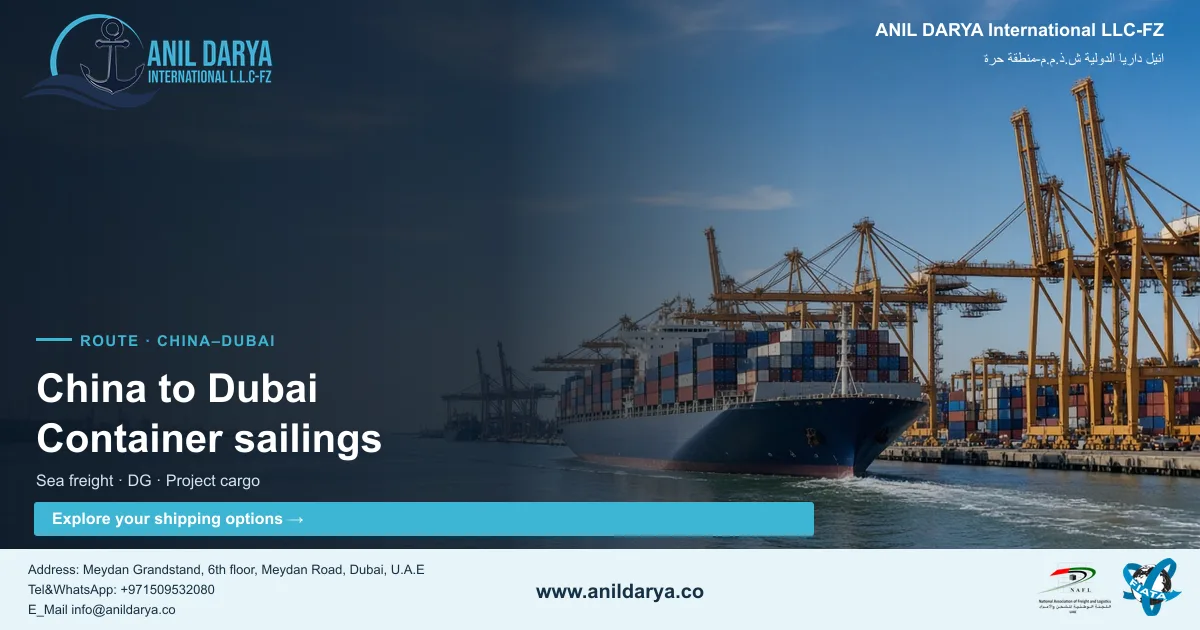
Shipping from China to Dubai usually means a container from a Chinese port such as Shanghai, Ningbo or Shenzhen into Jebel Ali, or air cargo into Dubai's airports when time matters more than cost. Your supplier or forwarder files the export declaration with China Customs, and the importer clears the goods with Dubai Customs, paying 5% duty on the CIF value plus 5% VAT. This guide covers each mode, dangerous goods and project cargo, the documents on both sides and the steps we follow.
China to Dubai shipping at a glance
| Item | Detail |
|---|---|
| Main modes | Sea FCL, sea LCL, air cargo, breakbulk and project cargo, dangerous goods by sea or air |
| Common Chinese load ports | Shanghai, Ningbo, Shenzhen (Yantian and Shekou), Guangzhou (Nansha), Qingdao, Tianjin, Xiamen |
| Main UAE discharge port | Jebel Ali (UN/LOCODE AEJEA); Khalifa, Sharjah and other UAE ports on some services |
| Air arrival | Dubai International (DXB) or Al Maktoum International (DWC) |
| Export side authority | China Customs (General Administration of Customs, GACC) |
| China export declaration timing | Goods in the customs area, declared 24 hours before loading |
| Import side authority | Dubai Customs, declarations filed on Mirsal 2 through Dubai Trade |
| Dubai customs duty | 5% of CIF value (alcohol 50%, cigarettes 100%) |
| Import VAT | 5%, deferred to the VAT return for registered importers whose customs number is linked with the FTA |
| Core import documents | Invoice, packing list, certificate of origin, bill of lading or air waybill, permits for restricted goods |
| DG rules at sea | IMDG Code 2024 edition (Amendment 42-24), mandatory from 1 January 2026 |
How does shipping from China to Dubai work?
Every China to Dubai shipment has the same three parts. The goods are cleared for export in China, carried by sea or air, then cleared for import in the UAE and delivered.
- Origin. The supplier makes the goods ready. Someone collects them, packs or stuffs the container and files the Chinese export declaration.
- Main carriage. A shipping line or airline carries the cargo to Dubai. We book that space with carriers for you.
- Destination. The consignee or a clearing agent files the Dubai Customs declaration, pays duty and VAT, collects the delivery order and takes delivery.
Who does each part depends on the Incoterm in your purchase contract. Under FOB, your supplier clears export and loads the goods at the Chinese port, and you take over from there. Under EXW, you or your forwarder handle everything from the factory gate, including the Chinese export declaration. Under CIF or CFR, the supplier pays freight to Dubai but you still pay destination charges. Our Incoterms 2020 guide for sea freight shows where cost and risk pass in each case.
A simple rule: if your supplier is experienced in export, FOB is usually the cleanest choice. You control the freight and the Dubai side, and the supplier handles the Chinese paperwork it knows best.
Which ports and airports handle China to Dubai cargo?
China has several large container ports, and the right one is usually the one nearest your supplier. Moving cargo by truck across China to a different port adds cost and time.
| Chinese region | Usual load port | Typical supplier base |
|---|---|---|
| Yangtze River Delta | Shanghai (Yangshan, Waigaoqiao), Ningbo | Shanghai, Jiangsu, Zhejiang |
| Pearl River Delta | Shenzhen (Yantian, Shekou), Guangzhou (Nansha) | Guangdong, including Shenzhen, Dongguan and Foshan |
| North China | Tianjin, Qingdao | Beijing, Hebei, Shandong |
| Southeast coast | Xiamen | Fujian |
On the UAE side, most containers from China discharge at Jebel Ali, which sits next to the Jebel Ali Free Zone. Read our Jebel Ali port guide for terminals, customs and trucking. Some services also call Khalifa Port in Abu Dhabi or Sharjah, which can shorten the truck leg if your site is in Abu Dhabi or the northern emirates.
Air cargo from China lands at Dubai International (DXB) or Al Maktoum International (DWC). The main Chinese cargo airports for this lane include Shanghai Pudong, Guangzhou Baiyun, Shenzhen Bao'an and Beijing.
Sea freight from China to Dubai: FCL or LCL?
Most cargo on this lane moves by sea. The first choice is whether you need your own container.
| Option | How it works | Best for | Watch out for |
|---|---|---|---|
| FCL 20ft | You book a whole 20ft box, stuffed at the factory or a warehouse | Heavy, dense cargo such as tiles, steel parts, machinery | Road and carrier weight limits for heavy boxes |
| FCL 40ft / 40ft high cube | Whole 40ft box with more volume | Furniture, light industrial goods, mixed stock from one supplier | Free time at Jebel Ali, delivery planning |
| LCL | Your cargo shares a box, consolidated at a Chinese warehouse and split in Dubai | Small volumes and first orders | Extra handling, consolidation cut-offs, release depends on the shared box |
| Reefer | Temperature-controlled container | Food, some chemicals, pharmaceuticals | Set temperature, food permits in the UAE |
| Flat rack / open top | Container frame for tall or wide pieces | Machinery and equipment slightly out of gauge | Lashing, carrier acceptance, limited equipment |
If you buy from several suppliers in the same region, ask us to consolidate them into one container at a Chinese warehouse. You pay for one FCL instead of several LCL lots, and you clear one shipment in Dubai. Our article on FCL vs LCL costs explains where the break-even point usually falls. For booking and container options, see our sea freight service.
How long does shipping from China to Dubai take?
Transit time is not only the sailing. Door to door, it adds factory pickup, Chinese export clearance, waiting for the vessel cut-off, the sailing itself, Dubai clearance and delivery.
| Stage | What drives the time |
|---|---|
| Cargo ready and pickup | Supplier production, packing, truck availability |
| Chinese export clearance | Correct declaration elements and documents, inspection if selected |
| Port cut-off and sailing | Weekly sailing day, port rotation, direct call or transshipment |
| Dubai clearance | Declaration filed before arrival, permits ready, duty paid |
| Delivery | Truck booking, consignee site, unloading |
Carriers publish their own schedules, and they change. Ask for the routing on every quote and check whether it is a direct call at Jebel Ali or a transshipment. Air cargo is much faster, but customs in both countries still takes its share.
[AMIR-FACT: our real port-to-port and door-to-door transit days from Shanghai, Ningbo and Shenzhen to Jebel Ali (FCL and LCL), and the carriers we usually book on this lane]
Air cargo from China to Dubai
Air cargo suits urgent orders, samples, spare parts, electronics and high-value goods. It is charged on the higher of actual weight and volumetric weight, so bulky light cargo costs more than its weight suggests.
- Use air when the cost of waiting, such as a stopped production line, is higher than the freight difference.
- Use sea when the cargo is heavy, bulky or not urgent.
- Split the order when you need part of it fast. Fly the first cartons and send the rest by sea.
Air cargo needs an air waybill instead of a bill of lading, and the same invoice, packing list and certificate of origin for Dubai Customs. Lithium batteries, aerosols, paints and many chemicals are dangerous goods by air and need a DG declaration and airline acceptance. As an IATA-approved cargo agent, we book this space directly. See our air cargo service for details.
[AMIR-FACT: the airlines and typical airport-to-airport transit days we actually see on China to Dubai air cargo]
Dangerous goods from China to Dubai
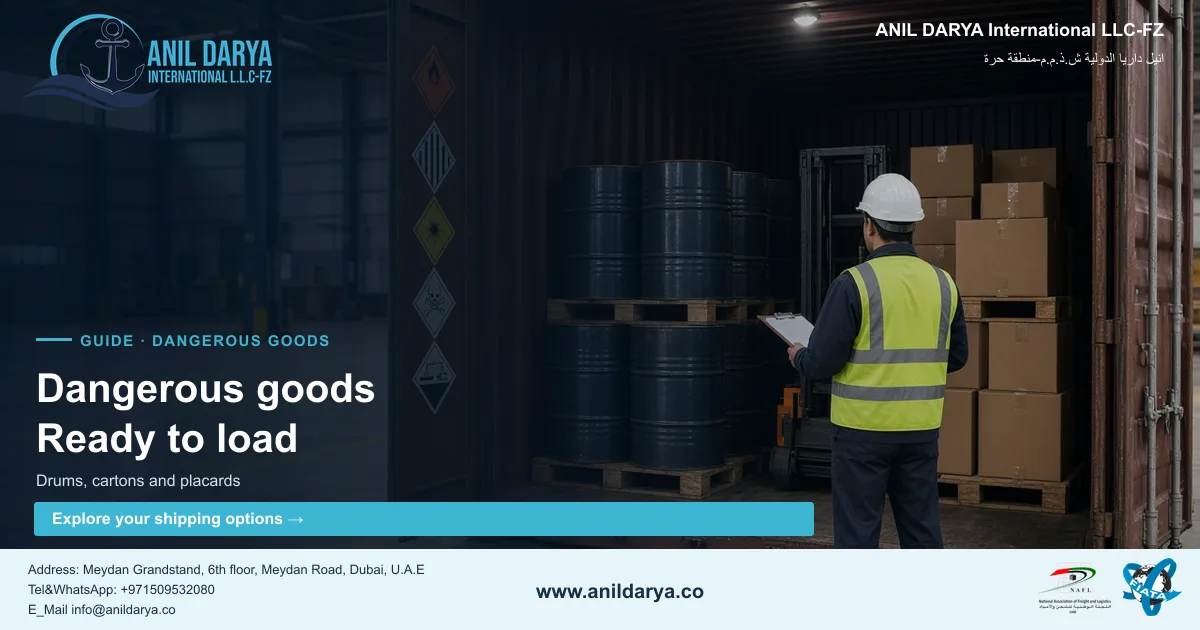
A large share of what the UAE buys from China is DG without the buyer realising it: lithium batteries, paints, adhesives, cleaning chemicals, solvents, aerosols and some cosmetics. DG shipments fail most often at the booking stage, when the carrier rejects incomplete papers.
What China requires before DG can be exported
China Customs inspects the packaging used for exported dangerous goods. There are two checks. Performance appraisal confirms the packaging type meets the required standard, based on test reports. Use identification checks how the real goods are packed, including an on-site check. In July 2024 the customs inspection department announced a nationwide pilot of batch inspection, which lets qualified exporters ship several lots of the same batch after one on-site check. It excludes Class 6.2 infectious substances and Class 7 radioactive material.
In practice, ask your supplier early whether the packaging certificates are ready. Without them, the cargo cannot be booked as DG at the Chinese port.
What the carrier and the UAE side require
Sea DG moves under the IMDG Code. The 2024 edition with Amendment 42-24 has been mandatory since 1 January 2026, so make sure the supplier's Safety Data Sheet and DG declaration follow the current amendment.
| Item | Who provides it | Why it matters |
|---|---|---|
| UN number, proper shipping name, class, packing group | Supplier | Carrier acceptance and correct labelling |
| Safety Data Sheet (SDS) | Supplier | Checked by the carrier and needed for UAE permits |
| China DG packaging certificates | Supplier, issued after China Customs inspection | No export DG booking without them |
| DG declaration (IMDG or IATA) | Shipper, signed by a trained person | Required by the carrier for every DG load |
| Container packing certificate, placards | Stuffing party | Checked at the terminal |
| UAE permit for the product, if restricted | Consignee, before arrival | Dubai Customs releases restricted goods only with the approval |
At Jebel Ali, the port safety regulator limits how long some DG classes can stay in the port. Class 8 corrosives arriving as imports must be cleared within 3 working days, so the Dubai declaration and any permit need to be ready before the vessel berths. Our guide to dangerous goods customs clearance in the UAE covers the import side, and our dangerous goods team checks the papers and carrier acceptance before you commit to a sailing.
Breakbulk and project cargo from China to Dubai
China supplies a lot of the machinery, steel structures, transformers, generators and plant equipment used in UAE projects. Much of it does not fit a standard container. It moves on flat racks on container ships, or as breakbulk on general cargo or heavy-lift vessels.
| Cargo | Usual method | Decision rule |
|---|---|---|
| Machinery slightly over container height | Open top or flat rack | If it fits a 40ft flat rack by size and weight, container services give more sailings |
| Wide or very heavy single pieces | Breakbulk or heavy-lift vessel | If it does not fit a flat rack, the vessel date drives the whole plan |
| Steel structures, pipes, beams | Breakbulk | Volume and lengths decide whether breakbulk beats many flat racks |
| Full plant or project shipments | Mixed: containers plus breakbulk | Plan one master packing list so the Dubai clearance matches every piece |
For project cargo from China we plan in this order:
- Get drawings, dimensions, weights and centre of gravity for every piece from the supplier.
- Choose flat rack or breakbulk tonnage and agree the load port with the carrier.
- Agree lifting points, lashing and securing with the carrier and the Chinese terminal.
- Prepare a piece-by-piece packing list that matches the invoice and bill of lading.
- Plan discharge in the UAE, the road route, permits and any escort the load needs.
- File the Dubai declaration before arrival so the pieces leave the quay quickly.
Our break bulk and project cargo service covers the UAE end.
[AMIR-FACT: one real breakbulk, project or DG shipment we handled from China to the UAE (cargo, load port, how it moved, result)]
China export customs: what your supplier must do
China Customs (GACC) controls exports. The consignor, usually your supplier, files the export declaration on paper or electronically, either by itself or through a customs broker. On the Shanghai government's guidance, the declaration is made after the goods reach the customs supervision area and 24 hours before loading.
- The exporter must have market entity status and be recorded as a foreign trade operator and a customs declaration entity. Registration can be done online through the China International Trade Single Window.
- The main commercial documents are the contract, invoice and packing list, plus any licence the goods need.
- Goods under statutory inspection, such as DG packaging, need the inspection result before export.
Under EXW you need a Chinese party to act as the exporter of record, because a buyer in Dubai cannot normally file a Chinese export declaration. This is one reason FOB is easier for most buyers. Make sure the values and descriptions on the Chinese export declaration match the invoice you will give Dubai Customs.
Dubai Customs: documents for goods from China
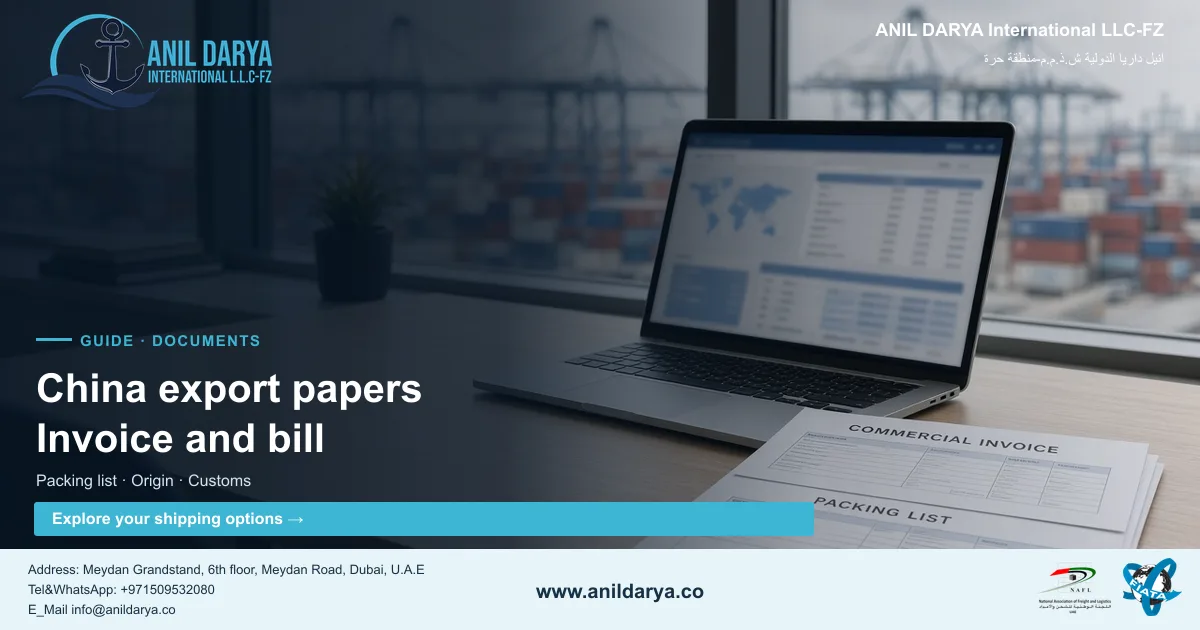
Dubai Customs lists four documents for a customs declaration: invoice, packing list, certificate of origin, and a permit from the relevant authority where the goods are restricted. Sea cargo also needs the bill of lading and, on import, the shipping line's delivery order. Air cargo needs the air waybill.
| Document | Issued by | What to check |
|---|---|---|
| Commercial invoice | Chinese supplier | Full description, HS code, unit price, total value, currency, Incoterm, consignee name |
| Packing list | Chinese supplier | Cartons or pieces, gross and net weight, volume, marks matching the cartons |
| Certificate of origin | Issuing body in China | Matches invoice goods and consignee |
| Bill of lading or air waybill | Carrier or forwarder | Consignee and notify party, weights and piece count match the packing list |
| Delivery order | Shipping line in Dubai | Released after local charges are paid |
| Permit for restricted goods | Competent UAE authority | Applied for before arrival |
Declarations are filed on Mirsal 2 through the Dubai Trade portal. Each one is risk-assessed and the declarant gets a clearance or a hold message. To file, a business needs a Dubai Customs business code, registered online through Dubai Trade. If you do not have one, a clearing agent with a clearing and forwarding licence and its own code can file with your authorisation. We arrange this through a licensed clearing agent or work with your own.
Import duty and VAT on goods from China
Dubai charges customs duty of 5% of the CIF value for most goods. Alcohol is charged at 50% and cigarettes at 100%. Some goods have other rates or are exempt, so confirm the rate for your HS code before you order.
Import VAT is 5%. The FTA charges it on the customs value, which includes insurance, freight and customs fees. A VAT-registered importer that has registered its customs number with the FTA can defer the VAT to its return. An importer that is not registered must pay the VAT before customs releases the goods.
| Your situation | Duty | VAT |
|---|---|---|
| Mainland importer, VAT-registered, customs number linked with FTA | 5% of CIF, paid at clearance | Deferred to the VAT return |
| Mainland importer, not VAT-registered | 5% of CIF, paid at clearance | 5% paid before release |
| Goods moved into a free zone such as Jafza | Due only if goods later enter the mainland | Depends on free zone rules and later movement |
| Temporary import, re-exported on time | Deposit equal to the duty, refunded on re-export | Check with your tax adviser |
Freight and insurance from China are part of the duty base. A cheap freight rate does not change the 5% much, but an undervalued invoice can lead to a hold and a reassessment.
Restricted and prohibited goods
Dubai Customs says some goods need special approval from the competent authority, and goods that go against the values and morals of the country are banned. Books, discs and other media are released only after inspection by the information authority. Common product groups that need a permit or approval include:
- Food, cosmetics and medicines.
- Many chemicals, pesticides and fertilisers.
- Telecom and wireless equipment.
- Printed and recorded media.
Check the permit before your supplier ships. A permit applied for after arrival means storage and container charges while you wait.
What affects the cost of shipping from China to Dubai?
We do not publish prices because they change with each booking. These are the parts of the total cost and what moves them.
| Cost part | What moves it |
|---|---|
| Origin charges in China | Pickup distance, export clearance, terminal handling, consolidation for LCL |
| Sea or air freight | Container size or chargeable weight, season, carrier, surcharges, special equipment |
| DG and out-of-gauge | DG surcharges, packaging certificates, flat rack or breakbulk premiums, lashing |
| Destination charges in Dubai | Terminal handling, delivery order, LCL unpacking, documentation |
| Duty and VAT | CIF value and HS code |
| Delivery | Distance to your site, truck type, unloading equipment |
| Delays | Demurrage and detention when free time runs out |
Ask every forwarder to quote the same scope, from the same Incoterm to the same delivery point, so you compare like with like.
How to ship from China to Dubai: step by step
- Agree the Incoterm with your supplier. FOB is usually simplest for Dubai buyers.
- Send us the cargo details: commodity, HS code, weight, volume or dimensions, supplier address, ready date and whether any item is DG.
- Get a quote and routing. We compare sea and air options and the load port nearest your supplier.
- Check permits. If the goods are restricted in the UAE, apply before the cargo sails.
- Book space. For DG, reefer or out-of-gauge cargo we get carrier acceptance first.
- Collect and export. The supplier or our origin trucking moves the cargo, and the export declaration is filed with China Customs before loading.
- Check documents before sailing. We match invoice, packing list, certificate of origin and the draft bill of lading.
- File the Dubai declaration before arrival, so it is ready when the vessel berths.
- Pay duty, VAT if due and local charges, and collect the delivery order.
- Deliver and return the empty within free time.
Our Dubai freight forwarding team handles the UAE end of each step.
Checklist before your supplier ships
- Incoterm agreed and written in the contract.
- HS code confirmed for every item, and the duty rate checked.
- Invoice, packing list and bill of lading show the same weights, piece counts and consignee.
- Certificate of origin requested from the supplier.
- UAE permits applied for if the goods are restricted.
- Consignee has a Dubai Customs business code, or a licensed agent is authorised.
- VAT registration linked to the customs number, if you want to defer import VAT.
- For DG: SDS, China packaging certificates, DG declaration and carrier acceptance.
- For project cargo: drawings, weights, lifting points and a UAE road plan.
- Free time agreed with the carrier, and cargo insurance arranged.
Common mistakes on the China to Dubai lane
- Undeclared DG. Batteries or chemicals booked as general cargo can be rejected or fined.
- Mismatched values. The Chinese export value and the invoice given to Dubai Customs should agree.
- Late permits. Applying after arrival runs up storage and container charges.
- Wrong load port. Trucking cargo across China to a distant port adds cost and days.
- EXW without an exporter of record. Nobody in China can file the export declaration.
- Ignoring volumetric weight. Bulky light cargo by air costs far more than expected.
- No delivery plan. Containers that land without a truck booking use up free time.
Frequently asked questions
What is the cheapest way of shipping from China to Dubai?
Sea freight is the cheapest for most cargo. LCL suits small volumes, and FCL becomes better value as volume grows. Air costs more but can be the cheaper total when delays are expensive.
Which port do containers from China arrive at in Dubai?
Most containers from China discharge at Jebel Ali (AEJEA), next to the Jebel Ali Free Zone. Some services also call Khalifa Port in Abu Dhabi or Sharjah.
What is the import duty on goods from China to Dubai?
Dubai charges 5% customs duty on the CIF value for most goods, 50% on alcohol and 100% on cigarettes. Import VAT of 5% also applies, which VAT-registered importers can defer to their VAT return.
What documents do I need to import from China to Dubai?
Dubai Customs asks for an invoice, packing list, certificate of origin and any permit for restricted goods. You also need the bill of lading or air waybill and, for sea cargo, the delivery order from the shipping line.
Who files the export declaration in China?
The consignor, usually the supplier, files it with China Customs directly or through a customs broker. It is made after the goods reach the customs area and 24 hours before loading.
Can I ship lithium batteries or chemicals from China to Dubai?
Yes, as dangerous goods. You need the UN number and class, an SDS, China Customs packaging certificates, a DG declaration and carrier acceptance, plus any UAE permit for the product.
Can you ship machinery that does not fit in a container?
Yes. Pieces that fit a flat rack can move on container ships. Larger or heavier pieces move as breakbulk or heavy-lift cargo, planned piece by piece from drawings and weights.
Do I need a trade licence to import from China into Dubai?
To file a customs declaration you need a Dubai Customs business code, which licensed businesses register for through Dubai Trade. Without one, a licensed clearing agent can file with the goods owner's authorisation.
Is VAT charged on freight costs too?
Yes. Import VAT is charged on the customs value, which includes insurance, freight and customs fees, not only the price of the goods.
Get a quote for shipping from China to Dubai
Send us your supplier location, cargo details and ready date, and we will come back with a routing and price by sea or air. Use our freight rate inquiry form, or contact our team to talk through a DG, breakbulk or project shipment first.
Sources
- Shanghai Municipal Government: Customs registration and declaration (24 hours before loading)
- CIRS: China customs batch inspection pilot for exported hazardous chemicals and DG packaging (July 2024)
- IMO: IMDG Code 2024 edition (Amendment 42-24)
- Dubai Customs: Submit customs declaration (required documents)
- Dubai Customs: FAQ (duty rate, business code, clearing agents, deposits, restricted goods)
- Dubai Customs: Mirsal 2 declaration channels
- UAE Government portal: Customs duty
- Federal Tax Authority: VAT guide (import VAT)
- Trakhees circular EHS/PM/04/12: Class 8 cargo at port
Reviewed: 10 November 2026