
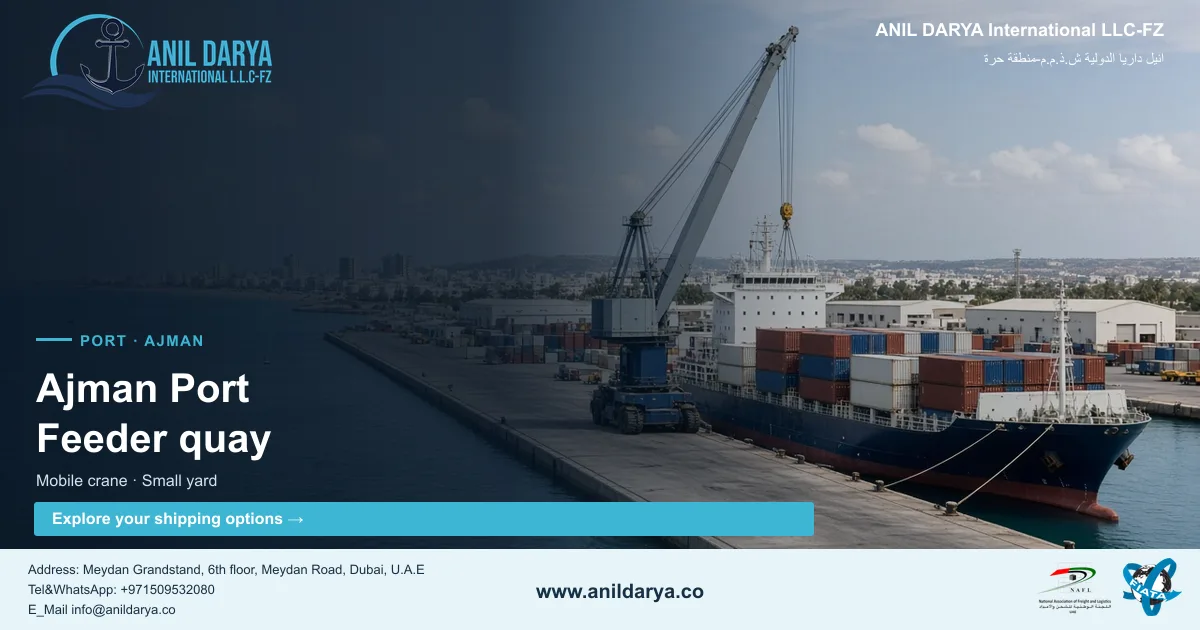
Ajman port shipping means moving cargo through a small, shallow-water port on the UAE's west coast, about 25 km from Dubai and 10 km from Sharjah. Most containers reach Ajman on feeder ships from Jebel Ali or by truck after discharge in Dubai, and Ajman has its own customs authority, separate from Dubai Customs. This guide covers the port's limits, the terminal, Ajman customs declarations and fees, and how we plan a shipment through Ajman.
Ajman port at a glance
| Item | Detail |
|---|---|
| Location | Ajman, about 25 km from Dubai and 10 km from Sharjah |
| UN/LOCODE | AEAJM |
| Port and customs authority | Department of Port and Customs, Ajman (restructured by Amiri Decree No. 15 of 2011) |
| Container terminal operator | Hutchison Ajman International Terminals (Hutchison Ports), since 2012 |
| Container and general cargo quay | 1,250 m, with a 12.9 hectare yard |
| Largest ship | 170 m length at all times (180 m at high water), about 20,000 dwt |
| Maximum draft | 7.6 m at all times (8.0 m at high water) |
| Cargo handled | Containers, general cargo and breakbulk, Ro-Ro, small tankers |
| Ship repair | Dry dock of 175 x 32 x 6.0 m, up to 30,000 dwt |
| Nearest airports | Sharjah International about 14 km, Dubai International about 30 km |
| Published feeder transit | Jebel Ali to Ajman in 2 days on Maersk's ICFS Ajman Feeder |
| Customs duty and VAT | Most goods 5% of CIF value; import VAT 5% |
| Free zone next to the port | Ajman Free Zone, established 1988, more than 9,000 companies |
What is Ajman port and who runs it?
Ajman port is the commercial seaport of the Emirate of Ajman, between Sharjah and Umm Al Quwain on the west coast. The Department of Port and Customs Ajman regulates the port and applies the GCC Common Customs Law of 2002 along with Ajman's own customs and maritime rules. Its offices are in Al Butain, Ajman.
The container terminal is run by Hutchison Ports. Hutchison Port Holdings signed a ten-year concession with the Ajman port authority in October 2011, and its company Hutchison Ajman International Terminals (HAJT) took over operations from 1 January 2012. In June 2025, the Department of Port and Customs Ajman and Hutchison Ports signed a memorandum of understanding for a joint AED 1 billion investment, with a 15-year plan to operate, manage and develop the port. The timeline was not published, so treat any new capacity as future, not current.
For you as a shipper, three things follow from this setup:
- Your customs declaration is filed with Ajman customs, not with Dubai Customs, even if the box first landed at Jebel Ali.
- The terminal is small, so ship size, not port congestion, is usually the limit.
- Few mainline services call here. Most boxes arrive by feeder or by road.
Berths, depth and vessel limits at Ajman
Ajman is a shallow port by UAE standards, and this decides which ships and which cargo can use it. Port guides that copy the official sailing directions give these figures.
| Feature | Figure | What it means for your cargo |
|---|---|---|
| Entrance channel | Dredged to 8 m in 1998 | Small feeders and general cargo ships only |
| Berths 1 to 5 | 548 m in total, 8 m alongside | Main berths for containers and general cargo |
| Nine other berths | 1,654 m in total, 5 m alongside | Coasters, dhows and small craft |
| Ro-Ro berth | 150 m long, 5 m alongside | Small Ro-Ro and landing craft |
| Maximum ship | 170 m length, 7.6 m draft (180 m and 8.0 m at high water), 20,000 dwt | No mainline container ships; feeder and short-sea only |
| Container quay and yard (HAJT) | 1,250 m quay, 12.9 ha yard | Compact yard, plan collection inside free time |
The same sailing directions note that dredged areas silt up and depths can be less than charted, and pilotage is compulsory with 48 hours' notice. Other port databases list slightly different depths, so the carrier's own acceptance for your ship and draft is what counts.
A simple rule: if your cargo is on a large deep-sea ship, it will not berth at Ajman. It discharges at Jebel Ali or another deep-water port first, then comes to Ajman by feeder or by truck.
Shipping from Dubai to Ajman port: feeder or truck?
There are two practical ways to get a container from the main Dubai hub into Ajman.
Feeder from Jebel Ali to Ajman
Maersk publishes an ICFS Ajman Feeder with a Jebel Ali to Ajman transit of 2 days. Port data from Cogoport for March 2026 showed CMA CGM, Star Feeders and Unifeeder as the main operators by capacity calling Ajman. With a feeder, the box is discharged in Ajman and cleared by Ajman customs at the port.
A feeder makes sense when your bill of lading already names Ajman as the port of discharge, or when the carrier offers a through rate to Ajman at little extra cost.
Truck from Jebel Ali or Sharjah
If the carrier does not offer Ajman, the box discharges at Jebel Ali or a Sharjah port and moves by road. Ajman is about 25 km from Dubai, so the road leg is short. You then choose where customs happens: at the discharge port, or under a transit declaration with clearance in Ajman.
| Your situation | Usual routing | Why |
|---|---|---|
| Carrier quotes a through rate to Ajman | Feeder from Jebel Ali to Ajman | Clearance at Ajman, box released close to the consignee |
| Mainline service only to Jebel Ali | Discharge at Jebel Ali, truck to Ajman | More sailings, short road leg |
| Consignee in Ajman Free Zone | Either route, with a free zone entry declaration | Duty suspended while goods stay in the zone |
| Breakbulk under 20,000 dwt ship size | Direct general cargo call at Ajman | Saves a second lift and a road move |
| Heavy lift or deep-draft ship | Jebel Ali or Sharjah, then road | Ajman's depth and berths are too limited |
[AMIR-FACT: our real door-to-door days and the carriers or feeders we actually use for Jebel Ali to Ajman, and whether we usually feeder or truck]
Read our Jebel Ali port shipping guide for the hub side of this move.
Which cargo moves through Ajman port?
Port databases list containers, general cargo, logs, Ro-Ro and small tankers. The Ajman Free Zone next to the port adds trading, light industry and re-export cargo. Here is how each type usually works.
| Cargo type | How it moves | What to plan |
|---|---|---|
| FCL dry containers | Feeder to the HAJT terminal, or truck from Jebel Ali | Port of discharge on the bill of lading, free time |
| LCL cargo | Consolidated at a Dubai or Sharjah hub, delivered by truck | Delivery order from the consolidator, warehouse booking |
| Food and reefer cargo | Reefer box on a feeder or by road | Health release certificate from Ajman Municipality |
| Steel, timber, building materials | Small general cargo ships at berths 1 to 5 | Ship size under the port limits, discharge plan |
| Vehicles and plant | Ro-Ro berth or flat racks | Vehicle clearance certificate from Ajman customs |
| Dangerous goods | Containers under IMDG rules, carrier and port approval | Acceptance for every leg, direct delivery |
Containers through Ajman port: FCL and LCL
FCL is the usual way to use Ajman. The box stays sealed from origin to the consignee, and only one customs declaration is needed. Cogoport's port data showed weekly volumes of about 3,000 TEU in February 2026, most of it imports, so this is a small terminal compared with Jebel Ali.
The same data put average import dwell time at 6.4 days in February 2026, down from 12.4 days in September 2025. That is the time boxes spent in the port, not the transit time, and it shows that clearance speed varies through the year. File documents before the feeder arrives.
LCL rarely discharges at Ajman itself. Your cargo is usually unpacked at a consolidator's warehouse in Dubai or Sharjah and trucked to Ajman. If you are unsure which suits your volume, our FCL vs LCL guide shows where the break-even point usually falls, and our sea freight service covers both.
Breakbulk and project cargo at Ajman
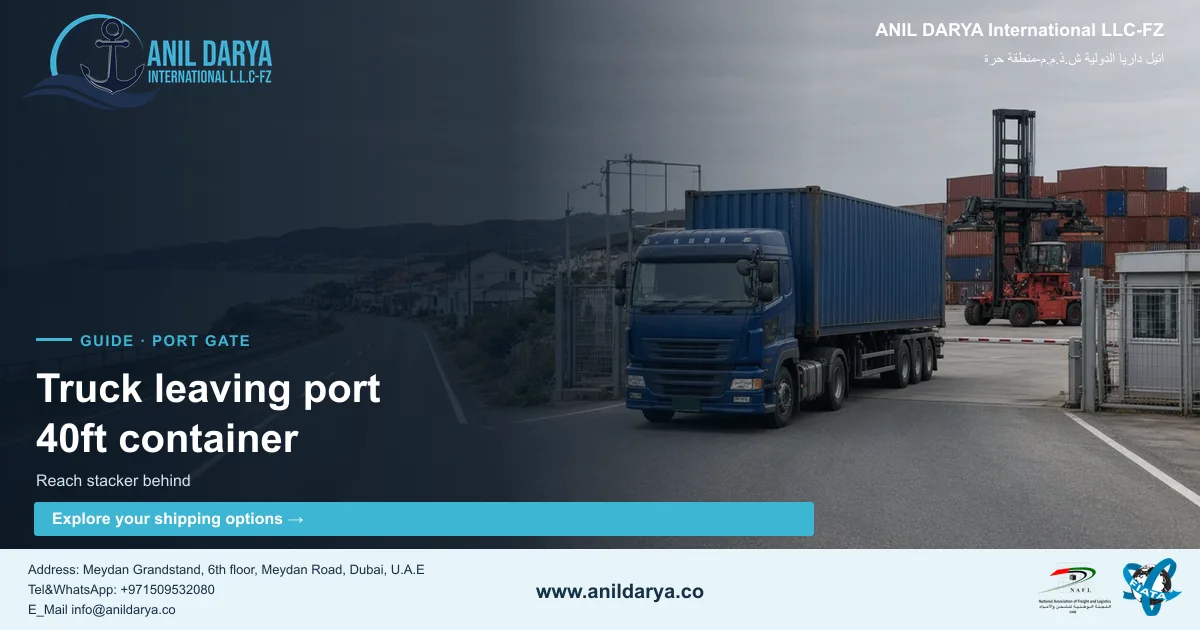
Ajman's general cargo berths take small conventional ships. The 20,000 dwt and 7.6 m draft limits rule out most large heavy-lift ships, so project cargo here is usually steel, timber, pipes, machinery and building materials in modest lots.
Our planning order for breakbulk through Ajman:
- Check that the ship's length, draft and tonnage fit the port limits for the berth you need.
- Collect weights, dimensions and lifting points for each piece.
- Confirm with the terminal which cranes or ship's gear will discharge the cargo.
- Book trailers and any road permit for the short drive to the site.
- File the Ajman import declaration before arrival so the cargo leaves the quay quickly.
Decision rule: if the heaviest piece needs a ship larger than Ajman accepts, discharge it at Jebel Ali and truck it in. The road leg is short, and the deep-water port gives you more ship options. See our break bulk and project cargo service and our guide to breakbulk documents and the UAE port process.
Dangerous goods through Ajman
We did not find a published Ajman port circular on dangerous goods storage that we could verify. That means the rules come from the IMDG Code, the carrier's acceptance and the port's approval for each shipment. Because most DG boxes reach Ajman by feeder from Jebel Ali, the DG rules at Jebel Ali also apply while the box sits there before the feeder sails.
What you need for a DG booking into Ajman:
- UN number, proper shipping name, class and packing group for each product.
- A safety data sheet and a signed dangerous goods declaration.
- UN-approved packaging, labels and container placards.
- Carrier acceptance for the main leg and the feeder leg.
- Any permit a UAE authority requires for the product, ready before arrival.
Plan direct delivery from the port where the class allows it, and avoid storage in the yard. Our dangerous goods shipping team checks acceptance before you commit to a sailing.
Ajman customs: declarations, documents and fees
Ajman runs its own customs. The UAE government portal lists the Department of Ports and Customs, Ajman as the customs authority for the emirate, separate from Dubai Customs and Sharjah Customs. Declarations are issued through the department's online services, and Ajman's service catalogue gives a service time of one day.
Which documents does Ajman customs ask for?
For a business declaration, the Ajman service catalogue lists:
- Delivery order from the shipping line.
- Commercial invoice.
- Packing list.
- Bill of lading.
- Certificate of origin.
- Approval from the regulating authority, if the goods are restricted.
- Other documents depending on the goods.
How much does an Ajman customs declaration cost?
Ajman publishes a fee for each declaration type. These are customs service fees, separate from duty and VAT.
| Declaration type | Fee (AED) |
|---|---|
| Free zone entry or exit | 20 |
| Import, transfer, warehousing, transshipment, temporary admission | 70 |
| Exempt import issuance | 80 |
| Export, re-export, temporary export | 100 |
| Statistical declaration (inbound, outbound, transit) | 50 |
Customs duty and import VAT
UAE customs tariffs range from 0 to 5%, and most goods pay 5% of the CIF value under the GCC common tariff that Ajman applies. Some goods are exempt or charged at other rates, so check your HS code.
Import VAT is 5%. If the importer is VAT-registered and gives the Federal Tax Authority its customs registration number, the VAT is accounted for on the VAT return under the reverse charge. If not, VAT must be paid before the goods are released.
Food and vehicles: extra steps in Ajman
Food arriving through Ajman port needs a health release certificate from Ajman Municipality. The listed documents include the origin health certificate, certificate of origin, customs declaration, packing list and, for animal products, a halal certificate. The fee is AED 200 and the stated service time is 2 days.
Vehicles are inspected by the customs inspection section, which issues a vehicle clearance certificate before the declaration is released.
Ajman port and Ajman Free Zone
Ajman Free Zone was established in 1988, sits next to the port and hosts more than 9,000 companies from over 145 countries. Its sectors include trading, chemicals, construction, automotive and light manufacturing.
The delivery point decides the paperwork:
- Goods for a free zone company enter on a free zone entry declaration (AED 20). Duty is due only if the goods later move into the UAE local market.
- Goods moving from the free zone to the local market need a customs declaration, commercial invoice and deposit statement, and duty is then paid.
- Goods sold out of the free zone abroad leave on an exit or re-export declaration.
Ask your consignee for its licence type before shipping. A free zone address on the invoice with a local import declaration, or the reverse, is a common cause of amendments. For the re-export side, see our guide to re-export for bulk and breakbulk cargo, which explains the same logic for Jafza.
How to ship through Ajman port: step by step
This is how we handle a typical import into Ajman. We book space, prepare documents, arrange trucking and clearance in the UAE, and work with the consignee on the Ajman side.
- Confirm the delivery address and whether the consignee is in Ajman Free Zone or the local market.
- Agree the Incoterm with your supplier, so it is clear who books freight and who clears in Ajman.
- Send us the cargo details: goods, HS codes, weights, dimensions and packing.
- We compare a through rate to Ajman by feeder with discharge at Jebel Ali and a truck move.
- We book space. For DG, reefer or out-of-gauge cargo we get carrier acceptance first.
- We check the invoice, packing list, certificate of origin and bill of lading so names, weights and HS codes match.
- The declaration is filed with Ajman customs before arrival, together with any health release or permit.
- Duty, VAT if due and the line's charges are paid, and the delivery order is issued.
- We truck the box to the consignee and return the empty to the depot within free time.
For exports, the order is reversed: booking, empty release, stuffing, export or re-export declaration, gate-in before the cut-off, then the bill of lading.
Checklist before you ship to Ajman
- Port of discharge on the bill of lading matches your plan: Ajman, or Jebel Ali with a truck move.
- Ship size checked against Ajman's 170 m length and 7.6 m draft limits for breakbulk.
- HS code and duty rate confirmed for every item.
- Invoice, packing list and bill of lading show the same consignee, weights and piece counts.
- Consignee's licence type known: Ajman Free Zone or local market.
- VAT registration linked to the customs registration number, if you want to defer import VAT.
- Health release planned for food; vehicle inspection planned for cars and plant.
- DG acceptance confirmed for the main and feeder legs.
- Free time agreed with the carrier, including feeder days.
- Cargo insurance arranged.
Common mistakes with Ajman cargo
| Mistake | What happens | How to avoid it |
|---|---|---|
| Assuming Dubai Customs clears Ajman cargo | Declaration filed in the wrong place, delays | Decide at booking where clearance will happen |
| Booking a ship too large for Ajman | Cargo diverted to another port at extra cost | Check length, draft and tonnage first |
| No through rate to Ajman | Box stops at Jebel Ali with no onward plan | Agree feeder or trucking at booking |
| Free zone and local status mixed up | Wrong declaration type, duty paid twice or amendments | Confirm the consignee's licence before shipping |
| Food sent without the health release planned | Cargo held at the port, storage builds up | Prepare origin health and halal certificates early |
| Feeder days ignored in free time | Demurrage starts before the box reaches Ajman | Ask for enough free time to cover both legs |
Our article on demurrage and detention shows how these charges build up.
Ajman or another UAE port: which fits your cargo?
| Your situation | Port to compare | Why |
|---|---|---|
| Consignee in Ajman, small feeder volumes | Ajman port | Short delivery, Ajman clearance at the port |
| Large ships, many sailings, Dubai distribution | Jebel Ali | Deep water and the widest service choice |
| Consignee in Sharjah or the northern emirates | Sharjah port shipping | City terminal close to Ajman with its own customs |
| Bulk or breakbulk for Ras Al Khaimah | Saqr Port in Ras Al Khaimah | Deeper berths for bulk and larger general cargo ships |
The right port depends on ship size, carrier network and where the cargo finally goes. We can price more than one route so you compare the total cost to the door.
Frequently asked questions
Who operates Ajman port?
The Department of Port and Customs Ajman regulates the port. Hutchison Ports runs the container terminal through Hutchison Ajman International Terminals, which took over in January 2012.
What is the port code for Ajman?
The UN/LOCODE for Ajman port is AEAJM. You will see it on bookings, bills of lading and tracking systems.
How deep is Ajman port?
Sailing directions give an 8 m entrance channel and 8 m at berths 1 to 5. Ships can be up to 170 m long with a 7.6 m draft at all times, or 180 m and 8.0 m at high water, and up to about 20,000 dwt.
How long does it take to ship from Jebel Ali to Ajman?
Maersk publishes a 2-day transit for its ICFS Ajman Feeder from Jebel Ali to Ajman. By road the distance is about 25 km, so trucking is usually faster once the box is released.
Is Ajman customs the same as Dubai Customs?
No. Ajman has its own customs authority, the Department of Ports and Customs Ajman. Duty and VAT rules are national, but the declaration and fees follow Ajman's own system.
What documents do I need to clear cargo at Ajman?
Ajman customs lists a delivery order, commercial invoice, packing list, bill of lading, certificate of origin and any permit for restricted goods. Food also needs a health release certificate.
How much is an import declaration in Ajman?
Ajman lists AED 70 for import, transfer, warehousing, transshipment and temporary admission declarations, and AED 100 for export and re-export. Duty and VAT are charged on top.
Can I ship to Ajman Free Zone without paying duty?
Yes, goods can enter the free zone on a free zone entry declaration with duty suspended. Duty and VAT apply when the goods move into the UAE local market.
Get a quote for Ajman port shipping
Send us your cargo details, the delivery address in Ajman and the Incoterm, and we will compare feeder and truck routings with a price. Use our freight rate inquiry form, or contact our team to plan a DG or breakbulk shipment first.
Sources
- Ajman Government: Department of Ports and Customs Ajman
- Ajman Government: Issuance of customs declarations (documents and fees)
- Ajman Government: Health release certificate for food shipments at Ajman Port
- Ajman Government: Ajman Free Zone services
- UAE Government portal: Customs duty and local customs authorities
- Federal Tax Authority: Taxable person guide for VAT (rate and import VAT)
- Maersk: ICFS Ajman Feeder timetable
- Ship Technology: Hutchison to operate Ajman port (October 2011)
- Enterprise AM: HPH and Ajman Port and Customs AED 1 bn MoU (June 2025)
- Sea-Seek: Ajman port (channel, berths, vessel limits)
- ShipNext: Ajman port restrictions and cargo types
- Findaport: Port of Ajman (dry dock, airports)
- Cogoport: Ajman port statistics (weekly TEU, dwell times, operators)
Reviewed: 10 November 2026